Best Freight Audit Software for Forwarders in 2026
The best freight audit software is the one that matches how your business actually buys and sells freight. A shipper that wants someone else to audit and pay every carrier bill needs a different product than a forwarder that wants every vendor charge checked against contracted rates inside the system where the shipment already lives. This guide sorts the US market into those groups, shows what to compare, and explains how to test any vendor on your own invoices before you commit.
TL;DR
- Freight audit software checks each carrier or vendor invoice against the shipment, the contract rate and the supporting documents before anything is approved or paid.
- The market splits into audit-and-pay firms, standalone audit platforms, and TMS-native audit. Which one is best depends on your mode mix, your exception capacity and who should hold the payment.
- Compare exception handling, integration depth, invoice ingestion formats and payment controls before you compare feature lists.
- Run any shortlisted vendor on a representative batch of your own contracts and invoices, and treat savings percentages as vendor claims until you have tested them.
- FreightSuite is an agentic TMS for forwarders that builds rate management, invoice recognition, cost tracking and workflow automation into one platform, so audit sits next to operations and finance.
Table of Contents
- What freight audit software actually does
- Three kinds of freight audit providers
- How duplicate invoice detection works
- What to compare before you shortlist
- The options side by side
- Where FreightSuite fits
- Why contract data decides the result
- How to test any vendor on your own invoices
- What freight audit software costs
- FAQ
- Sources
What freight audit software actually does
Freight bill audit software compares what a carrier or vendor charged with what should have been charged. At its simplest it takes an invoice, finds the matching shipment, and checks linehaul and fuel against the agreed rate, shipment facts against the bill of lading, and accessorials against proof of delivery and receipts. It also checks the invoice against invoices already received, which is where duplicates surface. Docsumo’s description of freight invoice audit follows this same logic, and most vendors in the category work the same way.
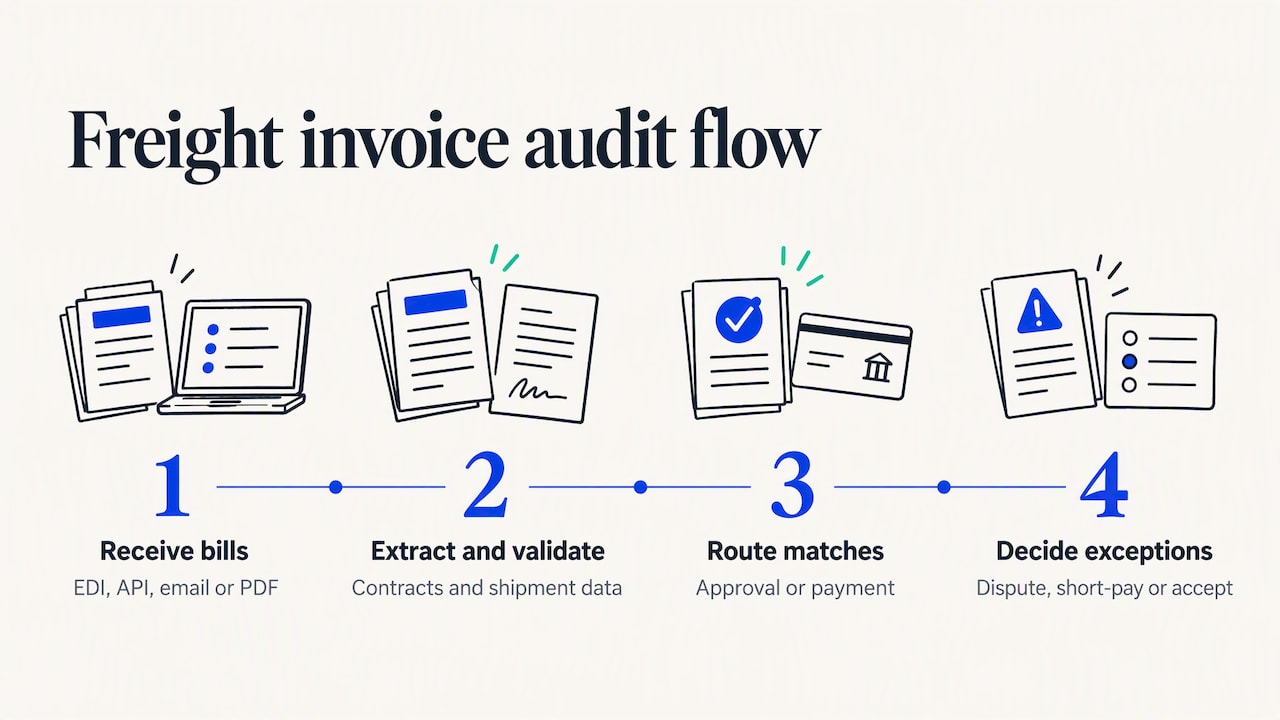
The workflow has four stages. Invoices and backup documents come in by EDI, API, email or PDF. The software extracts the charges and validates them against contracts and shipment data. Bills that match are routed onward for approval or payment. Bills that do not match become exceptions, and a person or a rule decides whether to dispute, short-pay or accept them.
For a freight forwarder the picture is more complicated than for a shipper. You are on both sides of the invoice. You receive bills from ocean carriers, airlines, truckers, customs brokers and terminals, and you issue invoices to customers that must carry the right cost and margin. An audit step that only protects your payables misses the other half of the problem: a vendor charge that slips through unchecked becomes either a lost margin point or an awkward customer conversation.
Three kinds of freight audit providers
Providers in this category broadly fall into three groups, and confusing them is the most common reason a buying process stalls.
Audit-and-pay firms. These are service businesses with software behind them. Cass Information Systems, U.S. Bank Freight Payment, Intelligent Audit and ConData are names buyers meet early. They typically audit invoices, handle disputes and, in several cases, pay carriers on your behalf. They suit shippers with high invoice volume and little appetite to staff an audit desk, particularly where carrier payment and working capital are part of the conversation.
Standalone audit platforms. Loop, Trimble Freight Audit, FreightPOP and Navix sit here, along with newer AI-first tools. They digitize contracts and rate tables, audit line items automatically and put exceptions in a workflow. Most are strongest on specific modes: Loop, for example, is best known for LTL, truckload and parcel line-item audit. Check carefully how well a platform handles ocean and air charges before assuming it fits a forwarder.
TMS-native audit. Here the audit is a function of the transport management system rather than a separate product. Rates, shipments, documents, costs and accounting live in one place, so a vendor invoice is matched against a shipment record that already carries its expected cost. This is the model FreightSuite follows, and it matters most for forwarders, whose cost data is rarely clean enough to audit from outside.
None of these is universally superior. A shipper with thousands of parcel invoices a week and no audit staff will probably be better served by an audit-and-pay firm. A forwarder whose margin depends on catching vendor charge errors before they reach a customer invoice usually does better with audit built into its operating system.

How duplicate invoice detection works
Duplicate invoices are the error buyers ask about most, and the weakest tools handle them badly. Matching on invoice number alone catches only the careless duplicates. Carriers resubmit bills with a new invoice number, a corrected total or a slightly different charge structure, and a system that only looks at the number will pay twice.
Better systems compare several attributes at once: carrier, PRO or booking number, bill of lading, origin, destination, weight, service date, invoice total and charge structure. They use probabilistic matching to flag near-duplicates even when the invoice numbers differ. Freehand describes this approach, including the need to track payment status so the system can tell a legitimate corrected resubmission from a true duplicate. Linehaul makes the same point: rebills, supplements, corrections and rerates are real events, and a reviewer has to separate them from repeats.
That last distinction is what to test. Ask any vendor to show you what happens when a carrier sends a corrected invoice for a bill you already paid. If the answer is a blanket rejection, your team will spend its time clearing false positives. If the answer is a flag with the original payment, the difference in charges and a clear next step, the software understands how freight billing really behaves.
What to compare before you shortlist
Feature lists in this category look alike. The differences that change outcomes are narrower.
Exception handling
Automating clean invoices is easy. The cost sits in the messy ones. Medius’s buyer guidance on AP automation recommends checking how exceptions are identified, routed and tracked, and whether the workflow keeps audit visibility instead of pushing problems into email or spreadsheets. In freight, ask who owns an exception: your staff, the vendor’s staff, or a shared queue with service levels.
Integration depth
An audit tool that cannot read your shipment data or write back to your accounting system creates a second data entry job. Check whether integrations are real time and bidirectional, and whether they cover your TMS, ERP and accounting package. For forwarders, the accounting link matters as much as the shipment link, and our piece on TMS accounting integration and the audit trail explains why.
Ingestion formats and mode coverage
Carriers do not send invoices in one format. You will see EDI, API feeds, emailed PDFs and carrier portals, often within the same week. Confirm the software handles all the formats your vendors use, and confirm it covers your modes. Heavy or oversized loads, such as engines and drivetrain components, generate accessorials and handling charges that a parcel-first tool may not model well, and how freight shipping of heavy diesel engines works shows how many cost lines a single heavy shipment can carry.
Rate engine depth
Audit is only as good as the rates it audits against. Tools that digitize your contracts and tariff tables, including surcharges and expiry dates, find more errors than tools that check only against a flat rate. Poor master data defeats any engine, which is why we wrote about fixing freight master data for charge calculation.
Payment controls
Some providers pay carriers. Many audit platforms do not, leaving payment with your AP system, TMS or a separate freight-payment provider. Automation Anywhere’s buyer guide lists a clear distinction between invoice processing and payment execution among its comparison criteria, and it is a distinction worth making explicit with every vendor.
Analytics and negotiating leverage
Audit data is also business intelligence. According to a white paper from SWG on freight payment auditing, audit systems let companies monitor billing performance and identify lane or provider inefficiencies, which gives them leverage with carriers. Billing terms and incoterms feed into that picture, because who bears freight cost changes which invoices you receive at all, as this guide to CIF and FOB freight risk illustrates for importers.
The options side by side
The table compares the models rather than ranking brands, because the right choice depends on your profile. Confirm current capabilities with each vendor, since products change.
| Model | Examples | Strongest for | Watch for |
|---|---|---|---|
| Audit-and-pay firm | Cass, U.S. Bank Freight Payment, Intelligent Audit, ConData | High-volume shippers that want audit, disputes and payment handled externally | Less control over rate logic, and forwarder-specific ocean and air charges |
| Standalone audit platform | Loop, Trimble Freight Audit, FreightPOP, Navix | Parcel, LTL and truckload line-item audit with automated approvals | Mode coverage beyond road and parcel, and who owns exceptions |
| TMS-native audit | FreightSuite | Forwarders that want rates, shipments, documents, costs and accounting in one system | Not a managed service that pays carriers for you |
The honest reading of this table is that the choice is rarely about which product has more features. It is about where you want the work to happen and who you want accountable for the exceptions.
Where FreightSuite fits
FreightSuite is an agentic TMS for freight forwarders and logistics companies. It is built as an alternative to legacy platforms such as Cargowise, Magaya, Descartes, Multifreight, Logi-Sys and Logitude, and it includes rate management, air and ocean tracking, finance and operations, workflows, and AI agent orchestration natively, without add-ons.
For audit, the relevant pieces are the ones that sit around the invoice. Automated document management and invoice recognition read vendor bills as they arrive. Rate management holds the contracted cost the bill is measured against. Dynamic FX and cost tracking keep multi-currency charges honest, credit control protects the receivables side, and integrated accounting connections carry approved costs onward. Because these live in one platform, a vendor charge that does not match the shipment is visible where the operations team already works, before it turns into a customer invoice with the wrong margin.
That is why we think of audit for forwarders as a workflow problem, not a standalone product. Our guides on rate audit automation and TMS checks that catch forwarder overpayments and on freight exception management set out how we approach it. If you want to see how the finance side works in practice, the FreightSuite solution for finance teams is the place to start, and you can book a walkthrough of the platform at freightsuite.com.
We also want to be clear about fit. FreightSuite is a TMS, not a managed audit-and-pay service. If your priority is outsourcing carrier payment entirely, an audit-and-pay firm is the more direct route. If your priority is running faster, eliminating admin and protecting forwarder margin inside one system, that is the problem we built for.
Why contract data decides the result
Every audit engine rests on contract data. If rate tables are incomplete, if surcharge rules live in email threads, or if expiry dates are not tracked, the software will either miss errors or flood your team with false exceptions. Before you buy anything, spend a week assembling the contracts, tariffs and accessorial schedules that you actually enforce. The vendors that take this seriously will ask for them during evaluation, and the ones that do not will surface the problem after go-live.
Contract management is the upstream half of audit. Rates that are negotiated well but loaded badly do not stick, which is the subject of our guide to carrier contract management for negotiators. If you shop rates through APIs, the checklist for auditable carrier rate shopping covers how to keep the quoted rate on record so the invoice can be compared with it later.
How to test any vendor on your own invoices
A demo on clean sample data proves very little. A sound evaluation follows a short sequence.
Start by collecting a representative batch: several months of invoices across your main carriers and modes, the contracts behind them, and a handful of known problems such as a duplicate, a disputed accessorial and a rerate. Give the same batch to every shortlisted vendor. Then measure what they found, what they missed, how many false exceptions they raised and how long each exception took to resolve. A vendor that finds fewer errors but raises far fewer false alarms may cost you less in labor than one that flags everything.
Next, ask for the exception-handling roles in writing. Who reviews, who disputes with the carrier, and who approves a short payment? Then verify the integration with your actual stack rather than a logo on a slide. Implementation effort depends on contract complexity, carrier onboarding, data migration and integration scope, so ask for a plan with named responsibilities on both sides.
Treat savings claims with care. Vendors publish recovery percentages, and one audit provider claims that correcting discrepancies can recover 4 to 8 percent of annual freight spend, which is a vendor claim and should be validated against your own data. The SWG paper cited above gives an illustrative example of a $100,000 freight budget carrying $1,600 to $4,980 in overcharges and estimates that outsourcing invoice management can cut internal processing costs by roughly 50 to 70 percent. Use figures like these to frame the question, then let your own pilot supply the answer.
What freight audit software costs
Pricing varies by model. Audit-and-pay firms commonly charge per transaction or as a share of recovered savings, and platforms often charge a subscription tied to invoice volume or modules. Many do not publish prices, so you should expect to request a quote. FreightSuite does not publish a price either, and pricing is discussed after a demo. When you compare quotes, check which features are included and which are add-ons, because a low entry price that excludes exception workflows, integrations or document capture is rarely the cheaper option.
The cost that matters most is often internal. Count the hours your team spends keying invoices, chasing carriers and reconciling cost against customer billing. For forwarders, our overview of common freight forwarding inefficiencies shows where that time usually goes, and it is a useful baseline to set against any subscription.
FAQ
What is the best freight invoice auditing software?
There is no single best product. The right platform depends on your freight spend, your mix of modes, how much automation you want against outsourced management, and your capacity to handle manual exceptions. Forwarders should weight ocean, air and accessorial coverage and TMS integration heavily, while parcel-heavy shippers will care more about line-item rating and automated approvals.
How does freight audit software catch duplicate invoices?
It compares several shipment attributes, not just the invoice number: carrier, PRO or booking number, bill of lading, origin, destination, weight, service date and total. It also tracks payment status, so a corrected resubmission of a paid bill is flagged for review instead of being paid again or rejected blindly.
Do I need audit software if I already use a TMS?
Maybe not a separate product. If your TMS holds contracted rates and shipment costs and reads vendor invoices against them, much of the audit already happens there. If it cannot validate charges or flag duplicates, you will need either stronger TMS functionality or a separate audit tool connected to it.
Does freight audit software pay carriers?
Some providers do and many do not. Audit-and-pay firms typically handle payment, while many software platforms only validate and route invoices, leaving payment to your AP system, TMS or a freight-payment provider. Ask each vendor to state exactly who releases payment and under what controls.
Sources
- Docsumo: freight invoice audit software
- Freehand: how duplicate invoice detection works at scale
- Linehaul: duplicate freight invoice detection
- Medius: five questions to ask when choosing AP automation software
- Automation Anywhere: invoice processing software buyer’s guide
- SWG white paper on freight payment auditing
- How freight shipping of diesel engines works
- CIF and FOB freight risk for importers

