Best Freight Rate Software for Forwarders in 2026

The best freight rate software for a forwarder is the one that keeps buy rates, sell rates, surcharges and quotes in the same system that runs your shipments. Standalone rate tools can be excellent at one job, but every handoff between a rate sheet and an operations platform is a place where margin leaks. Below we compare the main categories of freight rate software, name the products that sit in each, and show where FreightSuite fits.
This guide is written for forwarders and logistics companies in the United States deciding what to run their pricing on, whether that means replacing spreadsheets, adding a rate module, or moving off a legacy platform such as CargoWise or Magaya.
TL;DR
- Freight rate software falls into four groups: market benchmarking, digital marketplaces, standalone rate management tools, and rate management built into a TMS.
- Forwarders that need quotes to match operational cost should favor rate management inside the TMS, because one data set removes version errors and quote-to-cost gaps.
- Manual rate handling is estimated to expose 3 to 7 percentage points of gross margin per load, so the cost of staying on spreadsheets is real.
- Before you buy, test how each platform handles messy, unstructured rate sheets, local port charges and multi-modal surcharges.
- FreightSuite is an agentic TMS that includes rate management, tracking, finance, workflows and AI agent orchestration without add-ons.
Table of Contents
- What freight rate software actually has to do
- Why the pressure to modernize is rising
- The four types of freight rate software
- How the main options compare
- Where FreightSuite fits
- What the buyer’s regret usually looks like
- How to choose: seven criteria that matter
- A realistic path off spreadsheets
- See freight rate management inside a TMS
- FAQ
- Sources
What freight rate software actually has to do
Freight rate management sounds simple until you count the moving parts. A forwarder holds contract rates with carriers, spot rates that change weekly or daily, origin and destination local charges, surcharges that differ by trade lane, and accessorials that appear only on certain shipments. On the sell side, each customer may have its own margin rules, validity periods and currency preferences.
Good software does five things well. It stores buy and sell rates with versions and validity dates. It applies rules automatically so a quote reflects the right surcharge and margin. It brings in new rates quickly, including from the formats carriers actually send. It turns a quote into a booking and a job without retyping. And it carries the quoted cost through to invoicing, so you can see whether you made the margin you promised.
That last point is where most standalone tools stop. A rate tool can produce a fast, accurate quote, but if the shipment lives in a different system, nobody checks the quote against the landed cost until the invoice arrives. We cover that quoting workflow in more depth in our guide to freight quote management.
Why the pressure to modernize is rising
The market has moved from periodic rate sheets to continuous repricing. Volatile spot markets mean a quote that was right on Monday can lose money by Thursday. Customers also expect self-service and fast answers, and forwarders know it. In a 2026 survey of more than 400 freight forwarders and customs brokers, 55% named automation and AI as their main route to outgrowing competitors, and 65% expected AI to deliver the most organizational value over the next two years.
The same reporting points out that perceived value in traditional operational technology has plateaued, while interest in rate management and compliance platforms is climbing. The ground is shifting beneath this industry, and rate management is where many forwarders feel it first, because it touches revenue on every single quote.
The margin exposure is the other side of the argument. Market research estimates that manual rate management leaves 3 to 7 percentage points of gross margin exposed on every load, driven by fragmented data and slow responses to spot movements. For a forwarder whose net margin is a small slice of gross profit, that range is the difference between a healthy year and a hard one.
The four types of freight rate software
Most comparison pages mix very different products into one list. A benchmarking platform and a TMS are not substitutes, so it helps to sort the field first.
Market benchmarking and rate intelligence
These platforms tell you what the market is paying. Xeneta is a well-known example in ocean and air. They are valuable for procurement and for checking whether your contract rates are competitive. They do not run your quotes, jobs or invoices, so they work alongside a rate management system rather than replacing one.
Digital marketplaces and instant-quote platforms
Freightos and similar marketplaces let you compare and book spot capacity online. They suit forwarders who need quick spot options or who want to offer online quoting to customers. The tradeoff is that your contract rates, margin rules and cost tracking still need a home somewhere else.
Standalone rate management tools
Products such as Freightify, CargoEZ and Freightgate focus on storing carrier rates, surcharges and contract terms, then producing quotes. They can be fast to deploy and strong at rate loading. The question to ask is how cleanly the quote flows into operations and finance, and whether you are paying for another integration to maintain.
Rate management inside the TMS
Legacy platforms such as CargoWise, Magaya and Descartes bundle rate management into a broader forwarding suite, and newer systems like GoFreight and FreightSuite do the same with a more modern architecture. The advantage is a single source of truth. Industry commentary on rate management consistently makes the point that the top performers tie pricing directly into the core TMS so pricing, procurement and operations all work from the same data and the quoted price matches the operational cost.
How the main options compare
The table below compares categories and representative products on the criteria that decide real projects. It reflects each product’s general positioning, not a benchmark test, and you should confirm current capabilities and pricing with each vendor.
| Approach | Representative products | Strongest at | Watch out for |
|---|---|---|---|
| Market benchmarking | Xeneta | Knowing what lanes cost across the market | Does not run quotes, jobs or billing |
| Marketplace | Freightos | Instant spot comparison and booking | Contract rates and margin logic live elsewhere |
| Standalone rate tools | Freightify, CargoEZ, Freightgate | Loading and applying carrier rates | Integration with operations and accounting |
| Legacy forwarding suites | CargoWise, Magaya, Descartes | Breadth of features, large installed base | Add-on modules, configuration effort, dated interfaces |
| Agentic TMS | FreightSuite | Rates, operations, finance and AI agents in one system | Requires clean rate data to get full value |
No single row wins for everyone. A procurement team at a shipper may want benchmarking alone. A small forwarder that only needs online spot quotes may be happy on a marketplace. But a forwarder that wants quoting, job costing, tracking and invoicing to agree with each other is shopping in the last two rows.
Where FreightSuite fits
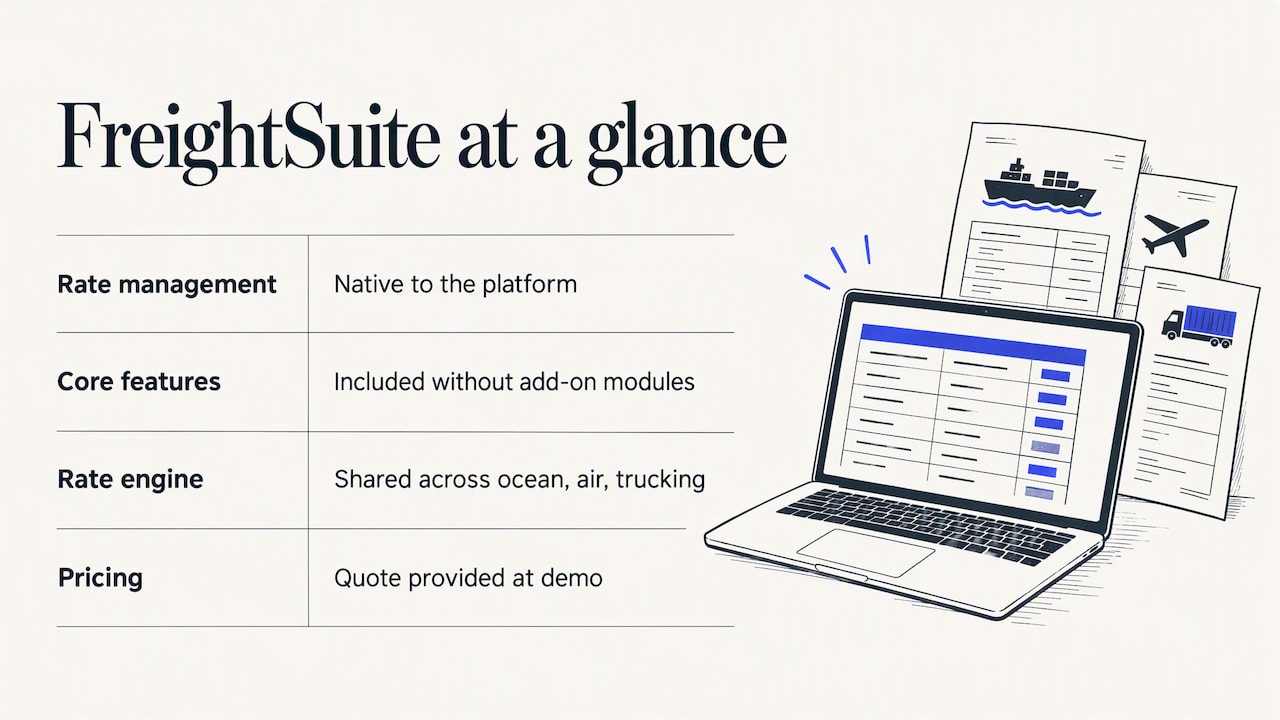
FreightSuite is an agentic TMS built for freight forwarders and logistics companies. Rate management is native to the platform, alongside air and ocean tracking, financial management, operations, customizable workflows and AI agent orchestration. Core features are included out of the box, without add-on modules, which matters when you compare total cost against suites that price features separately.
The practical benefit of native rate management is that a rate is never copied from one system to another. The sell price you quote is the same record your operations team books against and your finance team invoices from. Dynamic FX and cost tracking, automated document management, invoice recognition and credit control sit on that same data, so margin is visible per shipment rather than reconstructed at month end. Our piece on exchange rate integration for logistics explains why currency handling is one of the quietest sources of margin leakage in multi-currency quoting.
FreightSuite is also organized around the modes forwarders actually run. Ocean teams can look at our ocean freight TMS and automation, air teams at the air freight management system, and trucking operations at road freight transport management. Each shares the same rate engine, so a multi-modal quote does not require three tools.
For teams comparing against CargoWise, Magaya, Descartes, Multifreight, Logi-Sys or Logitude, the question we hear most is whether a lighter, cloud-native system can carry real forwarding complexity. Our answer is to bring your hardest lanes, your messiest rate sheets and your most demanding customer to a demo and judge the platform on those. FreightSuite does not publish pricing, so the demo is also where you get a quote for your size and mode mix.
What the buyer’s regret usually looks like
The most common disappointments with freight rate software have little to do with the interface. They come from the data.
The first is unstructured rate sheets. Carriers and agents send rates as PDFs, spreadsheets with merged cells and emails with the real surcharge buried in the body. Practitioners report that how well an AI engine parses and normalizes these formats often decides the actual efficiency gain, more than raw API connectivity does. If a vendor demos only with a clean file, ask to upload one of yours.
The second is surcharge and local charge logic. Multi-modal routing, port-specific fees and conditional accessorials usually need configuration, whatever the sales deck says about instant deployment. Ask who does that configuration, how long it took for a customer with your lane mix, and what happens when a rule changes.
The third is preparation. Moving from spreadsheets is an operational shift, not just a software purchase. The bottleneck is often the lack of standardized, digitized rate data, so plan a cleanup phase for historical contracts, surcharge rules and accessorials before you connect any AI rate engine. Our walkthrough on fixing freight master data lays out the steps for charge calculation and EDI or API connections.
How to choose: seven criteria that matter
Start with the system boundary. Decide whether you are buying a rate tool or a platform. If quotes, jobs and invoices should reconcile automatically, favor a platform where rate management is native.
Next, test rate ingestion with your own files. Include a contract with tiered surcharges, a carrier PDF and an agent spreadsheet. Measure how much manual correction each needs.
Then check the hybrid model. Forwarders increasingly blend long-term contract rates with live carrier pricing, so confirm the system can hold both, compare them side by side and apply margin rules to each.
Look at quote speed and customer-facing options. Customers now expect fast, professional and self-service quoting, so ask how the platform supports branded quotes, customer dashboards and approvals.
Follow the quote into finance. Verify that a quoted rate becomes the cost and revenue baseline on the job, that FX is handled dynamically, and that your accounting software connects without custom work.
Count the add-ons. Ask for a written list of what is included and what is priced separately, including tracking, document automation and AI features. Pricing structures that look similar on a first call can diverge sharply once modules are added.
Finally, ask about the AI itself. A chat box is not the same as agents that complete work inside your workflows, such as extracting rates, drafting quotes or chasing documents. Ask for a live example on your data, with a human approval step you control.
A realistic path off spreadsheets
The forwarders who get value fastest treat implementation as three stages. First, inventory every place rates live today: shared drives, email folders, personal spreadsheets, carrier portals. Second, standardize the top lanes and top customers, which usually account for most quote volume, and load those first. Third, run the new system in parallel for a few weeks, comparing quotes and job margins against your old process before you switch fully.
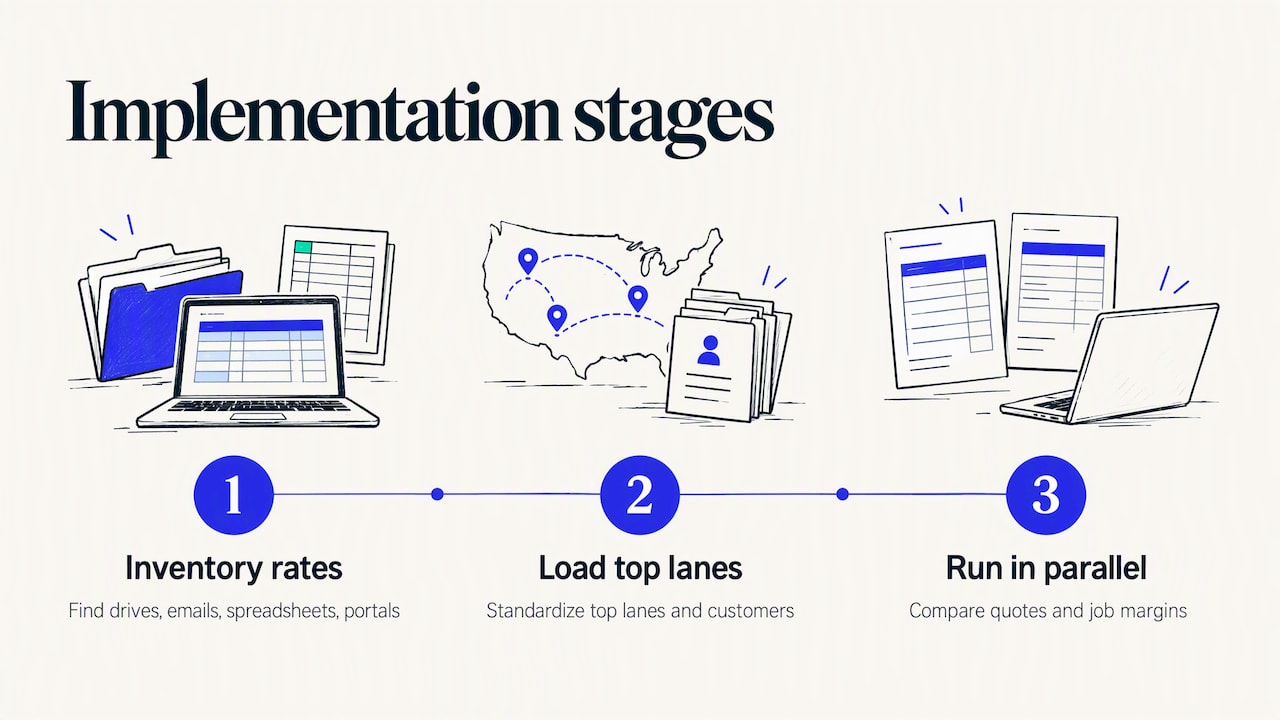
This staged approach limits risk and gives your team a reason to trust the system. It also surfaces the inconsistencies in your own data early, when they are cheap to fix. The firms that struggle are usually the ones that try to load every rate on day one.
If you are also weighing a broader platform change, our explainer on freight forwarding TMS fundamentals covers what a modern system should include beyond rates.
See freight rate management inside a TMS
If you want to judge the difference between a rate tool and a platform, the quickest test is to bring a real quote from request to invoice in one system. We would be glad to run that with your lanes and your rate sheets on FreightSuite, and you can browse more guides in our resources library while you prepare.
The window to modernize is real, and it has a timeline. Forwarders that move pricing into an agentic TMS now will quote faster and protect margin while competitors are still reconciling spreadsheets. The choice is yours to make.
FAQ
What is the best freight rate software for freight forwarders?
It depends on what you need beyond quoting. Benchmarking tools suit procurement, marketplaces suit spot buying, and standalone rate tools suit teams that only need quotes. Forwarders who want rates, operations and finance to reconcile should choose a TMS with native rate management, such as FreightSuite.
What is freight rate management?
It is the practice of storing, updating and applying buy and sell rates, surcharges and margin rules so quotes are accurate and consistent. In software, it replaces spreadsheets and email threads with versioned rate data and automated quoting. The best systems also carry the quoted cost into the shipment and invoice.
What are the main CargoWise alternatives?
Forwarders commonly evaluate Magaya, Descartes, GoFreight, Logitude, Logi-Sys, Multifreight and FreightSuite. They differ in cloud architecture, included modules, regional strength and how much configuration they require. Test each with your own rate sheets and your most complex shipment before you decide.
How long does it take to implement freight rate software?
Software setup can be quick, but data preparation sets the real timeline. Contracts, surcharge rules and accessorials usually need cleaning before they load well. Starting with your top lanes and customers and running in parallel for a few weeks is a safe approach.

