Exchange Rate Integration for Logistics: A TMS Guide

Exchange rate integration in logistics means connecting approved FX rate sources directly to the system where you quote, cost, invoice and close your books, so that every job, every office and every ledger entry uses the right rate for its purpose. Done well, it removes spreadsheet updates, stops regional quoting discrepancies and shows you the true margin on each shipment. Done badly, it hides losses in overhead until the quarter has already closed.
The ground is shifting beneath forwarders on this point. Costs arrive in euros, yuan or Mexican pesos weeks after revenue is booked in dollars, and the gap between the two is where margin quietly disappears. This guide walks through which rates to use and when, how to handle revaluation, and what to demand from a TMS.
TL;DR
- Use two kinds of rates: a central bank reference rate for customs, tax and audit reporting, and bank or treasury rates for actual payments. Never blend them.
- For US customs, only proclaimed or certified rates are allowed, and the Federal Reserve H.10 release is the certified source.
- The main FX exposure in freight is the delay between cost accrual and invoice settlement, so revalue open payables at every month-end.
- Centralize rates behind an approval step so every office quotes from the same number.
- Track realized and unrealized FX per job, not in a general overhead account.
Table of Contents
- Why FX is a margin problem, not just an accounting problem
- The two rate types you must never mix
- Matching the rate to the job
- Centralize and approve rates before they reach the TMS
- Handling FX revaluation at month-end
- A worked example
- What smaller forwarders can do now
- What to demand from a TMS
- How FreightSuite handles exchange rates
- FAQ
- Sources
Why FX is a margin problem, not just an accounting problem
A forwarder sells in one currency and buys in several. The ocean carrier bills in USD, the destination agent bills in EUR three weeks after delivery, the trucker bills in local currency, and the customer pays in whatever the contract says. Each leg has its own booking date and its own settlement date.
DHL’s guidance on managing foreign exchange risk makes the underlying point for cross-border businesses: transactions span days or weeks, so the rate you priced at is rarely the rate you pay at. In a freight forwarding P&L, where net margins on a job are often a small slice of gross revenue, a couple of percentage points of currency movement on a large payable can erase the profit on a lane.
The damage compounds when the rate is handled manually. One office updates its spreadsheet on Monday, another on Thursday, and a third keeps last month’s number because nobody told it otherwise. Quotes go out at different effective rates for the same lane, and finance spends the month-end close explaining the differences. That is EBIT leaking through process, not through the market.
The two rate types you must never mix
The most common design error in logistics FX is using a single live market rate for everything. A forwarder actually needs two distinct families of rates.
Reference rates for customs, tax and audit
For US import entries, the rule is strict. Under 19 CFR Part 159, Subpart C, no rate may be used to convert foreign currency for Customs purposes other than a proclaimed or certified rate. The certified rates come from the Federal Reserve. The H.10 release publishes noon buying rates in New York for cable transfers, certified by the Federal Reserve Bank of New York for customs purposes, with bilateral data updated every Monday at 4:15 p.m. and covering the previous business week.
If you are a customs broker or a forwarder filing entries for your clients, this means your TMS should pull the certified rate, store it with its effective date, and attach it to the entry value calculation. An auditor should be able to open the file and see which published rate was used and why. Our Customs Brokerage TMS Software page describes how this kind of control fits into broker workflows.
Treasury and bank rates for payments
When you actually pay a foreign agent or receive funds from a customer, the number that matters is what your bank gives you. Bank lists often show TT Buy and TT Sell, which are simply the commercial buying and selling rates for telegraphic (electronic) transfers. A reference rate will not match them, and it should not be expected to.
The discipline is to keep each rate in its lane. Reference rates drive compliance values and reporting. Bank or treasury rates drive cash. The difference between the two is a real, measurable variance, and your system should surface it instead of forcing the two to agree. Mixing them is how forwarders end up with audit questions and ledgers where realized and unrealized gains cannot be reconciled.
Matching the rate to the job
Not every task in a forwarding business needs the same rate. A sales rep building a quote wants a rate that reflects what it will cost to buy the currency, perhaps with a buffer. Operations costing a job wants a consistent internal rate through the life of the shipment. Finance posting an invoice wants the rate on the transaction date. Customs wants the certified rate.
We cover this mapping in detail in our checklist on matching each team’s job to the right FX rate in a TMS. The short version is a simple table.
| Task | Typical rate source | Why |
|---|---|---|
| Customs entry valuation (US) | Federal Reserve H.10 certified rate | Required by regulation for Customs conversions |
| Quoting | Approved commercial rate, often with a buffer | Protects margin during the quote validity window |
| Job costing | Fixed internal rate per period or per job | Keeps estimates comparable across shipments |
| Invoice posting | Rate on transaction date from approved source | Supports clean sub-ledger entries |
| Payments | Bank or treasury rate actually obtained | Reflects real cash movement |
| Period-end revaluation | Period-end rate from approved source | Measures unrealized gain or loss on open balances |
The point of the table is not that every forwarder must copy it. The point is that each row is a decision somebody made on purpose, written down, and enforced by the system rather than by memory.
Centralize and approve rates before they reach the TMS
Fetching rates automatically is the easy part. Plenty of tools can pull a feed. The harder, more valuable shift is from manual spreadsheet updates to a centralized rate process with approval, so that every global office uses the same approved number. Rate management vendors in the CargoWise ecosystem describe the same pattern: fetch, route through approval, and push to the system. The logic holds no matter which platform you run.
In practice, we recommend four controls.
First, define the source for each rate type once, and document it. Second, route any change through an approver in finance or treasury, so that a single analyst cannot move the quoting rate for the whole company. Third, stamp each rate with an effective date and keep the history, because the answer to “which rate did we use on this job in March” has to be retrievable. Fourth, make the system reject entries that bypass the approved table, instead of relying on people to remember.
This is where a native approach matters. When rate management lives inside the TMS rather than in a connector bolted to a separate finance tool, quotes, job costs and invoices all read the same table the moment it is approved. FreightSuite includes rate management, dynamic FX and cost tracking, and finance modules in the core product, with no add-ons required to turn them on. For the step-by-step version, see our guide to stopping FX margin leak with dynamic FX tracking.
Handling FX revaluation at month-end
Integration does not end at the transaction. Open payables and receivables denominated in foreign currency must be remeasured at period end, and the gain or loss recognized. This is the question behind the search for FX revaluation in logistics, and it is where many forwarders stumble.
Sequence matters
According to Light’s documentation on FX revaluations, revaluation adjusts general ledger balances to reflect current exchange rates and is a required step in the period-end close. The practical lesson, which applies in any ERP or accounting package, is about order. Revaluation should run after the sub-ledger tasks are finished: AP, AR and journal entries locked. Months should be processed sequentially. If you skip a month or revalue out of order, the gain and loss calculations are corrupted, and the cleanup is usually a manual reversal of the period.
So your TMS and accounting connection need to agree on the close calendar. A TMS that posts invoices after the ledger has been revalued creates exactly the discrepancy you were trying to avoid. Our article on TMS accounting integration and the audit trail explains how to keep postings and ledger periods aligned.
Realized versus unrealized, per job
A forwarder has an advantage over a general business here, because the shipment is a natural unit of profit. Accrue the estimated cost on the booking date, revalue the open accrual at each month-end, and when the invoice is finally paid, record the difference between estimate and payment as realized FX on that job. A dedicated disbursement clearing account makes the variance visible, as a Hong Kong freight accounting guide also describes for late-arriving carrier and agent invoices.
The benefit is analytical. If FX sits in general overhead, every lane looks as profitable as its quote said. If it sits on the job, you learn that the Rotterdam agent lane loses two points to currency when invoices land after 45 days, and you can reprice it or ask for dollar billing.
A worked example
Take a forwarder that sells a door-to-door shipment from Shanghai to Chicago for $12,000 and budgets $9,000 of cost. Suppose €2,000 of that is a destination agent charge, accrued at a rate of 1.10 dollars per euro, or $2,200.
By month-end, the shipment has delivered and the agent has not yet invoiced. The euro now stands at 1.14, so the open accrual revalues to $2,280, an unrealized loss of $80. Three weeks later the agent invoices and your bank settles at 1.16, so the payment costs $2,320. The realized loss against the original accrual is $120, of which $80 was already recognized as unrealized at month-end, leaving $40 to book on payment when the revaluation entry reverses.

These numbers are illustrative, not market data. What matters is the shape: with job-level tracking, the finance team sees $120 of FX erosion tied to a named shipment and a named vendor. Without it, the $120 vanishes into a general account, and the job’s reported margin is overstated.
Multiply by hundreds of jobs a month and several currencies, and the number stops being small.
What smaller forwarders can do now
Large firms hedge with forwards and options through treasury desks. Smaller forwarders rarely have access to deep liquidity or sophisticated instruments, and research on SME currency risk argues that the practical answer is better forecasting and multi-source FX data integrated into the operating system rather than into a separate spreadsheet. You do not need a treasury department to start. You need clean data, consistent rates and visibility.
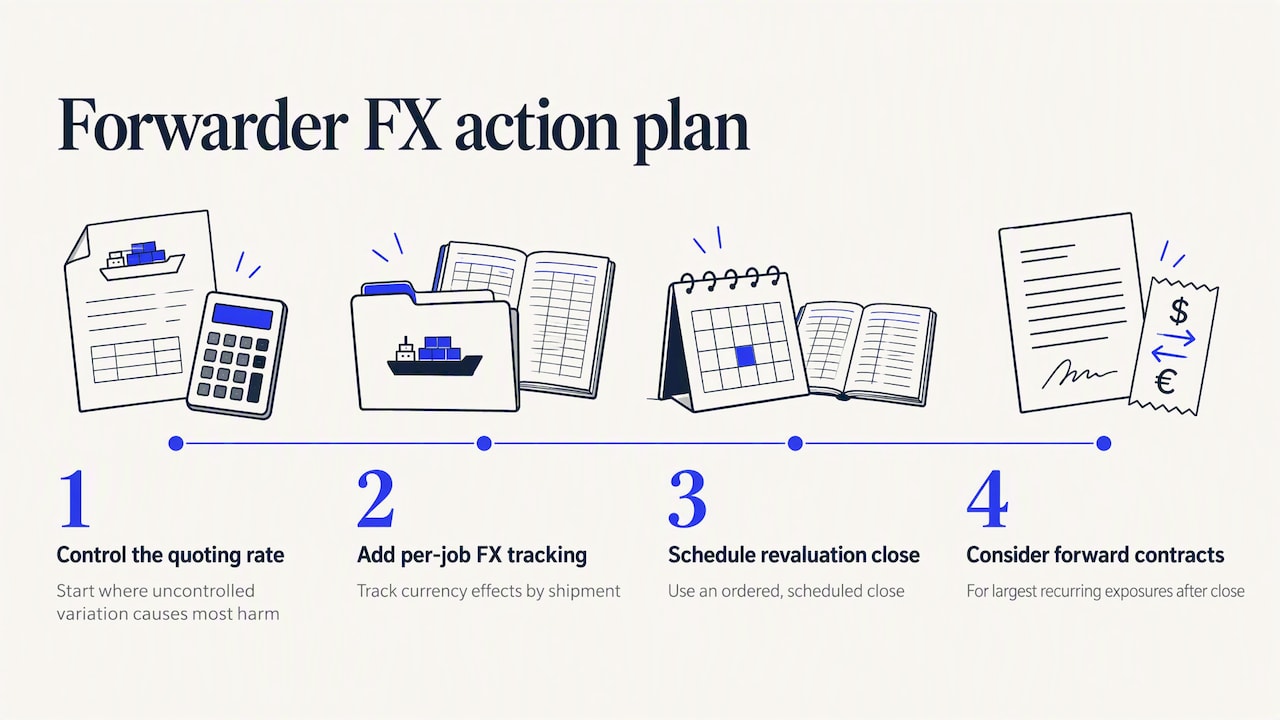
A sensible sequence for a mid-sized forwarder looks like this. Begin by getting the quoting rate under control, because that is where uncontrolled variation does the most direct harm. Then add per-job FX tracking. Then move revaluation into a scheduled, ordered close. Only after that does it make sense to talk to a provider about forward contracts on your largest recurring exposures. Providers such as MillTech discuss the FX pressures facing freight and logistics firms, and your bank will have its own view.
Smaller logistics operators are also looking at how other technology approaches reduce manual rate handling and help forecast movements. One example of how a 3PL describes system integration for ecommerce fulfillment shows the same principle at work: connect the systems once and stop retyping data.
What to demand from a TMS
When you evaluate platforms, ask for evidence on a short list of capabilities rather than accepting a general claim of “multi-currency support.”
Ask whether the system supports multiple rate types and lets you assign them by task. Ask whether rate changes pass through an approval workflow and whether history is retained. Ask whether certified H.10 rates can be used for US customs values while bank rates are used for payments. Ask whether foreign-currency payables can be revalued at period end and whether the result is posted per job. Ask how the integration with your accounting software handles period locks. Finally, ask whether all of this is in the base product or priced as a module, because a feature that costs extra tends to stay switched off.
If you are comparing us against incumbents, our comparison page sets out where FreightSuite differs from legacy systems such as CargoWise, Magaya, Descartes, Multifreight, Logi-Sys and Logitude. For a wider view of how the pieces fit, read Freight Forwarding TMS Explained for Logistics Pros, and see how freight master data feeds accurate charge calculation.
How FreightSuite handles exchange rates
FreightSuite is a cloud-based, agentic TMS built for freight forwarders and logistics companies. Dynamic FX and cost tracking, credit control, invoice recognition and integrated accounting connections sit alongside rate management, ocean and air tracking, workflows and AI agent orchestration in one platform, with core features included out of the box. That means the rate your sales team quotes at is the same rate operations costs against and finance reconciles to, and the agents can automate the routine work around it.
If you want to see how that looks with your own currencies, lanes and close calendar, book a look at FreightSuite. The window to fix this is real, and it has a timeline: every month of manual rate handling is another month of margin you cannot see.
FAQ
Is there an API for exchange rates?
Yes, many providers offer exchange rate APIs, and banks and treasury platforms offer their own feeds. The Federal Reserve also publishes H.10 data for download. The harder question is which feed fits which task, since a feed that is right for payments may be wrong for customs values.
What are the four types of foreign exchange transactions?
The four core types are spot transactions, forwards, swaps and options. A Congressional Research Service overview describes them, including spot settlement within two business days. For most forwarders, spot and occasional forwards cover the real exposure.
What does dirty float mean?
A dirty float is a floating exchange rate system in which a central bank occasionally intervenes to influence the currency’s value instead of letting the market set it entirely. For a forwarder, it is a reminder that some currencies can move sharply on policy decisions, which is a reason to build buffers into quotes.
What are TT Buy and TT Sell?
TT Buy and TT Sell are the bank’s commercial buying and selling rates for telegraphic transfers, meaning electronic payments. Use them, or your treasury’s actual executed rate, for payment accounting. Do not use them in place of the certified rate for US customs conversions.
Sources
- DHL: A guide to managing foreign exchange risk
- eCFR: 19 CFR Part 159, Subpart C, Conversion of Foreign Currency
- Federal Reserve: Foreign Exchange Rates, H.10
- Light Help Center: FX Revaluations
- Accounting software for logistics and freight forwarding companies in Hong Kong
- SME currency risk research
- MillTech: Navigating rising FX challenges in freight and logistics
- Congressional Research Service overview of foreign exchange markets

