Multi-Currency Billing for Freight Forwarders: A Practical Guide

Multi-currency billing means quoting, invoicing and collecting in the currency your customer wants while paying carriers, agents and vendors in whatever currency they demand, and still knowing what each shipment earned in your own reporting currency. For a freight forwarder this is not an edge case. It is the daily shape of the business, and the way you handle it decides whether a profitable lane stays profitable once the money actually moves.
This guide walks through where forwarders lose margin to currency, the accounting rules that apply to US-based companies, the controls that work, and what to demand from software. It is written for finance leaders, operations heads and owners who suspect their spreadsheets are hiding a leak.
TL;DR
- A single forwarding job often touches three currencies: you quote in one, pay carriers in another and invoice the client in a third, so every job carries FX exposure from the moment of the quote.
- Lock the exchange rate at quote or booking, apply a written rate policy consistently, and keep gains and losses out of operational job margin.
- Reconcile line by line against the shipment record, not in bulk, and keep tax-exempt international freight separate from taxable domestic services.
- US companies must follow ASC 830 and, for tax, IRC Section 988, which means your system needs transaction-date rates and period-end remeasurement.
- Choose shipment-level billing and FX tooling built into your TMS over a standalone treasury platform unless you run a large multi-entity group.
Table of Contents
- Why forwarders feel multi-currency billing more than most
- Where the margin actually leaks
- The accounting rules behind the invoice
- Five habits that keep currency out of your job margin
- What multi-currency billing software should do for a forwarder
- A worked example: one ocean shipment, three currencies
- Payment methods and collections
- How FreightSuite handles it
- A rollout plan that does not disrupt month end
- FAQ
- Sources
Why forwarders feel multi-currency billing more than most
A retailer with a European storefront has a currency problem at the checkout. A forwarder has it at every stage of a job. According to industry analysis on FX risk for forwarders, a shipment is frequently quoted in one currency such as USD, paid to the carrier in another such as EUR, and invoiced to the client in a third such as GBP. Each hop is a point where the rate can move, a bank can take a spread, or a clerk can key the wrong figure.
The same source reports that forwarders without automated rate locks can give up an average of 4.5% of net margin on international shipments, and that manual bank conversions often cost 1.5% to 3.8% in spreads alone. Treat those as figures from one industry publication rather than a universal benchmark, but the direction is not controversial. Forwarding margins are thin, so a small currency slip is large relative to profit.
The problem is also structural. The Drewry paper on invoicing and payment in global container shipping found that automation of invoice reconciliation and settlement is very low among shippers and forwarders, particularly the small and mid-sized ones. Manual processes and several currencies are a bad combination.
Where the margin actually leaks
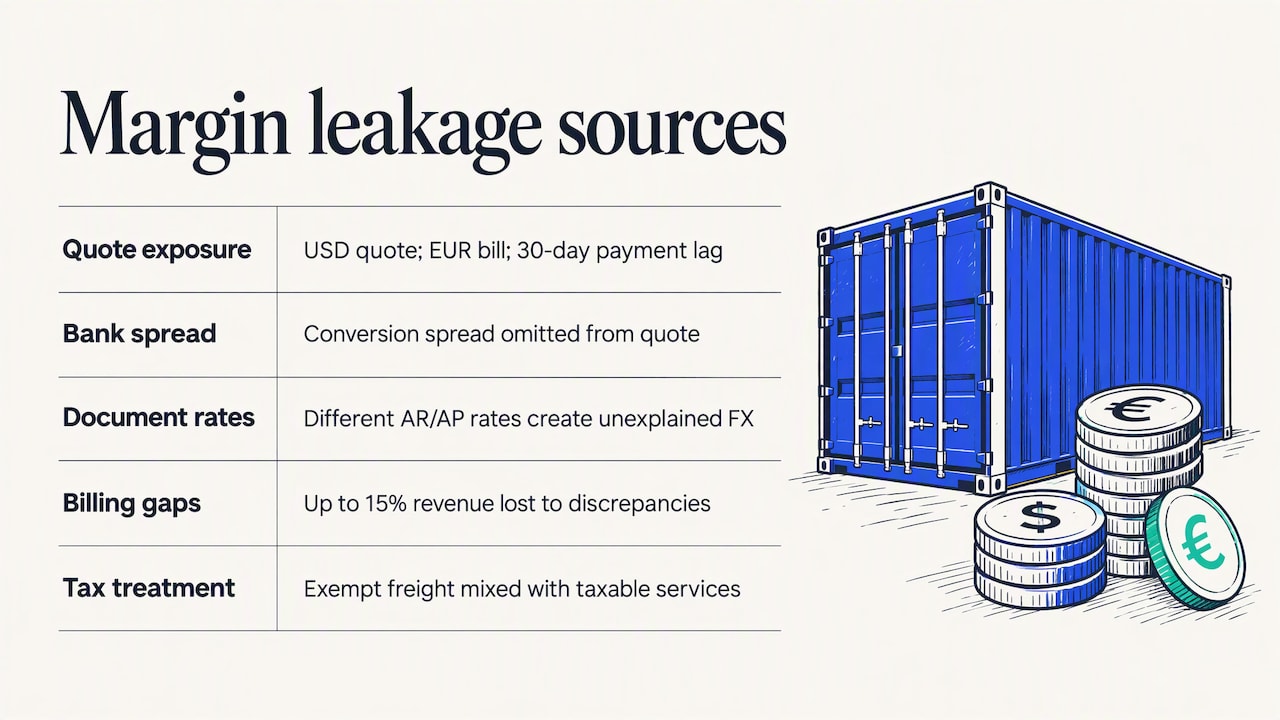
Most leakage comes from five places, and they compound.
The first is the gap between quote and settlement. You quote a customer in dollars on Monday, the carrier invoices in euros two weeks later, and the customer pays thirty days after that. Every day of that window is open exposure. The onex.center analysis argues that waiting until settlement to think about FX is reactive and costly, and that currency management belongs inside the booking process, not at the bank.
The second is the bank spread. If your bank or a payment provider converts at its own rate, the spread is a cost nobody put in the quote. It rarely appears on a job, so it shows up later as a mystery in the general ledger.
The third is inconsistent rates across the document chain. The subraps guide to freight forwarder financial statements points out that when rates differ between AR and AP posting, revaluation and settlement, you get unexplained gains and losses. If the receivable used one source and the payable used another, the difference is not real performance. It is noise, and noise hides real problems.
The fourth is billing discrepancy. The same source describes forwarders losing up to 15% of revenue through unverified billing discrepancies when agent settlement is treated as a lump-sum finance task rather than a shipment-level operational one. That figure is an upper bound from a single publication, but the mechanism is familiar to anyone who has chased a missing charge across three currencies.
The fifth is tax treatment. Forwarders sometimes fail to separate tax-exempt international freight revenue from taxable domestic services such as inland trucking, and one Chinese-language accounting guide warns that without that split authorities can require the whole transaction value to be taxed. The example there concerns VAT and local sales tax rules abroad, so confirm how your own state and customs jurisdictions treat each charge with your tax advisor before you rely on it.
The accounting rules behind the invoice
If you report under US GAAP, multi-currency billing is not only a convenience. It has to follow ASC 830 on foreign currency matters. In practical terms, a foreign currency transaction is first measured at the exchange rate on the transaction date. Monetary items such as receivables and payables are then remeasured at the rate on each reporting date, and the resulting gains and losses go through net income.
That has direct consequences for your billing process. Your system must store the rate used on the invoice date, hold the open balance in both the transaction currency and your functional currency, and be able to revalue open items at period end. It must also record the realized difference when the customer finally pays at a different rate. A spreadsheet can do this for ten invoices. It cannot do it reliably for ten thousand.
For tax, the IRS publishes a practice unit on IRC Section 988 nonfunctional currency transactions, covering functional currency and the computation of foreign currency gain or loss on receivables and payables denominated in a nonfunctional currency. The takeaway for a billing owner is simple: the gain or loss calculation needs an audit trail down to the invoice and payment. Your CPA decides how the rules apply to your entity structure, and you should bring them in before you change how you book FX, not after.
Five habits that keep currency out of your job margin
Lock the rate when the quote is issued
The most effective protection is not a month-end revaluation. It is fixing the rate at the moment of quote or booking, so the customer price, the expected cost and the expected margin all reference one rate. The onex.center piece describes this as the most reliable way to keep margins from drifting with the market. Where a customer needs a quote that stays open for days, build the rate validity into the quote itself so sales knows when a requote is needed.
This is also where rate management and billing meet. If your tariffs, carrier rates and surcharges sit in one place with their currencies attached, the quote converts correctly the first time. If they live in a dozen spreadsheets, you are converting by hand and hoping.
Write the rate policy down and apply it every month
Choose a rate source and a rule for each document type. Which source do you use for the invoice date, which for the vendor bill, and which for revaluation? Match each job type to the right source. FreightSuite has a checklist for matching logistics jobs to the right FX rate that is a good starting point for that conversation with your finance team. The principle matters more than the source: a fixed policy applied consistently keeps operational metrics distinct from currency swings, as the onex.center analysis puts it.
Separate FX gains and losses from operational margin
This is the habit that changes how leaders read their numbers. Finance commentary in the subraps guide recommends booking exchange gains and losses to a financial account instead of burying them in job margin. Do that and you can tell whether a route is truly profitable or simply riding a favorable currency swing. A lane that looks strong only because the euro slid against the dollar is a lane you should price differently next quarter.
In practice, each job should show two views: margin at the booked rate, which reflects pricing and operations, and the FX result, which reflects timing and treasury. Sales gets rewarded on the first. Finance owns the second.
Reconcile by shipment, not in bulk
Successful forwarders, according to the subraps guide, reconcile multi-currency payments line by line against shipment records. A lump-sum agent settlement of 40,000 in one currency tells you nothing about which jobs were paid, short-paid or double-billed. A unique, consistent job ID that carries through the quote, the vendor bills, the customer invoice and the payment makes line-level reconciliation possible. Without it, every discrepancy becomes a manual investigation.
Split tax treatment at the charge level
Tag every charge as international freight, customs, disbursement or domestic service at the point it is created. That lets the ledger separate exempt from taxable revenue automatically, instead of someone untangling it at quarter end. Your master data matters here, and our guide to fixing freight master data for charge calculation and EDI or API flows explains how to get the charge codes right.
What multi-currency billing software should do for a forwarder
Most search results for this topic cover general accounting or payments tools. Xero, for instance, advertises processing in over 150 currencies with hourly exchange rate updates, and subscription platforms such as Zuora document a multiple currencies feature for pricing and transacting in several currencies. These are real strengths for their intended jobs. A general ledger needs to handle many currencies, and a subscription biller needs currency-specific price lists.
A forwarder needs something additional: currency awareness at the shipment level. The questions to ask any vendor are these.
Can I set the currency on each rate, quote, vendor bill and invoice independently, and see all of them on the same job? Does the system lock a rate at quote or booking and keep that rate visible through to settlement? Can it recognize incoming vendor invoices and match them to the job and its currency without retyping? Does it show job profitability at the booked rate and the FX result separately? Can it handle credit control across customers who pay in different currencies? And does it connect cleanly to the accounting package your auditors already use, so the ledger and the operations record agree?
On that last point, accounting integration is where many projects stall. The Chift overview of multi-currency across accounting tools notes that robust systems such as SAP, Xero Premium and NetSuite let you assign currencies to journals, bank accounts, customers and suppliers, which tells you the accounting side can carry the detail, provided the operational system sends it correctly. If you run Xero, see how we preserve load, lane and carrier detail in Xero so the ledger does not lose the shipment context.
TMS or treasury platform?
Some buyers searching for the best multi-currency TMS land on treasury management systems, which share the acronym but not the job. Treasury platforms handle cash consolidation, liquidity and hedging across banks and entities. The CFOpresso review of treasury software describes the market as split between full enterprise platforms and lighter tools, and its guidance is that mid-market logistics companies often see better return from native, shipment-level financial automation that integrates with accounting than from a heavy standalone treasury rollout. A large group with many legal entities and an active hedging program may still need treasury software. A forwarder whose pain is job-level margin and invoice accuracy usually does not.
A worked example: one ocean shipment, three currencies
Take a hypothetical forwarder in Houston moving a container from Rotterdam. The shipper in the UK is quoted in pounds. The carrier bills in euros. The forwarder reports in dollars.
With a rate lock at quote, the forwarder converts the expected euro cost and the pound price into dollars at one documented rate, and expects a margin of, say, a few hundred dollars on the job. Three weeks later the carrier invoice arrives. If it is matched to the job automatically and revalued at the invoice-date rate, the difference between expected and actual cost lands in an FX account, not in the job margin. When the customer pays in pounds, the realized difference on the receivable also goes to the FX account.
At month end, the sales team sees the lane margin they priced. Finance sees the exchange result that came from timing. If the euro moved against the forwarder, the loss is visible and explainable, and nobody concludes that the lane or the salesperson failed.
Without a lock and a job-level link, the same shipment produces a vague total variance at the bank statement level, which someone has to unpick. That is exactly the situation the subraps guide describes with unexplained gains and losses.
Payment methods and collections
Billing in a customer’s currency is only half the job. You also need a way to get paid in it. Forwarders typically collect by wire, ACH or local transfer, and some use virtual accounts that let customers pay in local currency while funds are managed centrally. The onex.center analysis notes that proactive companies use automated conversion triggers and virtual accounts to manage local collections and international payments from one place. Whatever route you choose, keep the receiving currency, the fees charged and the conversion rate attached to the payment record so the invoice can be closed against exactly what arrived.
Watch short payments in particular. Bank charges deducted along the way mean a customer who paid the full invoice amount can still leave a small open balance. A good billing process writes that off to a defined bank charges account with a trail, rather than leaving the invoice open for months to confuse credit control. Our piece on logistics payment automation for finance teams covers how to automate matching and exceptions.
How FreightSuite handles it
FreightSuite is an agentic TMS built for freight forwarders and logistics companies, with rate management, financial management, operations automation, invoice recognition, credit control, dynamic FX and cost tracking and accounting software connections built into the platform rather than sold as add-ons. That means currency is handled where the shipment lives, not bolted on at month end.
The window to fix this is real, and it has a timeline: every quarter you run FX through spreadsheets is a quarter of margin you cannot see. If you want to see how the billing side works, start with our freight forwarding billing and accounting software page, or read about dynamic FX tracking for forwarders, which lays out six steps to stop FX margin leaks. Finance leaders can also look at our solutions for finance teams. When you are ready to see it on your own jobs, book a conversation with the FreightSuite team.
If you are weighing us against an incumbent platform, our CargoWise comparison sets out the differences on features and how everything is packaged.
A rollout plan that does not disrupt month end
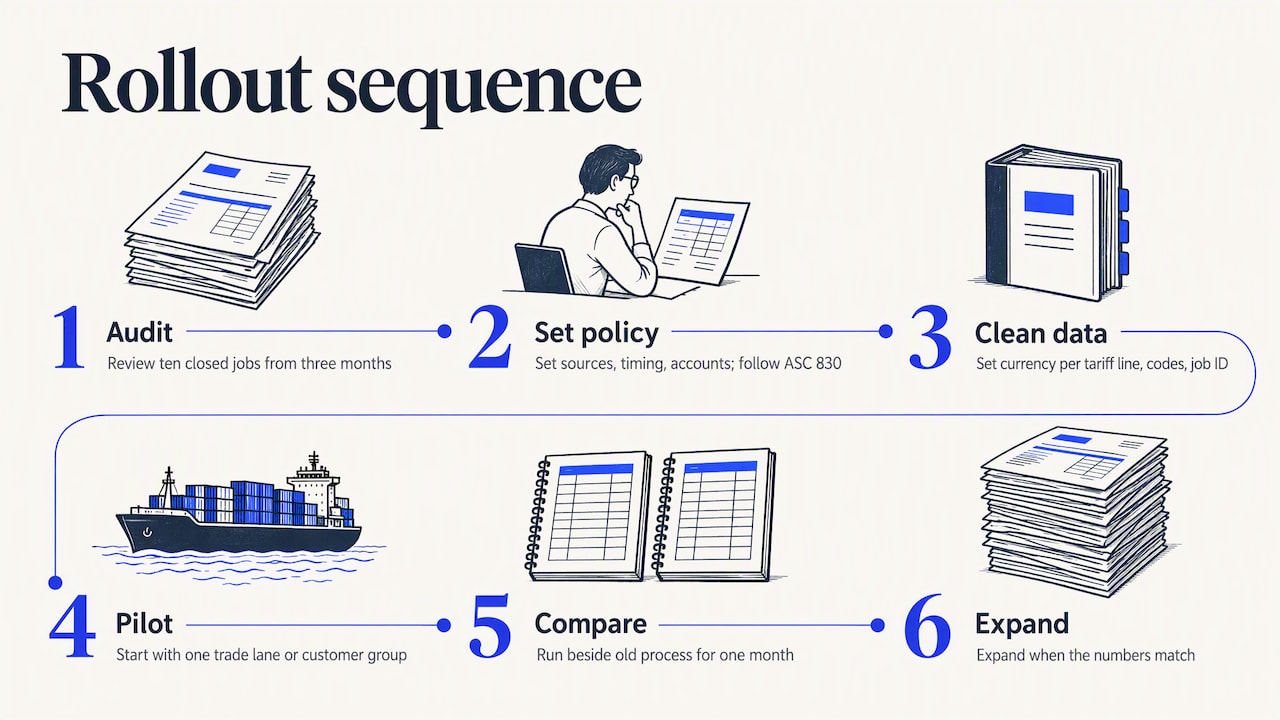
Changing how you bill in multiple currencies sounds risky because it touches every invoice. Staging it keeps the risk small.
Start with an audit of the last three months. Pull ten closed jobs that involved at least two currencies and compare the expected margin at quote with the realized margin. Note every place the rate source differed. That exercise usually makes the business case on its own and shows which of the leaks above is biggest for you.
Next, agree the rate policy with your controller and, if needed, your outside CPA. Decide the sources, the timing and the accounts for realized and unrealized differences, consistent with ASC 830 treatment of your reporting currency.
Then clean the master data. Currency on every tariff line, consistent charge codes, one job ID. This is unglamorous and it is where most of the benefit comes from. Our overview of common freight forwarding inefficiencies shows how manual re-keying and fragmented data drive the cost.
Finally, move one trade lane or one customer group first, run it alongside your old process for a month, and compare. Expand when the numbers match. The choice is yours to make, but the sequence matters: policy first, data second, tooling third.
FAQ
How do I bill a customer in a different currency than I pay the carrier?
Quote the customer in their currency using a rate fixed at quote or booking, and record the carrier cost in its own currency on the same job. Convert both to your reporting currency at your documented rate so expected margin is clear. Any later difference between the booked rate and the rate at invoice or payment belongs in an FX gain or loss account, not in job margin.
Which exchange rate should appear on an invoice?
Use the rate your written policy names for the invoice date, and store it with the invoice. Under ASC 830, foreign currency transactions are first measured at the transaction-date rate, so the system should keep that rate for later remeasurement. Ask your CPA which published rate source fits your reporting needs.
Do I need a treasury management system for multi-currency billing?
Usually not, unless you run a large multi-entity group with active hedging. Billing accuracy and job-level FX visibility are operational problems, and mid-market logistics companies often get more from shipment-level automation that connects to their accounting software, as the CFOpresso review suggests. A treasury platform addresses cash and risk across banks, which is a different need.
What should I look for in multi-currency billing software for freight forwarding?
Look for currency on every rate, quote, vendor bill and invoice, rate locking at quote, separate reporting of FX results, automated invoice matching to the job, credit control across currencies and a clean accounting integration. General accounting tools cover the ledger well, but they do not know what a shipment is, so check that the job record carries the currency detail all the way through.
How do I keep FX swings from distorting lane profitability?
Report job margin at the booked rate and book exchange differences separately. That lets you see whether a lane earns its margin through pricing and operations or only through a favorable currency move. Apply the same rate policy every month so month-to-month comparisons stay meaningful.
Sources
- Automated FX Hedging for Freight Forwarders (onex.center)
- Accurate Financial Statements for Freight Forwarders (subraps)
- International freight forwarder accounting guide (hygjwl.com)
- ASC 830: Foreign Currency Matters (njcpausa.com)
- Overview of IRC Section 988 Nonfunctional Currency Transactions (IRS)
- Invoicing and payment processes in global container shipping (Drewry)
- Best Treasury Management Software in 2026 (CFOpresso)
- Xero multi-currency accounting
- Zuora Multiple Currencies overview
- How to handle multi-currency in different accounting tools (Chift)

