Stop FX Margin Leak: Six Steps to Dynamic FX Tracking for Freight Forwarders
Dynamic FX tracking is real-time monitoring of currency movements paired with automatic landed-cost revaluation inside your TMS, so quoted margins hold up all the way to settlement. For a freight forwarder juggling a dozen currencies across a single ocean booking, that automation is the difference between a quote you can trust and one that quietly loses money between acceptance and invoice. This tracking can be built natively into rate management and finance modules, which is the direction the whole industry is heading.
TL;DR:
- Automated FX hedging tools can recover several percentage points of margin per shipment, mainly by locking rates at quotation and reducing unhedged exposure.
- Dynamic FX tracking requires live rate feeds, configurable lock periods, and detailed audit trails to prevent margin leaks during currency fluctuations.
- Implementing effective treasury workflows, such as locking obligations at quote and using forward contracts, minimizes dual conversion and rate movement risks.
- Full integration between the TMS, banking, and FX providers ensures real-time rate updates and automated payment processing, without manual intervention.
- Regular review of FX variance reports and setting appropriate alert thresholds in dollar exposure help maintain control over currency-related margin loss.
Table of Contents
- Why FX Volatility Is Quietly Draining Your Margins
- The Core Components of Dynamic FX Tracking
- Treasury Workflows That Stop Dual-Conversion Losses
- Wiring Dynamic FX Into Your TMS Through Automation
- Metrics That Prove Your FX Controls Are Working
- Your Implementation Checklist for Going Live
- Real-Time Monitoring Techniques and Tools
- Data Sources and Accuracy Considerations
- Setting Alert Thresholds for Currency Movements
- Case Studies in Dynamic FX Tracking
- How FreightSuite Handles Dynamic FX Tracking for You
- Sources
- FAQ
Why FX Volatility Is Quietly Draining Your Margins
Currency swings are not a background risk. They are a documented driver of financial performance for freight forwarders, and a study on supply chain risk in South Africa ties currency fluctuation directly to profitability outcomes across the sector.
Here’s the mechanic most operations teams underestimate: a single booking might involve a buy rate in one currency, a sell rate in another, and a settlement that happens weeks later in a third. Every gap between quote and invoice is exposure. Forwarders who don’t manage that exposure directly can watch several percentage points of margin evaporate per shipment once the wire finally clears.
Statistic Callout: Automated FX hedging and rate-locking tools can reclaim multiple percentage points of margin per shipment that would otherwise disappear to unhedged currency swings, according to industry reporting on forwarder hedging outcomes. That gap shows up two ways: margin measured at booking versus margin actually realized at settlement, as well as the hours your finance team spends reconciling the difference every month.
The Core Components of Dynamic FX Tracking
A TMS that actually tracks FX dynamically needs more than a currency converter bolted onto an invoice screen. It needs a layered system that distinguishes rate types, locks them at the right moment, and keeps a clean record of what happened.
- Mid-market rate versus offered rate. The mid-market rate is the reference point; the offered rate includes the spread your bank or FX provider charges, and that spread is where quiet losses accumulate.
- Forward-rate locking at quotation. Locking a conversion rate the moment a client accepts a quote creates mathematical certainty about margin, removing the guesswork between quote and delivery.
- Configurable lock windows. Not every booking needs a 90-day lock. Shorter lanes might only need a 10-day window, and your TMS should let you set that per trade lane.
- Multi-currency ledgers. Landed cost has to recalculate automatically as freight, duty, and surcharge lines land in different currencies.
- Audit trail metadata. Every executed conversion rate tied to an invoice or payment needs to be logged, timestamped, and retrievable, both for client disputes and for your own finance audits.
Treasury Workflows That Stop Dual-Conversion Losses
Dual conversion happens when money changes currency twice unnecessarily, once on the way in and again on the way out, and each conversion carries its own spread. Fixing this is less about buying new software and more about setting rules your sales, treasury, and accounts payable teams actually follow.
- Lock known obligations at quotation acceptance. Once a client signs off, treat that rate as fixed wherever your provider allows it. This single policy removes most of the guesswork from margin forecasting.
- Use forward contracts for fixed future payables. If you know you owe a carrier $50,000 in euros in 60 days, a forward contract acts as insurance against the rate moving against you before then.
- Maintain multi-currency balances for natural hedging. Holding a euro balance to pay euro invoices, rather than converting back and forth, is one of the cheapest FX controls available to a forwarder.
- Automate bulk payments on a schedule. Batching payables reduces the number of individual conversions and shortens the window of exposure per transaction.
- Route payments from matching currency wallets. Draw euro payables from euro wallets, not from a converted dollar balance, whenever your treasury setup allows it.
Pro Tip: Most banks widen their spread well beyond what specialist FX providers charge, so comparing your bank’s rate against a dedicated FX partner on your top three trade lanes often pays for itself within a quarter.
Wiring Dynamic FX Into Your TMS Through Automation
Rate-locking and multi-currency wallets only work at scale if your TMS talks directly to your banking and FX providers. That means real integration, not a spreadsheet someone updates every morning.
- Live FX feeds connected to the TMS. Pull rates on a continuous basis rather than a daily manual refresh, so quotes generated at 4 p.m. reflect the same reality as quotes generated at 9 a.m.
- Payment API connections for straight-through processing. Once a rate is locked and an invoice is approved, the payment should route without a human retyping numbers into a banking portal.
- Automated invoice currency routing. The system should recognize which currency a client bills in and which currency a carrier expects, then trigger the right conversion path automatically.
- Structured remittance metadata. Storing execution details alongside each payment, not just the amount, is what lets automated reconciliation actually match invoices to receipts without manual review.
- Sandbox testing before go-live. Run your bank API connections against a handful of pilot trade lanes before trusting the full book of business to automated routing.
Metrics That Prove Your FX Controls Are Working
You cannot manage what you cannot measure, and FX leakage is easy to hide inside a general ledger that only shows totals. Finance teams need reports built specifically around currency variance, not adapted from a generic P&L template.
- Realized FX variance by booking and trade lane. Compare the rate quoted against the rate actually settled, broken out by lane so you can spot which corridors bleed the most.
- Average spread cost as a percentage of invoice value. This number tells you how much your bank or provider is actually charging you above mid-market.
- Exceptions report for failed or delayed conversions. Anything that didn’t process cleanly needs its own list, reviewed weekly, not buried in a monthly summary.
- Percentage of invoices requiring manual revaluation. A high number here signals your automation isn’t catching enough cases on its own.
Statistic Callout: Forwarders adopting automated rate-locking have reported recovering enough margin to offset the cost of the FX tooling itself within a single year, based on industry case examples of adoption outcomes. Assign a specific owner, usually a controller or treasury lead, to review these reports monthly rather than letting them sit as a dashboard nobody checks.
Your Implementation Checklist for Going Live
Rolling out dynamic FX tracking works better as a phased project than a flip of a switch. Skipping the pilot phase is the most common reason implementations stall.
- Define your FX policy with commercial and treasury together. Decide which bookings get locked at quotation, which get forward contracts, and which currencies you’ll hold natively.
- Map your currency exposures. List every currency pair that touches your top twenty trade lanes and set up ledgers for each.
- Integrate rate feeds and payment APIs. Connect your live FX data source and banking rails to the TMS before touching live client bookings.
- Run end-to-end tests in a sandbox. Simulate a full booking-to-payment cycle and confirm the audit trail captures every executed rate.
- Pilot on a limited set of lanes. Choose two or three high-volume corridors and monitor exception reports closely for the first month.
- Train staff and monitor before full rollout. Sales needs to understand why locked quotes matter, and finance needs to know how to read the new variance reports.
Pro Tip: Pilot your riskiest currency pair first, not your safest one. If the automation handles a volatile pair like the Brazilian real or Turkish lira cleanly, the stable pairs will take care of themselves.
Real-Time Monitoring Techniques and Tools
Real-time FX tracking depends on how frequently your rate source refreshes and how that data reaches the point of decision, whether that’s a quote screen or an invoice approval workflow. Batch updates once or twice a day used to be standard practice, but that cadence leaves hours of exposure on volatile trade lanes.
Modern adaptive currency tracking pulls rates on a continuous feed and pushes updates directly into the quoting engine, so a sales rep generating a quote at any hour sees a rate that’s minutes old, not a stale number from the morning refresh. The technique that separates a good setup from a mediocre one is tying that live rate to an action, not just a display. A rate that updates on screen but doesn’t trigger a landed-cost recalculation is just a ticker, not real-time FX tracking.
Effective monitoring also layers in historical volatility context. A rate moving half a percent on a stable pair like the US dollar to the Canadian dollar means something different than the same move on a pair prone to sharp swings. Tools built for automated FX monitoring typically flag movement relative to a trailing average, not just the raw number, which helps operations teams tell the difference between normal noise and a move worth acting on.
For forwarders managing dozens of trade lanes, the practical test is simple: can a controller pull up currency fluctuations monitoring for any single lane, at any moment, without asking IT to run a report? If the answer is no, the monitoring isn’t actually real-time. It’s periodic reporting wearing a real-time label.
Data Sources and Accuracy Considerations
The quality of your dynamic foreign exchange analysis is only as good as the rate feed underneath it. Most forwarders draw from one of three source types: a banking partner’s proprietary feed, a third-party FX data provider, or a specialist logistics-focused FX platform. Each comes with tradeoffs in latency, cost, and how closely the quoted rate tracks the true mid-market number.
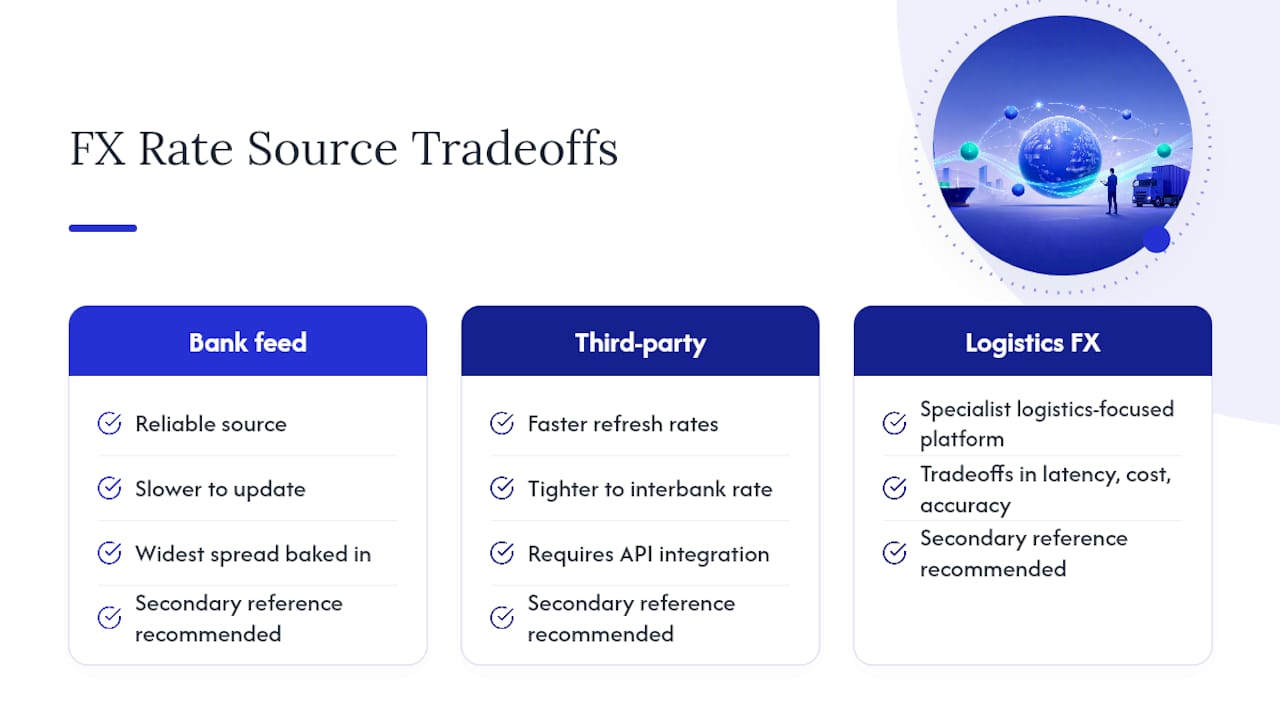
Bank feeds tend to be reliable but slower to update and often carry the widest spread baked in before you even see the number. Third-party data providers, the kind that serve trading desks, typically offer faster refresh rates and tighter accuracy to the interbank rate, but they require your TMS to have a genuine API integration rather than a manual export.
Accuracy also depends on how your system handles rate timestamps. A rate pulled at 2:00 p.m. and applied to an invoice generated at 2:47 p.m. introduces a small but real discrepancy, especially on volatile trading days. The strongest setups timestamp every rate at the moment it’s applied, not just at the moment it was fetched, so your audit trail shows exactly which rate governed which transaction.
One accuracy trap worth naming directly: relying on a single data source with no cross-check. If that feed goes down or lags during a volatile session, your entire quoting engine inherits the error silently. Forwarders with mature FX tracking software solutions typically build in a secondary reference rate, if only to flag when the primary feed drifts more than a small tolerance from a backup source.
Setting Alert Thresholds for Currency Movements
An alert system is only useful if it fires on movements that actually matter to your margin, not every tick of the market. Setting the threshold too tight buries your team in noise; setting it too loose means real risk slips through unflagged.
Most forwarders start by setting a percentage-based threshold, commonly somewhere in the range of half a percent to two percent movement within a trading session, depending on how volatile the specific currency pair tends to be. A pair like the euro to the US dollar might warrant a tighter threshold because even small moves are meaningful at scale, while a historically volatile pair might need a wider band to avoid constant false alarms.
The threshold should also vary by exposure size, not just percentage move. A half-percent swing on a $200,000 booking matters more in absolute dollars than a two-percent swing on a $5,000 shipment. Mature dynamic FX tracking setups weight alerts by dollar exposure, not just percentage change, so the team’s attention goes where the actual risk sits.
Who receives the alert matters just as much as when it fires. Route quote-stage alerts to sales, so a rep knows to re-confirm pricing before a client signs. Route settlement-stage alerts to treasury, so payments can be rescheduled or hedged if a currency has moved sharply since the booking was locked. Sending every alert to every team member trains people to ignore them within a week.
Case Studies in Dynamic FX Tracking
The clearest illustration of dynamic FX tracking’s value shows up in forwarders managing high-volume ocean freight lanes where the buy currency and sell currency rarely match. A forwarder booking Asia to North America freight, for example, might quote a US client in dollars while paying carrier invoices in a mix of Chinese yuan and euros for transshipment fees. Without rate-locking at the point of quote acceptance, every day between booking and final invoice introduces new exposure.
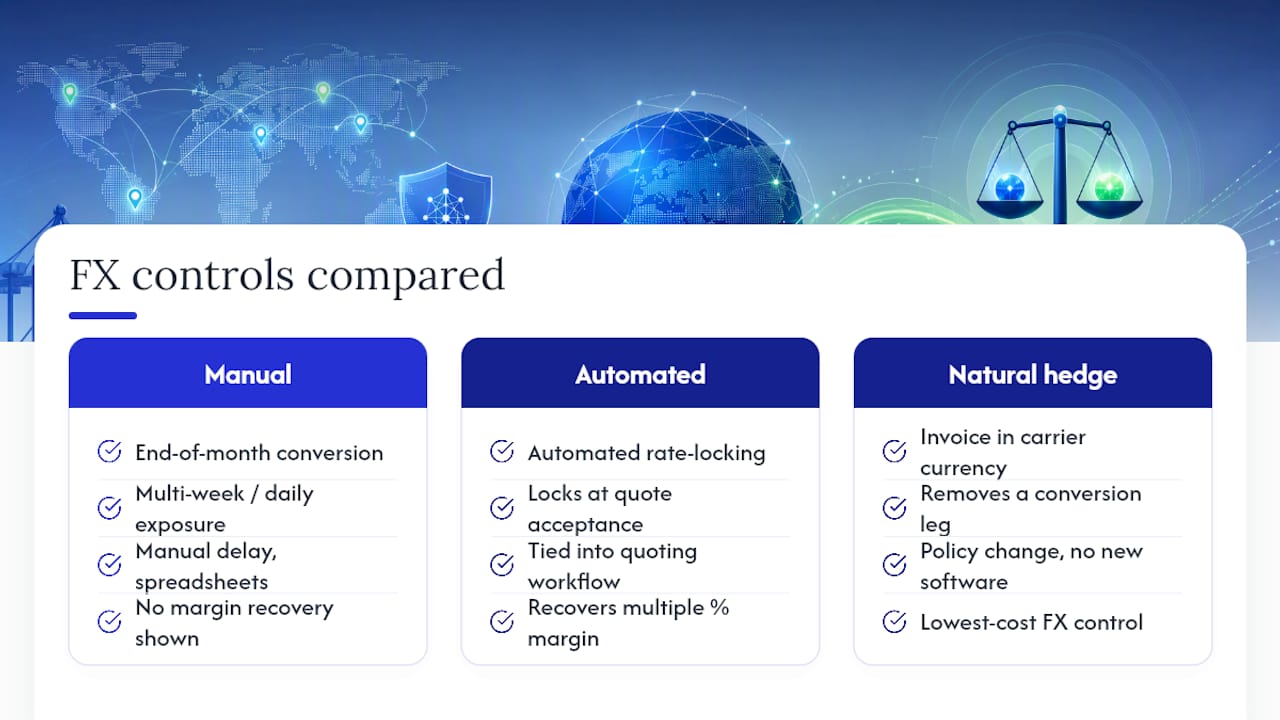
Industry reporting on automated FX hedging adoption shows forwarders recovering multiple percentage points of margin per shipment after shifting from manual, end-of-month currency conversion to automated rate-locking tied directly to the quoting workflow. The mechanism is straightforward: locking removes the multi-week gap where a currency could move against the forwarder, and automation removes the manual delay where someone forgets to convert funds until the invoice is already overdue.
A second pattern shows up around natural hedging. Forwarders that started invoicing certain clients in the same currency they use to pay carriers on that lane, rather than converting through dollars as an intermediary step, cut out an entire conversion leg. That’s one of the lowest-cost FX controls available, and it requires no new software, just a change in invoicing policy paired with a TMS that can actually bill in multiple currencies cleanly.
The common thread across these examples isn’t sophistication. It’s consistency: locking rates at a defined moment, tracking them automatically, and reconciling without a spreadsheet stitched together at month end.
How FreightSuite Handles Dynamic FX Tracking for You
Everything covered above, rate-locking at quotation, multi-currency ledgers, automated landed-cost revaluation, audit trails on every executed rate, can be built natively into rate management and finance modules. There’s no add-on module to buy and no third-party FX plugin to stitch together after the fact. That’s a common positioning claim among some newer TMS platforms: every feature ships out of the box, so finance teams are not waiting on vendor integrations to close the gap between quoted margin and realized margin.

Some finance tools connect rate management, air and ocean tracking, and multi-currency ledgers into a single workflow, so a rate locked at quotation flows straight through to invoicing without a manual reconciliation step. For forwarders running ocean lanes with heavy multi-currency exposure, the Ocean Freight TMS & Automation module ties directly into this same finance layer.
If your finance team is the one asking for better FX visibility, the finance team solutions page walks through how credit control, invoice recognition, and currency tracking work together inside one system. See how a real forwarder cut reconciliation time and margin leakage in the FreightSuite case study, then request a demo through the main FreightSuite platform to see dynamic FX tracking running against your own trade lanes.
Sources
- Architecting a Secure Multi-Currency Workflow For Freight Forwarder Booking - XTransfer
- FX Risk Management for Importers and Freight Forwarders: A Practical Guide | SeaRates Blog
- Automated FX Hedging for Freight Forwarders: Shielding Supply Chain Margins from Currency Swings | Onex Blog
- Supply chain risk and performance of freight forwarders in South Africa
FAQ
What Is Dynamic FX Tracking in a TMS?
Dynamic FX tracking is the real-time monitoring of currency rates paired with automatic landed-cost revaluation inside a transport management system. It keeps quoted margins accurate by updating cost calculations as rates move, rather than relying on a rate that was current only at the moment of quoting.
How Does Rate-Locking at Quotation Protect Margins?
Locking the conversion rate the moment a client accepts a quote fixes your margin at that number regardless of how the currency moves afterward. This creates mathematical certainty about profitability that a floating rate cannot offer.
What’s the Difference Between a Forward Contract and Natural Hedging?
A forward contract locks in a future exchange rate for a known payment date, acting as insurance against adverse currency moves. Natural hedging avoids the need for that insurance entirely by holding or invoicing in the same currency you’ll eventually pay out, which SeaRates identifies as one of the cheapest FX controls available to forwarders.
How Much Margin Can Automated FX Tracking Actually Recover?
Forwarders adopting automated rate-locking and hedging tools have reported recovering multiple percentage points of margin per shipment that would otherwise be lost to unhedged currency swings. The exact figure varies by trade lane volatility and shipment volume.
Does FreightSuite Include Dynamic FX Tracking Natively?
Yes, FreightSuite builds dynamic FX and cost tracking directly into its rate management and finance modules, alongside multi-currency ledgers and automated landed-cost recalculation. Current pricing and demo details are available directly on the FreightSuite website.
How Often Should FX Exception Reports Be Reviewed?
Exception reports for failed or delayed conversions should be reviewed weekly at minimum, with a summary rolled into monthly finance reviews. Assigning a specific owner, typically a treasury lead or controller, keeps these reports from being ignored between reviews.

