Rate Audit Automation: 5 TMS Checks to Catch Forwarder Overpayments
Freight forwarders should automate freight-rate audits inside their TMS to cut overpayments and speed dispute resolution. FreightWaves reports that forwarders face the same invoice inaccuracy risks as shippers, and we built FreightSuite with native rate management. The payoff is fewer manual checks, faster carrier adjustments, and clean data for your next rate negotiation.
TL;DR:
- Require invoice ingestion from EDI, email, and APIs, with charges matched against rate cards, tenders, and spot agreements, mapped accessorials, and logged disputes.
- Clean rate cards and standardize charge codes before enabling rules; pilot on the account with the most disputes, then verify recovered amounts with carriers.
- Use prepayment checks on high volume, rule friendly lanes, and post payment reviews as a safety net for other bills; define dispute windows in writing.
- Retain the rate source, original invoice, proof of delivery, and adjustment correspondence; GSA guidance calls for matching bills to contracts or tenders before payment.
- Set baselines for invoice accuracy, processing cost, dispute time, and recovered dollars; a Journal of Commerce study reported 20.8% average invoice inaccuracy across modes.
Table of Contents
- What does rate audit automation deliver for forwarders?
- What capabilities should your TMS have for automated audits?
- How do you implement rate audit automation inside your TMS?
- Why do master data and accessorial mapping decide audit accuracy?
- What compliance checks belong in a freight audit program?
- How do you measure the ROI of rate audit automation?
- How we help you automate freight-rate audits at FreightSuite
- FAQ
- Sources
What does rate audit automation deliver for forwarders?
The ground is shifting beneath manual auditing. Multimodal contracts, spot agreements, and layered accessorials have made line-by-line checking by hand unsustainable, and industry analysts describe the TMS as a financial enforcement engine that aligns carrier billing with rate cards. Several benefits follow from treating it that way:
- Fewer overpayments: the system flags every invoice line that departs from the contracted or quoted rate before money leaves your account.
- Lower cost per invoice: staff stop re-keying and cross-checking charges and move to carrier relationships and exception handling.
- Shorter disputes: line-level evidence can be sent to the carrier promptly, and your customers see the adjustment trail.
- Commercial intelligence: audit results show which lanes, carriers, and accounts leak margin, which gives your sales team facts to negotiate with.
FreightWaves experts also note that automated audit platforms help forwarders resolve carrier disputes faster while generating supply chain intelligence. That second effect is easy to miss. An audit program that only recovers money is a cost center, and one that feeds pricing decisions becomes a competitive advantage.
What capabilities should your TMS have for automated audits?
Use this checklist when you evaluate a TMS or an add-on. If a vendor cannot show each item working on your own invoices, keep looking.
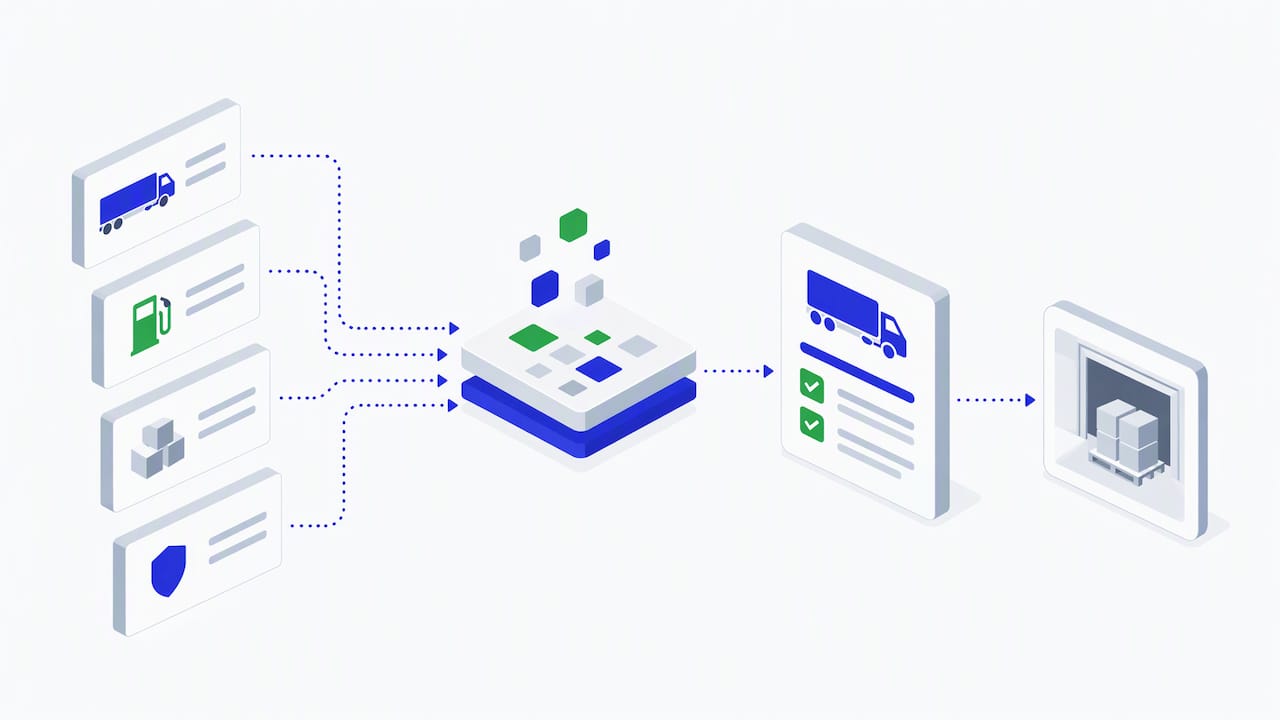
- Invoice ingestion across formats: EDI, emailed PDFs, and API feeds, with parsing and OCR that capture line-level charges rather than totals only.
- A rate engine: it matches billed lines against rate cards, tenders, and spot agreements, not just a single static tariff.
- Accessorial mapping: terminal, drayage, and third-party fees reconcile to contract fields instead of landing in a generic “other” bucket.
- A rule engine: configurable tolerances, approval routing, and automated dispute workflows, so an exception creates a task instead of an email thread.
- Audit trail and case management: every adjustment, approval, and carrier response is logged, which supports customer reporting and later review. Our guide to audit trails for ops teams shows what a useful record looks like.
An industry white paper on freight payment auditing describes three audit models: manual in-house work, outsourcing to audit firms, and freight audit payment software. It argues that software platforms can lower headcount needs and add transparency for forwarders. That is the model the capability list above supports.
How do you implement rate audit automation inside your TMS?
Sequence matters more than speed. Teams that rush to switch on rules before their data is clean may spend time chasing false exceptions.
- Inventory and clean your master data. Gather rate cards, contracts, and tenders, then normalize accessorial codes so one charge has one name.
- Connect invoice sources. Bring in EDI, API, and email feeds and enable parsing so every line-level charge is captured, not just the invoice total.
- Build and prioritize audit rules. Start with the checks that catch the most money, such as base rate mismatches and duplicate charges, and decide whether your pilot audits before or after payment.
- Pilot on one mode or key account. Capture your KPIs, tune tolerances, and validate every recovered amount with the carrier before you claim a result.
- Scale across carriers and modes. Embed audit outcomes into finance workflows so approved adjustments flow into payables and customer billing automatically.
Pro Tip: Run your pilot on the account with the most carrier disputes, not the easiest one. The rules you tune there will carry over to every other account.
Why do master data and accessorial mapping decide audit accuracy?
Audit programs can fail because of data problems, not just software. FreightWaves flags the common pitfall: accessorial and ancillary charges that were never mapped when the shipment was quoted. When a charge has no place in your rate structure, it can be difficult to validate.
- Set a canonical charge code list and enforce it at quoting, so sales and operations describe the same fee the same way.
- Ask carriers and subcontractors for structured rate templates wherever they can provide them, rather than PDFs that someone retypes.
- Map terminal and subcontractor fee splits to contract fields so a combined charge does not hide a surcharge inside a lump sum.
- Schedule periodic reconciliation runs to catch drift between rate cards and what carriers actually bill.
Pro Tip: When a new accessorial shows up on an invoice, add it to your code set that day. Waiting for a later cleanup can let the same exception recur.
Our guides on fixing freight master data and carrier rate shopping with auditable APIs walk through the normalization steps in more detail. Photo evidence helps too, and the photo proof of delivery rules show how stored delivery documentation can back up a disputed charge.
What compliance checks belong in a freight audit program?
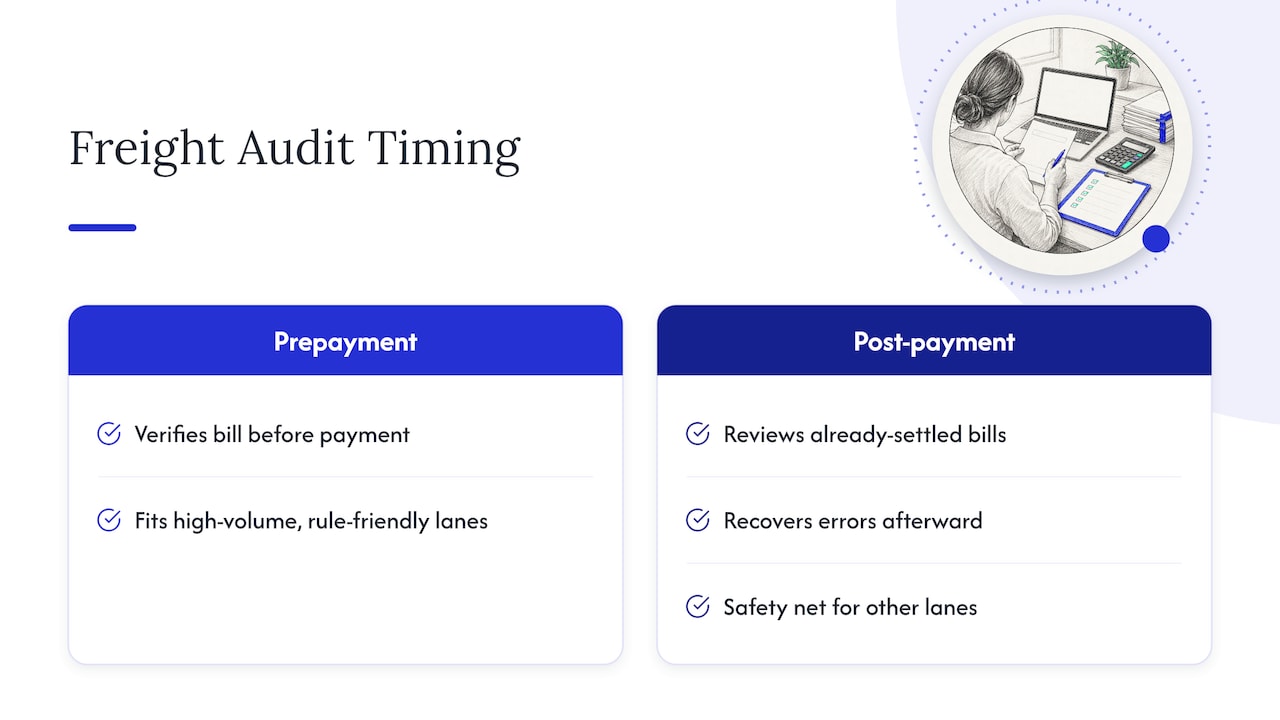
Two audit timings matter. A prepayment audit verifies a bill before it is paid, while a post payment audit reviews bills already settled and recovers errors afterward. Prepayment suits high-volume, rule-friendly lanes, and post payment is a sensible safety net for everything else.
The GSA transportation handbook is a useful framework even for private forwarders. Its guidance under 41 CFR Part 102-118 requires agencies to verify transportation bills against contracts and tenders, and it lists documentation and timing practices.
Under GSA’s 41 CFR Part 102-118 guidance, transportation bills must be verified against the governing contract or tender. That principle translates directly into a rule engine: no matched rate, no payment.
For your own program, retain the rate source, the original invoice, proof of delivery, and the adjustment correspondence. Federal rules reinforce the point: 49 CFR 375.215 says invoices must be truthful and rates must follow the tariff provisions in effect. Define your notification and adjustment windows in writing so carriers know when a dispute is still open.
How do you measure the ROI of rate audit automation?
Finance approves programs it can measure. Set baselines before the pilot starts, then report the same numbers monthly.
- Invoice accuracy rate and overpayment reduction: the share of invoices that match contract, and the drop in dollars paid above contract.
- Cost to process an invoice: measured before and after automation, with staff time included.
- Dispute resolution time and dollars recovered: days from flag to carrier credit, and the credits actually received.
- Operational measures: invoices handled per FTE, dispute rate, and days payable outstanding.
The Journal of Commerce’s freight payment benchmark study reports an average invoice inaccuracy rate of 20.8 percent across modes. Even if your own rate is lower, a baseline measured on your invoices will show where the leakage sits.
The same study finds that outsourcing audit and payment often reduces per-invoice processing costs materially. Automation inside your TMS targets the same saving without handing your carrier data to a third party. Our finance-focused piece on logistics payment automation covers how to present these numbers to your CFO.
How we help you automate freight-rate audits at FreightSuite
You do not need a separate audit tool bolted onto a legacy system. Our native rate management and AI agent orchestration support freight-forwarding workflows, with every core feature included out of the box. Start with one mode, prove the savings, then expand. Here is how to begin:
- Request a demo on FreightSuite and bring a sample set of carrier invoices.
- Pilot a single mode, such as ocean freight or air freight, against your own rate cards.
- Review our solutions for finance teams to see how audit results reach payables.

FAQ
What is freight rate audit automation?
It is software that checks every carrier invoice line against your contracted rates, tenders, and agreed charges without manual review. Exceptions are flagged and routed into dispute workflows. Clean invoices can move to payment with less manual handling.
Should forwarders audit before or after payment?
Prepayment audits stop errors before cash leaves, while post payment audits recover errors that slipped through. GSA guidance describes both types. Forwarders can use prepayment for high-volume lanes and post payment as a second check.
What documents do you need to support a freight audit?
Keep the rate source, the carrier invoice, proof of delivery, and any adjustment correspondence. 46 CFR 515.32 also requires forwarders to provide a detailed breakout of charges and make underlying documents available to principals on request.
Why do accessorial charges cause the most audit exceptions?
Accessorials are often missing from the original quote, so nothing exists to validate them against. FreightWaves identifies unmapped accessorial charges as a common pitfall. A canonical code set and structured rate templates can reduce that ambiguity.

