Best Shipment Visibility Platforms for Forwarders in 2026

The best shipment visibility platform is the one that matches your modal mix, covers your actual lanes and feeds the system where your team works. For most freight forwarders, that means choosing among three families: carrier-network trackers such as project44 and FourKites, condition-monitoring specialists such as Tive, and a transport management system with tracking built in, which is what we build at FreightSuite. This guide compares them on the criteria that decide real purchases, and it shows you how to test any vendor before you sign.
TL;DR
- Visibility software splits into execution tools that show where freight is and decision tools that plan what happens next. Most forwarders need the first type, wired into their TMS.
- project44 is known for multimodal network breadth, FourKites for North American truckload and yard work, and Tive for sensor-level condition data on high-value and cold-chain freight.
- A visibility tool is an add-on, not a replacement for a TMS. Audit your lane coverage first, and build a three-year total cost of ownership model before you buy.
- Judge AI claims by running your own historical exceptions, such as delayed ocean containers, through a structured proof of value.
- If you want tracking, workflows, finance and AI agents in one system, FreightSuite includes them natively.
Table of Contents
- What shipment visibility platforms actually do
- The three families of platforms
- How the main options compare
- Match the platform to your freight
- The audit most buyers skip
- What it really costs
- Testing AI claims before you believe them
- A step-by-step evaluation you can finish in a month
- Where FreightSuite fits
- FAQ
- Sources
What shipment visibility platforms actually do
The phrase covers more ground than most buyers expect. Industry analysis from FarEye sorts the category into two types: execution-focused platforms that provide real-time shipment tracking, and decision-focused tools such as SAP IBP and Oracle SCM Cloud that support planning, inventory and network design. Flowlity makes the same split between tools that show where goods are and tools that show what will happen next and what to act on.
That distinction answers a question many readers type when they search for supply chain visibility software. If your problem is that customers keep asking where their container is, you need an execution tool. If your problem is that you cannot see inventory risk three weeks out, you need a planning tool. Forwarders live almost entirely in the first problem, so this comparison focuses there.
The market is growing fast because the pain is real. The same FarEye analysis, citing Future Market Insights data, puts the logistics visibility software market at USD 973.5 million in 2025 and projects USD 2.84 billion by 2035, a compound annual growth rate of 11.3%. More money is chasing the same promise, which makes disciplined evaluation more valuable, not less.
The three families of platforms
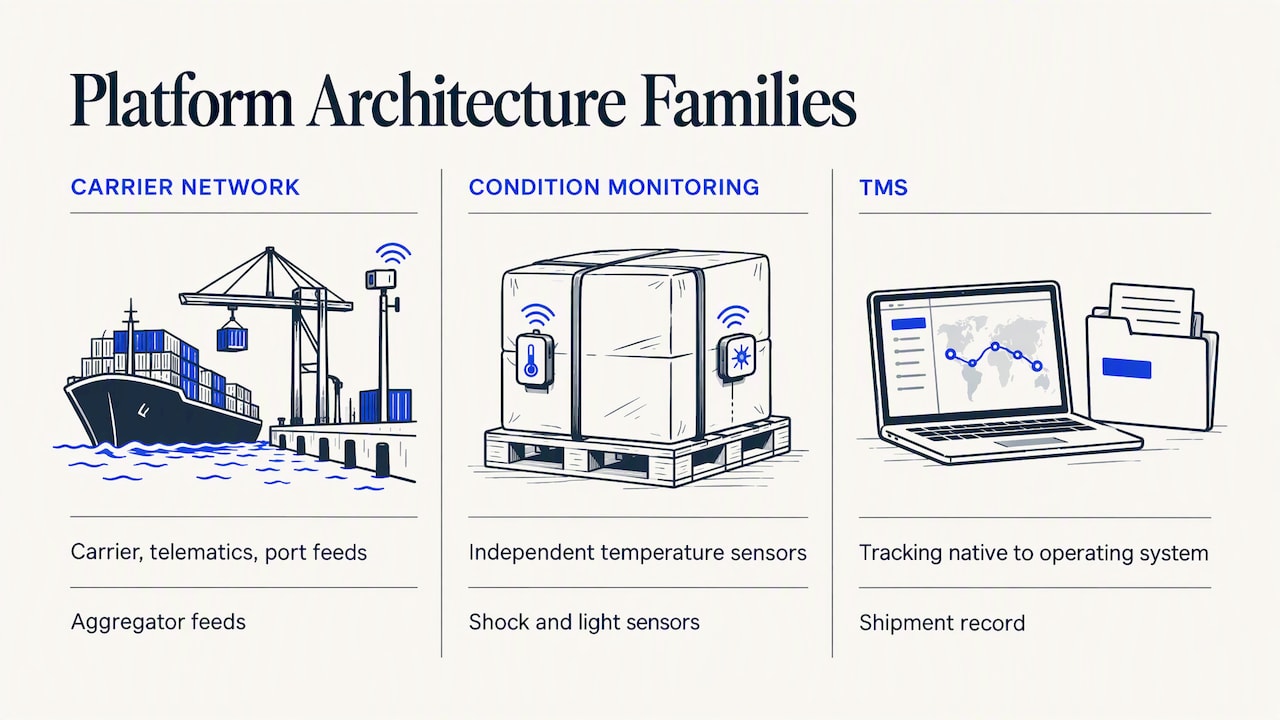
Before comparing names, it helps to see how the options differ in architecture. Each family gets its data differently, and that decides where it is strong and where it goes blind.
Carrier-network visibility platforms
These platforms connect to carriers, telematics providers, ports and data aggregators, then normalize the feeds into one tracking layer. GPX describes project44 as widely regarded as the broadest multimodal option, connected to well over a million carriers worldwide. The same review notes that selection is driven by modal mix and operational focus: project44 is recognized for global, multimodal carrier network breadth, while FourKites is noted for North American truckload, yard management and AI-driven exception workflows.
Customer reviews tell a similar story. On G2’s side-by-side comparison of FourKites and project44, project44 shows a 9.3 score for shipment tracking across 348 ratings against 8.7 across 104 for FourKites. Review scores reflect who is reviewing and how many, so treat them as a signal to test, not a verdict.
The tradeoff is that these are visibility layers. They show you the milestone, and then you carry that information into whatever system runs your quotes, bookings, documents and invoices. That integration work is real, and we return to it in the cost section.
Condition-monitoring and IoT specialists
Some freight cannot rely on carrier feeds at all. GPX notes that Tive uses dedicated cellular IoT hardware to deliver shipment-level temperature, shock and light data independent of carrier systems, which is why it is the common choice for high-value and cold-chain freight where network feeds cannot raise integrity alerts.
If you move pharmaceuticals, electronics or perishables, this layer is not optional. A milestone that says the pallet reached the terminal tells you nothing about whether it sat on a hot tarmac for six hours. The practical lesson from the research is that visibility is not a monolith. Flowlity’s review describes the most robust operations as pairing a primary visibility platform with a dependable hardware layer, so data stays alive across the gaps in carrier feeds.
A TMS with native tracking
The third family flips the architecture. Instead of buying a tracking layer and connecting it to your operating system, you run tracking inside the operating system. That is the approach FreightSuite takes. Our cloud-based transport management system for freight forwarders and logistics companies includes air and ocean tracking, rate management, operations, financial management, workflows and AI agent orchestration natively, without add-ons.
The case for this model is simple. When a container slips, the tracking event lands in the same record as the booking, the customer, the cost and the invoice. Nobody has to retype a delay into another screen, and the exception can trigger a workflow rather than an email chain. If you want the background on why this matters operationally, our guide to real-time logistics tracking for supply chain teams walks through the mechanics, and our piece on freight exception management explains what to do once the alert fires.
How the main options compare
The table below summarizes where each type of platform fits. It draws on the sources cited above and on our own product scope. It is a starting map, not a scorecard, because the right answer depends on your lanes.
| Platform type | Best known for | Strongest fit | Watch out for |
|---|---|---|---|
| project44 | Multimodal carrier network breadth | Large shippers and forwarders needing one tracking layer across modes | Often paired with other systems for execution |
| FourKites | North American truckload, yard management, exception workflows | Road-heavy networks in North America | Also primarily a visibility layer |
| Tive | Dedicated IoT hardware for temperature, shock and light | High-value and cold-chain freight | Hardware cost and maintenance |
| FarEye, Shippeo | Multimodal tracking for high-volume enterprise operations | Enterprise shippers with large volumes | Fit depends on your carrier mix |
| FreightSuite | Tracking built into a forwarding TMS with AI agents | Forwarders who want operations, finance and visibility in one system | Not a standalone hardware sensor network |
The Guideflow roundup of supply chain visibility software reaches similar conclusions about segmentation: project44 for enterprise network depth, FourKites for multimodal orchestration and operational KPIs. Notice that none of these labels says best overall. Every credible review ends with fit.
Match the platform to your freight
Start with modal mix, because it narrows the field faster than any feature list.
If you are an ocean-heavy forwarder, the questions that matter are container milestone accuracy, vessel and port event coverage, and how fast a delay reaches your team. Our ocean freight TMS and automation page shows how we handle that inside the operating record. If you run air, the issue is flight and airline status feeds connected to your air waybills, which we cover in how a TMS tracks air shipments.
If you are road-heavy, you care about driver apps, telematics, yard visibility and appointment times. Truckload carriers also depend on a healthy equipment supply, and resources such as parts networks in logistics are a reminder that visibility only creates value when the trucks behind the dots keep running. For a mixed forwarder, the question becomes whether you want one network layer across everything or one operating system that tracks what you handle.
If you carry cold-chain or high-value cargo, plan for the hardware layer on day one, as discussed below. And if customs brokerage is part of your service, check whether the platform ties clearance status to the shipment record, as our customs brokerage TMS software does.
The audit most buyers skip
The most common mistake is choosing a tool before auditing carrier data coverage. GPX’s guidance is blunt on this point: a visibility tool is an add-on to a TMS, not a replacement, and if a vendor cannot prove it covers at least 85% of your specific lanes through direct carrier-feed integration, you should budget for a parallel IoT hardware layer from the start rather than treating it as a later fix. That is advice from the GPX review, and it is a sound rule of thumb even if your own threshold differs.
Here is how to run the audit in practice. Pull your last twelve months of shipments and group them by lane and carrier. Send that list to each vendor and ask for a coverage report by lane, not a logo slide of carriers they connect to. Ask what share of events arrive by direct integration versus scraping or manual updates, and how long milestones take to appear. A vendor that is confident will answer with data. A vendor that is not will answer with a demo.
What it really costs
The subscription is the smallest line in the budget. Implementation, carrier change management, TMS integration and hardware maintenance can dwarf the license fee, according to the same GPX analysis. Its recommendation is to build a three-year TCO model that includes those overheads before signing any contract.
A sensible model has five lines: the license, the integration work between the tracking layer and your TMS, the internal hours spent on carrier onboarding, any hardware and its replacement cycle, and the cost of the exceptions still handled by hand. That last line is where an integrated system tends to win, because there is no second screen to reconcile. We do not publish a price for FreightSuite, so ask us for a quote based on your volumes and modes, and compare it to the full three-year number for the stacked alternative, not the headline subscription.
The finance side matters too. Tracking data that never reaches your accounting records leaves margin leakage invisible. Our pages on TMS accounting integration and solutions for finance teams show how shipment events connect to costs and invoices.
Testing AI claims before you believe them
Every vendor now says AI. The research is candid that the category is hyped, and that real value shows up only when you run your own historical data through the models in a structured proof of value. GPX recommends testing response times on your own exception scenarios, such as container delays or temperature excursions, before committing.
The same review frames the most effective teams as those that move from passive tracking to proactive orchestration, validating tools against real exceptions like delayed ocean containers rather than vendor demos. Take that literally. Pick ten shipments from last quarter that went wrong. Ask each vendor to replay them. Measure how early the platform flagged the problem, what it recommended, and whether anything happened automatically.
This is where the ground is shifting beneath the industry. As autonomous tracking matures, the platform you choose today has to be built for a future where AI agents, not human analysts, run most of the queries. The window is real, and it has a timeline. A tool that only paints dots on a map will be asked to do much more within a few years, and the choice is yours to make: build for agentic workflows now, or carry the technical debt later. Our overview of how AI agents handle freight tasks and our agentic architecture page explain how we approached that design.

A step-by-step evaluation you can finish in a month
Week one is scoping. Write down your modal mix, your top fifty lanes, your customers’ tracking expectations and the systems that must receive the data. Decide whether condition monitoring is in scope.
Week two is coverage. Run the lane audit described above with every shortlisted vendor, and eliminate anyone who cannot show lane-level numbers.
Week three is the proof of value. Replay your own historical exceptions, measure detection time, and check how each platform pushes events into your TMS or, in our case, whether the event already lives there.
Week four is the total cost. Build the three-year model, add integration and internal labor, and ask each vendor to confirm the assumptions in writing. By then the decision is usually obvious, and it is grounded in your freight rather than in a slide deck.
Where FreightSuite fits
We built FreightSuite as an agentic TMS, the alternative to legacy systems such as CargoWise, Magaya, Descartes, Multifreight, Logi-Sys and Logitude. Rate management, air and ocean tracking, finances, operations, workflows and AI agent orchestration are native, and the core features come out of the box without add-ons. For a forwarder, the benefit is that visibility is not a separate purchase. It is one part of a system that also handles documents, invoice recognition, dynamic FX and cost tracking, credit control and customer dashboards.
If your goal is to run faster, remove admin and protect margin, see how the platform works on your own shipments. Start at FreightSuite, or read our case study to see the results forwarders have reported. If you want to grow volume without growing headcount, our scale throughput page explains the approach. For a primer on the category itself, read freight forwarding TMS explained.
Be honest about the limits, too. If you need dedicated temperature and shock sensors on every pallet, you will still pair a TMS with a hardware specialist, and that is the right call. What we offer is the operating core that makes any such data actionable.
FAQ
What is the best shipment visibility platform for freight forwarders?
There is no single winner. Network platforms such as project44 and FourKites suit teams that want a standalone tracking layer, while a forwarding TMS with native tracking, such as FreightSuite, suits teams that want tracking, workflows and finance in one record. Choose after a lane-coverage audit and a proof of value on your own exceptions.
Is a visibility platform the same as a TMS?
No. According to GPX, visibility platforms are an add-on to a TMS, not a replacement. A TMS runs quoting, booking, documents and billing, so tracking either connects to it or lives inside it.
How much do shipment visibility platforms cost?
Vendors rarely publish prices, and the license is only part of the spend. Implementation, integration, carrier onboarding and hardware can exceed the subscription, so build a three-year total cost model before you commit. FreightSuite does not publish a price, so request a quote based on your volumes.
Do I need IoT sensors as well as software?
Only if you ship high-value or temperature-sensitive freight, or if a vendor cannot show roughly 85% direct-feed coverage of your lanes. In those cases a sensor layer from a specialist such as Tive supplies shipment-level data that carrier feeds do not. For standard dry freight, carrier and port feeds are often enough.

