AI TMS Software: How Agentic Platforms Compare in 2026

AI TMS software is a transport management system that uses machine learning and AI agents to do work your team used to key in by hand: parsing documents, updating shipments, reconciling invoices and chasing exceptions. For a freight forwarder, the useful question is not whether a vendor mentions AI. It is whether the AI sits inside the system of record and acts, or sits beside it and suggests. That difference decides how much headcount, margin and speed you actually gain.
This guide explains how AI freight forwarding software works, what an agentic TMS is, how the main categories of platform compare, and how to run an evaluation that avoids the most common mistake. We build FreightSuite, so you will find us in the comparison. We have tried to be straight about where each approach fits.
TL;DR
- An agentic TMS embeds AI agents in the system of record so they can start and complete tasks such as rebooking or invoice reconciliation, rather than only answering questions in a chat window.
- For forwarders, the fastest return comes from automating repetitive execution work (data entry, document parsing, exception handling), not from advanced forecasting modules built for manufacturers.
- The market splits into legacy platforms with AI added, specialist AI layers that connect to an existing TMS, and AI-native platforms where automation is part of the core product.
- Data quality limits every AI deployment, so pilot against your current manual process and measure the difference before you commit.
- FreightSuite is an agentic TMS for forwarders and logistics companies, with rate management, tracking, finance, workflows and agent orchestration built in rather than sold as add-ons.
Table of Contents
- What an agentic TMS is, and how it differs from SaaS with AI features
- How AI freight forwarding software works
- Where the return actually comes from
- The main categories of AI TMS software
- How FreightSuite approaches it
- The honest limits of AI: data, pilots and people
- How to evaluate AI TMS software: a practical process
- See it on your own shipments
- FAQ
- Sources
What an agentic TMS is, and how it differs from SaaS with AI features
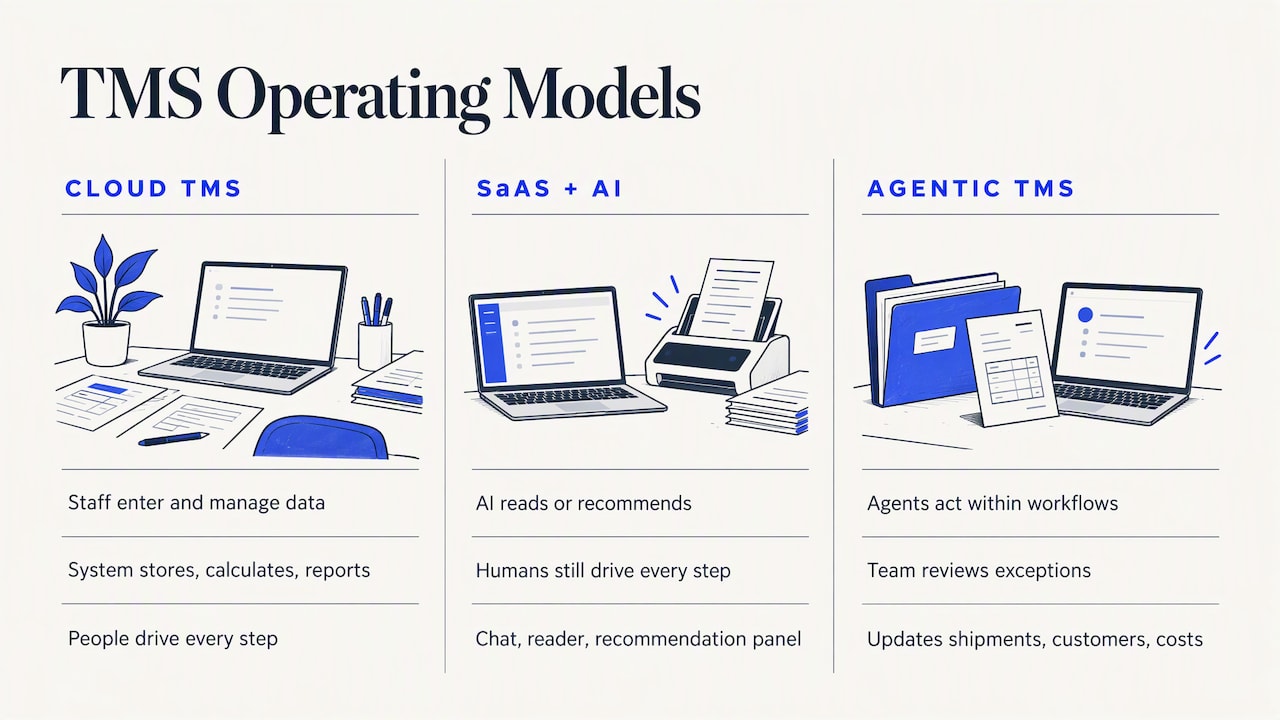
A traditional cloud TMS is software as a service: you log in, your people enter data, and the system stores it, calculates it and reports on it. The intelligence lives in the staff. Many vendors have since added AI features on top of that model, usually a chat assistant, a document reader or a recommendation panel. Useful, but the human still drives every step.
An agentic TMS reverses the default. Software agents are given goals inside defined workflows, such as getting an arrival notice matched to the right shipment, updating the customer and flagging a cost variance. They take the action, and your team reviews the exceptions. That is the practical answer to the question of SaaS versus agentic AI: SaaS gives your team a better tool, while an agentic platform gives your team a colleague that works the queue.
Logistics researchers describe the same shift. Fraunhofer IML frames agentic AI as the move from predictive models to agents that make and initiate decisions, and argues that companies should look beyond copilot chat surfaces and embed agents in the system of record, where they can start processes like rebooking or invoice reconciliation. If the agent cannot touch the shipment file, the booking and the invoice, it cannot finish the job, and your people end up copying its output into the real system.
How AI freight forwarding software works
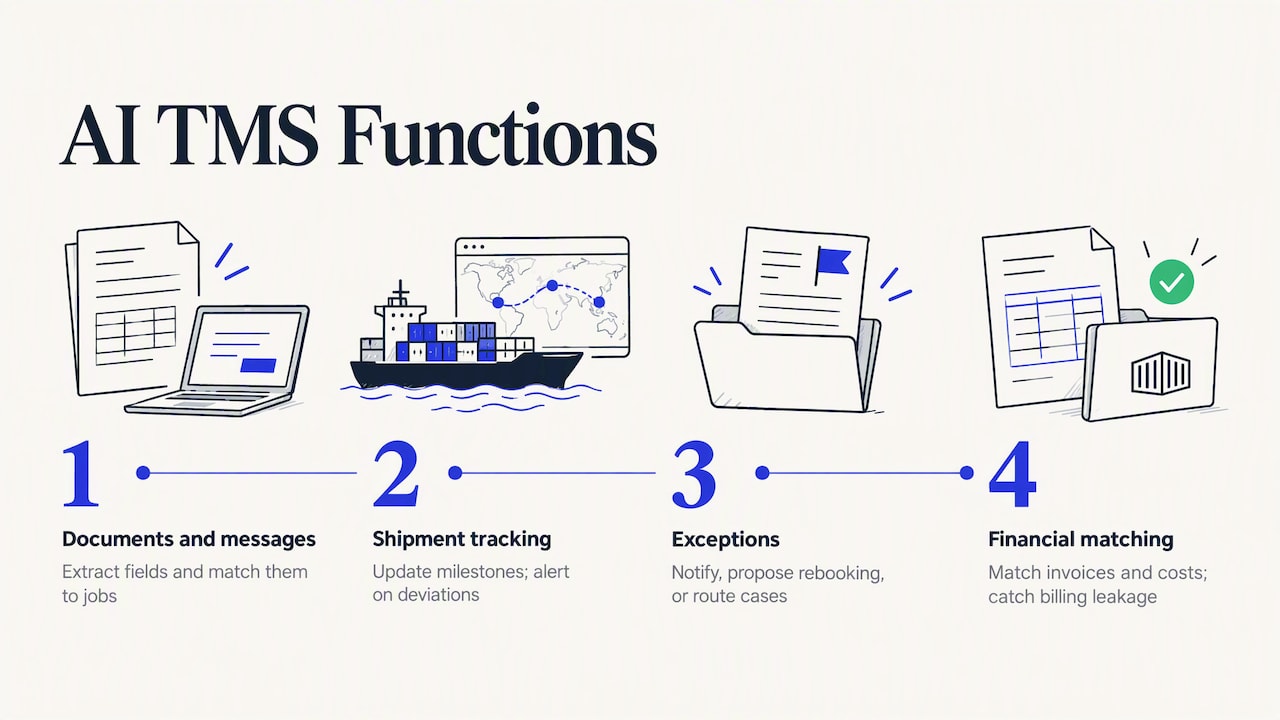
Strip away the marketing and most AI TMS software does four things, in roughly this order of maturity.
Reads documents and messages. Bills of lading, commercial invoices, airway bills, carrier invoices and customer emails arrive in every format. Extraction models turn them into structured fields and match them to the right job. This is where most forwarders see the first hours returned.
Keeps shipments current. Air and ocean tracking feeds update milestones and ETAs automatically. The agent compares what happened with what was planned and raises an alert only when something deviates, instead of asking a coordinator to check a portal.
Handles exceptions and routine decisions. A delayed vessel, a missing document or a rate that no longer matches the quote triggers a workflow: notify the customer, propose a rebooking, or route the case to the right person with the context attached.
Closes the financial loop. Invoice recognition, cost matching against the job, currency handling and credit control are repetitive, rule-heavy and error-prone, which makes them well suited to agents. Margin leakage often hides here, in costs that never get billed.
We cover the mechanics in more detail in how AI agents handle freight tasks and in our piece on AI in freight forwarding inside your TMS.
Where the return actually comes from
The most common mistake in selecting AI tooling is buying for the impressive demo rather than the daily workload. An AWS industries analysis of agentic AI in supply chains points out that forwarders often prioritize advanced predictive planning modules, designed for large manufacturers, over core execution automation, while the quicker payback comes from data entry, document parsing and exception management.
Forecasting does have a place. One overview of AI in U.S. logistics and customs reports that AI-driven demand forecasting can cut forecasting error by up to 50% compared with classical models. That matters to a shipper managing inventory. A forwarder sells capacity and service, and the profit is decided file by file: how many shipments each person can handle, how quickly invoices go out, how many costs are caught before the file closes. Automate those first.
The same logic applies well beyond forwarding. Any operation with high-volume, repeatable steps benefits from mapping tasks before buying tools, as shown in this look at AI-enhanced recruiter workflows for trucking fleets, where the gains come from automating the repetitive handoffs rather than from exotic models. Forwarders can apply the same discipline to their own queues.
The main categories of AI TMS software
When you shortlist, sort vendors by architecture first and by feature list second. In the forwarding space the options fall into three groups.
| Category | How AI is delivered | Typical strength | Typical trade-off |
|---|---|---|---|
| Established platforms with AI added (for example CargoWise, Descartes, Magaya) | Modules, assistants or document tools layered onto a mature core | Breadth, compliance depth, large installed base, multi-office reach | Automation often arrives as separate modules or services, and implementation can be heavy |
| Specialist AI layers | A separate tool that reads emails and documents, then connects to your existing TMS | Quick win on one workflow without replacing the core | Another system to integrate, and the agent sits outside the system of record |
| AI-native, agentic TMS (FreightSuite) | Agents and workflows built into the platform that holds your shipments, rates and finances | One data model, agents that can act on the file, faster rollout for growing forwarders | Less legacy history than the oldest platforms, so confirm fit for niche requirements |
A few notes on reading this table. Large established systems remain a sound choice for very large, multi-entity operations with complex compliance needs, and we would not pretend otherwise. Specialist layers make sense if you are locked into a core system for contractual or political reasons. But if you are choosing or replacing a core system, the question is whether you want automation to be a feature you configure and pay for separately, or the way the product works from the first day. Our comparison page sets FreightSuite beside the legacy names forwarders most often ask us about.
How FreightSuite approaches it
FreightSuite is an agentic TMS for freight forwarders and logistics companies. Rate management, air and ocean tracking, finances, operations, workflows and AI agent orchestration are built natively into one platform, and the core features are included out of the box without add-ons. That structure is deliberate. When rates, jobs, documents and accounting live in the same data model, an agent can read a carrier invoice, match it to the job, check it against the buy rate, and post the cost without a human moving data between tools.
In practice that covers automated document management, invoice recognition, dynamic FX and cost tracking, credit control, customer dashboards and connections to accounting software. Teams can customize workflows rather than bend their process to the software. The platform supports ocean freight, air freight, road freight and customs brokerage operations, so a forwarder running mixed modes does not need a different tool for each.
We do not publish pricing, so we will not quote any here. The route to a price is a demo or trial against your own workflows, which is also the right way to judge any vendor.
The honest limits of AI: data, pilots and people
AI does not fix messy data. Research on logistics deployments notes that legacy data silos limit effectiveness and that most systems need significant cleaning and standardization before agents can work well. Successful projects typically start with a pilot that benchmarks the AI against the existing manual process. A FreightWaves report on a Ryder and Terminal yard pilot shows the pattern: computer vision reached 99% accuracy in that test, and the result mattered because it was measured against the conventional check-in method.
There is also a maturity gap across the industry. A Descartes-published survey release says that even though TMS is increasingly seen as essential for shippers and logistics service providers, significant gaps remain in automation and digital maturity. For a forwarder, that gap is an opening: competitors still running on spreadsheets, email and manual rekeying are slower and more expensive, and the window to pull ahead is real, and it has a timeline.
People matter as much as models. Agents change the job of a coordinator from typing to supervising. Teams that plan for that, with clear rules about what an agent may do alone and what needs approval, adopt faster and trust the results sooner.
How to evaluate AI TMS software: a practical process
Use the following sequence to keep a selection honest.
- Measure your baseline. Count files per person, hours spent on document entry, days from delivery to invoice, and the share of costs found late. Without a baseline, no vendor claim can be tested.
- Pick two or three high-volume workflows. Document intake, tracking updates and carrier invoice matching are typical. Avoid starting with forecasting.
- Ask where the agent runs. If it lives outside the system of record, ask how it writes back, who owns the integration and what happens when either side changes.
- Ask what is included. Request a written list of which capabilities are in the base subscription and which are modules, services or usage fees.
- Run a pilot on your own data. Use real documents, including the ugly ones. Compare accuracy and time against your manual process, as the yard pilot above did.
- Check the finance side. Confirm multi-currency handling, cost recognition, credit control and your accounting software connection.
- Plan the migration. Ask how historic data, open shipments and rates move across, and how long your team will run two systems.
If your documents are the biggest pain point and you are not ready to change core systems, our guide to logistics document automation without ripping and replacing lays out that route. If you are still defining what a TMS should do for a forwarder at all, start with freight forwarding TMS explained.
See it on your own shipments
If you are comparing platforms this quarter, the fastest way to separate real agentic automation from a feature list is to watch it work on your files. Book a FreightSuite demo and bring a typical week: a few ocean and air jobs, the carrier invoices that came back wrong, and the emails your team dreads. You can also read the case study for results from a forwarder using the platform, or see how the system supports finance teams and sales teams.
FAQ
What is an agentic TMS?
An agentic TMS is a transport management system in which AI agents work inside the platform and complete tasks, such as updating shipments, matching invoices or proposing a rebooking, instead of only suggesting actions. Your team sets the rules and handles the exceptions. The agents act on the same data as everyone else, so there is nothing to copy between systems.
Is AI TMS software worth it for a small or mid-sized forwarder?
Often yes, because the gains come from repetitive execution work that every forwarder has, regardless of size. Start with a pilot on one or two workflows and compare results with your manual baseline. Smaller teams usually benefit from platforms where automation is included, since they have little capacity to integrate separate tools.
How is agentic AI different from SaaS?
SaaS describes how software is delivered: hosted, subscription-based and updated by the vendor. Agentic AI describes what the software does: it takes multi-step actions toward a goal. A TMS can be SaaS without being agentic, and the better platforms are both.
Will AI replace freight forwarding staff?
Agents take over data entry, document handling and routine follow-up, but customer relationships, pricing judgment and problem solving still need people. The realistic outcome is that each person handles more shipments and spends more time on work that wins and keeps customers.
Sources
- Agentic AI, Fraunhofer IML
- Transform Supply Chain Logistics with Agentic AI, AWS for Industries
- AI in U.S. Logistics & Customs Clearance: Innovations, Trends, and Challenges
- Ryder and Terminal tout success of AI-based yard traffic-monitoring pilot, FreightWaves
- The Descartes Systems Group Inc, Globenewswire

