One Quarter Wins: AI in Freight Forwarding Inside Your TMS
AI in freight forwarding speeds quoting, cuts manual data entry, sharpens ETA accuracy, and shrinks the volume of costly exceptions that eat into margin. Forwarders who deploy it well see faster quote turnaround, fewer re-priced shipments, and less detention and demurrage. The gains come from four practical capabilities working together: reading documents, optimizing rates and routes, predicting disruptions, and executing routine tasks under human supervision.
TL;DR:
- AI’s most impactful benefits arise from structured quoting and carrier ranking models that feed off clean, standardized data for faster, more accurate responses.
- Predictive ETA models use multiple data sources to improve accuracy and enable management by exception, reducing manual tracking and late discovery of delays.
- Automation of shipping documents efficiently extracts essential details for customs pre-alerts but still requires human review for ambiguous or low-quality files.
- Integrating AI within a TMS architecture is crucial, with a focus on data quality, pilot testing, and controlled scaling rather than using AI as a standalone add-on.
- Early AI pilots on high-volume, standardized lanes can demonstrate measurable improvements within three months, guiding broader deployment decisions.
Table of Contents
- What Does AI in Freight Forwarding Actually Do?
- How Does AI Improve Costing, Quoting, and Carrier Selection?
- Can AI Predict ETAs and Improve Shipment Visibility?
- What Can Document Automation and Customs Pre-Alerts Handle?
- How Should You Sequence AI Inside Your TMS?
- What Are the Risks of Agentic AI in Freight Forwarding?
- What ROI Should You Expect From an AI Pilot?
- How FreightSuite Puts AI to Work Inside Your TMS
- Sources
- FAQ
What Does AI in Freight Forwarding Actually Do?
Most of the confusion around AI in freight forwarding comes from treating it as one thing. It isn’t. A useful way to think about it, drawn from industry guidance on intermodal AI applications, is four distinct roles that map directly onto freight tasks.
The Interpreter reads. It parses inbound emails, RFQs, booking confirmations, and shipping documents, pulling structured data out of unstructured messages so your team stops retyping information that already exists somewhere in an inbox.
The Optimizer calculates. It runs rate comparisons, matches carriers to shipments, and adjusts routing and allocation based on cost, capacity, and service level.
The Sentinel predicts. It forecasts ETAs and flags disruptions before they become customer service problems, combining tracking feeds with historical performance data.
The Conductor, often built as a supervised agent, acts. It executes routine workflow steps like sending status updates or triggering a document request, with a human approving anything that touches money or compliance.
Computer vision adds a fifth layer at the physical edge: reading container numbers at yard gates, capturing damage photos for claims, and indexing containers without a human walking the yard with a clipboard. Together, these five capabilities cover the bulk of what forwarders mean when they talk about machine learning in the supply chain.
- Interpreter: document and email parsing, RFQ ingestion
- Optimizer: rate calculation, carrier matching, allocation optimization
- Sentinel: predictive ETA and disruption forecasting
- Conductor: supervised task automation and workflow execution
- Computer vision: gate reads, damage capture, container indexing
How Does AI Improve Costing, Quoting, and Carrier Selection?
Quoting is where AI freight optimization earns its keep fastest, because the inputs are structured and the decision logic is repeatable. Models ingest contract rates, spot market data, and fuel surcharges, then apply your margin rules automatically instead of routing every request through a rater’s inbox.
Carrier selection works the same way. Instead of defaulting to habit, the system ranks carriers on win rate, price stability over the past quarter, and transit reliability on that specific lane. That ranking updates as new performance data comes in, which matters more on volatile trade lanes than on stable ones.
Metrics worth tracking during rollout: average quote turnaround time, the percentage of quotes handled without a human touch, and win-rate change on lanes where AI-assisted pricing replaced manual quoting.
Forwarders that watch these three numbers get an early, honest read on whether the tool is actually working, rather than relying on anecdote from the sales floor.
- Track quote-to-response time before and after rollout
- Measure the share of quotes that need zero manual correction
- Compare win rates on AI-assisted lanes against a control group of manual lanes
Can AI Predict ETAs and Improve Shipment Visibility?
Yes, and this is one of the most measurable wins available today. Predictive ETA models combine carrier status messages, AIS and satellite vessel tracking, port congestion data, and weather feeds into a single forecast that updates as conditions change, rather than a static transit time pulled from a rate sheet.
Siemens Digital Logistics has described how stitching together more than 200 data sources for ocean visibility produces materially better ETA accuracy than any single carrier feed alone, and cuts the manual status-chasing that eats a planner’s day.
The practical shift: planners stop checking every shipment and start managing only the ones flagged as exceptions. That is the entire logic of “management by exception,” and it is what frees experienced staff for negotiation and problem-solving instead of status calls.
The downstream benefits show up in the numbers that matter to finance, not just operations:
- Fewer expedited or air-freight rescues triggered by late discovery of delays
- Lower detention and demurrage exposure because customs and drayage teams get earlier warning
- Reduced customer-service load, since automated milestone updates replace manual check-in emails
What Can Document Automation and Customs Pre-Alerts Handle?
Document parsing reliably extracts the fields that show up in nearly identical positions across most shipping paperwork: bill of lading and air waybill numbers, HS codes, weights and dimensions, shipper and consignee details, and container numbers. Feeding those fields directly into customs pre-alert systems shaves real time off clearance, since brokers aren’t retyping data that arrived electronically an hour earlier.
Automation reduces entry errors and the follow-up calls that come from a mistyped HS code or a mismatched weight, a pattern explored in more detail in FreightSuite’s guide on why automation reduces freight errors.
- Extracts B/L and AWB numbers, HS codes, weights, and party details
- Feeds customs pre-alert systems ahead of arrival
- Flags mismatches between commercial invoice and packing list for review
Where it still needs a human: ambiguous product descriptions, tariff classification calls with legal exposure, and any document that arrives as a low-quality scan or a photo taken sideways. DHL’s own freight forwarding education content makes a similar point: automation handles volume, people handle judgment calls.
How Should You Sequence AI Inside Your TMS?
The single biggest architectural mistake is treating AI as a bolt-on tool that sits beside your TMS instead of inside it. The pattern that actually works, described in C.H. Robinson’s own approach to Lean AI engineering, keeps the TMS as the system of record and layers AI on top as an orchestration engine that reads from it rather than replacing it.
Before anything else, assess data quality. A rate table with inconsistent lane codes or duplicate carrier entries will teach a model the wrong lesson faster than it will teach a person, and the failure shows up weeks later as a mispriced quote nobody can trace back to its source.
- Fix data quality first. Clean carrier records, standardize lane codes, and reconcile duplicate contracts before any model touches them.
- Pilot with read-and-recommend tools. Start with document parsing and quote drafting, where a human still approves the output.
- Move to supervised agents gradually. Let the system execute low-risk, repetitive steps once accuracy holds steady over multiple cycles.
- Build governance loops. Set approval thresholds, monitor output against a sample of manual reviews, and retrain on flagged errors monthly, not annually.
Pro Tip: Run your first AI pilot on your highest-volume, most standardized lane, not your most complex one. Complexity hides errors; volume exposes them fast enough to fix.
This sequencing mirrors how AI agents are already handling freight tasks at forwarders further along the adoption curve: narrow scope first, broader authority later, never the reverse.
What Are the Risks of Agentic AI in Freight Forwarding?
Agentic AI creates transactional risk the moment it touches money or a customs filing without a checkpoint. Keep high-impact decisions, rate approvals, and compliance submissions supervised until the system has a track record you can point to.
Bad data cascades fast. A single incorrect weight field on one shipment can misprice a quote, understate a customs declaration, and complicate a cargo claim, all from one uncorrected record.
Broad, unscoped agent projects also carry higher cancellation risk than narrow ones. Analysis of intermodal AI rollouts notes that Gartner-style estimates point to a high failure rate for agent projects that lack human checkpoints, compared with tightly scoped pilots that keep a person in the loop.
- Keep rate approvals and customs filings supervised early on
- Audit source data before scaling any model that touches billing
- Choose narrow, single-task agents over broad multi-function ones
What ROI Should You Expect From an AI Pilot?
Three pilots consistently produce measurable results within a single quarter: automated quoting on one high-volume lane, document parsing for a defined set of import shipments, and predictive ETA tracking on your busiest ocean lane.
Track quote handling time, the percentage of quotes fully automated, the drop in manual status updates, and dollars saved on detention and demurrage. BCG’s research on logistics AI adoption notes that demonstrable progress shapes market confidence, meaning early, visible wins matter for internal buy-in as much as for the balance sheet.
- Pick one lane, not your whole network, for the first quoting pilot
- Run document parsing on a fixed import volume for 60 days and compare error rates against your manual baseline
- Scale only the pilot that shows a clear time or dollar reduction, then expand lane by lane
Forwarders already tracking operational inefficiencies tend to know exactly where the pilot dollars will show up first.
How FreightSuite Puts AI to Work Inside Your TMS
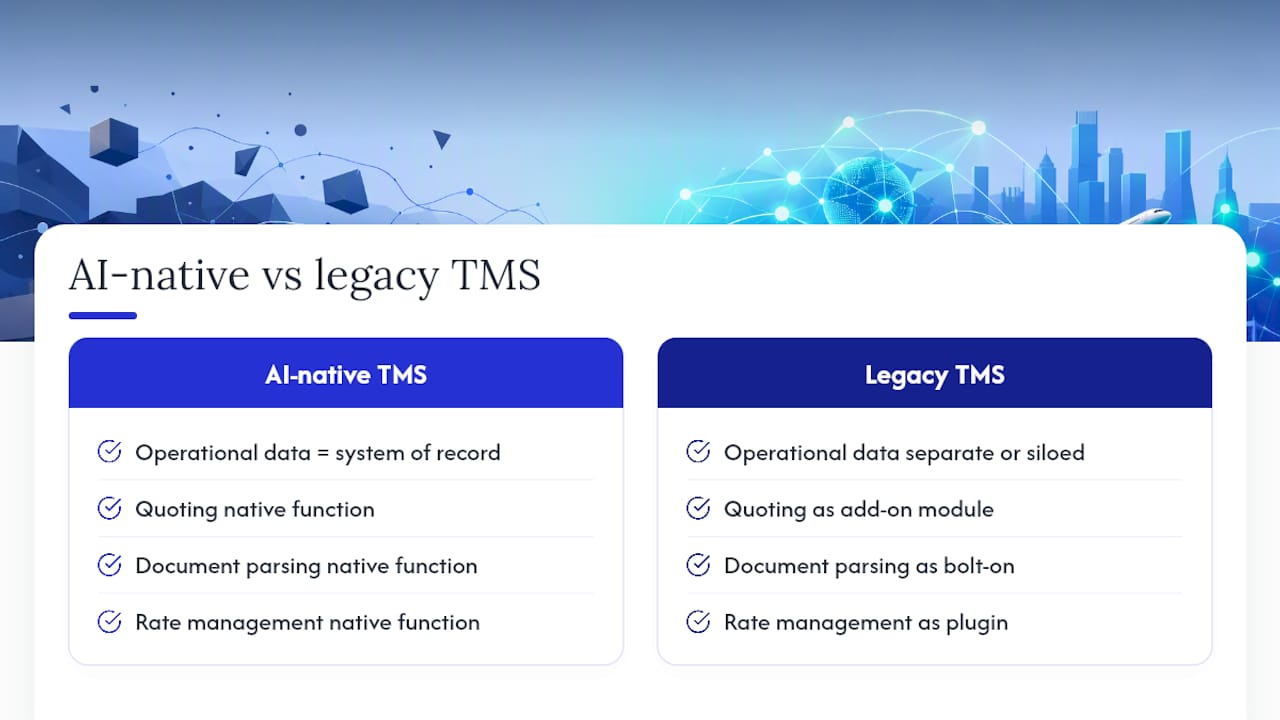
FreightSuite is built as an AI-native TMS from the ground up, not a legacy platform with AI features bolted on after the fact, which means the sequencing described above (data quality, read-and-recommend pilots, supervised agents) is already how the system is architected to work.

The platform keeps your operational data as the system of record while its AI agent orchestration handles quoting, document parsing, and rate management as native functions instead of add-on modules. For forwarders running ocean or air lanes, that means ocean freight and air freight rate logic sits inside the same system driving your tracking, finance, and customs workflows, so there’s no separate tool to reconcile against your books. Customs teams get document automation and pre-alert support built into the same customs brokerage capabilities that handle entry filing.
McKinsey’s research on freight logistics argues that durable competitive advantage comes from combining AI with proprietary operational data and customer relationships, not from AI alone. An AI-native TMS is how that combination actually gets built day to day, rather than staying a slide in a strategy deck.
If you’re ready to see how a single quoting or document-parsing pilot could run inside your own operation, check FreightSuite’s pricing plans and request a demo to walk through your highest-volume lane together.
Sources
For readers who want to go deeper, MIT Sloan’s overview of AI’s shifting role in logistics covers the broader supply chain context, while McKinsey’s freight-specific analysis and BCG’s industry adoption research offer the strategic framing behind the tactics covered here.
- How artificial intelligence is transforming logistics — MIT Sloan
- Code and cargo: How AI could change freight logistics — McKinsey
- AI is already moving the logistics industry forward — BCG
- How AI can help improve intermodal operations — The Conveyor
- When sea freight gets smarter — Siemens Digital Logistics
FAQ
What Is the 30% Rule in AI?
There’s no single, universally recognized “30% rule” specific to AI in freight forwarding; the phrase gets used loosely across different contexts, so treat any claim tied to it with caution and check the original source before repeating it.
What Is AI-Based Freight Forwarding Software?
It’s software, typically built into or alongside a TMS, that uses machine learning to automate tasks like document parsing, rate quoting, carrier matching, and ETA prediction rather than relying purely on manual data entry and static rate sheets.
Is AI Replacing Logistics Jobs?
Not entirely. AI is automating repetitive tasks like data entry and status updates, but carrier negotiation, exception handling, and customer relationships still depend on experienced staff, especially since durable competitive advantage still requires human relationships and proprietary data.
Is Maersk Using AI?
Major ocean carriers and forwarders across the industry, including large players like Maersk, have publicly discussed AI initiatives for forecasting and operations, reflecting the broader industry trend covered in DHL’s freight forwarding education resources on predictive analytics use cases.
How Long Does an AI Pilot Take to Show Results?
Most quoting or document-parsing pilots on a single lane show measurable results, in quote time and error rate, within a few months, provided the underlying data was cleaned before the pilot started.

