Forwarders: Freight Forwarding Software Definitions Mapped by Module
Freight forwarding software is a purpose-built system that manages rate quoting, booking, documentation, shipment tracking, and billing for forwarders operating across ocean, air, and road modes. It replaces the spreadsheet-and-email chaos most forwarders inherit, consolidating what would otherwise sit in five disconnected tools into one workflow, as Freightos notes in its own breakdown of forwarder platforms. Modern platforms like FreightSuite extend that core with AI agent orchestration on top of the standard modules.
TL;DR:
- Accurate multi-leg and multi-currency pricing are essential features for complex operations with cross-border shipments.
- Integration with carrier APIs and customs systems is crucial for seamless data flow and avoiding manual re-entry.
- Discrepancies in invoice matching can silently erode margins if the software cannot automate reconciliation effectively.
- Purpose-built freight forwarding systems like FreightSuite incorporate customs, multi-entity finance, and AI-driven automation, unlike generic TMS or ERP platforms.
- Starting with a phased rollout and clear success metrics helps mitigate implementation risks in adopting new freight software.
Table of Contents
- What Does Freight Forwarding Software Actually Do?
- The Core Modules: What Each One Actually Does
- How Is Freight Forwarding Software Different From a TMS or ERP?
- Freight Software Terms and Acronyms You’ll Actually Use
- How Do These Modules Work Together in a Real Shipment?
- What Should You Check Before Buying Freight Forwarding Software?
- Where FreightSuite Fits Into These Definitions
- See What a Modern Freight Forwarding TMS Looks Like
- Sources
- FAQ
What Does Freight Forwarding Software Actually Do?
Every forwarder juggles the same handful of jobs: price a shipment, book it, document it, track it, and get paid for it. Freight forwarding software exists because doing those five jobs across email threads, Excel rate sheets, and a carrier portal for every mode wastes hours and money nobody notices leaking away until the quarter-end reconciliation goes sideways.
Rate and tariff management is the foundation. A forwarder holds contract rates from ocean carriers, air lines, and truckers, plus spot rates that shift weekly. Good software keeps a rate library that separates buy rates from sell rates, applies margin rules automatically, and flags when a contract rate has expired before a quote goes out the door with stale pricing.
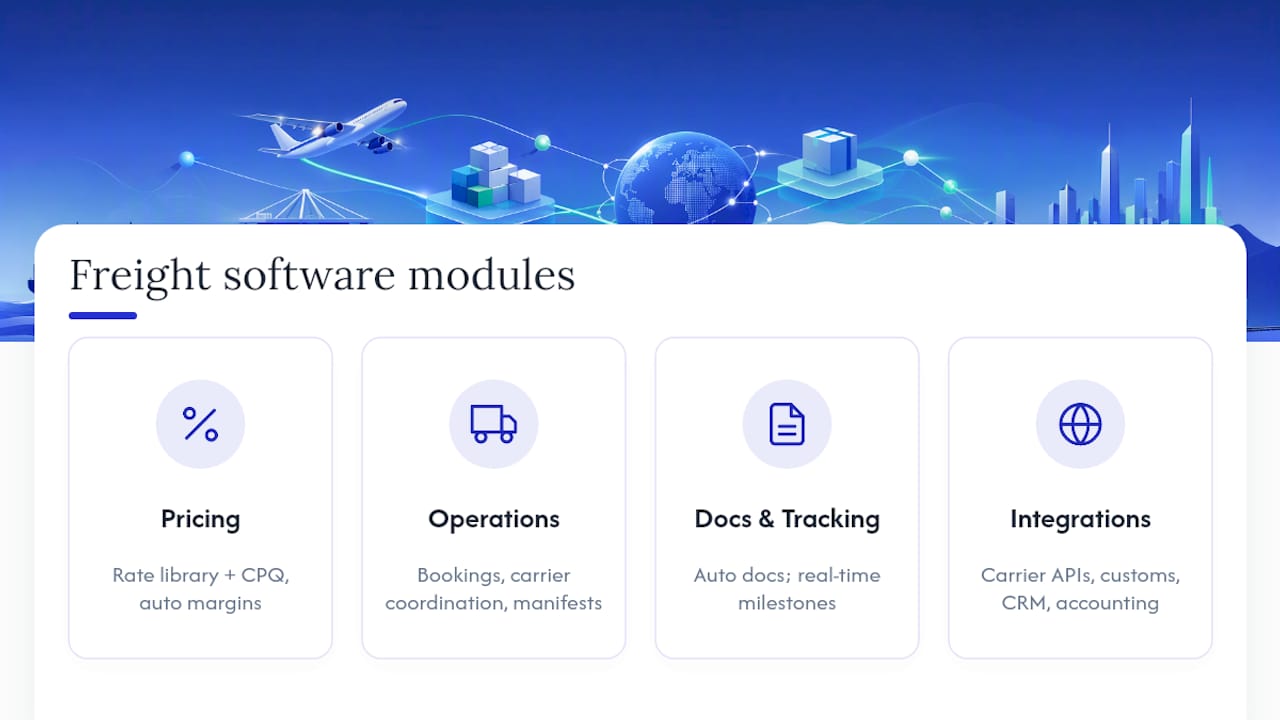
Quoting and CPQ (configure, price, quote) flows turn that rate data into a customer-facing number fast. Speed matters here because a shipper requesting quotes from three forwarders usually books with whoever responds first with an accurate number, not the one who eventually replies with the best price. CPQ tools in freight software also make quotes re-priceable when routing or fuel surcharges change mid-negotiation, something Experion’s overview of forwarder platforms identifies as a core differentiator from generic quoting tools.
Booking and carrier coordination covers the handoff once a shipper accepts a quote: generating carrier bookings, confirming space and schedules, and building manifests that match what was actually sold. Read more in this guide to freight quote management.
Document automation handles the paperwork that used to eat an operator’s whole morning: bills of lading, forwarder’s cargo receipts, commercial invoices, and packing lists generated from booking data instead of retyped by hand.
Real-time tracking gives both the forwarder and the customer visibility into milestones, port arrivals, and exceptions, usually through a shared dashboard rather than a string of status-check emails.
Finance functionality matches carrier invoices against booked rates, catches billing discrepancies before they become disputes, and rolls shipment-level costs into a usable profit and loss view.
Integrations tie all of it to carrier APIs, customs filing systems, CRM platforms, and accounting software, so data entered once in the booking stage doesn’t get retyped four more times downstream.
Pro Tip: Ask any vendor demo to show you a rate change flowing through to an already-issued quote in real time. If the quote doesn’t update or flag for review automatically, that’s a manual reconciliation step waiting to bite you during a rate spike.
The Core Modules: What Each One Actually Does
Freight forwarding software is best understood module by module, because that’s how the software is built and how forwarders actually use it day to day. Experion’s system-of-record framing captures this well: a forwarding platform is the operational record for the business, not a single tool with one job.
-
Shipment management tracks a job through its full lifecycle, from booking confirmation to delivery, flagging exceptions like a missed vessel connection or a customs hold before they become a customer service fire drill. This is the module operators live in for most of the workday.
-
Rate and quote engine stores tariff structures by carrier, lane, and mode, applies markup rules automatically, and manages contract rates separately from spot pricing. Multi-leg shipments, where a container moves by ocean then rail then truck, need pricing logic that stitches those legs into one number without an operator manually adding line items together.
-
Documentation module generates the paper trail: bills of lading, house and master bills of lading (HBL/MBL) for consolidated shipments, commercial invoices, and cargo manifests. Because this data pulls from the booking record instead of a blank template, a shipper name typo made once doesn’t propagate across five documents.
-
Customs and compliance handles tariff classification, electronic data interchange (EDI) filings with customs authorities, and the compliance checks that keep a shipment from getting stuck at a border. This module is where forwarder-specific software earns its keep against generic logistics tools, which rarely build customs filing into the core product.
-
Finance module matches incoming carrier invoices against what was quoted and booked, posts costs across multiple currencies, and produces a profit and loss statement at the shipment level rather than just a company-wide summary. Calsoft’s analysis of forwarder platforms points to this as a place where margin quietly leaks when the software can’t automate invoice matching, since a $40 discrepancy on one shipment is invisible until it’s multiplied across a thousand shipments a quarter.
-
Network and agent management governs how branches, overseas agents, and partner offices bill each other for shared shipments. A forwarder with agents in six countries needs intercompany billing that doesn’t require a finance team to manually reconcile who owes whom after every job closes.
Each module maps to a job function: operators live in shipment management, sales lives in the quote engine, compliance staff live in customs, and finance lives in the invoice-matching and P&L reporting.
How Is Freight Forwarding Software Different From a TMS or ERP?
The terms get used loosely, but they’re not interchangeable, and picking the wrong category of software costs forwarders real integration headaches later.
A transport management system (TMS) in its generic form handles shipment routing, carrier selection, and load tracking, largely built around trucking and domestic logistics use cases. A freight forwarding system (FMS) does everything a TMS does but adds the layers unique to international freight forwarding: consolidations, customs processing, multi-currency finance, and agent network billing. Calsoft makes this distinction explicit, noting that generic TMS and ERP platforms often can’t handle these forwarder-specific workflows natively. A glossary from Loop similarly describes TMS platforms as strong on routing and carrier analytics but built without the customs and documentation depth forwarders need.
An ERP (enterprise resource planning) system, meanwhile, is built for general business operations: accounting, inventory, HR. Some large forwarders bolt freight modules onto an ERP, but that usually means paying for custom development to replicate what a purpose-built FMS already does out of the box.
Deployment choice matters just as much as category:
- Cloud-native SaaS platforms update automatically, scale with shipment volume, and typically integrate faster with carrier APIs since the vendor maintains those connections centrally.
- On-premise systems give a forwarder full control over data residency, which matters for some regulatory environments, but shift the maintenance and update burden onto internal IT.
- Hybrid setups keep sensitive finance data on-premise while running operational modules in the cloud, a compromise some larger, older forwarders still prefer during a slow migration.
- Digital freight forwarder platforms and self-service shipper portals sit adjacent to this category. They’re customer-facing booking tools rather than back-office operating systems, and forwarders often run one alongside their internal FMS rather than instead of it.
A small forwarder moving a few hundred shipments a month can often get by on a lean cloud platform. A multi-branch operation with agents overseas usually needs the deeper customs and intercompany billing that only a purpose-built forwarding system provides.
Freight Software Terms and Acronyms You’ll Actually Use
Freight forwarding software comes loaded with acronyms that show up on carrier documents, in vendor demos, and in customs filings. Here’s what the ones you’ll hit most often actually mean.
- FCR (Forwarder’s Cargo Receipt): A document a forwarder issues confirming they’ve taken custody of goods for shipment, used often in consolidated cargo where a full bill of lading isn’t yet available.
- BL (Bill of Lading): The core shipping document that serves as a receipt, a contract of carriage, and often a title document for the goods. Whoever holds the original BL typically controls the cargo.
- HBL/MBL (House/Master Bill of Lading): In consolidated shipments, the forwarder issues an HBL to the individual shipper while the ocean carrier issues an MBL to the forwarder covering the whole container.
- OBL (Original Bill of Lading): A physical, signed BL required at destination to release cargo, as opposed to a telex release or seaway bill.
- AWB (Air Waybill): The air freight equivalent of a bill of lading, though unlike an ocean BL it’s not a document of title.
- CPQ (Configure, Price, Quote): The workflow and software logic for generating fast, accurate freight quotes, covered earlier in the rate and quote module. Quotiss’s guide to logistics acronyms lists CPQ among the terms forwarders encounter most when evaluating quoting tools.
- TMS (Transport Management System) and FMS (Freight Forwarding/Management System): Covered above, the routing-focused generic tool versus the forwarder-specific platform.
- ERP (Enterprise Resource Planning): General business software for accounting, HR, and inventory, occasionally extended with freight modules.
- NVOCC (Non-Vessel Operating Common Carrier): A forwarder that issues its own bills of lading and consolidates cargo without owning ships.
- LCL (Less than Container Load): Cargo consolidated with other shippers’ goods to fill a shared container, versus FCL (Full Container Load).
- EDI vs API: EDI (Electronic Data Interchange) is the older, structured messaging standard many customs authorities and carriers still require for filings. API (Application Programming Interface) connections are faster to build and more flexible, and most modern forwarding software uses API where the counterpart supports it, falling back to EDI where regulation demands it.
How Do These Modules Work Together in a Real Shipment?
Definitions only click once you see them run through an actual job. Here’s a shipment moving from first quote to final invoice.
-
Quoting to booking: A shipper requests a quote for an LCL shipment from Shanghai to Los Angeles. The rate engine pulls the current contract rate, applies the margin rule, and the CPQ tool returns a quote in minutes. The shipper accepts, and that quote data flows directly into a booking record, no retyping required.
-
Booking to manifest and carrier confirmation: The booking module generates a carrier booking request, confirms container space, and the shipment gets added to a consolidated manifest alongside other LCL cargo heading the same route. This is the stage where ForwarderOne’s breakdown of the freight booking process is worth a read if you’re mapping this workflow for a team new to consolidation logistics.
-
Customs clearance and document exchange: Once the vessel departs, the documentation module generates the HBL and commercial invoice, while the customs module files the classification and entry data through EDI or API with the destination customs authority ahead of arrival.
-
Billing and invoice reconciliation: After delivery, the carrier invoice arrives and the finance module matches it against the original booked rate. A discrepancy, say the carrier billed a demurrage fee that wasn’t quoted, gets flagged for review instead of silently eating into margin.
Pro Tip: Walk one real shipment through a vendor’s demo end to end, quote through final invoice reconciliation, rather than watching separate module demos. That’s the only way to see where data actually breaks between steps.
What Should You Check Before Buying Freight Forwarding Software?
Picking a platform is easier when you treat it as a checklist rather than a gut call based on a slick demo.
- Functional must-haves: Confirm the rate engine handles multi-leg and multi-currency pricing, the finance module supports multi-entity accounting if you operate more than one branch, and document generation covers HBL, MBL, and commercial invoices without manual template editing.
- Integration and data migration: Ask exactly which carrier APIs and customs systems the platform connects to natively, and get a straight answer on how historical shipment and customer data migrates from your current system, since a bad migration is the single most common reason forwarders regret a switch.
- Rollout and training: Set a realistic adoption timeline. Most teams need four to eight weeks to get comfortable with a new booking workflow, and rushing that window is how forwarders end up running the old spreadsheet alongside the new software for months.
- Pilot scope and success metrics: Start with one branch or one trade lane rather than a company-wide cutover, and define what success looks like before you begin. Faster quote turnaround, fewer invoice discrepancies, or reduced document errors are all measurable within the first quarter.
Where FreightSuite Fits Into These Definitions
FreightSuite is built around the exact module structure covered above: rate management, air and ocean tracking, finance, operations automation, and configurable workflows, with AI agent orchestration layered natively on top rather than bolted on. That last piece matters because it’s what separates an agentic TMS from a legacy system: AI agents handle repetitive matching and document tasks that used to require manual operator review.

Written by Annabel Eve. See the author bio for background on freight technology reporting.
See What a Modern Freight Forwarding TMS Looks Like
FreightSuite was built to replace legacy TMS platforms like Cargowise, Magaya, Descartes, Multifreight, Logi-Sys, and Logitude with an agentic system where rate management, tracking, finance, and AI orchestration run natively together instead of through bolted-on add-ons. If the module breakdowns in this guide sound like gaps in your current setup, from invoice matching to multi-currency finance to customs documentation, it’s worth seeing how those pieces work in practice. Check FreightSuite’s pricing plans or book a demo to walk through a real shipment end to end.
Sources
- Freight Forwarding Software: Automate End-To-End Shipment | Experion
- Freight Forwarding Software Explained for Global Trade | Calsoft
FAQ
What Is Freight Forwarding Software?
Freight forwarding software is a system that manages rate quoting, booking, documentation, tracking, and billing for forwarders handling ocean, air, and road shipments, replacing spreadsheets and disconnected tools with one operating record.
What Are the Top Freight Forwarding Software Options?
The category includes purpose-built forwarding platforms ranging from legacy on-premise systems to modern cloud-native, agentic platforms like FreightSuite that add AI orchestration on top of standard rate, tracking, and finance modules.
What Is the Best Freight Forwarding Software?
The best choice depends on your operation’s scale and complexity. Forwarders running multi-branch, multi-currency operations generally need a purpose-built system with deep customs and finance modules rather than a generic TMS or ERP add-on.
What Is FCR and BL?
An FCR (Forwarder’s Cargo Receipt) is a document a forwarder issues confirming custody of goods before a full bill of lading is available. A BL (Bill of Lading) is the core shipping document that acts as a receipt, contract of carriage, and often a title document controlling release of the cargo.

