
.png)
AI agents in freight logistics are defined as autonomous software systems that perceive supply chain data, reason through exceptions, and execute complex tasks without human intervention. Understanding how AI agents handle freight tasks is no longer a theoretical exercise. Agentic AI deployments have pushed operational automation rates past 90% in freight, far beyond the 50–60% ceiling that traditional rule-based systems hit. That gap represents real money, real headcount, and real competitive distance between operators who have adopted agentic AI and those still running legacy workflows. The ground is shifting beneath this industry, and the operators who recognize it earliest will define the next decade of freight forwarding.

AI agents do not simply analyze data and surface recommendations. They reason, plan, and execute across logistics workflows, moving supply chains from passive visibility to autonomous action. Industry experts describe agentic AI as “systems of action” rather than predictive analytics tools. That distinction matters because it changes what your operations team is actually responsible for.
The tasks AI agents handle autonomously today include:
The key distinction between agentic AI and older robotic process automation (RPA) is adaptability. RPA scripts break when a carrier portal changes its interface. AI agents use goal-oriented logic to recognize new UI elements and re-reason through the workflow without manual reprogramming. That adaptability alone eliminates a major source of operational disruption.
Pro Tip: Start your AI agent deployment with invoice auditing and shipment tracking. Both tasks have clear inputs, measurable outputs, and immediate ROI, which makes them ideal for proving value before expanding to more complex workflows.
The efficiency gap between agentic AI and traditional automation is not marginal. Agentic AI achieves automation rates above 90% while conventional AI systems plateau at 50–60%. That difference reflects the fundamental architecture: traditional systems follow fixed scripts, while AI agents adapt their approach based on current conditions.
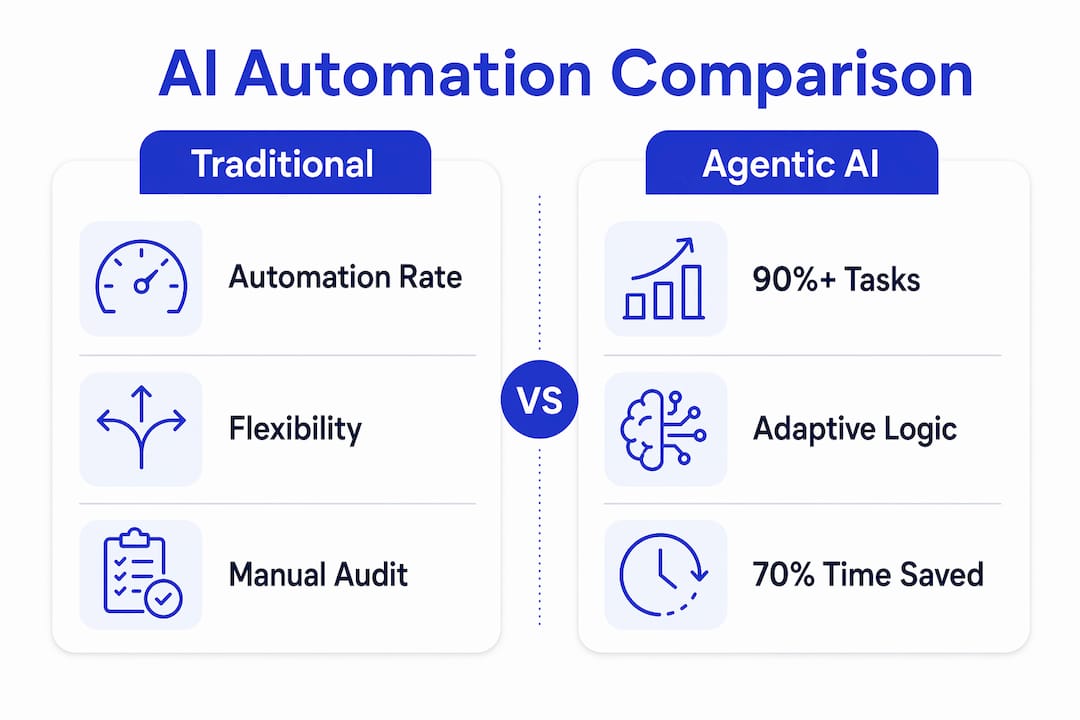
| Capability | Traditional automation | Agentic AI |
|---|---|---|
| Automation rate | 50–60% of tasks | 90%+ of tasks |
| UI change handling | Breaks, requires reprogramming | Adapts automatically |
| Invoice audit time | High manual review burden | Reduced by up to 70% |
| Exception handling | Escalates all exceptions | Resolves routine exceptions autonomously |
| Data context | Siloed per workflow | Shared common context layer |
AI agents reduce manual audit time by 70% compared to fully manual processes. For a finance team processing thousands of carrier invoices each month, that reduction translates directly into headcount capacity freed for higher-value work.
The shared data context is what makes multi-task coordination possible. A common context layer gives agents a single source of truth across order data, contract terms, and historical shipment records. Without it, agents operate in silos and produce conflicting outputs. With it, they coordinate across rate management, tracking, and finance workflows as a unified system.
Hybrid human-AI models produce the best results in practice. AI agents handle routine “see and sort” tasks while humans address complex decisions with pre-assembled intelligence packages. Your team stops doing data entry and starts making calls that require relationship knowledge, regulatory judgment, or commercial negotiation.
Deployment success depends on data infrastructure more than AI model sophistication. The quality of enterprise data is the real bottleneck to autonomous AI, not the algorithm itself. Agents that receive inconsistent, incomplete, or siloed data will produce unreliable outputs regardless of how advanced the underlying model is.
A practical deployment follows a phased approach:
The onboarding speed advantage of agentic AI over RPA is significant. Agents adapt to carrier portal changes automatically, which means you are not paying a developer to rescript every time a carrier updates their booking interface. That reduction in maintenance overhead compounds over time.
Pro Tip: Build your exception escalation protocol before you deploy. Define exactly which conditions trigger human review, and make sure agents pass a contextual package with every escalation. Your team should never receive a bare alert with no supporting data.
The next phase of AI in freight logistics is multi-agent orchestration. Rather than a single agent handling one task, specialized agents collaborate automatically across the full shipment lifecycle without human handoffs between steps. Gartner projects that 60% of supply chain disruptions will be resolved autonomously via multi-agent systems by 2031. That projection signals a fundamental shift in what logistics managers actually do.
Several trends are converging to accelerate this shift:
The window for early adoption advantage is real, and it has a timeline. Operators who build agentic infrastructure now will have trained systems, refined governance models, and measurable benchmarks before the broader market catches up. Those who wait will be implementing under competitive pressure rather than from a position of strength.
AI agents in freight logistics achieve automation rates above 90% by combining goal-oriented reasoning, shared data context, and adaptive execution across rate quoting, tracking, and invoice auditing workflows.
| Point | Details |
|---|---|
| Automation rate advantage | Agentic AI exceeds 90% task automation versus 50–60% for traditional systems. |
| Invoice audit efficiency | AI agents reduce manual audit time by up to 70%, freeing finance teams for higher-value work. |
| Data infrastructure is foundational | A shared common context layer across TMS, WMS, and ERP is required for coordinated agent action. |
| Phased deployment works best | Start with invoice auditing and exception handling, then expand as governance and confidence mature. |
| Multi-agent systems are next | Gartner projects 60% of supply chain disruptions resolved autonomously by 2031 via multi-agent orchestration. |
I have watched freight operators spend months evaluating AI platforms and then deploy them on top of fragmented data infrastructure. The result is always the same: the AI underperforms, the team loses confidence, and the project stalls. The technology was never the problem. The data was.
The operators who get genuine results from agentic AI treat data integration as a prerequisite, not an afterthought. They map their TMS, ERP, and carrier data flows before they write a single agent workflow. They define what “clean data” means for their operation and they hold that standard before going live. That discipline is unglamorous, but it is what separates a 90% automation rate from a 55% one.
The other thing I would push back on is the idea that AI agents replace freight professionals. They do not. They replace the repetitive, low-judgment work that was always a poor use of experienced operators. The professionals who thrive in an agentic environment are the ones who learn to manage AI systems, interpret their outputs critically, and escalate with precision. That is a higher-value role, not a diminished one. The choice is yours to make: upskill now, or watch the gap widen.
— Annabel
Freightsuite is built from the ground up as an AI-native freight forwarding TMS, with AI agent orchestration embedded directly into operations, finance, and workflow management. There is no bolt-on middleware and no separate AI layer to maintain.

Freightsuite’s agents handle rate management, air and ocean tracking, invoice auditing, and exception escalation across road, air, and ocean freight modes. The finance team workflows include automated invoice audit and dispute resolution, built on the same shared data context that powers every other agent in the system. If you are ready to see what 90%+ automation looks like inside a live freight operation, book a demo and we will walk you through it.
AI agents autonomously handle rate quoting, load matching, shipment tracking, invoice auditing, and appointment scheduling. They execute these tasks by reasoning through carrier data and workflow conditions without human input.
Traditional automation follows fixed scripts that break when systems change. AI agents use goal-oriented logic to adapt to carrier portal UI changes and complex surcharge clauses, achieving automation rates above 90% versus 50–60% for rule-based systems.
AI agents require a shared common context layer that integrates TMS, WMS, and ERP data in real time. Without unified order, contract, and historical shipment data, agents produce conflicting outputs and fail to coordinate across workflows.
Multi-agent orchestration is a system where specialized AI agents collaborate automatically across the full shipment lifecycle without human handoffs. Gartner projects that 60% of supply chain disruptions will be resolved autonomously via these systems by 2031.
Start with high-ROI tasks like invoice auditing and exception handling, where inputs and success criteria are clear. Build governance structures including exception ladders and escalation protocols before expanding agent autonomy.

