Real-Time Logistics Tracking: A Guide for Supply Chain Teams
.png)
Real-time logistics tracking is the continuous, live monitoring of shipments, vehicles, and freight status using integrated technologies to deliver immediate visibility across the supply chain. Known formally as supply chain visibility, this practice combines GPS, RFID, Electronic Logging Devices (ELD), IoT sensors, and Transportation Management Systems (TMS) to eliminate information gaps that cost operations teams time and money. Live GPS positioning updates every 5–15 minutes give dispatchers an accurate, current location for every active load in the network. That frequency is the foundation of proactive decision-making, not reactive firefighting.
What is real-time logistics tracking and how does it work?
Real-time logistics tracking is defined as the continuous collection, transmission, and display of shipment location and status data as freight moves through the supply chain. The industry term for this capability is supply chain visibility, and it covers everything from a truck leaving a warehouse to a container clearing customs.
Real-time tracking uses GPS, RFID, barcode scanning, IoT sensors, and TMS platforms to provide continuous logistics visibility. Each technology plays a distinct role. GPS delivers live vehicle location. RFID and barcode scanning confirm status at checkpoints like loading docks, port gates, and distribution centers. IoT sensors monitor cargo conditions such as temperature and humidity. ELDs capture driver hours and vehicle telematics. The TMS acts as the central platform that pulls all of this data together.

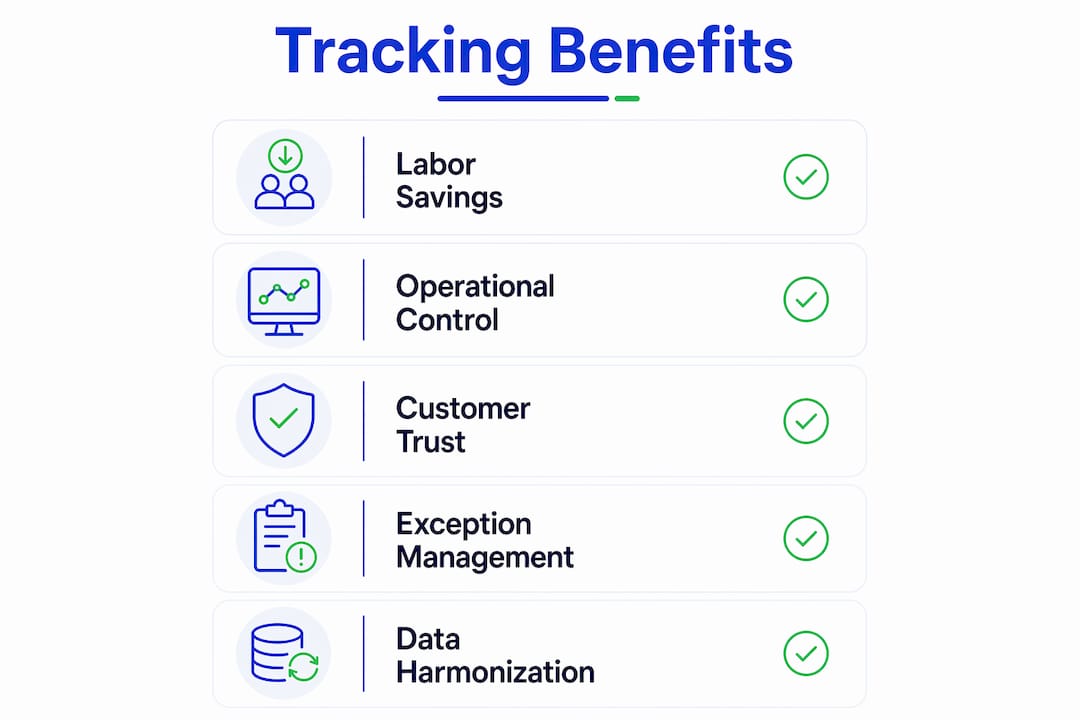
Data harmonization is the process that makes all of this usable. Without it, you have GPS pings from one carrier, barcode scans from another, and ELD data from a third, all in different formats with no common reference point. Effective systems aggregate, standardize, and integrate tracking data from multiple carriers and legacy systems into one central platform. That single view is what transforms raw data into decisions.
Pro Tip: When evaluating any tracking platform, ask vendors specifically how they handle data harmonization across carriers with different API formats. A platform that cannot normalize data from your top five carriers will create more work, not less.
What are the key benefits of real-time shipment tracking?
The benefits of real-time shipment tracking fall into three categories: labor savings, operational control, and customer trust. Each one compounds the others.
Labor savings through eliminated check calls
The primary ROI of real-time tracking is the drastic reduction in manual labor, specifically the elimination of “check calls” to carriers. A check call is when a dispatcher phones a driver or carrier to ask where a load is. In high-volume operations, teams make dozens of these calls per day. Real-time tracking removes that need entirely. Dispatchers see live location data on a dashboard instead of waiting on hold.
Operational control through automated exception alerts
Automated exception alerts notify all relevant parties immediately when a load deviates from its planned route or falls behind its scheduled delivery window. That immediacy is the difference between a manageable delay and a missed appointment. When a shipment falls two hours behind schedule, the system flags it automatically. Your team can reroute, notify the receiver, or adjust the appointment window before the problem escalates.
Integrating appointment windows with real-time ETAs allows systems to flag shipments as early, on time, or late without manual calculation. This is a significant operational shift. Instead of a coordinator manually comparing scheduled versus actual arrival times across 50 loads, the system does it continuously and surfaces only the exceptions that need human attention.
Customer trust through transparency
Real-time tracking reduces “Where Is My Order” (WISMO) queries and builds brand trust by giving customers timely, accurate updates. Fewer inbound inquiries mean your customer service team spends less time answering status questions and more time solving real problems. Proof-of-delivery confirmation with timestamp and electronic signature capture closes the tracking loop at delivery and can trigger immediate invoicing. That single automation accelerates your cash cycle.
How does real-time tracking improve exception management?
Exception management is where real-time tracking delivers its sharpest operational advantage. The difference between periodic status updates and continuous data streams is not just speed. It is the ability to act before a problem becomes a crisis.
Traditional tracking depends on scheduled status updates; real-time tracking provides continuous updates that allow earlier detection and intervention. A shipment that checks in every four hours could be sitting at a customs hold for three of those hours before anyone knows. A real-time system surfaces that hold within minutes.
The downstream impact of early exception detection reaches far beyond the logistics team:
- Customer service teams can proactively notify receivers before they call in, turning a potential complaint into a demonstration of reliability.
- Receiving and warehouse teams can adjust dock schedules and labor allocation based on accurate, live ETAs rather than guesses.
- Production teams relying on just-in-time components can activate contingency inventory or adjust line schedules before a delay causes a stoppage.
- Finance teams gain accurate accrual data because they know exactly when shipments arrive and when invoicing should trigger.
Real-time shipment tracking gives teams a current view of freight movement rather than delayed snapshots, fundamentally changing how teams manage risk. Centralized dashboards that display all active loads simultaneously make this possible at scale. A logistics manager monitoring 200 active shipments cannot manually track each one. A dashboard that surfaces only the exceptions requiring attention makes that workload manageable.
Pro Tip: Set exception alert thresholds based on your specific appointment windows, not generic industry defaults. A 30-minute delay threshold works for a distribution center with tight dock schedules. A 4-hour threshold may be appropriate for bulk freight with flexible receiving windows.
What are common challenges in real-time shipment visibility setup?
Setting up real-time shipment visibility is not a plug-and-play exercise. The technology is mature, but the integration work is where most implementations stall.
The table below compares the two most common approaches logistics teams take when building out their tracking infrastructure.
| Approach | Data coverage | Integration complexity | Best suited for |
|---|---|---|---|
| Carrier-native tracking portals | Limited to each carrier’s own network | Low per carrier, high in aggregate | Small operations with 1–3 carriers |
| Centralized TMS with data harmonization | All carriers in one unified view | High upfront, low ongoing | Mid-to-large operations with multimodal freight |
The carrier-native approach is faster to start but creates fragmentation. Your team ends up logging into five different portals to get a complete picture of the day’s freight. The centralized TMS approach requires more upfront integration work but delivers a single source of truth that scales with your operation.
The most common integration challenges include:
- Disparate data formats. Carriers use different APIs, EDI standards, and update frequencies. A TMS must normalize all of these into a consistent data model.
- Legacy carrier systems. Not every carrier offers real-time GPS tracking. Some still provide only milestone-based updates at pickup, in-transit, and delivery. Your platform needs a strategy for these gaps.
- Team adoption. A dashboard is only useful if your team uses it. Training coordinators to trust automated alerts rather than defaulting to check calls is a behavioral change, not just a technical one.
- Multimodal complexity. Air, ocean, and road freight each have different tracking data sources and update cadences. A platform built only for road freight will struggle with container visibility on ocean lanes.
Freightsuite addresses this directly through its operations team capabilities, which include native air and ocean tracking alongside road freight, all within a single TMS. That multimodal coverage eliminates the need to stitch together separate platforms for each freight mode.
Key Takeaways
Real-time logistics tracking delivers its greatest value not from GPS data alone, but from the integration and harmonization of that data into a single platform that enables proactive exception management across every freight mode.
| Point | Details |
|---|---|
| Core definition | Real-time tracking is continuous live monitoring of shipment location and status using GPS, RFID, ELD, and TMS integration. |
| Primary ROI driver | Eliminating manual check calls to carriers frees logistics teams for higher-value supply chain work. |
| Exception management advantage | Automated alerts flag delays and route deviations immediately, enabling intervention before problems escalate. |
| Data harmonization is mission-critical | GPS data alone is insufficient; standardizing multi-carrier data into one platform is what creates actionable visibility. |
| Implementation best practice | Centralized TMS platforms with multimodal support outperform carrier-native portals for operations managing diverse freight. |
Why real-time tracking is about data, not just dots on a map
The most persistent misconception I encounter is that real-time logistics tracking is essentially GPS. Logistics managers invest in a tracking tool, see a map with moving dots, and consider the job done. The dots are the least interesting part.
The real transformation happens in the data layer. When you harmonize tracking feeds from 15 carriers, normalize their different update formats, and connect that data to your appointment windows and customer commitments, you get something qualitatively different from a map. You get a decision engine. The system tells you which of your 200 active shipments needs attention right now, and why.
The shift from reactive to proactive logistics management is not a technology upgrade. It is an operational maturity upgrade. Teams that make this shift stop spending their day answering “where is my shipment?” questions and start spending it on the exceptions that actually require judgment. That is where the labor savings compound into something strategic. Headcount that was absorbed by check calls and manual status updates gets redirected toward carrier relationship management, rate negotiation, and process improvement.
My advice to logistics managers evaluating tracking solutions: do not evaluate the map. Evaluate the exception management workflow. Ask how the platform handles a carrier that only provides milestone updates. Ask how it surfaces the three loads that need attention out of the 200 active ones. Ask how it connects to your TMS data so that a delay automatically updates the downstream appointment. Those answers tell you whether you are buying a visibility tool or a decision support system.
— Annabel
How Freightsuite supports live freight visibility
Freightsuite is built as an Agentic TMS with air freight tracking, ocean freight visibility, and road freight management integrated natively into a single platform. Logistics managers get a unified dashboard that pulls tracking data from multiple carriers, normalizes it, and surfaces exceptions automatically through AI-driven workflows. There are no separate portals to log into and no manual data reconciliation.

Freightsuite’s automation layer handles exception alerts, ETA comparisons, and proof-of-delivery confirmation without manual intervention. If you manage multimodal freight and want to see how a purpose-built Agentic TMS handles real-time visibility at scale, book a demo to see the platform in action.
FAQ
What is real-time logistics tracking?
Real-time logistics tracking is the continuous monitoring of shipment location and status using GPS, RFID, ELD, and TMS integration, with live updates typically every 5–15 minutes. It gives logistics teams accurate, current data on every active load in the network.
How does real-time tracking differ from standard shipment tracking?
Standard tracking provides scheduled milestone updates at pickup, in-transit, and delivery. Real-time tracking delivers continuous data streams that allow teams to detect and act on delays, route deviations, or customs holds within minutes rather than hours.
What is the biggest operational benefit of real-time shipment tracking?
The largest ROI driver is the elimination of manual check calls to carriers, which frees logistics teams from repetitive status inquiries and redirects that time toward higher-value supply chain work.
What does data harmonization mean in logistics tracking?
Data harmonization is the process of aggregating and standardizing tracking data from multiple carriers and systems into one central platform. Without it, GPS data from different sources cannot be compared or acted on consistently.
What technology does real-time logistics tracking use?
Real-time logistics tracking uses GPS for live location, RFID and barcode scanning for checkpoint confirmation, IoT sensors for cargo condition monitoring, ELDs for driver and vehicle data, and a TMS to integrate and display all data in one place.

