Logistics: 9 Step Auditable API Checklist for Carrier Rate Shopping
Carrier rate shopping is the automated process of comparing multiple carrier services and pricing structures in real time to select the best option for each shipment, and its chief benefit is a lower delivered cost per parcel or load without breaking transit or service commitments. It relies on rate-shopping APIs, routing guides, and platforms that turn this comparison into a repeatable, auditable workflow rather than a manual chore.
TL;DR:
- Automated rate shopping is essential for accurately comparing negotiated carrier rates across multiple modes and lanes to ensure optimal shipment costs.
- Response times for checkout-level rate queries should be under two seconds to prevent cart abandonment, with larger batch processes tolerating slightly longer delays.
- Successful implementation requires thorough auditing, proper integration, and regular review of business rules, with pilot testing on high-volume lanes to ensure accuracy.
- Maintaining current negotiated rate tables, validating addresses, and enforcing routing policies help prevent discrepancies and compliance issues.
- Poor data accuracy, such as DIM-weight errors or outdated service mappings, remains a common obstacle, and standardizing inputs improves comparison reliability.
Table of Contents
- What carrier rate shopping is and its core variants
- How rate shopping works technically: APIs, inputs, and ranking
- Key components and features to expect from rate-shopping software
- Benefits and measurable KPIs
- Implementation checklist and rollout plan
- Operational controls, audit trail, and exception handling
- Common pitfalls and quick fixes
- Comparison of leading carrier rate shopping tools/platforms in the market
- Legal and compliance considerations related to carrier contracts and rate shopping
- Impact of carrier rate shopping on customer service and delivery performance metrics
- Strategies for continuous optimization using carrier rate shopping data
- Best practices for data accuracy and input standardization to ensure reliable rate comparisons
- How FreightSuite addresses rate shopping needs and suggested next steps
- Primary documentation and industry explainers to read next
- Sources
- FAQ
What carrier rate shopping is and its core variants
Manual rate gathering means a coordinator calling or logging into three or four carrier portals, copying numbers into a spreadsheet, and picking whichever looks cheapest that day. It is slow, inconsistent, and rarely accounts for surcharges or service-level requirements. Automated rate shopping replaces that with software that queries carriers simultaneously and returns a ranked answer in seconds, as Parcel Perform’s glossary describes it.
The mechanics differ depending on where the comparison happens and what is being shipped.
- Checkout-level shopping shows a customer live rate options at the point of sale, often for e-commerce parcels.
- TMS or OMS rate engines run the comparison internally, after order creation, weighing negotiated rates and business rules the customer never sees.
- Multi-modal shopping spans parcel, less-than-truckload, and full-truckload lanes, each with its own rate structure and carrier pool.
Most operations trigger rate shopping at order time, again during pick and pack if dimensions change, and on a schedule for planned truckload moves. Getting the trigger point right matters as much as the comparison logic itself.
How rate shopping works technically: APIs, inputs, and ranking
Underneath the interface, rate shopping is a request-response pattern built on a handful of consistent inputs and a scoring step. Get the inputs wrong and the ranked results will look clean but mislead the person booking the shipment.
- Inputs: origin and destination, weight, dimensions, package type, service constraints such as delivery date, and a negotiated-rate table specific to the shipper.
- API call: a request, commonly a POST to a rate or quote endpoint, carries those inputs to one or more carrier connectors or to an aggregator that queries several carriers at once, as ShipStation’s rate-shopping documentation shows with its rates examples.
- Response: the endpoint returns an array of quotes, each carrying carrier name, service level, price, and estimated transit time.
- Ranking: the engine scores those quotes against cost, transit time, carrier reliability, and routing guide compliance, then surfaces the winner.
- Selection: the system either books automatically or presents the top option for approval, depending on how much automation the business rules allow.
Aggregator APIs like the one Easyship documents can return many carrier services and a landed cost figure in a single call, which shortens the integration work considerably compared to connecting to each carrier separately.
Response time matters more than most teams expect. A checkout-facing rate shop needs to return in well under two seconds to avoid cart abandonment, while a batch TMS process comparing dozens of shipments can tolerate longer windows measured in several seconds per shipment.
Pro Tip: Ask any rate-shopping vendor for their p95 response time under peak load, not just their average, since averages hide the slow outliers that stall your warehouse floor.
Key components and features to expect from rate-shopping software
Scoping a build or a vendor evaluation gets easier once you know which pieces actually do the work. The rate engine sits at the center, but it depends on everything around it.
- Rate engine and carrier connectors that pull live pricing from each contracted carrier or through an aggregator API.
- Negotiated-rate tables that apply your specific contract pricing rather than public list rates.
- Routing guide enforcement with override reason codes and an approval flow for exceptions.
- A business-rule engine that handles spend caps, service-level filters, and lane-specific logic.
- Carrier coverage spanning both national carriers and regional players, plus support across parcel, LTL, and truckload modes.
- Audit logging and quote persistence, tied into your order management system, warehouse management system, label generation, and accounting software.
Skip any one of these and the gap shows up later, usually as a finance reconciliation problem or a routing guide that nobody actually follows.
Benefits and measurable KPIs
The payoff from rate shopping shows up in a short list of numbers worth tracking from week one: average cost per shipment, routing guide compliance rate, rate-shop latency, invoice variance against the quoted rate, and surcharge ratio as a share of total spend.
- Lower average cost per shipment, achieved by consistently picking the cheapest option that still meets the SLA.
- Less manual work, since coordinators stop calling carriers or juggling spreadsheets.
- Higher routing guide compliance, because the system enforces the policy instead of relying on memory.
- Fewer invoice mismatches, since the quoted rate is stored and compared against the bill.
Surcharges now make up roughly a third to over 40% of billed parcel spend, which means a rate comparison that ignores accessorials and residential fees is comparing the wrong numbers entirely.
Savings scale with how many carriers are in the comparison and how much volume runs through it. A shipper comparing three carriers captures the obvious wins, but the fourth carrier often wins in the lanes and weight tiers the other three do not, according to OmniOrders. Higher shipment volume also means more opportunities for automated selection to outperform a manual process, since consistency compounds over thousands of shipments in a way it never does over a handful.
Implementation checklist and rollout plan
Getting from decision to production without breaking anything follows a fairly predictable sequence, and skipping steps is the most common reason rollouts stall.
- Audit current spend: export shipping history, segment it by weight, zone, and carrier, and flag the lanes where multiple carriers compete for the same volume.
- Choose the integration path: connect directly to carrier APIs or route through an aggregator, depending on how many carriers you use and how much engineering time you can spend.
- Ingest negotiated rates: load your actual contract pricing so comparisons reflect real costs, not published list rates.
- Map service codes: align each carrier’s service names to your internal categories so “ground” means the same thing everywhere.
- Validate addresses: bad address data produce bad DIM-weight and zone calculations before the rate comparison even starts.
- Define business rules: set spend caps, service-level filters, and routing guide policies, along with the override workflow for exceptions.
- Run a sandbox test: verify the API responses and ranking logic against known shipments before anything touches live volume.
- Pilot on selected lanes: choose a handful of high-opportunity lanes, run them in parallel with the old process, and compare quoted rates against actual invoices.
- Expand and iterate: widen the rollout once the pilot lanes show consistent accuracy and adjust rules as edge cases surface.
Most teams can move from audit to a working pilot within a few weeks, with full production rollout following once the pilot lanes show consistent invoice matching.
Pro Tip: Pilot on your highest-volume, most contested lanes first. That is where rate shopping pays for itself fastest and where discrepancies are easiest to spot.
Operational controls, audit trail, and exception handling
Rate shopping without governance turns into a compliance headache the first time finance asks why an invoice does not match the quote. The fix is a control matrix that treats every quote as a record, not a disposable number.
- Persist the quoted rate and tie it to the shipment record, since it is the figure finance needs for accrual and reconciliation, a point Rivane’s rate-shopping guidance treats as essential rather than optional.
- Require override reason codes whenever a booking departs from the routing guide, with an approval step for anything above a defined cost threshold.
- Log the full request and response, not just the selected quote, so disputes and audits have something to point to.
- Define retry, timeout, and error-handling behavior up front, since a carrier API failing silently mid-quote is how shipments end up booked at the wrong rate or not booked at all.
A data model that moves shipments through clear states, from pending to quoted to selected to booked, with each transition logged and each override explained, closes most of the audit gaps that surface during a finance review.
Common pitfalls and quick fixes
A handful of mistakes account for most of the friction teams hit after go-live, and each one has a straightforward fix.
- DIM-weight errors: measure the actual dimensional impact on your top SKUs and prioritize repackaging where it changes the winning carrier.
- Ignoring surcharges: compare total landed cost, including residential and peak surcharges, not just the base rate.
- Missing regional carriers: audit lane coverage and add regional connectors where the volume justifies the integration work.
- Over-automation without controls: start with conservative business rules and expand automation only after the override rate settles down.
Pro Tip: Review your override log monthly during the first quarter. A rising override rate usually means a business rule needs adjusting, not that the rule should be ignored.
Comparison of leading carrier rate shopping tools/platforms in the market
The market splits into three rough categories. Parcel-focused aggregators, documented by providers such as Easyship and ShipStation, connect to dozens of carrier services through a single API and suit e-commerce shippers who need fast, checkout-friendly quotes. Freight-focused platforms extend the same logic into LTL and truckload, where negotiated rates and routing guides carry more weight than a simple price comparison. Full transport management systems fold rate shopping into a broader operational layer that also handles booking, tracking, finance, and document automation, which matters once a shipper outgrows a standalone rate tool and needs the comparison tied to accrual, invoicing, and carrier performance data in one place.
Choosing between this depends less on brand names and more on where the volume sits. A parcel-heavy e-commerce operation gets most of its value from a lightweight aggregator. A freight forwarder juggling ocean, air, and road contracts across multiple carriers needs the comparison embedded in a system that also manages contracts, tracking, and finance, since a standalone rate tool eventually becomes another disconnected spreadsheet. One example in this second category is a transport management system with rate management, carrier connectors, and audit logging built in natively rather than bolted on, which is the direction most freight forwarding operations move toward as their carrier mix and compliance requirements grow.

Legal and compliance considerations related to carrier contracts and rate shopping
Carrier contracts carry terms that a rate-shopping engine has to respect, not just reference. Negotiated rate tables typically include minimum volume commitments, and consistently routing shipments to the cheapest carrier in the short term can quietly violate a volume commitment that was priced into a better rate elsewhere. Reviewing contract terms alongside your business rules avoids that trap.
Accessorial and surcharge terms also vary by contract, and a rate engine that pulls list-rate surcharges instead of the negotiated version will misprice comparisons in ways that only show up when the invoice arrives. Storing the quoted rate at booking time, as covered earlier, gives you the paper trail needed to dispute a mismatched invoice or demonstrate compliance during a carrier audit.
Data handling deserves attention too. Rate requests carry shipment details, and depending on your carrier agreements and the regions you operate in, there may be requirements around how that data is transmitted and stored. None of this replaces legal counsel reviewing your specific carrier agreements, but building override approvals and audit logs into the rate-shopping workflow from the start makes any later compliance review considerably less painful.
Impact of carrier rate shopping on customer service and delivery performance metrics
Rate shopping affects more than the invoice line. Choosing a carrier purely on price without weighing transit time and reliability can push more shipments toward slower or less consistent services, which shows up later as late deliveries and increased customer service tickets. That is why a rate engine that ranks on cost alone, without routing guide enforcement and transit constraints, tends to backfire even when it technically saves money.
A well-tuned system holds transit time and service-level requirements as hard constraints, then optimizes cost within them, so the customer experience does not erode while spend drops. Tracking on-time delivery rate alongside cost per shipment keeps both goals visible instead of letting one quietly undermine the other. Carrier reliability scoring, factored into the ranking logic, also helps steer volume away from carriers with a pattern of delays even when their quoted price looks attractive.
The net effect, done right, is that customers notice nothing has changed except that shipments still arrive when promised, while the shipping budget tells a different story. Getting the balance wrong, on the other hand, shows up quickly in support tickets and delivery complaints, which is a signal worth watching in the weeks after any rate-shopping change goes live.
Strategies for continuous optimization using carrier rate shopping data
Rate shopping generates a steady stream of data that most teams under-use once the initial rollout is done. Every quote, selection, and override is a record of how carriers actually perform against your specific lanes and volume, not just their advertised pricing.
Reviewing override logs on a regular cadence surfaces where business rules no longer match reality, whether that is a carrier whose service has degraded or a lane where a regional carrier now beats the incumbents. Comparing quoted rates against final invoices over time also reveals which carriers consistently bill above their quote, information worth bringing back into contract renegotiations. Feeding carrier performance data, including on-time rates and dispute frequency, back into the ranking logic keeps the system tuned to how carriers actually behave rather than how they behaved when the rules were first written.
Seasonal and volume shifts change which carrier wins too. A carrier that is competitive at low volume may lose ground once peak season surcharges kick in, so revisiting rate-shopping rules ahead of peak periods rather than reacting mid-surge tends to protect margins better. Treating the rate-shopping engine as a living system that gets reviewed quarterly, rather than a one-time setup, is what separates the teams that keep capturing savings from the ones that see an initial win and then watch it erode.
Best practices for data accuracy and input standardization to ensure reliable rate comparisons
A rate comparison is only as good as the inputs feeding it, and most accuracy problems trace back to inconsistent data rather than a flawed ranking algorithm. Standardizing package dimensions and weight capture at the point of packing, rather than relying on estimated or default values, removes one of the largest sources of DIM-weight miscalculation.
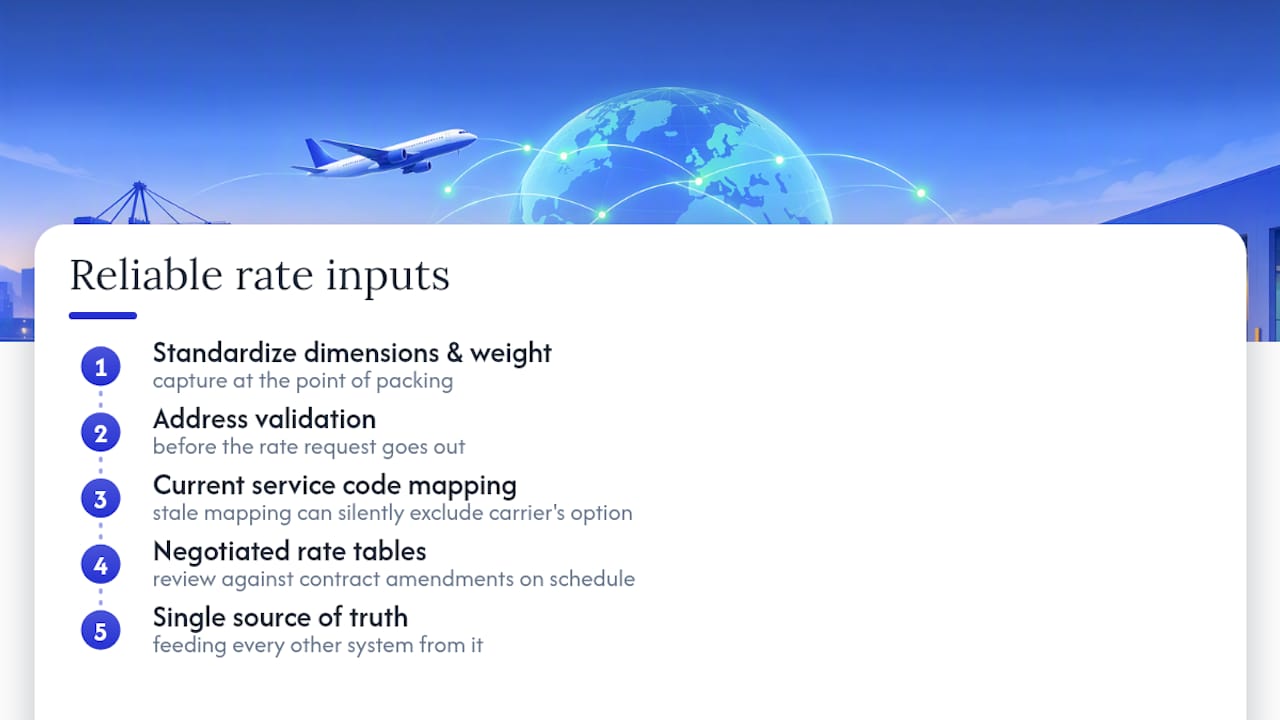
Address validation before the rate request goes out prevents zone-based pricing errors that only surface after the shipment has already moved. Keeping service code mappings current matters just as much, since carriers periodically rename or restructure service tiers, and a stale mapping can silently exclude a carrier’s best option from the comparison. Negotiated rate tables need the same discipline: reviewing them against actual contract amendments on a set schedule, rather than assuming they are still accurate months after the last update, keeps the comparison honest.
Consistency across systems matters as much as accuracy within any single one. When the order management system, the warehouse system, and the rate engine each store weight or dimension data slightly differently, the rate comparison inherits whichever version arrived last, which is rarely the correct one. Establishing a single source of truth for shipment attributes, and feeding every other system from it, is the standardization step that quietly fixes most of the downstream rate accuracy complaints.
How FreightSuite addresses rate shopping needs and suggested next steps
Freight forwarders juggling ocean, air, and road contracts need rate shopping tied to the rest of the operation, not sitting off to the side in a separate tool. Some transport management systems bring rate management, carrier contract handling, and AI-driven business rules together natively, alongside audit logging that stores every quoted rate for accrual and reconciliation.

- Faster rate-shop times across multi-modal lanes, since carrier connectors and negotiated rates often live inside the same system used for booking and finance.
- Stronger routing guide compliance, enforced automatically rather than tracked in a spreadsheet.
- Stored quoted rates, ready for finance to reconcile against invoices without chasing down a separate audit trail.
If your team is ready to see this in practice, request a demo of FreightSuite, run a pilot on your highest-volume lanes, or export a 90-day shipping audit to baseline what rate shopping could save before committing to a rollout.
Primary documentation and industry explainers to read next
- ShipStation’s rate-shopping API documentation for endpoint examples.
- Parcel Perform’s glossary entry for foundational definitions.
- FreightSuite’s guide to carrier contract management for negotiated-rate ingestion.
Sources
- What is Rate Shopping? | Parcel Perform Glossary
- Rate Shopping
- Carrier Rate Shopping and Carrier Selection at Shipment Creation | Rivane ERP Use Cases
- Complete Guide To Parcel Audit In 2026 - ShipScience
- Shipping Rates API: Compare & Calculate Multi-Carrier Shipping Quotes
FAQ
Which carrier has the lowest shipping rates?
No single carrier is consistently the cheapest across every lane, weight, and service level, which is exactly why rate shopping exists. The winning carrier shifts by zone, package dimensions, and surcharge structure, so automated comparison across your contracted carriers finds the cheapest option for each specific shipment rather than assuming one carrier wins every time.
What is a carrier rate?
A carrier rate is the price a shipping carrier charges to move a specific shipment, based on factors like weight, dimensions, origin, destination, and service level. It can reflect either the carrier’s published list price or a negotiated rate specific to a shipper’s contract, and accurate rate shopping always compares the negotiated version.
How much does it cost to ship 1,000 pounds?
The cost depends heavily on mode, distance, and service level, since a shipment could move as a single LTL pallet or as multiple parcels, each priced differently. Rather than a fixed figure, shippers get an accurate answer by running the shipment’s actual weight, dimensions, and destination through a rate comparison against their contracted carriers.
What does “carrier” mean in shipping?
In shipping, a carrier is the company that physically transports a shipment, such as a parcel service, trucking company, or freight line. The term applies across parcel, LTL, truckload, and freight forwarding, and it is distinct from a broker or forwarder, who arranges transport but does not move the freight itself.

