Prove Email Parsing in Days: 200–500 Email Pilot for Logistics Ops
A well-built logistics email parser pulls core shipment fields, origin, destination, weight, dimensions, dates, and commodity, out of inbound messages, validates them against a schema, and pushes clean records into your systems without a human retyping anything. Done right, teams see high extraction accuracy on structured fields and a direct integration path into a TMS, as platforms like FreightSuite demonstrate. The rest of this piece is a pilot-to-rollout playbook for getting there.
TL;DR:
- High extraction accuracy relies heavily on proper normalization of units, location codes, and schema validation, often achieving over 90% accuracy with combined LLM and deterministic processing.
- Handling exceptions effectively, with confidence thresholds above 90% for auto-acceptance and review queues for lower confidence, helps maintain trust and efficiency in the parsing system.
- Carrier-specific email layout variations demand layout-agnostic extraction methods, as reliance on fixed templates can break with template changes or new carriers.
- A short, targeted pilot with 200 to 500 emails validates accuracy before expanding, using key fields like origin, destination, and weight to measure improvements and reduce manual entry.
- Full control over ongoing monitoring, including metrics such as exception rates and downstream errors, is essential to sustain accuracy as carrier formats evolve over time.
Table of Contents
- What logistics email parsing covers: core fields and common message types
- The parsing pipeline: monitor, classify, extract, normalize, validate, push
- Normalization and validation: units, locations, codes, and schema checks
- Handling attachments, images, and messy threads
- Confidence thresholds and exception handling
- Pilot and rollout plan: testing on your inbox first
- Evaluation checklist: choosing or building a parser
- How FreightSuite implements parsing and TMS integration
- Handling ambiguous or incomplete data in emails
- Privacy and compliance considerations for parsing logistics emails
- Adapting parsing models to different carriers’ email formats
- Automated error correction and feedback loops
- Performance metrics and monitoring accuracy over time
- If you want a completed solution: how FreightSuite can help
- Sources
- FAQ
What logistics email parsing covers: core fields and common message types
Freight moves on email, and every rate request, booking confirmation, or proof of delivery carries a different mix of data. Before building or buying a parser, define the scope. Trying to extract everything at once is how pilots fail.
Start with the fields that drive quoting and booking decisions, since those carry the most immediate return:
- Origin and destination (city, postal code, and port or airport code where relevant)
- Weight and dimensions, plus commodity description and equipment type
- Service level, required pickup and delivery dates, and any accessorials (liftgate, inside delivery, hazmat)
- HBL, MBL, and incoterms when the shipment is international
Message types shape which of these fields actually show up. A rate request usually front-loads origin, destination, weight, and service level. A proof of delivery centers on dates and signatures. A carrier capacity email might only confirm equipment availability and a lane. Booking confirmations sit somewhere in between, referencing a prior quote while adding dates and references. A pilot that targets a short, high-value field list for one message type at a time holds accuracy steady while the team learns where extraction breaks.
The parsing pipeline: monitor, classify, extract, normalize, validate, push
A reliable pipeline separates what artificial intelligence is good at from what deterministic code is good at. One practical workflow, documented in a freight quote parsing case study, breaks into six steps that most logistics teams can replicate:
- Monitor the shared quote or booking mailbox for new inbound messages.
- Classify each email by type (quote request, POD, booking confirmation) since downstream logic depends on it.
- Extract raw fields using a large language model tuned for freight terminology.
- Normalize those raw values with deterministic rules (unit conversion, port codes, incoterm lists).
- Validate the normalized record against a schema before it touches any other system.
- Push the finished record to a TMS, quote sheet, or downstream tool.
That workflow, laid out in Parabola’s freight quote email parsing use case, reflects a principle worth repeating: let the LLM handle the messy, variable language of an inbound email, and let fixed code handle anything that has one correct answer, like resolving a port name to its UN/LOCODE or converting pounds to kilograms. Mixing those two jobs inside one model invites inconsistent output.
Integration endpoints vary by team maturity. Some push extracted data through an API directly into a TMS, others start simpler with a CSV export or a Google Sheet, and some route exceptions to Slack for a quick human check before anything moves forward.
Pro Tip: Build your review step before you build your automation. If nobody knows what to do with a flagged exception, the parser will look worse than it is.
Normalization and validation: units, locations, codes, and schema checks
Extraction is only half the job. Raw output from an LLM might read “2,200 lbs” in one email and “1 t” in the next, and without a normalization layer, that inconsistency lands directly in your billing or routing system.
A few normalization tasks come up in nearly every freight email parsing project:
- Converting weight and dimension units to one canonical format (kilograms, centimeters, or your TMS’s preferred standard)
- Resolving port and city names to a fixed reference list, including UN/LOCODE mapping and fuzzy alias handling for misspellings or abbreviations
- Mapping freight class and incoterms to their canonical short codes rather than leaving free text in the record
Schema validation and confidence scoring close the loop. Each extracted field should carry a confidence score, and any field that fails schema validation, a nonexistent port code or an incoterm the list does not recognize, should be flagged rather than silently accepted.
A field accuracy figure worth anchoring to: an experimental freight email extractor combining LLM extraction with deterministic post-processing reached overall accuracy above 90%, with individual field accuracies spanning from the low eighties to complete accuracy for dangerous-goods flags. Deterministic normalization, not the LLM alone, drove the biggest gains in that project.
Handling attachments, images, and messy threads
Not every shipment detail lives in the email body. Rate confirmations often arrive as PDF attachments, packing lists show up as Excel files, and some carriers still send scanned images of a booking form.
A workable fallback order handles most of what lands in a freight inbox:
- Check the email body text first, since it is the cheapest and most reliable source
- Fall back to attachments (PDF, Excel) when the body is thin or references a document
- Use OCR for scanned images or non-searchable PDFs, and route to human review when OCR confidence is low
Thread isolation matters just as much as attachment handling. A forwarded chain with six replies buries the active quote block under old signatures and quoted history. Effective parsing identifies the newest reply, strips signature blocks and quoted sections, and isolates the live content before extraction even starts.
Template-based OCR breaks constantly in freight because every carrier formats its documents differently, and a layout shift can silently corrupt a whole field. Layout-agnostic, meaning-based extraction holds up better against that kind of drift. This is one reason legacy OCR tools keep needing manual retuning.
Confidence thresholds and exception handling
Automation only earns trust when it knows what it does not know. A practical threshold policy might auto-accept extractions above 90% confidence, route anything between 70% and 90% to a quick review step, and send anything below 70% to full manual handling.

That kind of tiered approach, consistent with confidence threshold patterns used in production logistics workflows, keeps a human in the loop exactly where the risk is highest, without slowing down the majority of messages that extract cleanly.
A few design choices make the exception queue fast rather than another backlog:
- Show the source email and the extracted value side by side so a reviewer confirms or corrects in seconds
- Group exceptions by field type (a bad port code review is different from a missing weight review)
- Track the queue size daily, since a growing backlog signals the confidence threshold needs retuning
Pro Tip: Measure time saved per processed message from day one. It’s the single number that justifies expanding the parser to more mailboxes.
The metrics worth watching long term are extraction accuracy by field, exception rate, time saved per message, and downstream errors prevented, since that last one is what finance and operations actually feel.
Pilot and rollout plan: testing on your inbox first
You do not need a quarter-long project to know whether email parsing works for your operation. A tight pilot answers the question in days.
- Pull a sample of 200 to 500 recent emails, a range consistent with pilot guidance for validating extraction accuracy before wider rollout.
- Define the core fields you will measure, no more than six or seven to start.
- Time how long manual entry currently takes for that same sample, as your baseline.
- Run automated extraction against the sample and compare results field by field.
- Review accuracy and note where exceptions cluster, whether by carrier, message type, or field.
Only after accuracy holds steady should you expand the field list, add new connectors, or train the exception queue on edge cases. Success shows up as fewer manual entry hours, a falling error rate downstream, and quotes that turn around faster than they did before the pilot began.
Evaluation checklist: choosing or building a parser
Whether you are shortlisting vendors or specifying an internal build, a short checklist keeps the evaluation grounded in what actually matters for freight.
- Freight-specific field accuracy, not generic email parsing benchmarks
- Thread isolation that correctly finds the active quote in a long forwarded chain
- Location and unit normalization built on a real reference list, not free text
- Connector options that match your stack (API, TMS, spreadsheet, Slack)
- Latency low enough to support same-day quoting
- Ongoing maintenance burden and who owns it when a carrier changes their template
- A pricing model that scales with your volume rather than penalizing growth
A few red flags are worth asking about directly in a demo: template-only OCR with no fallback, no clear normalization strategy for ports or units, confidence scores that are opaque or unexplained, and setups that require IT involvement for every new carrier format. Frameworks for evaluating enterprise automation tools, of the kind Gartner and AIIM publish for document and information management, offer useful structure for asking harder questions before signing a contract.
How FreightSuite implements parsing and TMS integration
FreightSuite is built as an agentic TMS, meaning AI agent orchestration and automation sit natively inside the platform rather than bolted on through a third-party add-on. Parsed shipment data flows through API integration directly into rate management, booking, and operations workflows, with the AI agent architecture handling the extraction-to-record step that would otherwise need a separate tool.
Because normalization and schema validation run inside the same system as booking and invoicing, parsed fields map straight into existing rate and finance workflows, an approach that also touches invoice and finance automation for teams handling high email volume. Deployment typically involves connecting the shared inbox, mapping fields to your existing TMS structure, and setting review expectations for exceptions from day one.
Handling ambiguous or incomplete data in emails
Freight emails are rarely complete. A shipper might send a weight without units, skip the destination postal code, or reference “the usual terms” instead of spelling out incoterms. A parser that guesses in these situations creates more cleanup work than it saves.
The safer pattern is to treat ambiguity as a signal, not a problem to paper over. When a field is missing or contradicts another part of the message, the system should flag it rather than fill in a default value silently. A shipment listed as “500 units” with no weight or dimension should route to review instead of triggering a rate calculation built on a guess.
Context recovery helps in some cases. If a customer has sent five prior shipments on the same lane with consistent packaging, a reasonable assumption can be proposed, but it should always surface as a suggestion a reviewer confirms, not as an auto-accepted fact. The deterministic normalization layer discussed earlier plays a direct role here too: explicit negation handling (recognizing when an email says a shipment is not hazardous, for example) prevents a parser from mislabeling a field it technically extracted but misunderstood.
The goal is not zero ambiguity. It is making sure ambiguous data never moves downstream disguised as certain data.
Privacy and compliance considerations for parsing logistics emails
Inbound freight emails often carry more than shipment details. Customer contact information, pricing terms, and sometimes payment references sit in the same thread as the weight and dimensions you actually need.
A parsing setup should extract only the fields required for the workflow it feeds, rather than ingesting and storing full email content by default. Retention policy matters here: keep raw emails only as long as needed for audit or dispute resolution, and be clear internally about who can access the review queue where source emails sit alongside extracted values.
Cross-border data handling adds another layer for freight forwarders operating across regions, since shipment emails often include customer and consignee information tied to different privacy frameworks depending on where the parties are located. Information-management frameworks from organizations like Gartner offer general guidance on governance for automated document processing, though the specific compliance obligations depend on your jurisdiction and your customers’ locations, and are worth confirming with counsel rather than assuming from general best practice.
Access control on the exception review queue deserves the same scrutiny as access to the TMS itself, since a reviewer correcting a parsed field is looking at the same sensitive content the original email carried.
Adapting parsing models to different carriers’ email formats
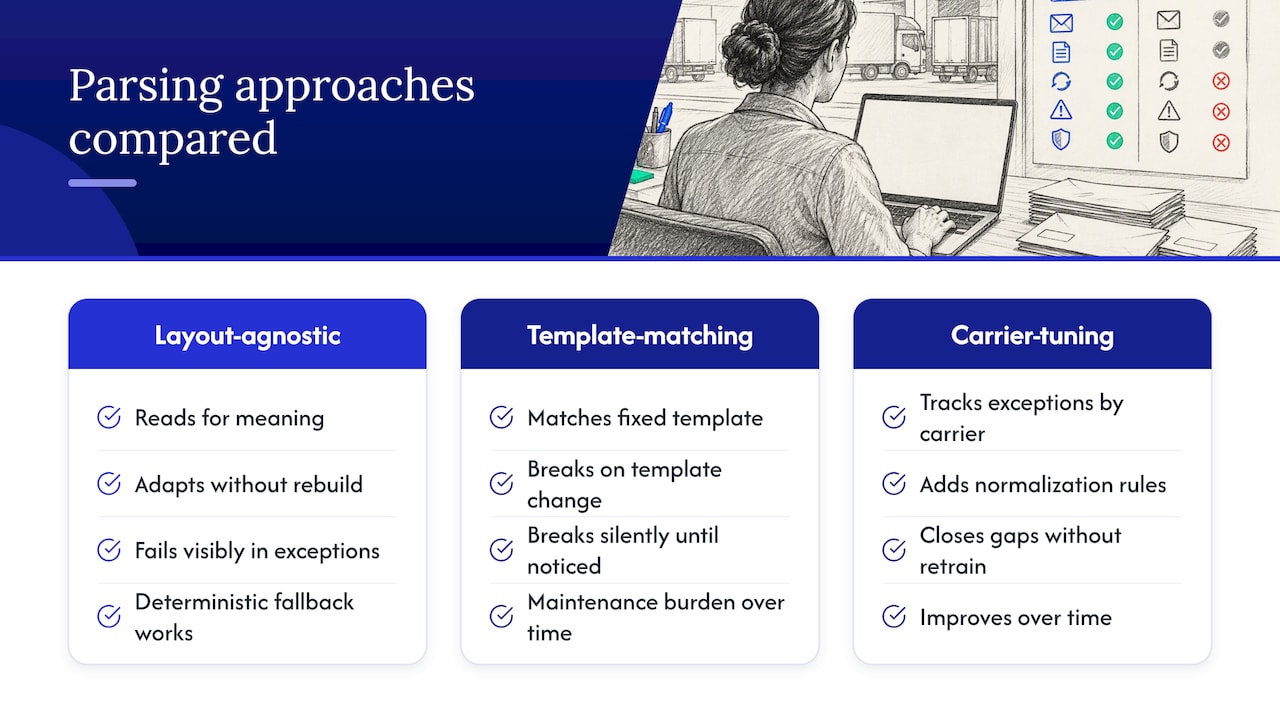
Every carrier writes emails differently. One ocean carrier might send a rate confirmation as a structured table, another as three paragraphs of prose with the weight buried in the second sentence. A parser tuned to one format will misfire the moment a new carrier or a template change enters the mix.
Layout-agnostic extraction, where the model reads for meaning rather than matching a fixed template, holds up better against this kind of variation than older template-matching OCR tools, which is a distinction background practitioner reports on freight automation keep coming back to. When a carrier changes their invoice layout, a meaning-based parser adapts without a rebuild, while a template-based tool breaks silently until someone notices.
That said, even a strong extraction model benefits from carrier-specific tuning over time. Tracking exception rates by carrier reveals patterns: maybe one air carrier consistently omits the service level, or a customs broker always references incoterms in a nonstandard abbreviation. Building a small library of carrier-specific normalization rules, sitting alongside the general deterministic layer, closes those gaps without retraining the whole extraction model.
The practical takeaway for an ops team evaluating this: ask any vendor how they handle a carrier that changes its email template overnight. A confident, specific answer about layout-agnostic extraction and deterministic fallback is a good sign. A vague answer about “custom templates” is a maintenance burden waiting to happen.
Automated error correction and feedback loops
A parser that never improves is a parser that will eventually fall behind carrier changes and edge cases it has not seen. Building a feedback loop from the exception queue back into the extraction and normalization logic is what keeps accuracy from decaying over time.
Every correction a reviewer makes in the exception queue is a data point. When a reviewer fixes a misread port code or corrects a weight unit, that correction should feed back into the deterministic mapping tables, not just fix the one record. Over time, this turns the alias list and port resolver into an asset that reflects your actual email traffic rather than a generic starting list.
For the LLM extraction layer itself, feedback loops work differently, since retraining a model on every correction is neither practical nor necessary for most teams. Instead, tracking which fields generate the most corrections points to where a prompt needs refining or where a deterministic override should catch a known failure pattern before it reaches a reviewer at all.
The open-source freight extraction work referenced earlier makes a related point: deterministic post-processing, not repeated model retraining, produced the more reliable and reproducible fixes for port code and normalization errors. That is worth internalizing before investing heavily in constant model fine-tuning. Fix the deterministic layer first, and save model-level changes for genuine extraction gaps the rules cannot cover.
Performance metrics and monitoring accuracy over time
Extraction accuracy on day one tells you almost nothing about whether a parser will hold up in month six. Carrier formats shift, new customers with unfamiliar terminology start emailing, and volume grows past what the initial pilot tested.
Four metrics are worth tracking on an ongoing basis rather than just during the pilot: field-level extraction accuracy, exception rate by carrier and field, time saved per processed message compared to the manual baseline, and downstream errors prevented, meaning mistakes that would have reached a rate sheet or invoice without the validation layer catching them.
Reviewing these numbers monthly, rather than only when something breaks, catches slow accuracy decay before it becomes a customer-facing problem. A steady rise in exceptions tied to one carrier usually means that carrier changed a template. A drop in confidence scores across the board can signal a broader issue with the extraction model rather than a single bad batch.
Operational research on automation consistently frames this kind of monitoring as necessary for sustained gains: automation delivers its productivity upside when it stays integrated with how the operations team already works, not as a one-time setup left unmonitored. Treating email parsing as a system that needs periodic review, the same way you would monitor any other production system, is what separates a pilot success from a tool that quietly degrades a year later.
If you want a completed solution: how FreightSuite can help
Building and maintaining an email parsing pipeline yourself means owning the extraction model, the normalization rules, and the integration work indefinitely. The TMS integrates parsed shipment data directly into rate management, booking, and operations workflows without the need for a separate tool to maintain.

Forwarders using FreightSuite get native AI agent orchestration built into the platform, with automation, tracking, and finance features included rather than sold as add-ons. If you handle ocean, air, or road freight and want to see how inbound email data could flow straight into your quoting and booking process, request a demo through FreightSuite to walk through your own inbox as the test case.
Sources
The sources behind this playbook were chosen for their direct relevance to freight email automation rather than general email parsing advice. Gartner and AIIM provide the information-management and document-processing frameworks that inform vendor evaluation and governance. The Lemex freight email extractor project supplies the field-level accuracy figures cited throughout, showing what LLM-plus-deterministic extraction achieves in practice. Parabola’s freight quote parsing workflow grounds the six-step pipeline in a real, implemented use case.
FAQ
What is email parsing?
Email parsing is the automated extraction of specific data fields from the text, attachments, or structure of an email, turning unstructured message content into structured records a system can use. In logistics, that means pulling shipment details like weight and destination instead of a person retyping them by hand.
What is a logistics email?
A logistics email is any inbound or outbound message tied to moving freight, including rate requests, booking confirmations, carrier capacity updates, and proof of delivery notices. Each type carries a different mix of shipment data, which is why classification is usually the first step in a parsing pipeline.
What is the best email parser for logistics?
There is no single best parser for every operation, since the right choice depends on your carrier mix, email volume, and existing TMS. Evaluate options against freight-specific field accuracy, deterministic normalization for ports and units, and how directly the output integrates with your TMS, as platforms like FreightSuite do natively.
How can I parse an email for freight data?
Start with a small pilot: pull 200 to 500 recent emails, define a short list of core fields like origin, destination, and weight, and run automated extraction against them while comparing results to manual entry. From there, add deterministic normalization for units and locations before expanding the field list or connecting the output to a TMS.

