Credit Hold Workflow for Freight Forwarders: Triggers to Release

A credit hold workflow is a written, system-enforced route that decides when a customer’s bookings, shipments or document releases stop, who can restart them, and what evidence they need. For a forwarder, the best version runs inside the TMS, where bookings, charges, invoices and receivables already live. It is not a spreadsheet that someone checks on Fridays. FreightSuite builds credit control and workflow customization natively into the TMS, so the rules in this article can be enforced at the moment a booking is created instead of discovered after the cargo has moved.
TL;DR
- Trigger holds by rule, not by feeling: an overdue invoice past a set number of days, an exposure above the credit limit, or a broken payment commitment.
- Decide in advance what a hold stops: new bookings, release of documents, or both. Document release is the strongest lever a forwarder has.
- Split roles: operations flags, credit reviews and consults sales, and a narrow group approves releases with a logged reason.
- Pause the trigger for disputed invoices and unapplied payments, and give urgent shipments a one-time, logged exception route.
- Record every hold, exception and release so you can audit the workflow and measure how long accounts stay blocked.
Table of Contents
- Why freight forwarders need a credit hold workflow
- What a credit hold can stop in freight forwarding
- Set triggers that are rules, not opinions
- Decide who places, reviews and approves
- Handle urgent shipments and disputes without breaking the rule
- Tell the customer clearly and promptly
- Release holds with evidence and a clear path
- Document everything so you can audit it
- Build the workflow inside your TMS
- FAQ
- Sources
Why freight forwarders need a credit hold workflow
Forwarders extend credit in an unusual way. You often pay the carrier, the airline, the trucker or the terminal before your customer pays you. Every day a shipment moves for an overdue account, your own cash is financing someone else’s business, and your margin on that file is smaller than the exposure on it.
The ground is shifting here because volumes and rates swing quickly, and exposure can climb faster than a monthly review can catch. A credit hold is the control that stops the climb. A credit hold is a block on an account that halts new orders or shipments on open terms until a credit condition is resolved. The block is only as good as the workflow behind it: the rule that triggers it, the people who can lift it, the message that goes to the customer and the record left behind.
Without those four pieces, holds become political. Sales argues, operations ships anyway, and finance finds out at month end. With them, a hold is a routine event that customers understand and your team executes the same way every time.
What a credit hold can stop in freight forwarding
Start by deciding which steps a hold actually blocks, because a forwarder has more choke points than a typical seller of goods.
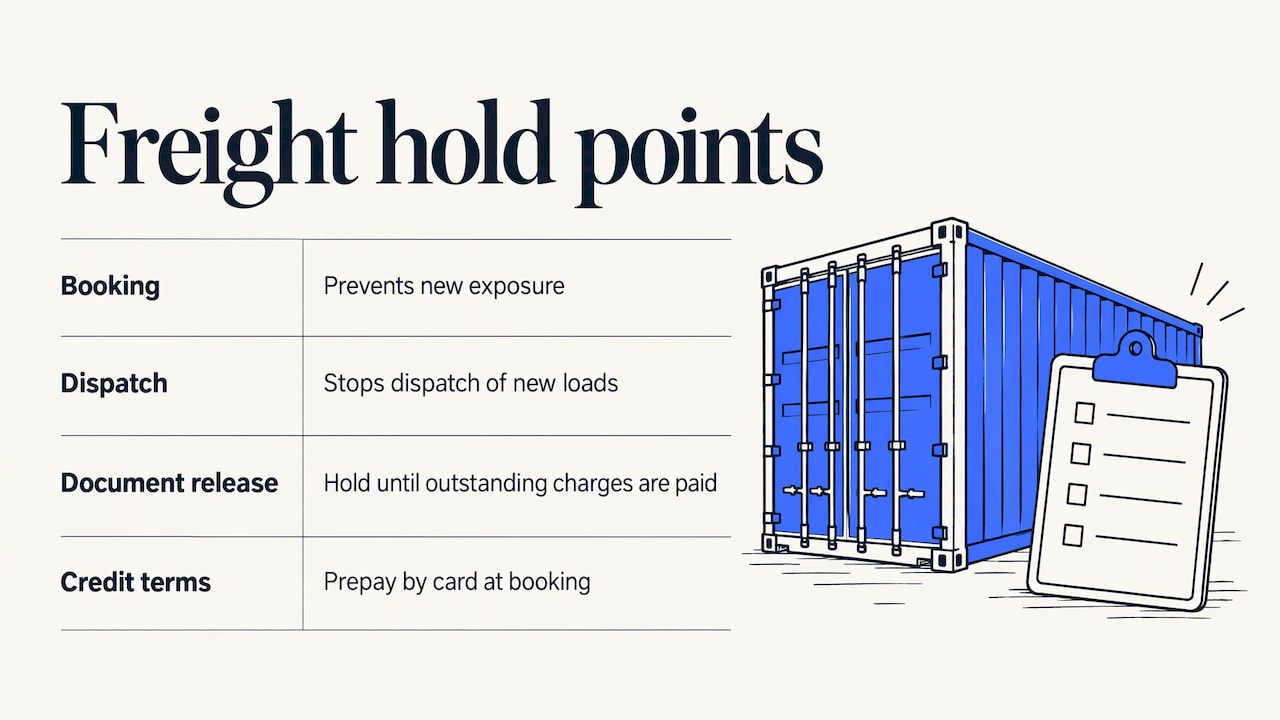
Booking and quoting. The earliest point is booking confirmation. Blocking here prevents new exposure from being created at all. Many carriers do this: XPO’s intermodal terms state that an account is placed on credit hold when satisfactory arrangements are not made on past due balances, and that customers without established credit privileges must pay by lockbox or wire transfer before transportation is arranged.
Pickup, dispatch and in-transit moves. A hold can stop dispatch of new loads. Stopping cargo already moving is a different and more delicate decision, covered below.
Document release. For ocean freight, the bill of lading is the leverage. Gateway Lines’ terms of service state that the carrier holds the Master Bill of Lading until full payment is received, and that it is not released until all outstanding charges are settled, even if the shipment has physically arrived. Forwarders can apply the same logic to their own house documents, delivery orders and customs paperwork, as long as the customer terms you agreed allow it.
Invoicing on credit terms. Some teams convert a held customer to prepayment: ExFreight’s credit terms, for example, require shipment charges for accounts without credit terms to be prepaid by credit card at booking. That is a useful template for your own fallback route.
One technical detail matters when you design this. Holds exist at two levels, the customer and the individual order. Syteline’s documentation notes that placing a customer on credit hold prevents shipments to that customer, while individual orders must be placed on hold separately. Decide in your workflow whether an account-level hold automatically catches open bookings, or whether each open file is reviewed one by one. Forwarders with many open files per customer usually want the automatic version with a review list for in-flight work.
Set triggers that are rules, not opinions
The trigger is the heart of the workflow. NACM, the National Association of Credit Management, names the common triggers as exceeding the credit line, being past due, or being inactive, and describes exception review for orders over the limit and for balances more than 30 days past due. NACM also notes that orders exceeding a customer’s limit signal a need for investigation and may justify halting shipments until the situation is resolved. Some companies add a per-order dollar cap, the amount that can be released without delay on any single order, as a second check.
For a forwarder, four trigger families cover most situations.
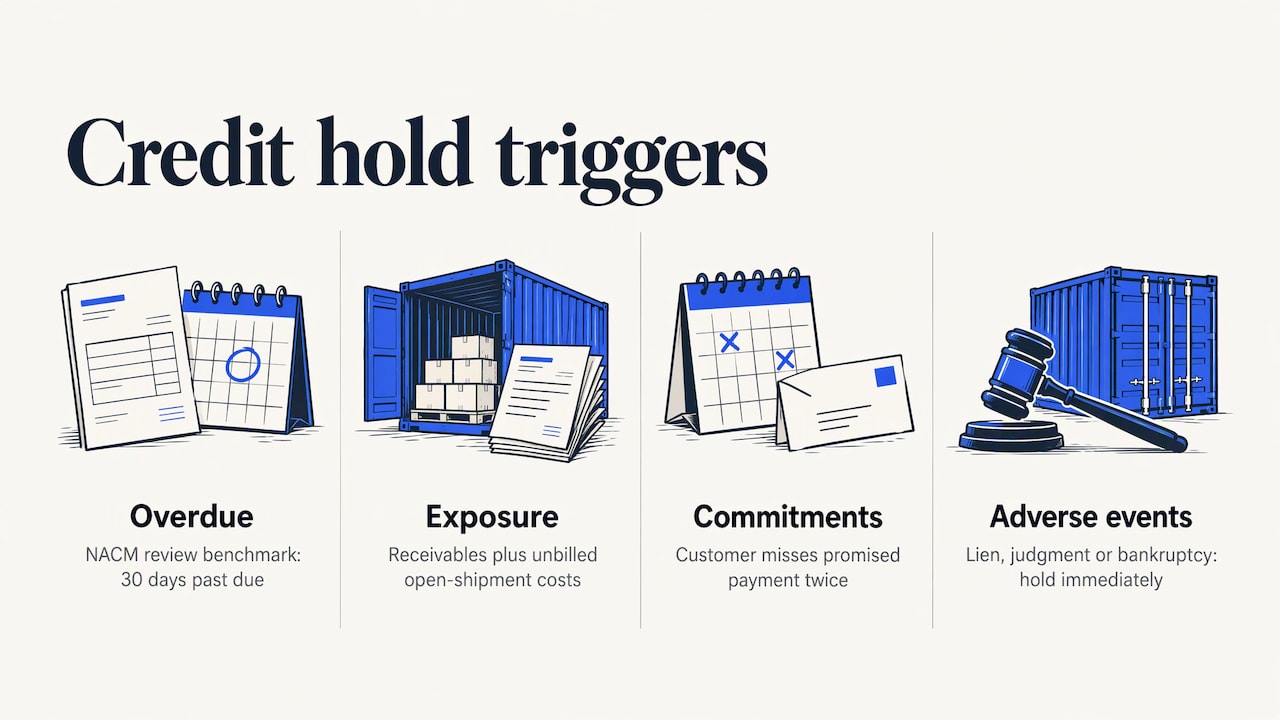
Overdue balance. Pick a number of days past the invoice due date. Thirty days past due is the benchmark NACM mentions for review, but your own number should reflect your terms, your customer mix and how fast you pay carriers. A forwarder paying ocean lines on seven-day terms cannot afford the same tolerance as a seller of goods with sixty-day supplier terms.
Exposure above limit. Exposure is not just what has been invoiced. It is the outstanding receivable balance plus the value of open work not yet invoiced. PointForce’s order-hold documentation describes this exact calculation: the receivable balance plus the shippable value of outstanding orders is compared to the credit limit, and if it is exceeded, the operator can modify, release with a password, or hold the order. In freight, the equivalent is unbilled costs and charges on open shipments, which is why a TMS that holds finance and operations in one record has an advantage over a separate accounting package.
Broken commitments. A customer who promises payment on a date and misses it twice tells you more than any score does. Define how many broken promises in what period trigger a hold.
Adverse events. News of a lien, judgment or bankruptcy filing should move an account to hold immediately, regardless of balance. In a bankruptcy, speed matters: NACM Commercial Services describes the trade creditor’s process as placing unshipped orders on hold and stopping shipments in transit by making demand on the carrier or other bailee before the buyer takes possession. This is a legal step, so involve your attorney the moment an adverse event appears.
There is also a useful middle zone. Rather than a single on or off switch, many teams define bands: within limit, near limit (alert only), over limit (finance approval needed) and overdue (account restricted). Near-limit alerts give account managers time to chase payment before a hold ever becomes necessary.
A practical test of your thresholds: run last year’s receivables through them. If the rule would have held accounts that always paid within a week of the cutoff, loosen it. If it would have missed the accounts that ended up as bad debt, tighten it.
Decide who places, reviews and approves
The fastest way to turn a credit hold into a fight is to leave the roles vague. NACM’s guidance is clear on sequence: customer service may spot accounts that need review, credit should review the account and consult sales before acting, and sales should be told immediately once a hold is in place.
Translated to a forwarding office, the division of work looks like this. Operations and customer service raise the flag, because they see the booking requests and hear the customer’s side first. Credit control or finance owns the decision, because they see the full balance. The account manager is consulted before the hold and notified at once after it, because they own the relationship and will take the call. A named senior person, a finance director or commercial director, owns exceptions above a set value.
The release side deserves even more discipline than the placement side. Keep the list of people who can override a hold short, name the roles explicitly, and require a stated reason for each override. If everyone in operations can release a hold to keep a customer happy, you do not have a hold, you have a suggestion.
Two principles protect the control. First, segregation of duties: the person who benefits from shipping, usually sales, should not be the sole person who approves the release. Second, approval should be tied to what was approved. If a customer is cleared to ship a container and the order is then changed to three containers, the approval should not silently stretch to cover it. Re-approve after material changes to the booking.
This is where a workflow engine earns its place. In FreightSuite, workflows can be customized and credit control sits alongside operations and finance in one platform, so the approval route can match your organization chart rather than a vendor’s default. Our guide to credit limit automation for freight forwarders walks through how limits and approvals connect.
Handle urgent shipments and disputes without breaking the rule
Every credit hold workflow is tested by the same three situations: a customer who disputes an invoice, a customer who has paid but the payment is not yet applied, and a customer with an urgent shipment who promises payment tomorrow. Plan them in advance so that the exception path is as defined as the hold.
Disputed invoices. NACM advises coding disputed past-due receivables so that they do not automatically trigger holds. The logic is sound: if a customer is current on everything except one invoice they have contested with a reason, holding the whole account punishes a good customer and damages the relationship. Make the dispute code a controlled field, with an owner and a resolution deadline, so that it cannot become a place to hide overdue debt. Clean documentation helps here, and our piece on audit trails for resolving logistics disputes covers how to keep the evidence that settles them quickly.
Unapplied payments. Cash that has arrived but sits unmatched should never cause a hold. Reconcile before you restrict. Accounting integrations and invoice recognition shorten this gap considerably, because payments are matched to the right invoices sooner.
Urgent shipments. NACM notes that exceptions may be appropriate for project circumstances, temporary conditions, disputes or claims, and that a credit manager may raise a limit after review. A practical rule: allow a one-time manual release for an urgent shipment when a dated promise to pay exists, and log the date, the approver and the amount. A second request for the same customer within a defined window goes to the senior approver. The alternative route is to convert the customer to payment before release, in line with the prepayment approach carriers use.
Cargo already in motion. If the account goes on hold while freight is in transit or at destination, the question becomes what your terms allow. ExFreight’s credit terms, for instance, state that it has a lien on shipments in its possession and that for non-payment a shipment may be held, stored or sold. Whether you have similar rights depends entirely on your own trading terms and the law, so have your counsel review the language before you rely on it. Equally, apply any hold on cargo in transit only through a defined step, never as an ad hoc decision by the person on the phone.
For more on handling the operational side of these events, see our overview of freight exception management.
Tell the customer clearly and promptly
A hold is a business event, not an accusation. NACM recommends notifying customers promptly, using clear language, and distinguishing an order review from a credit hold, since customers react very differently to being told their order is being checked versus being told their account is blocked. When you reach out, open with a friendly reminder that the account has exceeded its limit and an order is pending, then move straight to next steps.
A good notice contains five things: what is held (new bookings, document release, or both), why it is held (the specific invoice or balance), what amount or action clears it, who to contact, and how quickly work resumes after payment. Send it in writing, to the accounts payable contact as well as the operational contact, since they are often different people at forwarding customers.
Keep internal notes off customer-facing screens. The customer should see the reason and the path to release, not your risk commentary about their finances. The same principle applies to dashboards: if customers can log in to view shipments and invoices, the hold status should be stated neutrally and point to the resolution step.
Release holds with evidence and a clear path
Releasing a hold should be as rule-driven as placing one. Define routes in advance: automatic release when the overdue balance is paid in full, release by finance when a payment plan is confirmed, release by the account manager within a small tolerance, release conditioned on payment or a deposit, or a decline with a message to the customer.
For every manual release, require three items: evidence (a remittance advice, a signed payment plan, a cleared dispute), the approver’s name and the reason. Renew approval after relevant order changes, and review any hold that remains open longer than a set number of days. Holds that sit for weeks are a sign that the account is either a bad risk that should be terminated or a good customer that your process is irritating.
Automation can help in preparation but should not be the final judge on higher-risk cases. Systems can pull the balance, the payment history and the open shipments into one view and suggest a decision, while an accountable person approves large releases, payment plans and write-offs. That balance suits forwarders, where a single wrong release can ship a six-figure cargo for an account that is already overdue.
Document everything so you can audit it
A hold that cannot be reconstructed later is a liability, both for disputes with customers and for internal controls. Each hold record should capture the customer and the order, the limit, the calculated exposure and its components, the trigger reason, a creation timestamp, an owner, the required action, a review deadline, the decision, the approver and the decision date.
Exceptions deserve even tighter records: the rationale, the risk mitigation measure and the approving authority. Have the credit manager maintain the exception log and report on it monthly. Then watch a handful of measures: how long accounts stay on hold, how many manual releases occur, how many releases were later followed by non-payment, and which users override most often. A rising override count usually means that thresholds are mismatched with commercial reality, or that someone is bypassing the control.
The broader finance discipline around this is covered in our guides on invoicing within 24 hours to cut DSO and logistics payment automation for finance teams. Late invoicing is one of the quietest causes of overdue balances, and no hold policy fixes a bill that goes out three weeks after delivery.
Build the workflow inside your TMS
The pattern across all of these steps is the same. The data needed for a good decision, open shipments, unbilled costs, invoices, payments, documents and customer terms, sits in different places in most forwarding businesses. Each handoff is a delay and an opportunity for someone to ship before finance has looked.
FreightSuite is a cloud-based, agentic TMS for freight forwarders and logistics companies, with credit control, financial management, automated document management, workflow customization and AI agent orchestration included natively, without add-ons. That means a credit hold can be a workflow step in the same system where your team books ocean, air and road freight, rather than a message between systems. If you want to see how this fits your operation, start with the FreightSuite platform, or look at the capabilities for ocean freight and finance teams.
If you are moving from a legacy system, bring the data with you carefully. Credit limits, terms and open balances must reconcile on day one, or the first holds will be wrong. Our article on TMS data migration explains how to reconcile rather than simply copy.
The window to tighten credit control is real, and it has a timeline: it closes the next time a large customer slips from thirty days to ninety. The choice is yours to make before that happens.
FAQ
What is a credit hold in freight forwarding?
It is a block on a customer’s account that stops new bookings, shipments or document releases on open credit terms until an overdue or over-limit balance is resolved. In forwarding, the block often applies to release of bills of lading and delivery documents as well as to new work. The exact scope should be written into your credit policy and customer terms.
When should a forwarder put a customer on credit hold?
Use rules set in advance: an invoice past due by a defined number of days, exposure above the approved limit, repeated broken payment promises, or an adverse event such as a lien or bankruptcy filing. NACM identifies exceeding the credit line, being past due and inactivity as common triggers. Set your own days and amounts from your payment terms and your customer mix.
Who should approve the release of a credit hold?
Credit or finance should own the decision, with sales consulted before and notified after. Keep the list of people able to override a hold short, and require evidence and a logged reason for every manual release. Large or repeated exceptions should go to a senior approver.
Should a disputed invoice put the whole account on hold?
Not when the rest of the account is current. NACM advises coding disputed past-due receivables so they do not automatically trigger holds. Give each dispute an owner and a deadline so the code cannot be used to shelter overdue debt.
What should a credit hold notice say?
It should state what is held, which balance caused it, what clears it, who to contact and when work resumes after payment. Use plain language, send it promptly and in writing, and distinguish an order review from a credit hold.
Sources
- NACM News: How credit holds impact a customer relationship
- NACM: Things to Consider When Setting and Communicating Credit Limits
- NACM Commercial Services: Managing Business Bankruptcies
- XPO: Terms and Conditions for Intermodal Transportation Service
- Gateway Lines: Terms of Service
- ExFreight: Credit Terms and Conditions
- PointForce: Order Holds Overview
- Syteline: About Credit Hold

