E-Signature for Logistics Documents: What Can Be Signed Electronically

Most freight and logistics documents can be signed electronically in the United States, including rate confirmations, carrier agreements, straight bills of lading and proofs of delivery. The exceptions are specific: negotiable bills of lading need a dedicated e-BL platform, and hazardous-material shipping papers carry their own rules. The sections below cover what to sign, where the law draws lines, and how to build a workflow that holds up when a customer, carrier or auditor asks for the record.
TL;DR
- Under the federal ESIGN framework, a signature cannot be denied legal effect solely because it is electronic, for transactions in interstate or international commerce.
- Rate confirmations, broker-carrier agreements, straight bills of lading and delivery receipts are the usual candidates for e-signing. Negotiable bills and hazmat papers need extra handling.
- A defensible workflow records intent, consent, identity, timestamps and the final signed copy, then stores it with the shipment file.
- Signing is only one stage. The gain comes when signed documents flow into billing, tracking and the audit trail without re-keying.
- Plan for offline moments and for partners or jurisdictions that do not accept electronic signatures.
Table of Contents
- What an electronic signature is, and why it matters in freight
- Are electronic signatures on shipping documents legally valid in the US?
- Which logistics documents can be signed electronically
- Where the rules get stricter
- Building an e-signature workflow from preparation to storage
- Identity, consent, security and recordkeeping
- Planning for the limits
- Where the signature fits in your TMS
- A short rollout plan
- FAQ
- Sources
What an electronic signature is, and why it matters in freight
An electronic signature is not a picture of your handwriting. Federal law defines it as an electronic sound, symbol or process attached to or logically associated with a contract or other record, executed or adopted by a person with intent to sign the record. That definition is deliberately broad. A typed name, a click-to-sign action in a browser or a finger signature on a driver’s phone can all qualify, as long as the intent and the link to the record are there.
That matters in logistics because the industry runs on documents that cross several hands in a single day. A forwarder issues a rate confirmation, a carrier accepts it, a driver signs at pickup, a consignee signs at delivery, and finance needs every one of those papers to invoice. Each paper handoff is a place where a shipment waits. Moving signatures online removes the scanning, emailing and chasing, and it produces a timestamped record that is easier to retrieve than a folder of photographed pages.
For forwarders the stakes are higher than for a single trucking company. You sit between shippers, carriers, agents and customs brokers, so one delayed signature can hold a whole file. The strategic question is not whether to adopt e-signatures. It is whether your signing process is connected to the rest of your operation or sits beside it as one more tool.
Are electronic signatures on shipping documents legally valid in the US?
Yes, in general, and the footing is firm. For transactions that are part of interstate or international commerce, the ESIGN Act prevents a document from being denied legal effect, validity or enforceability solely because it is electronic. Most freight movements fit that description.
The transportation regulators have also spoken directly. The FMCSA publishes regulatory guidance on electronic signatures and documents that sets out how it accepts them on documents required by the Federal Motor Carrier Safety Regulations. If your operation touches motor carrier paperwork, that page is the reference to bookmark.
Two practical points follow. First, validity depends on process, not on the software logo. Adobe’s summary of US practice recommends that workflows capture intent to sign, consent to do business electronically, an opt-out clause, signed copies and accurate, reproducible records. Second, a specific regulation can still override the general rule for a specific document type, which is where hazmat and negotiable instruments come in.
Which logistics documents can be signed electronically
The candidates fall into three groups: commercial agreements, transport documents and delivery records. Typical examples include rate confirmations, load tenders, broker-carrier and shipper agreements, carrier setup packets, straight bills of lading, delivery receipts and proof-of-delivery forms. The table sorts them by how much extra care they need.
| Document | E-signing fit | What to check |
|---|---|---|
| Rate confirmation | Strong | Authorized signer on the carrier side, broker countersign if needed |
| Broker-carrier and shipper agreements | Strong | Consent to electronic dealing, retained signed copy |
| Carrier onboarding packets | Strong | Identity of the person signing for the carrier |
| Straight bill of lading | Strong | Required content matches what a paper document would carry |
| Proof of delivery | Strong | Offline fallback for devices without signal |
| Negotiable bill of lading | Dedicated platform | A general e-sign tool is not enough |
| Hazmat shipping papers | Conditional | Shipper certification, retention and in-transit access rules |
Rate confirmations and carrier agreements
These are the easiest wins. A workflow that works well starts with an approved rate-confirmation template, fills in the load terms, confirms the carrier contact, invites the authorized carrier representative to sign, adds a broker countersignature if needed, and keeps the completed PDF and its audit certificate with the load record. The audit certificate is the piece many teams forget, and it is the piece that answers the question “who agreed to what, and when” months later.
Bills of lading
A bill of lading is both a receipt and a contract, and federal rules say what it must contain. For for-hire motor carriers covered by the regulation, a receipt or bill of lading must show the consignor and consignee, origin and destination, package count, freight description and the applicable weight, volume or measurement, and the carrier must keep a record under 49 CFR Part 373. The same part requires a forwarder to issue a receipt or through bill of lading covering transportation from origin to ultimate destination for each interstate shipment it arranges.
Nothing in that language requires ink. The principle carriers apply is that an electronic document should carry the information a paper one would have. Pitt Ohio’s freight tariff, for example, states that electronically created and transmitted bills of lading and delivery receipts have the same validity as paper when that condition is met. Individual carriers publish their own terms, so read the tariff of each carrier you tender to.
If you also handle household-goods or moving freight, the document stack differs again. This overview of mandatory interstate moving documents explains how estimates and bills of lading fit together in that segment.
Negotiable bills are a separate case. A document that works as a title to the goods needs a dedicated electronic bill of lading platform rather than a general signing tool. We cover the control side of that in 6 TMS controls that secure eBL management.

Proof of delivery
An ePOD can speed submission, reduce lost-paper problems and, depending on your financing arrangement, shorten the path to payment. One carrier guide notes it may even enable same-day funding. The same guide is clear about scope: an ePOD covers delivery, but a bill of lading is still needed at pickup. Mobile signatures also give you instant proof of delivery and a faster payment cycle.
Where the rules get stricter
Some documents deserve a slower look before you move them online. None of these are reasons to avoid e-signing. They are the places where a good workflow earns its keep.
Hazardous-material shipping papers
The shipper’s certification on a hazmat shipping paper must be legibly signed by a principal, officer, partner, employee or agent of the shipper. PHMSA’s interpretation adds that a third party may sign at the customer’s request or under a contract, but the signer must be properly trained and is responsible for the certification. If your forwarding team signs on behalf of shippers, record that authority and the training in the file.
Retention has numbers attached. PHMSA states that an offeror must keep a shipping paper or electronic image for at least two years, and a carrier must keep a copy or image for one year after accepting the shipment in the circumstances that interpretation describes.
Access during transport is the other constraint. Electronic hazmat papers are not universally interchangeable with paper copies on the road. One PHMSA special permit allows electronic communications in place of hard copies only under its stated conditions, including prompt production to officials. Unless you operate under a permit like that, keep the paper copy rule in your hazmat procedures.
Driver and vehicle materials
Not every document in the cab is a signature question. FMCSA says certain ELD information materials, including manuals, instruction sheets, malfunction instructions and blank driver-record grids, may be kept in electronic form under 49 CFR 390.32(b). That is a useful reminder that the regulators have already moved a good deal of paper online.
Household goods and blank forms
For household-goods carriers, FMCSA guidance allows a carrier to require a shipper to sign an incomplete document, never a blank one, and only when the missing information is limited to actual shipment weight for a non-binding estimate or unforeseen charges incurred in transit. Electronic signing does not change that rule. Your template should not let anyone sign a form with empty fields. Consumers reading up before they sign will find a practical checklist in these questions to ask movers, which is a good reminder of how much a signature commits a party to.
International and ocean documents
Cross-border paperwork adds the laws of other countries. BIMCO’s Electronic Signature Clause 2021 expressly contemplates electronic signing of contracts and connected documents such as bills of lading and letters of indemnity, while noting that enforceability depends on the applicable jurisdictions and document type. The clause also provides for promptly supplying a handwritten signature if an electronic one is not recognized. Forwarders can borrow that logic: write a fallback into your agreements so a single unrecognized signature never stalls a shipment.
Building an e-signature workflow from preparation to storage
A signature is one event in a chain. A complete contract workflow runs through intake, drafting, review and approval, e-signature, storage and post-signature tracking, and a standalone signing tool covers only the signing stage. For a forwarder, the chain looks like this.
- Prepare from data, not from scratch. Generate the document from the shipment record so consignee, weights, rates and references are never retyped. Retyping is where disputes begin.
- Route to the right signer in the right order. One described digital bill of lading flow sends the document to the shipper and sequential signers with SMS alerts, has the driver sign after loading and the receiver sign at delivery, then stores it digitally.
- Capture consent and intent. Show the signer that they are agreeing to do business electronically and give a way to opt out.
- Verify identity in proportion to risk. A driver’s delivery receipt and a multi-year carrier agreement do not need the same authentication. Match the control to the exposure.
- Store the signed record with the shipment. Keep the final document, timestamps and audit certificate attached to the file, not in a separate inbox.
- Trigger the next step. A signed POD should release the invoice. A signed rate confirmation should confirm the cost line.
The last two steps are where most teams lose the benefit. When signed documents live outside the system that runs your shipments, someone still has to find them, rename them and attach them. Our walk-through of API-first digital signatures in logistics shows how connecting the signing step to billing can bring invoicing down to the same day.
Identity, consent, security and recordkeeping
The practical standard is to document signer intent, consent and attribution, use risk-appropriate authentication and access controls, encrypt records, preserve timestamps, audit trails and the final signed record, and align retention with the document type.
FIATA’s best practice guide for electronic contracting goes further and treats security as something the whole organization owns. It recommends secure servers or cloud storage, strong encryption, access controls, separate backups, internal authorization controls, audits and employee training. The point for a forwarder is that a tool alone does not make you secure. Who may send a document, who may sign on a customer’s behalf and who may view the archive are policy decisions you make once and enforce everywhere.
When you evaluate any system that will hold signed records, ask how it handles those controls and what certifications back them. Our checklist of security RFP clauses for a TMS is a good starting list. For dispute handling, a complete trail pays for itself, and audit trails for ops teams explains how to use it to resolve disagreements in minutes instead of days.
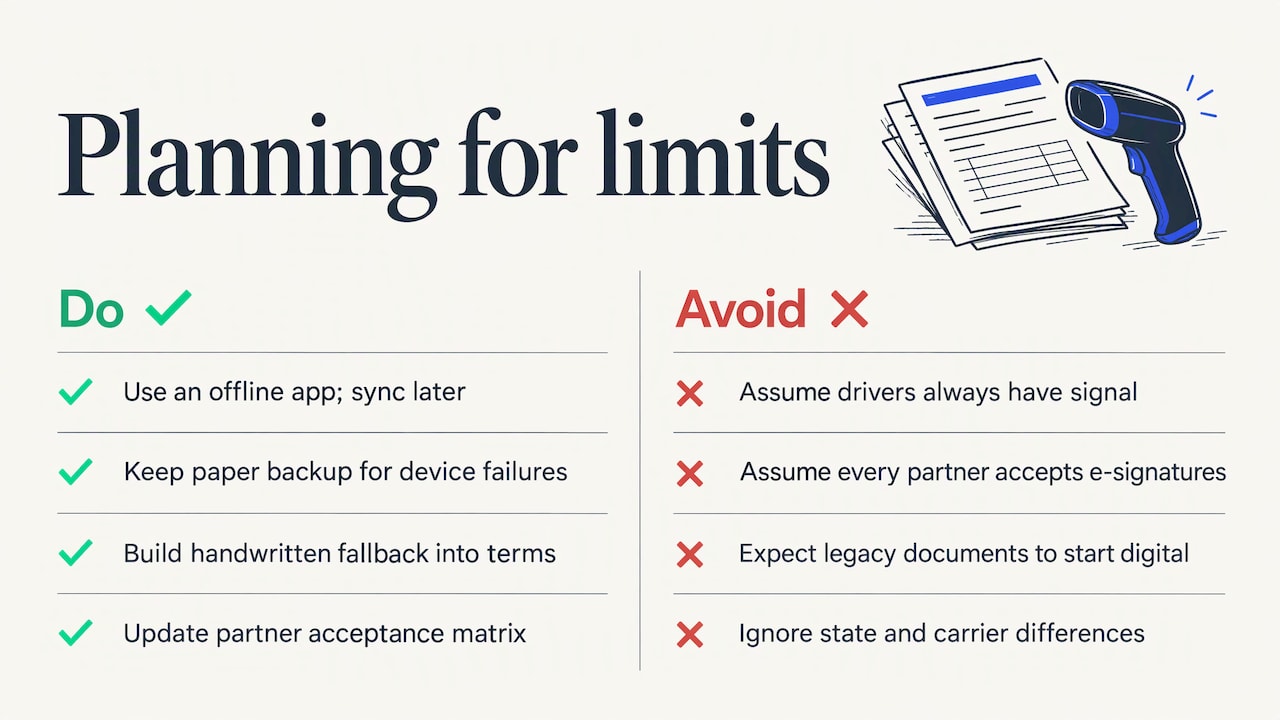
Planning for the limits
Good adoption plans for the awkward moments rather than hoping they do not occur.
Connectivity. Drivers deliver to docks with poor signal. Use an app that works offline and syncs later, and keep a paper backup procedure for device failures, as the ePOD guidance above advises.
Partners who insist on paper. Some consignees, customs offices or carriers will not accept an electronic signature. Build the fallback into your terms, in the way BIMCO’s clause does, so you can substitute a handwritten signature without reopening the deal.
Scanned paper still has a place. Not every legacy document will start digital. Reading signed paper into your system with bill of lading OCR lets old and new formats live in the same file. And if you worry about disrupting a working process, logistics document automation without rip and replace shows how to layer improvements onto what you already run.
State and carrier differences. Federal law sets the baseline, but carriers publish their own tariffs and some industries add rules. Keep a short matrix of which partners accept which documents electronically, and update it when terms change.
Where the signature fits in your TMS
The ground is shifting beneath forwarding operations. Margins depend on how many touches each shipment needs, and every document that waits for a signature is a touch you pay for in headcount and delayed cash. Signing electronically is the first step. Connecting it to the rest of the file is the strategic one.
FreightSuite is an agentic TMS built for freight forwarders and logistics companies, with automated document management, invoice recognition, workflow customization, credit control, customer dashboards and accounting software connections included in one platform. The aim is that a signed document does not end up in an inbox. It belongs to the shipment, supports the invoice and stays retrievable. You can see how that plays out by mode on our road freight, ocean freight and air freight pages, or start from FreightSuite to book a demo. If you are comparing platforms first, our review of document management options for forwarders and the guide to the best cloud TMS for US forwarders are good places to begin.
A short rollout plan
Start with the documents that carry the least regulatory risk and the most volume: rate confirmations and carrier onboarding packets. Standardize templates, name the authorized signers on each side and agree on where completed records are stored. Move to delivery receipts and proof of delivery next, once your driver and consignee process works offline. Treat negotiable bills and hazmat papers as a separate project with their own owner and written procedure.
Measure the result with numbers your finance team already tracks: days from delivery to invoice, documents per shipment that need manual handling, and time to retrieve a signed record when a customer asks. The window to do this ahead of competitors is real, and it has a timeline: customers increasingly expect digital paperwork as standard, and forwarders who cannot offer it will notice in their win rates before they notice it in their costs.
FAQ
Is an e-signature on a bill of lading legally binding?
For a straight bill of lading in interstate or international commerce, ESIGN prevents the document from being denied effect solely because it is electronic. The document still has to carry the information a paper bill would, and the carrier’s own terms may add requirements. Negotiable bills of lading need a dedicated electronic bill of lading platform.
Can hazmat shipping papers be signed electronically?
The shipper’s certification must be signed by an authorized person, and a trained third party may sign for the shipper under a contract or at the customer’s request. Retention periods apply, and in-transit access to electronic papers is limited to situations a regulation or special permit allows. Check PHMSA’s interpretations and your own hazmat procedures before moving these papers online.
What should an e-signature record include?
Keep the final signed document, the signer’s identity and consent, timestamps and an audit trail, and store them with the shipment file. The record should be accurate and reproducible so you can show it to a customer, carrier or regulator later. Retention should follow the document type.
What happens if a partner will not accept an electronic signature?
Write a fallback into your agreements so a handwritten signature can be supplied promptly. BIMCO’s electronic signature clause takes this approach for international transactions. That way one partner’s preference never stops the shipment.
Sources
- 15 U.S.C. § 7006: Definitions
- Electronic Signature Laws & Regulations, United States (Adobe)
- FMCSA: Regulatory Guidance Concerning Electronic Signatures and Documents
- Electronic Signature for Trucking & Freight (SignSend)
- Electronic Signature for Freight Brokers and Rate Confirmations
- eCFR: 49 CFR Part 373, Receipts and Bills
- Pitt Ohio: Electronic Documents and Signatures
- Electronic Proof of Delivery (ePOD) Guide, O Trucking
- eSignatures in Logistics: Faster Shipping Contracts (Blueink)
- PHMSA Interpretation 24-0085
- PHMSA Interpretation 09-0285
- PHMSA Special Permit DOT-SP 15747
- FMCSA: Can the ELD information packet be in electronic form
- FMCSA: Regulatory Guidance Concerning Household Goods Carriers
- BIMCO Electronic Signature Clause 2021
- How Digital Bills of Lading Boost Transparency (DocuSign)
- End-to-end contract workflow: signing to storage (Anvil)
- eSignature for Logistics Industry (signNow)
- FIATA Best Practice Guide on Electronic Contracting

