Carrier Contract Management for Negotiators: Make Rates Stick with AI
Carrier contract management is the discipline of negotiating, implementing, monitoring, and optimizing the agreements that govern freight rates, service levels, and liability with your transportation providers. The single most impactful first step is treating the contract as a living operating document, not a filed PDF: instrument it with KPI-based enforcement from day one. Done well, following practices consistent with FMCSA compliance standards and supported by modern freight management platforms, this discipline reduces spend leakage and forces carriers to honor the service they sold you.
TL;DR:
- Regularly review historical lane data, invoice accuracy, and market rates to negotiate better carrier terms and ensure qualification for volume-based discounts.
- Encode negotiated rates, surcharges, and SLAs into your TMS, and establish automated systems for real-time performance monitoring and invoice validation.
- Share KPI scorecards with carriers and enforce SLA breaches with predefined alerts and escalation paths to maintain service levels and strengthen relationships.
- Collect and analyze detailed shipment, invoice, and benchmark data continuously, not just before renewal, to support informed negotiation and proactive contract management.
- Use integrated TMS platforms like FreightSuite to automate contract enforcement, manage multi-modal terms, and eliminate manual reconciliation gaps.
Table of Contents
- What Is Carrier Contract Management and Why Does It Matter?
- How Do You Prepare and Negotiate Carrier Contracts?
- How Do You Operationalize a Carrier Contract After Signing?
- What KPIs Should You Track for Carrier Performance?
- How Do You Verify Carrier Invoices and Handle Disputes?
- When Should You Renew, Renegotiate, or Re-Tender a Contract?
- What Is the Business Case for Disciplined Contract Management?
- How Does FreightSuite Close the Execution Gap in Contract Management?
- What Legal Compliance Issues Should You Watch in Carrier Contracts?
- How Do You Manage Change and Communication During Contract Rollout?
- How Do You Manage Risk in Carrier Contracts?
- What Data Should You Collect to Support Contract Decisions?
- Get More Out of Every Carrier Agreement You Sign
- Sources
- FAQ
What Is Carrier Contract Management and Why Does It Matter?
Most freight forwarders and shippers sign a carrier agreement, forward it to accounting, and never open it again until renewal. That is where the money disappears. The execution gap between what a contract promises and what actually gets billed and delivered is where transportation spend quietly leaks, often through unnoticed surcharges, missed service levels, and rate cards that never made it into the booking system.
Carrier contract management closes that gap. It covers everything from the data you gather before you sit down at the negotiating table to the automated checks that flag an invoice charging the wrong fuel surcharge six months later. The core components are consistent regardless of mode: rate structures and surcharge rules, service level agreements with measurable KPIs, liability and insurance provisions, and renewal or termination clauses that give you leverage instead of taking it away.
Freight and supply chain teams that treat this as a compliance afterthought pay for it twice. Once in the rate they negotiated, and again in the rate they actually get billed. The teams that treat it as an operational system, with rate verification, scorecards, and audit trails built into their workflow, tend to catch the difference before it compounds across a full year of shipments.
How Do You Prepare and Negotiate Carrier Contracts?
Negotiating from a position of strength starts long before the first call with a carrier’s sales rep. It starts with your own data.
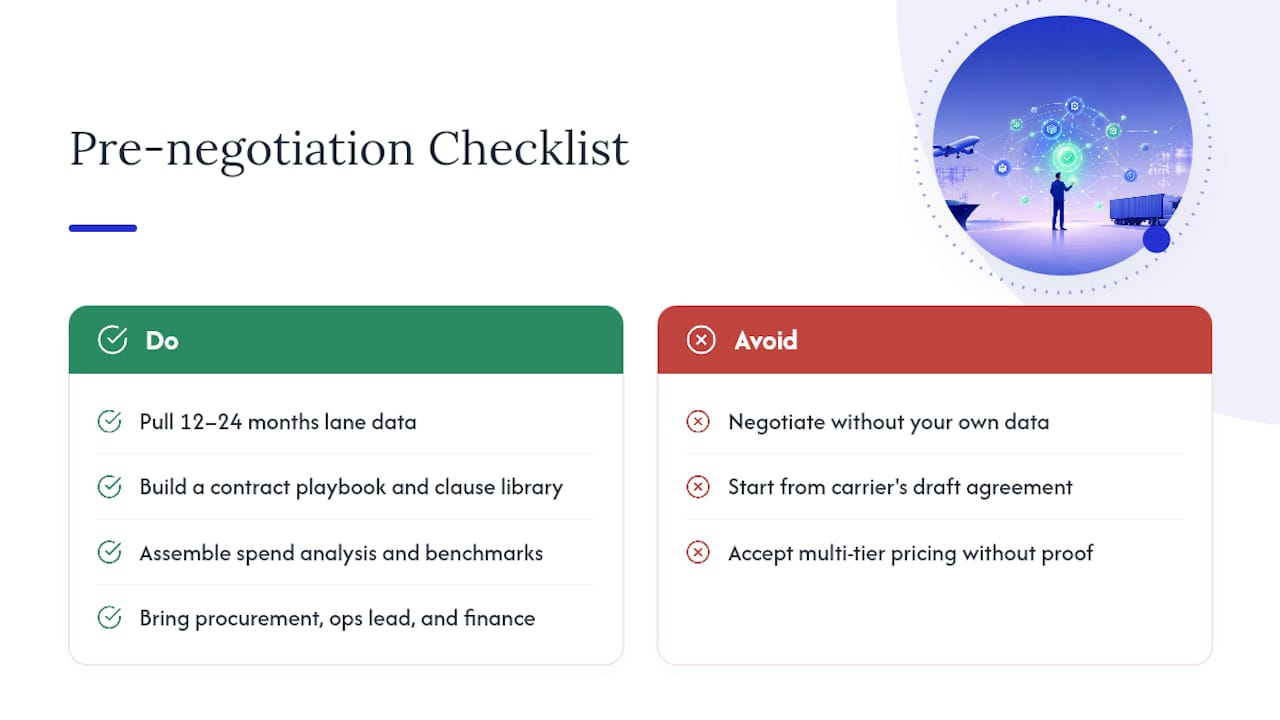
Pull twelve to twenty-four months of lane-level spend and shipment history before you schedule a single conversation. You want volume by lane, seasonality patterns, accessorial charge frequency, and your current on-time performance by carrier. Without this, you are negotiating on the carrier’s terms, using their assumptions about your business instead of your own evidence.
Pro Tip: Build a contract playbook and clause library before you ever open a carrier’s draft agreement. Experienced negotiators start from their own template rather than redlining the carrier’s paper, which preserves framing control and cuts weeks off the negotiation cycle.
The clauses that deserve the most attention during negotiation include rate and surcharge rules, SLA language tied to measurable KPIs, clear renewal and notice terms, liability and insurance provisions, and audit and dispute rights that allow access to review invoices against contracted rates.
Volume tiers deserve their own line of scrutiny. Carriers love multi-tier pricing because it looks generous on paper while rarely triggering in practice. Ask for the actual historical volume data that would have qualified you for each tier over the past year, not hypothetical projections.
Before you walk into negotiation, assemble a short checklist: your spend analysis, a benchmark rate comparison for competitive lanes, your SLA history with the incumbent carrier if renewing, and the specific people who need to be in the room. That typically means procurement, a transportation operations lead who understands the lanes day to day, and someone from finance who can speak to margin impact. Carriers negotiate differently when they see an operational stakeholder at the table, not just procurement chasing a lower rate.
How Do You Operationalize a Carrier Contract After Signing?
A signed contract that never makes it into your booking system is just a legal document sitting in a shared drive. Turning it into enforced pricing and service requires a specific sequence of technical and organizational steps.
- Translate the rate card into system rules. Every negotiated rate, surcharge formula, and accessorial charge needs to be encoded into your TMS as routing guide logic, not left for a dispatcher to remember or look up manually.
- Set up EDI or API connections with the carrier. Confirm which transaction sets you need (204, 214, 210 in the motor carrier world, for example) and run test files before live volume flows through the connection.
- Run pilot shipments before full cutover. A small batch of test bookings surfaces rate mismatches, missing accessorial codes, and mapping errors while the stakes are low.
- Assemble the carrier onboarding packet. This includes the signed rate agreement, certificate of insurance, W9 or equivalent tax documentation, and the operational contacts for tracking and claims. The bill of lading format and data fields should be confirmed at this stage too, since mismatched BOL data is a common source of invoice disputes later.
- Assign clear owners for each handoff. Procurement negotiates and signs. Operations handles onboarding, routing guide updates, and day-to-day exceptions. Billing owns invoice matching and dispute filing. Without a documented handoff, contract terms tend to live only in the head of whoever negotiated them, and that knowledge walks out the door when they change roles.
Version control matters more than most teams expect here. Rate cards get amended, surcharges get updated quarterly, and if your TMS is running an outdated version of the routing guide, you are paying the old rate or, worse, the carrier’s default rate. A platform that automates shipment status updates tied to live contract terms removes a large share of this manual reconciliation risk.
What KPIs Should You Track for Carrier Performance?
The metrics you choose to track determine whether your carrier scorecard is a real management tool or a quarterly PDF nobody reads. Five KPIs cover the essentials for most carrier relationships:
- On-time delivery rate, measured against the appointment window written into the contract, not a loose estimate
- Damage and loss ratio, tracked as a percentage of total shipments to catch trends before they become claims disputes
- Tender acceptance rate, which reveals whether a carrier is actually honoring the committed capacity in your agreement
- Billing accuracy, the percentage of invoices that match contracted rates without manual correction
- Lane-level margin, which tells you whether a contract that looked good in aggregate is quietly losing money on specific routes
Carrier contract management execution gaps cost shippers a significant share of transportation spend annually when rate leakage and missed SLA enforcement go unchecked. That figure alone justifies building a scorecard discipline rather than reviewing performance only when a carrier relationship visibly deteriorates.
Carrier scorecards work best when they are shared, not stockpiled internally for a leverage play at renewal. Self-service carrier portals that give a carrier visibility into their own on-time percentage, revenue-to-date, and scorecard ranking tend to produce faster corrective action than a quarterly email nobody opens. Carriers respond to transparency because it removes the ambiguity of “we think you’re underperforming” and replaces it with a number they can see in real time.
When a carrier misses an SLA threshold, the enforcement path should already exist in the contract, not get improvised. Automated alerts should fire the moment a KPI crosses its breach threshold, triggering a documented notice to the carrier with a defined escalation path if the pattern continues. Reserve termination for repeated undocumented failures. A root-cause conversation, backed by scorecard evidence, usually resolves capacity or service issues faster than starting a new carrier search from zero, and it preserves a relationship that may still have value once the underlying problem gets fixed.
How Do You Verify Carrier Invoices and Handle Disputes?
Invoice verification is where contract terms either get enforced or quietly ignored. The reproducible process is a three-way match: compare the contracted rate on file, the original booking record, and the carrier’s actual invoice, line by line.
- Pull the contracted rate for the exact lane, service level, and equipment type at the time the shipment moved, not the current rate card if it has since changed.
- Compare against the booking record to confirm the accessorials, weight, and service level that were actually requested match what’s on the invoice.
- Flag discrepancies automatically where possible. The most common invoice errors are unauthorized surcharges, incorrect weight or dimensional measurements, and service substitutions where a carrier bills for expedited service on a shipment that moved standard.
- Log every dispute with a timestamp, dollar amount, assigned owner, and expected resolution date, so nothing sits unresolved past a carrier’s own dispute window.
- Track recovery as a running total, both in dollars recouped and in days-to-resolution, so patterns by carrier become visible over time.
A documented dispute log does double duty. It recovers cash in the short term, and it becomes evidence at renewal. A carrier with a rising invoice error rate has far less leverage to hold their rate flat when you can show the pattern in their own billing history.
When Should You Renew, Renegotiate, or Re-Tender a Contract?
Start the renewal process well before the notice period in your contract requires action, ideally several months out for most carrier agreements. Waiting until thirty days before auto-renewal locks you into whatever terms the carrier prefers, because you no longer have time to credibly threaten a re-tender.
Before that conversation starts, gather the evidence that actually shifts outcomes:
- Full SLA performance history, especially on-time delivery and tender acceptance trends over the contract term
- Invoice accuracy rate and total dollars recovered through disputes, which signals how tightly the carrier has been managing their own billing discipline
- Actual volume against the negotiated tier structure, so you know whether you qualified for better pricing you never received
- Benchmark rates from comparable lanes, either from other carriers or market rate indices
Set a proactive alert well ahead of any volume-tier threshold, since losing eligibility for a discount tier because nobody was watching the trend line is an entirely avoidable cost. Whether you renegotiate with the incumbent or run a formal re-tender depends on performance history: strong SLA compliance and accurate billing argue for renegotiation with updated tiers and incentive structures, while repeated service failures or a stagnant rate despite market softening argue for opening the lane to competitive bids. Either path, keep termination-for-convenience language and penalty clauses on the table as negotiable levers, not fixed boilerplate.
What Is the Business Case for Disciplined Contract Management?
The financial argument for investing in carrier contract management discipline is not abstract. It shows up in four measurable places: recovered invoice leakage, improved on-time delivery percentage, fewer open disputes at any given time, and less manual administrative hours spent chasing carrier billing questions.
For a business case memo or slide, four KPIs make the argument cleanly:
- Percent of freight spend actively audited against contracted rates, since unaudited spend is where leakage hides
- Recovery rate on identified overcharges, expressed as dollars recouped versus dollars disputed
- SLA compliance rate across your top carriers by spend, tracked quarter over quarter
- Average time to resolve a dispute, which shortens dramatically once a documented process replaces ad hoc email chains
Litigation and settlement outcomes in transportation disputes illustrate the far end of what happens when contract terms and documentation are not managed with rigor. Most carrier disputes never reach that scale, but the underlying lesson holds at any size: clear terms and an audit trail are cheaper than the alternative. A memo showing the trend over several recent quarters of these KPIs tends to make a stronger case for investment than any single incident ever will.
How Does FreightSuite Close the Execution Gap in Contract Management?
The gap between a signed contract and an enforced one is almost always a systems gap, not a negotiation failure. FreightSuite is built as an AI-native TMS specifically to close that gap across the full contract lifecycle.
On the implementation side, FreightSuite’s rate management module lets you encode negotiated rate cards, surcharge rules, and volume tiers directly into booking logic, so the rate quoted at negotiation is the rate applied at booking. Air and ocean tracking modules feed real-time shipment status into performance dashboards, which supports the KPI monitoring that makes scorecards meaningful rather than retrospective.
A few capabilities map directly onto the pain points covered above:
- AI agent orchestration can extract key terms from contract documents and flag upcoming renewal dates automatically, reducing the risk of missing a notice period
- Native workflows connect operations, billing, and procurement so contract updates propagate without a manual handoff
- Integrated customs brokerage and multi-modal support means complex contracts spanning air, ocean, and ground carriers stay managed in one system rather than fragmented across spreadsheets
Pro Tip: If your current process relies on someone manually checking invoices against a printed rate sheet, that is the exact workflow AI agents in freight operations are designed to replace, freeing your team to focus on negotiation strategy instead of line-item reconciliation.
What Legal Compliance Issues Should You Watch in Carrier Contracts?
Legal compliance in carrier contracts extends well beyond the boilerplate liability paragraph most teams skim past. If your shipments include hazardous materials, FMCSA’s regulations on hazardous materials carriage impose specific documentation, packaging, and driver certification requirements that your contract’s liability and indemnification clauses need to reference directly, not assume.
International shipments raise a separate layer of compliance risk. Contracts involving cross-border movement should account for trade control obligations, since the Bureau of Industry and Security publishes enforcement and penalty guidance that applies when restricted goods or destinations are involved, regardless of whether the carrier or the shipper initiated the shipment. Building a clause that assigns responsibility for export compliance screening avoids a costly ambiguity if a shipment gets flagged.
Delivery terms deserve equal scrutiny. Incoterms define exactly where risk and cost transfer between buyer and seller, and a contract that leaves this undefined, or references an outdated Incoterms version, creates real ambiguity about who bears the cost of a damaged or delayed shipment.
Insurance and cargo liability limits should be reviewed against your actual freight value, not accepted at whatever the carrier’s standard limitation of liability states. A contract that caps liability at $0.50 per pound is a very different risk exposure for high-value electronics than for bulk commodities, and your legal and risk teams should confirm the cap matches what you are actually shipping.
How Do You Manage Change and Communication During Contract Rollout?
A new carrier contract fails operationally more often from poor internal communication than from bad terms. The people executing bookings, tracking shipments, and processing invoices every day need to know what changed, when it changed, and why, before the new terms go live.
Start with a rollout memo that goes to every operational team touching the contract, not just the negotiators who signed it. Spell out the effective date, the specific rate or service changes, and exactly which shipments the new terms apply to. A contract that takes effect mid-month on some lanes but not others is a common source of confusion if the communication is vague about scope.
Run a short training session with the operations and billing teams before go-live, walking through how the new rate structure appears in the TMS and what a correctly matched invoice should look like. This is also the moment to update any internal documentation, routing guides, or standard operating procedures that reference the old terms.
Designate a single point of contact for questions during the first thirty to sixty days after rollout. New contract terms almost always surface edge cases nobody anticipated during negotiation, like an accessorial charge that wasn’t explicitly addressed or a lane that falls outside the negotiated scope. Having one person who can make a quick, consistent ruling on those edge cases prevents different teams from interpreting ambiguous terms in conflicting ways.
How Do You Manage Risk in Carrier Contracts?
Risk in carrier contracts falls into three practical categories: operational delays, force majeure events, and liability exposure, and each needs distinct contract language rather than a single generic risk clause.
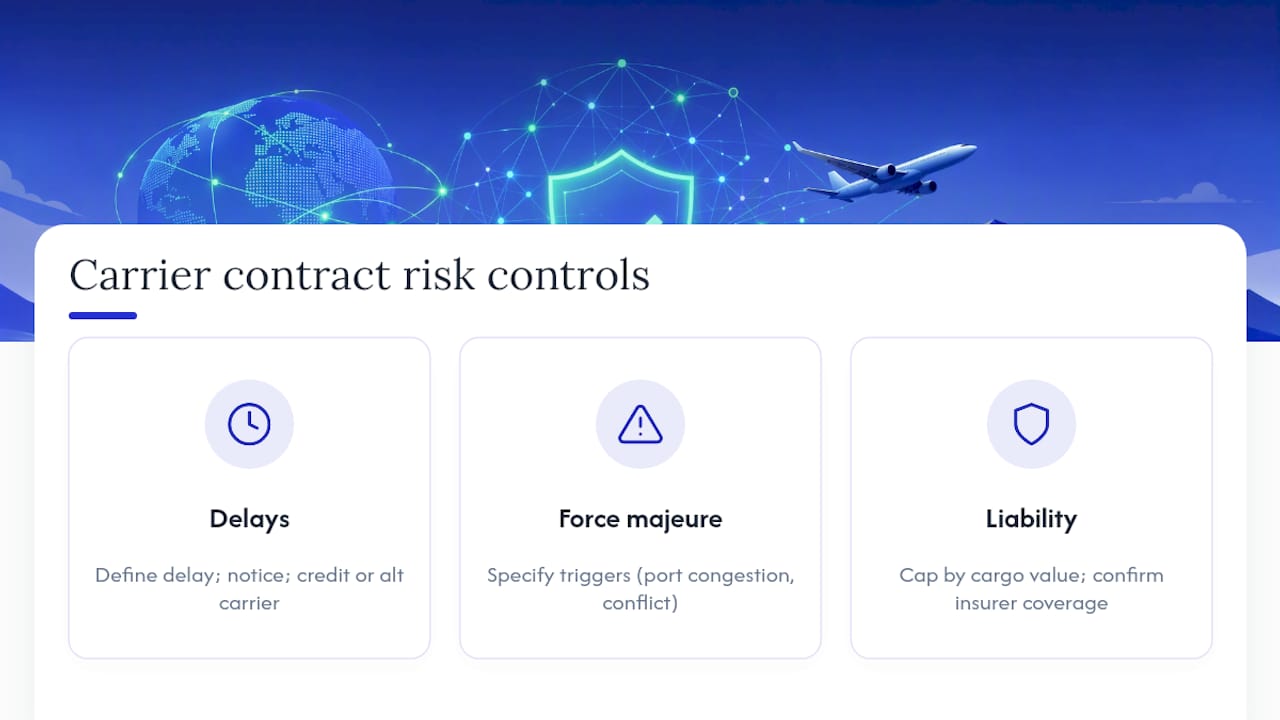
Delay risk should be addressed with specific, measurable consequences tied to the SLA language covered earlier, not vague language about “reasonable efforts.” Define what constitutes a delay, what notice the carrier owes you when one occurs, and what remedy applies, whether that’s a service credit, a right to use an alternate carrier without penalty, or another negotiated outcome.
Force majeure clauses need updating more often than most teams realize. A force majeure provision written years ago may not clearly address the kind of disruptions that have affected global freight in recent years, from port congestion to regional conflict affecting specific trade lanes. Push for language that defines specific triggering events rather than a broad, undefined “acts of God” clause that gives a carrier wide latitude to claim an exemption from performance.
Liability exposure should be reviewed against your actual cargo value and claims history, not the carrier’s default limitation of liability. If you regularly ship high-value goods, negotiate a liability cap that reflects that reality, and confirm the carrier’s insurance certificate actually covers the declared value range you need.
What Data Should You Collect to Support Contract Decisions?
The negotiators who consistently win better terms are the ones who show up with their own data instead of relying on the carrier’s version of the relationship. That starts with shipment-level detail: lane, weight, mode, service level, and actual transit time, captured consistently enough to spot patterns across a full year, including seasonal swings.
Invoice history matters just as much as shipment history. Tracking your own audit results, error rate by carrier, and dollars recovered through disputes gives you a documented performance record that exists independent of whatever the carrier reports about themselves.
Benchmark data closes the loop. Comparable rates from other lanes, other carriers, or market indices tell you whether a rate that looked competitive three years ago still is. A freight lifecycle management approach that treats data collection as continuous, rather than a scramble right before renewal, produces far more credible negotiating positions than a rushed analysis pulled together in the final weeks before a contract expires.
Get More Out of Every Carrier Agreement You Sign
Most of the practices covered here, rate verification, SLA scorecards, automated dispute logging, are only as good as the system enforcing them day to day. FreightSuite is built as an AI-native TMS specifically so contract terms don’t stay trapped in a PDF while your booking system runs on outdated rate cards.

Where legacy systems require manual rate lookups and separate spreadsheets to track carrier performance, FreightSuite brings rate management, air and ocean tracking, and AI agent orchestration into one workflow, so the terms you negotiated are the terms your team actually books and pays against. That matters most for teams managing agreements across multiple modes, where a road freight capabilities view and an ocean or air lane view need to reflect the same enforced rate logic without duplicate manual entry.
If your current process relies on someone manually cross-checking invoices against a rate sheet every month, that is the exact gap FreightSuite’s automated verification is designed to close. Check the FreightSuite pricing page to see which plan fits your carrier volume, or visit FreightSuite to schedule a product demo and see how contract terms flow from negotiation into live booking logic.
Sources
The regulatory and industry references below informed the compliance and operational guidance throughout this article.
- Sirion — Carrier contract management discussion and execution-gap analysis
- FMCSA — How to comply with federal hazardous materials regulations
- NMFTA — What is a bill of lading?
FAQ
What Is the Difference Between CLM and ERP?
Contract lifecycle management (CLM) software manages the negotiation, execution, and monitoring of specific agreements like carrier contracts, while enterprise resource planning (ERP) software manages broader business operations like accounting, inventory, and procurement. A modern TMS with CLM capabilities, such as FreightSuite, often integrates with a company’s existing accounting or ERP system rather than replacing it.
What Are Examples of CLM Tools?
Contract lifecycle management tools range from dedicated enterprise CLM platforms to transportation management systems with built-in contract features, like rate management, automated renewal alerts, and AI-based term extraction. In freight forwarding specifically, an AI-native TMS that combines rate management with contract monitoring, such as FreightSuite, functions as CLM built directly into the operational system.
What Does Carrier Management Mean?
Carrier management refers to the ongoing process of selecting, onboarding, monitoring, and evaluating the freight carriers a company works with, including performance tracking through KPIs like on-time delivery and tender acceptance. It works hand in hand with carrier contract management, since the contract sets the terms that performance monitoring then enforces.
What Does Contract Management Do?
Contract management oversees a formal agreement from drafting and negotiation through implementation, ongoing performance monitoring, and eventual renewal or termination. For carrier contracts specifically, it means translating negotiated rates and SLAs into system rules, auditing invoices against those terms, and using performance evidence to inform the next renewal or re-tender decision.

