Operations Teams: 7 Signals to Replace Legacy TMS With a Phased Plan
If your dispatch team is running spreadsheets alongside your TMS, your carrier data does not match invoices, and your vendor has not shipped a meaningful feature in over a year, it is time to replace your legacy TMS. The right path is not a big bang cutover. It is a phased migration that starts with a scoped pilot, a Phase 0 data audit, and one narrow lane group before anything touches settlement or billing.
TL;DR:
- Manual workarounds and unreliable data integration indicate your legacy TMS no longer supports efficient operations and needs replacement.
- Paralleling systems during a phased migration allows validation of the new platform without disrupting ongoing freight workflows.
- Data cleanup, especially for rates and carrier information, must occur before migration to avoid failed implementations and ongoing operational issues.
- Replacing a TMS can take four to six weeks for a narrow rollout or 60 to 90 days for a full enterprise transition, depending on scope and data quality.
- Operations, not IT, should own the TMS replacement process to ensure the system aligns with actual freight workflows and staffing realities.
Table of Contents
- Why Replace Legacy TMS: 7 Signals It’s Time
- How Do You Migrate Off a Legacy TMS Without Disrupting Operations?
- What Data Should You Migrate First When Switching TMS Platforms?
- How Long Does a TMS Implementation Actually Take?
- Who Should Own a TMS Replacement Program?
- How FreightSuite Supports a Phased TMS Replacement
- Sources
- FAQ
Why Replace Legacy TMS: 7 Signals It’s Time
The ground shifts slowly under a TMS, and most teams don’t notice until the cracks show up in the P&L. Here are the operational signals that reliably predict rising cost and eroding service, in the order they tend to appear.
- Manual workarounds have become the actual workflow. If dispatchers keep a shadow spreadsheet because the system’s rate logic can’t be trusted, the software has already lost its job.
- Integration failures with your ERP or WMS are routine. Frequent EDI or API errors mean your team spends hours reconciling data that should move automatically.
- Carrier performance data doesn’t match market reality. Scorecards that show every carrier hitting 98% on-time delivery, while your customers complain about late freight, are a sign the data pipeline is broken, not that your carriers are excellent.
- The rate engine consistently underperforms. If your team overrides suggested routings more often than it accepts them, optimization has stopped optimizing.
- Vendor ownership is unstable. Consolidation across the TMS market has left some products deprioritized after acquisitions, and buyers now have to weigh roadmap continuity as seriously as feature checklists.
- New carrier onboarding takes weeks instead of days. When capacity is tight and you can’t add a vetted carrier fast enough to move a load, the system is costing you freight, not just efficiency.
- Maintenance costs keep climbing while releases keep slowing. Rising annual fees paired with a thinning feature roadmap is the clearest financial tell that a platform has entered its decline phase.
How Do You Migrate Off a Legacy TMS Without Disrupting Operations?
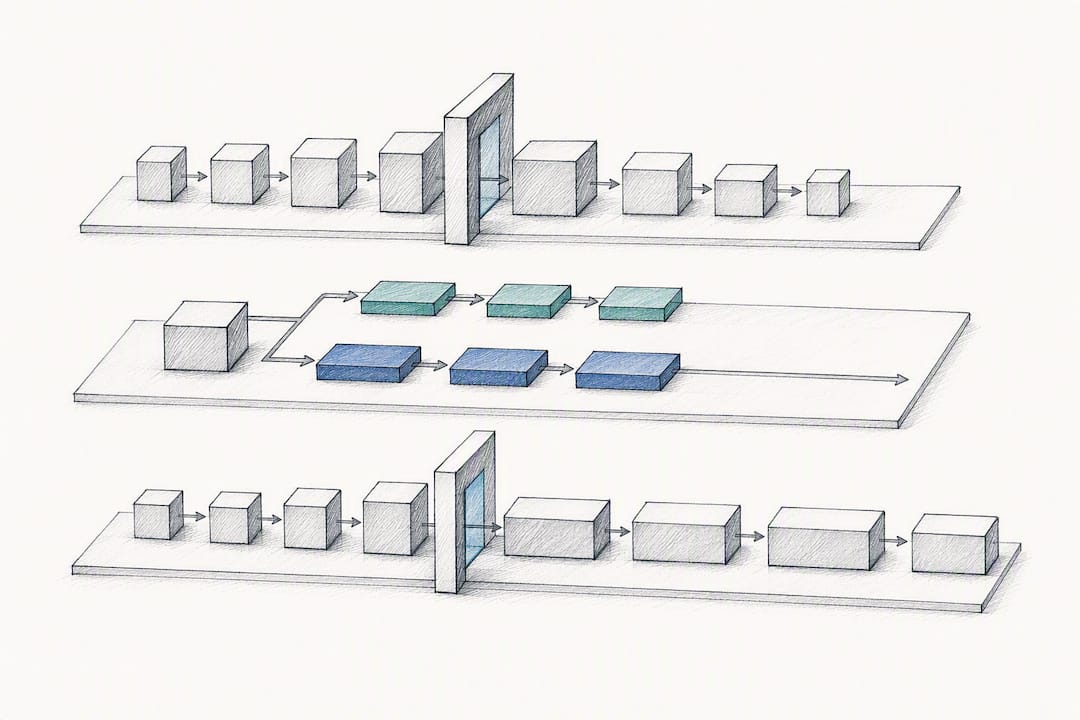
Rip-and-replace sounds efficient on paper and rarely survives contact with a live freight network. A phased approach, sequenced by decision domain rather than by system, lets you migrate dispatch and routing first while settlement stays on legacy, because the interface between them is a completed delivery record, not a live dependency. That single sequencing choice is what makes parallel running practical instead of chaotic.
- Run Phase 0 first. Audit your data, confirm which production connectors your target vendor already has for your carriers, baseline your current KPIs (on-time rate, cost per shipment, exception volume), and write down the business rules your legacy system enforces informally.
- Scope the first cutover narrowly. Pick one region and one decision domain, usually dispatch and routing, and leave settlement, billing, and finance on the legacy platform until the new system has proven itself.
- Run both systems in parallel on real volume. A sample of live loads, typically running for two to four weeks, with clear acceptance criteria (matching rate calculations, on-time performance, exception handling) tells you whether the new system is ready before you cut the old one off.
- Demand a scripted proof of concept. Insist any vendor you’re evaluating runs a demo using your actual lanes, your actual rate cards, and your actual carrier list, not generic sample data. Analysts consistently flag that demos built on clean sample data hide the functional gaps that surface only when your freight hits the system.
Pro Tip: Ask any vendor to load your worst carrier contract, the one with the confusing accessorial rules, into their rate engine during the demo. If they can’t handle it live, they can’t handle it in production either.
A pragmatic 90 day framework, built around data preparation, parallel running, and full cutover, works for most mid-size to enterprise shippers because it gives every decision domain its own timeline instead of forcing one deadline on the entire operation, a structure Nuvocargo’s replacement guide lays out in detail.
What Data Should You Migrate First When Switching TMS Platforms?
The transition is mostly a data problem wearing a technology costume. Dirty rate tables, incomplete carrier master records, and inconsistent address geocoding are the leading cause of failed go-lives, and cleanup has to happen before migration starts, not during it, according to Panorama Consulting’s analysis of failed TMS rollouts.
Prioritize five datasets, in this order:
- Contracted lane rates. These drive every quote and every margin calculation, so errors here compound immediately.
- Carrier master data. Names, MC numbers, insurance certificates, and service areas need to be current before you build EDI connections around them.
- Historical load data. A sample of past shipments lets you test the new system’s rate logic against known outcomes.
- EDI and API specifications. Document every connection your legacy system maintains so nothing silently drops during cutover.
- Address and geocoding data. Bad geocoding quietly breaks routing optimization long before anyone notices why delivery windows keep slipping.
Carriers generally need advance notice before you change tendering platforms, giving them time to update EDI connections and load-acceptance processes on their end. Skipping that notification window is one of the most preventable causes of early service disruption, a point Nuvocargo’s operational guide reinforces directly. Test every connector in a sandbox first, then validate it against a small batch of live loads running in parallel, and keep a documented fallback plan in case a specific carrier connection needs more time than the rest.
How Long Does a TMS Implementation Actually Take?
Timelines vary more by scope than by vendor. A narrow, single-region rollout can go live in four to six weeks. A full enterprise replacement, covering multiple regions and every decision domain, typically runs 60 to 90 days. Neither is universally right; the choice depends on how much of your operation you’re willing to run on two systems at once.
| Scenario | Typical Duration | What Makes It Possible |
|---|---|---|
| Narrow-scope pilot | four to six weeks | One region, pre-existing carrier connectors, clean data, parallel running |
| Phased enterprise rollout | 60 to 90 days | Multiple decision domains sequenced, data cleanup completed before kickoff |
| Full domain migration (dispatch through settlement) | 90+ days | Settlement and finance migrated last, after operational domains are proven |
A rapid four to six week go-live is only realistic when five preconditions hold: narrow scope, a single region, connectors that already exist for your carriers, data quality addressed before kickoff, and a genuine parallel-running window rather than a rushed cutover.
Before moving from parallel running to full cutover, confirm these exit criteria:
- Rate calculations match legacy output within an agreed tolerance across your sample load set.
- On-time performance tracking in the new system reconciles with your carrier scorecards.
- Exception handling (delays, damage claims, rebooking) has been tested against at least one real disruption.
- Your operations team can execute daily workflows without falling back on the legacy interface.
Once you cut over, commit to 30 days of dedicated monitoring with daily KPI reviews. Skipping that window is how small configuration issues turn into carrier disputes three weeks later. For a deeper breakdown of milestone sequencing, FreightSuite’s implementation timeline guide walks through how the phases stack against each other.
Who Should Own a TMS Replacement Program?
Operations should own the rollout, not IT. When IT leads a TMS replacement as a pure systems project, the resulting configuration tends to reflect data architecture logic rather than how dispatchers, carriers, and customer service actually work day to day, a gap that Supply Chain Desk’s implementation guide calls out as one of the most common causes of scope creep.
Your operating model should follow your staffing reality and volume pattern:
- In-house SaaS licensing fits teams with stable headcount and the bandwidth to run their own rollout and ongoing configuration.
- Managed transportation fits organizations without dedicated TMS staff, since it pairs software with an operating team and compresses time to value, though it trades some direct control for faster onboarding.
- A hybrid model works when volume is volatile and you want instant access to carrier capacity without building that network yourself, an approach worth exploring through a partner like Envio 3PL if internal staffing can’t flex fast enough.
Pro Tip: Assign one operations lead as the single point of accountability for the rollout, even if IT and finance both have seats at the table. Split ownership is how timelines quietly slip by a quarter.
How FreightSuite Supports a Phased TMS Replacement
FreightSuite was built for exactly the kind of operations-led migration this guide describes, not a forced weekend cutover. Rate management, air and ocean tracking, financial and credit control tools, customs brokerage capabilities, and AI agent orchestration all run natively inside one platform, which means you can migrate dispatch and routing first and leave settlement on your legacy system until you’re ready, without duct-taping two vendors together.

That native architecture is what makes Phase 0 practical. Our team can validate carrier connectors against your actual EDI and API specs before a single load moves, and we support parallel running with real acceptance criteria rather than asking you to trust a sales deck. If you’re evaluating road freight, ocean freight, or air freight workflows specifically, we’ll run the demo on your lanes and your rate cards, not generic sample data, because that’s the only version of a demo that tells you anything real. Finance teams evaluating the switch can also look at how FreightSuite handles invoice recognition and FX tracking before committing to a domain sequence.
Book a scripted proof of concept using your own lanes, review FreightSuite’s pricing plans to match the rollout to your budget, or start with our case study to see how a phased migration played out for another freight forwarder before you commit your own timeline.
Sources
- Legacy TMS Migration Playbook: Sequencing the Cutover
- How To Replace Your TMS Without Disrupting Operations (2026 Guide) | Nuvocargo
- TMS implementation guide — Supply Chain Desk
- Top reasons for TMS failure — Panorama Consulting
- Top TMS implementation mistakes to avoid — GetTransport blog
FAQ
How Do You Know It’s Time to Replace Your TMS?
If your team relies on manual spreadsheets to compensate for system gaps, your integrations fail regularly, and vendor feature releases have slowed or stopped, those signals together indicate it’s time to plan a replacement.
What Is a Phased TMS Migration?
A phased migration sequences the cutover by decision domain, moving dispatch and routing to the new system first while settlement and finance remain on the legacy platform until parallel running proves the new system out.
How Long Does Replacing a Legacy TMS Take?
A narrow-scope pilot can go live in four to six weeks under the right preconditions, while a full phased enterprise rollout typically takes 60 to 90 days.
How Much Notice Do Carriers Need Before a TMS Switch?
Carriers generally need 30 days’ notice before you change tendering platforms so they can update their EDI or API connections without service disruption.
Should Operations or IT Lead a TMS Replacement?
Operations should lead the rollout because the system needs to reflect actual daily freight workflows, while IT supports the technical integration work.

