The Best AI Agents for Logistics in 2026: How to Choose

The best AI agents for logistics are not the ones with the most impressive demo. They are the ones that work on your own shipment, rate, document and accounting data, inside the system where your team already works, and within limits you control. For a freight forwarder or logistics company, that usually means an agentic TMS, where agents are built into operations, rather than a bolt-on layer that has to be fed from five different screens.
This guide compares the main categories of AI agents for logistics, shows what separates a useful agent from an expensive experiment, and explains where FreightSuite fits. The ground is shifting beneath this industry, and the window to build an advantage is real, and it has a timeline.
TL;DR
- AI agents for logistics fall into four camps: enterprise supply chain suites, point solutions for one task, general-purpose agent builders, and agentic TMS platforms.
- Gartner predicts that 50 percent of cross-functional supply chain management solutions will use intelligent agents by 2030, so the question is when and how, not whether.
- Data quality, guardrails and human oversight matter more than model sophistication.
- Forwarders usually see the best return by starting with one narrow, repeatable task and expanding from there.
- FreightSuite is an agentic TMS that includes rate management, tracking, finance, workflows and agent orchestration natively, without add-ons.
Table of Contents
- What an AI agent in logistics actually is
- The four kinds of AI agents for logistics
- How the categories compare
- Seven criteria that separate a useful agent from a demo
- What the evidence says about results
- Where FreightSuite fits
- Use cases to start with
- A practical plan for the first 90 days
- See an agentic TMS on your own freight
- FAQ
- Sources
What an AI agent in logistics actually is
A chatbot answers a question. An agent takes an action. In logistics, that means reading an inbound email with a booking request, pulling the right rate, drafting the quote, checking a shipment’s status against a carrier source, reconciling an invoice against a quote or chasing a missing document, then logging what it did. Gartner describes agentic AI as systems that autonomously plan and take actions to meet user-defined goals, a virtual workforce that can offload and augment human work.
The difference matters for buying. A tool that summarizes information helps one person work a little faster. An agent that completes a task end to end changes how many shipments one person can handle. That is the thread behind the capacity conversation every forwarder is having: growing volume without growing headcount at the same rate.
The AWS guidance on agentic AI in logistics points to a design principle that holds up in practice: define agents with a focused persona, such as a logistics agent or a sourcing agent, rather than one all-purpose tool. Narrow scope limits data access, improves security and gives the agent the context it needs for the problem in front of it.
The four kinds of AI agents for logistics
Search results for this topic mix very different products in one list. Sorting them by category is the quickest way to cut through that.
Enterprise supply chain suites
Large platforms such as Oracle, Blue Yonder and C3 AI add agents on top of planning, inventory and demand forecasting. They suit shippers and manufacturers running complex networks with dedicated IT teams. For a mid-size forwarder, they are often more platform than the job requires, and the agents sit far from the daily work of quoting, booking, tracking and billing.
Point solutions for a single task
These tackle one problem: quote extraction from email, shipment visibility, document reading, freight audit or detention tracking. They can deliver fast, visible wins. The trade-off is integration. Each point solution has its own data, its own login and its own bill, and an agent in one tool cannot see what an agent in another tool knows.
General-purpose agent builders
Workflow and agent platforms let your team assemble custom agents. They offer flexibility, but you carry the burden of connecting them to rates, bookings, accounting and customer records, and of maintaining those connections when systems change. They work best when you have technical staff and a clear process to automate.
Agentic TMS platforms
Here the agents live inside the transport management system, so they act on the same shipments, rates, documents and invoices your team already uses. Many TMS vendors are adding agent features, which is the trend Gartner describes. The key question is whether agents are native to the architecture or a feature attached to an older data model.
How the categories compare
| Criteria | Enterprise suites | Point solutions | General agent builders | Agentic TMS |
|---|---|---|---|---|
| Best fit | Shippers, manufacturers, complex networks | One painful task | Teams with technical staff | Forwarders and logistics companies |
| Data access | Planning and inventory data | Narrow, one workflow | Whatever you connect | Shipments, rates, documents, finance in one place |
| Time to first value | Long | Short | Medium to long | Short to medium |
| Integration burden | High | Grows with each tool | You own it | Lower, since agents share the system of record |
| Governance | Platform-level | Per tool | You design it | Set once, applied across workflows |
| Risk | Overbuilt for the job | Tool sprawl | Maintenance load | Depends on how native the agents are |
No category wins everywhere. A shipper optimizing a manufacturing network has different needs from a forwarder managing ocean, air and road files with a lean ops team. The right question is which one sits closest to your actual work.
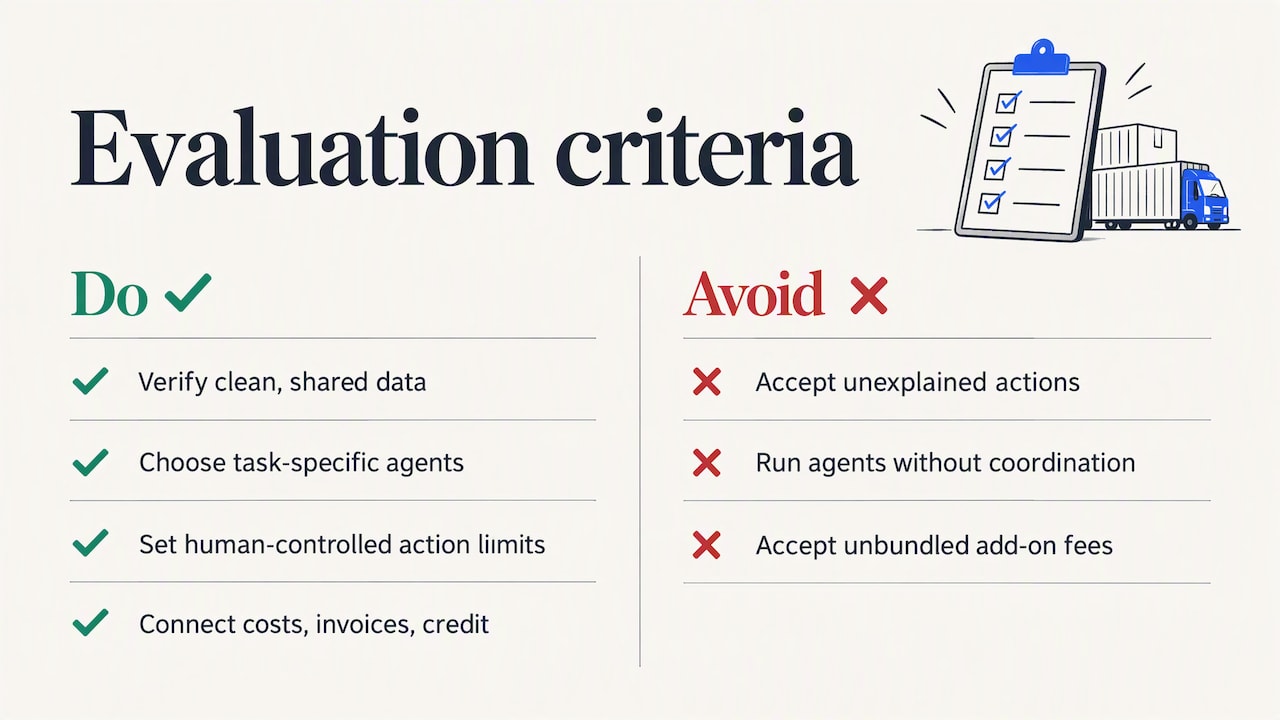
Seven criteria that separate a useful agent from a demo
When forwarders evaluate AI agents, we see the same seven questions decide the outcome. Each connects to what the research says about what works.
Data foundation. Industry experts on the MIT Center for Transportation and Logistics podcast caution that AI sophistication is rarely the bottleneck. Data quality is. Agents fed fragmented, manual or poorly structured data from legacy systems underperform, whatever the model. Ask where the agent gets its data and whether that data is clean, current and shared across departments.
Scope and specificity. Look for agents built for named freight tasks, such as shipment status lookups, document reconciliation, rate retrieval and invoice matching, not a generic assistant that claims to do everything. Problem-specific automations on narrow, repeatable tasks tend to return more than attempts to replace whole workflows overnight.
Guardrails. Freight carries financial and regulatory consequences. A good agent works within predefined thresholds for actions like booking, rate acceptance or vendor selection. Gartner’s guidance stresses clear human-in-the-loop policies: the agent handles volume, and the team keeps control over exceptions and deviations. Ask to see how limits are configured and who can change them.
Transparency and auditability. MIT CTL research scientists urge freight leaders to prioritize both. You should be able to see what the agent did, what data it used and why. If an agent cannot explain an action, finance and compliance will not trust it.
Integration with accounting and finance. A shipment is not finished until it is billed correctly. Agents that see costs, FX movements, invoices and credit status protect margin in a way that tracking-only tools cannot.
Orchestration. Once you run more than one agent, someone has to coordinate them: which agent triggers which, what happens on failure, where a human steps in. Orchestration of AI agents is the layer that turns isolated automations into a working operation. Ask whether it is built in or something you assemble yourself.
Cost model. Watch for add-on pricing. Agents priced as separate modules, per-seat extras or usage meters can erode the business case. Ask for the complete list of what is included before the pilot, not after.
What the evidence says about results
The numbers are encouraging, with caveats worth reading.
McKinsey reports that a growing number of manufacturers, logistics operators and energy players are seeing quantifiable impacts from agentic AI. Its research points to cost reductions for logistics operations using agentic AI for routing and scheduling, and to documentation work moving from days to hours or minutes. It also projects 30 to 50 percent lower operating costs across advanced industries by 2030 through automation of repetitive tasks. Those are projections across industries, not a promise for any single forwarder.
On the procurement side, a 2025 MIT study of autonomous negotiation examined more than 280,000 executed negotiations in freight procurement. It found that AI-driven systems improved cost-effectiveness by 59 percent compared with human-led negotiations, with a 17 percent gain in time efficiency. The researchers also found that equipment properties, customer status and supplier usability moderated success. In other words, context matters, and results will differ by lane, mode and relationship.
On adoption, Gartner predicts that by 2028 at least 15 percent of day-to-day business decisions will be made autonomously through agentic AI, up from 0 percent in 2024. The forwarders who build data maturity early are the ones positioned to benefit.

Where FreightSuite fits
FreightSuite is an agentic TMS built for freight forwarders and logistics companies. We designed it as an alternative to legacy systems such as Cargowise, Magaya, Descartes, Multifreight, Logi-Sys and Logitude, with automation and AI agent orchestration native to the platform rather than added later.
That design shows up against the criteria above.
First, the data foundation. Rate management, air and ocean tracking, finances, operations and workflows live in one system, so agents work from the same shipment, rate and cost data your team does. Automated document management and invoice recognition feed that record, and dynamic FX and cost tracking, credit control and customer dashboards sit on top of it. Connections to accounting software keep finance aligned with operations.
Second, scope. Agents handle focused freight tasks: status updates, document handling, rate retrieval, invoice matching. You can see how we approach this in our agentic architecture and in our overview of how AI agents handle freight tasks.
Third, customizable workflows. Because workflows are configurable in the TMS, you decide where an agent acts alone and where a person approves. That is the human-in-the-loop model the research recommends, applied to your own thresholds.
Fourth, no add-ons. All core features, including the agent capabilities, are included out of the box. For forwarders trying to run faster, eliminate admin and improve profitability, that makes the evaluation simpler: one platform, one scope, no module-by-module negotiation.
FreightSuite covers the main modes as well: ocean freight, air freight, road freight and customs brokerage. A forwarder running several modes does not need a separate agent stack for each.
An honest caveat: if you are a shipper optimizing a manufacturing network, an enterprise planning suite is the better category. FreightSuite is built for the people moving the freight, not for those planning inventory.
Use cases to start with
The research is consistent that the most successful freight AI implementations begin narrow. These are the starting points we see forwarders prioritize, and each maps to a task that is frequent, rules-based and measurable.
Shipment status is the first. Customers ask where their cargo is, and staff spend hours checking carrier sites and replying. Automating that frees capacity quickly, and our guide to shipment status automation walks through the approach.
Documents are the second. Bills of lading, commercial invoices and packing lists arrive in every format. Agents that read, match and flag discrepancies reduce rework, and you do not have to replace your existing stack to get there, as we explain in logistics document automation without rip and replace.
Rates and contracts are the third. Making negotiated rates stick, and retrieving the right one for each quote, protects margin. See our piece on carrier contract management for how teams approach it.
Finance and reporting are the fourth. Invoice recognition, cost tracking and operational reports are repetitive and error-prone by hand. Our guide to freight operations reporting automation covers that ground, and finance teams can see how this works on the finance solutions page.
A practical plan for the first 90 days
Start with a single pain point where your team can count the hours lost today. Pick one: status inquiries, document reconciliation or quote turnaround.
Clean the inputs before you deploy. Standardize rate sheets, customer records and document naming. The research is clear that poor data limits any agent, and an afternoon spent on data hygiene often beats a month of prompt tuning.
Set thresholds in writing. Decide which actions an agent may take alone, which need approval and which are off limits. Include rate acceptance, booking changes and anything touching a customer’s invoice.
Involve the people who do the work. Gartner and McKinsey analysts urge leaders to involve the workforce in designing AI-integrated workflows rather than only training them on tools. Your coordinators know where the exceptions hide.
Measure against a baseline. Track handling time, error rates and shipments per employee before and after. Expand only when the numbers justify it.
The role of your people evolves in the process. Staff move from keying data to supervising agents, auditing outputs and managing relationships, which is the human-machine model the MIT CTL discussion describes: augmentation, not replacement.
See an agentic TMS on your own freight
If you run a forwarding or logistics operation and want to see agents working on real shipment, rate and finance data, explore FreightSuite. You can also read how forwarders are scaling throughput without adding headcount or review results in our case study. The choice is yours to make, and the forwarders who start with a focused use case this year will be the ones setting the pace next year.
FAQ
Which AI is best for logistics?
It depends on the job. Shippers planning networks lean toward enterprise supply chain suites, while forwarders handling quotes, bookings, tracking and billing get more from agents inside their TMS. Judge any option on data access, guardrails, auditability and what is included in the price.
What is the difference between an AI agent and a standard automation?
Standard automation follows a fixed rule: if X happens, do Y. An agent can interpret messy inputs such as emails and documents, decide among several steps and complete a task toward a goal. Both work best inside defined limits, and a human should review exceptions.
What is an agentic TMS?
An agentic TMS is a transport management system where AI agents are part of the core architecture. They act on the same shipments, rates, documents and invoices as your team, under rules you set. FreightSuite is built this way for freight forwarders and logistics companies.
Will AI agents replace logistics staff?
The research points to augmentation. Agents take on routine volume and exception detection, while people handle complex judgment, relationships and oversight of the agents. Teams that plan for this shift early tend to redeploy their people rather than lose them.
How should a forwarder start with AI agents?
Pick one repeatable task, such as shipment status or document reconciliation, clean the underlying data, set approval thresholds and measure results against a baseline. Expand once the first workflow proves itself.
Sources
- Gartner: half of supply chain management solutions will include agentic AI by 2030
- Gartner: top 10 strategic technology trends for 2025
- AWS for Industries: transform supply chain logistics with agentic AI
- MIT CTL: the latest technology in freight transportation
- McKinsey: agentic AI implementations in advanced industries
- MIT Digital Supply Chain Transformation: autonomous negotiation

