Best Cloud TMS in 2026: Platforms for US Freight Forwarders
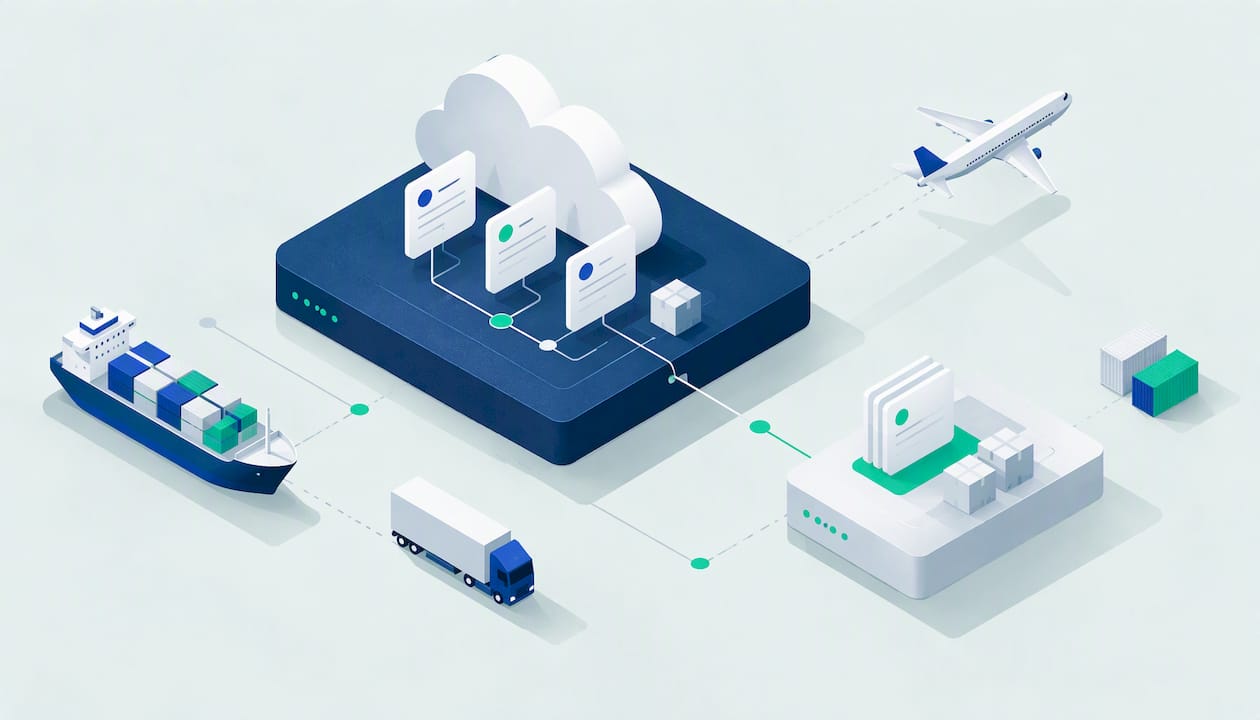
The best cloud TMS in 2026 is the one that runs your actual jobs, from quote to invoice, with the least manual work and the fewest add-ons. For US freight forwarders and logistics companies, that shortlist usually includes FreightSuite, CargoWise, Magaya, GoFreight, Descartes and a handful of lower-priced cloud tools. They are built for different company sizes and different ambitions, and the differences matter more than the feature checklists suggest.
Most of the pages that rank for this topic are written for trucking carriers or large shippers. This guide is written for the forwarder: the company that sells ocean, air and road capacity, manages customs and documents, and lives or dies on margin per file.
TL;DR
- Cloud TMS platforms for forwarders split into three groups: global enterprise suites (CargoWise, Descartes), mid-market platforms (Magaya, GoFreight, FreightSuite) and low-cost per-user tools (Logistaas, Logitude World, Linbis).
- Most vendors do not publish prices. Where numbers exist, they range from $45 per user per month to about $300 per user per month, and implementation and migration cost extra.
- Implementation speed separates the field: weeks for modern cloud platforms, multiple quarters for the legacy suites.
- FreightSuite is the agentic option, with rate management, tracking, finance, workflows and AI agent orchestration included natively rather than sold as add-ons.
- Whatever you shortlist, bring your own documents to the demo and make the vendor process a real job from quote to invoice.
Table of Contents
- What “cloud TMS” should mean for a forwarder
- The platforms US forwarders actually shortlist
- FreightSuite: the agentic alternative to legacy systems
- CargoWise and Descartes: depth, with a long runway
- Magaya: strong when the warehouse is part of the business
- GoFreight and the low-cost cloud tools
- What the subscription price leaves out
- How to choose: five tests that separate platforms
- Run the demo as a live test
- Why tracking and finance should live in one system
- Where FreightSuite fits
- Which platform for which forwarder
- FAQ
- Sources
What “cloud TMS” should mean for a forwarder
Every vendor now calls itself cloud-based, so the label tells you very little. What matters is whether the system was built for multi-tenant, browser-based operation, whether updates arrive without a project, and whether the data model understands a forwarder’s world: house and master bills, consolidations, multi-leg routings, buy and sell rates, and costs that arrive weeks after a shipment moves.
Gartner’s market overview lists the capabilities it treats as mandatory for a TMS: shipment visibility, settlement that matches expected and actual charges, freight sourcing and procurement, planning including consolidation, and execution. Read that list as a forwarder and you can see the gap in many products. Visibility and settlement are not separate departments in a forwarding business. They are the same file, and a TMS that treats them as different modules forces your team to re-key data between them.
The ground is shifting beneath this industry. The question is no longer whether a system can store a shipment. It is whether it can do the administrative work around that shipment, so your people spend their time on customers and pricing instead of on copying numbers from one screen to another.
The platforms US forwarders actually shortlist
The table below summarizes what the available third-party research and vendor information support. Prices are as published or reported by comparison research in 2026, and they will change, so confirm every figure with the vendor before you budget.
| Platform | Best fit | Reported price | Implementation |
|---|---|---|---|
| FreightSuite | Forwarders and logistics companies that want native automation and AI agents | No published price | Modern cloud rollout, see our implementation guides |
| CargoWise | Global forwarders running customs in many countries | Transaction- and module-based | Multiple quarters |
| Magaya Supply Chain | US mid-market forwarders that also run a warehouse | Entry near $300 per user per month | Not stated in the research |
| GoFreight | Small to mid-sized US forwarders | Custom quote | Roughly 4 to 8 weeks |
| Logistaas | Cost-conscious forwarders | $45 to $85 per user per month | Not stated in the research |
| Logitude World | Small and growing forwarders | $75 to $99 per user per month | Not stated in the research |
| Linbis | Small forwarders | From $150 per month | Not stated in the research |
| Descartes | Large, complex operations | Custom quote | Multiple quarters |
The pricing and fit details for Magaya, GoFreight, Logistaas, Logitude World and Linbis come from a 2026 freight forwarding software comparison and a companion comparison of nine platforms. The same research notes that most listed platforms do not publish prices at all and require a custom quote.
FreightSuite: the agentic alternative to legacy systems
FreightSuite is a cloud TMS built for freight forwarders and logistics companies, and it was designed as the alternative to legacy platforms such as CargoWise, Magaya, Descartes, Multifreight and Logi-Sys. Its core idea is that automation and AI agent orchestration belong inside the TMS, not in a separate tool bolted on afterward.
In practice, that means rate management, air and ocean tracking, finance, operations and workflows are built in. So are the pieces that usually generate the most hidden administrative labor: automated document management, invoice recognition, dynamic FX and cost tracking, credit control, customer dashboards and connections to accounting software. All core features are included out of the box, without add-ons.
That last point deserves attention when you compare quotes. Many forwarders discover that the headline subscription is only part of the real cost, because modules, integrations and services are priced separately. A platform that includes the core in one package makes the total easier to forecast and easier to defend to a finance team.
FreightSuite also covers the main modes as dedicated capabilities: ocean freight TMS and automation, air freight management, road freight transport management and customs brokerage. Pricing is not published, so you will get a quote after a demo.

CargoWise and Descartes: depth, with a long runway
CargoWise is the reference point for global forwarders. The research describes it as best for companies running customs in many countries, with coverage across dozens of countries, transaction- and module-based pricing, and implementation measured in multiple quarters. If you operate a network of offices across continents and need one system of record for all of them, that depth is genuine.
The tradeoff is time and complexity. A rollout that takes several quarters ties up your best operations people, and module-based pricing means the bill grows as your needs do. Descartes sits in a similar position for large operations, and the same comparison puts its implementation timeline in the multiple-quarter range as well.
For a US forwarder with a handful of offices, or a growing company that wants to move faster than a legacy rollout allows, this is the main reason to look at a modern cloud platform instead. You can see how long a realistic project runs in our guide to how long a TMS implementation really takes.
Magaya: strong when the warehouse is part of the business
Magaya Supply Chain is positioned as the best choice for US mid-market forwarders that also operate their own warehouse. Third-party research places entry pricing near $300 per user per month, which is the highest of the published figures in this group. Per-user pricing at that level adds up quickly as you give access to sales, customer service, accounting and operations staff.
If warehousing is central to your revenue, Magaya’s fit is easy to understand. If it is peripheral, you may be paying for capability you will not use, and it is worth asking how the price changes when your team grows.
GoFreight and the low-cost cloud tools
GoFreight is a cloud forwarding platform aimed at small-to-mid-sized US forwarders. The same research reports implementation in roughly 4 to 8 weeks, against multiple quarters for CargoWise and Descartes. That speed is a real advantage, and it shows why modern cloud platforms have taken share from older systems.
Below that tier sit the tools with published prices. Logistaas is listed at $45 to $85 per user per month, Logitude World at $75 to $99 per user per month, and Linbis from $150 per month. Published pricing is helpful because it lets you budget before a sales call. The question to ask is what is not included: automation depth, AI capabilities, integration limits and support levels vary widely at this price point, and a low seat price can hide expensive services later.
What the subscription price leaves out
A TMS budget has more lines than the subscription. Data migration, training and integrations can each be a significant extra cost, and they are the lines most often missing from the first quote. Ask every vendor to itemize them.
There are four costs worth pricing separately before you sign:
First, migration. Moving customers, rate tables, open shipments and historical data takes real effort, and some vendors charge for it by the hour.
Second, integrations. Accounting software, carrier connections, tracking feeds and customs filing each need a connection, and some vendors charge per connector.
Third, training. A system your team does not use well does not produce the savings in the business case.
Fourth, your own time. Even a fast implementation takes your operations leads away from customers for a few weeks. Our TMS implementation roadmap breaks a project into seven phases so you can plan that load realistically instead of treating it as an IT project.
How to choose: five tests that separate platforms
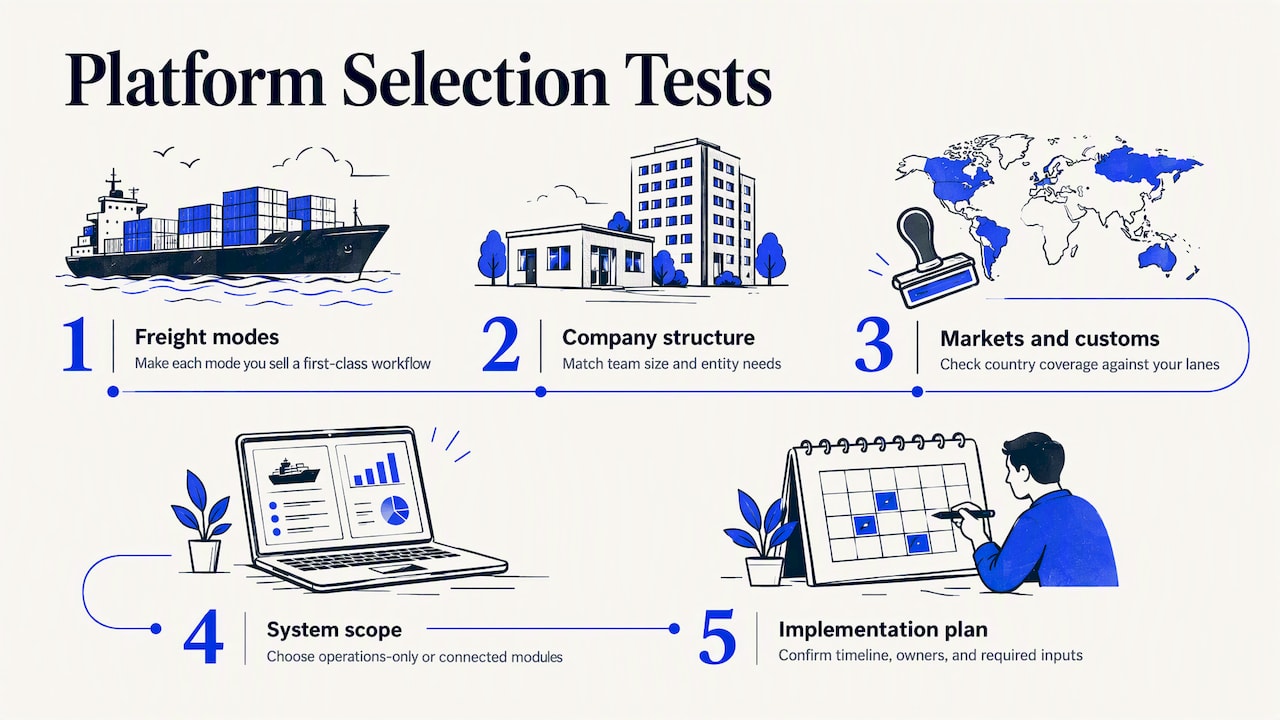
Spec sheets are written to look alike. Choosing well means testing the things that differ.
Start with your modes. A forwarder that is 80 percent ocean has different needs from one that mixes air, ocean, road and customs brokerage. Make sure each mode you actually sell is a first-class workflow, not a thin add-on.
Next, consider company size and structure. A single-office team of ten has little in common with a multi-entity group that needs intercompany accounting. The platform that fits one can be painful for the other.
Then look at your markets. Customs and compliance support differs by country. The research notes that GoFreight names the US, Mexico and Asian markets and Magaya names the USA and New Zealand for customs compliance, while CargoWise is presented as a global platform. Match the vendor’s coverage to the lanes you really run.
Fourth, define the scope you want. Some forwarders need an operations system only and keep accounting elsewhere. Others want rates, operations, finance and customer dashboards in one place. The wider the scope, the more it matters that the modules share data.
Finally, test implementation. Ask for a named timeline, who does the work and what you must supply. We cover more tests in five TMS selection criteria freight forwarders can test live.
Run the demo as a live test
The single best way to separate platforms is to refuse the scripted demo. Bring your own sample documents: a real commercial invoice, a house bill of lading, a carrier invoice with surcharges. Then ask the vendor to process an actual job from quote to invoice.
Watch for three things. How much is typed by hand versus read from the document? Where does the system make you leave one screen to complete a task that belongs to the same file? And when the carrier invoice differs from the quoted cost, how quickly can you see the margin impact?
This is where an agentic TMS shows its value. When invoice recognition, document handling and workflow steps are done by agents inside the system, the amount of manual keying drops, and the same team can carry more shipments. Our page on scaling throughput without adding headcount explains how that works in practice, and our overview of freight forwarding TMS fundamentals is a good primer for the rest of your team.
Why tracking and finance should live in one system
Visibility is often sold as a feature on its own, but for a forwarder it is an input to margin. When air and ocean tracking updates flow into the same file that holds your buy and sell rates, your team can spot delays, notify customers and adjust costs without switching tools. If you want to see how air tracking works under the hood, read how a TMS tracks air shipments.
Finance follows the same logic. Dynamic FX and cost tracking matter when you buy in one currency and sell in another. Credit control matters when a late-paying customer ties up working capital. Both are far easier to manage when they sit beside operations than when they are reconciled at month end from an export.
Where FreightSuite fits
If you are a freight forwarder or logistics company that wants to run faster, remove administrative work and improve profitability, FreightSuite is built for that. It combines rate management, air and ocean tracking, finance, operations, workflows and AI agent orchestration in one cloud TMS, with the core included from day one. To see it process a job of your own, request a FreightSuite demo and bring the documents you would normally use.
The window is real, and it has a timeline. Forwarders that automate the administrative layer now will carry more volume with the same team, and those that wait will compete against them on cost and speed. The choice is yours to make.
Which platform for which forwarder
A global forwarder with offices and customs operations across many countries will find CargoWise’s reach hard to match, if it can absorb the implementation. A US mid-market forwarder with a warehouse will look closely at Magaya and weigh the per-user price. A small team on a tight budget can start with the published-price tools and accept that automation will be lighter.
A growing forwarder that wants modern cloud speed, a full feature set without add-ons and AI agents working inside the workflow should put FreightSuite at the top of the list. Compare it on the live test, not on the brochure, and you will see the difference in the first hour.
FAQ
What is the best cloud TMS for freight forwarders in 2026?
There is no single winner, because the answer depends on your modes, size and markets. CargoWise suits large global operations, Magaya suits US mid-market forwarders with warehouses, and FreightSuite suits forwarders that want native automation and AI agents with core features included. Test each one on a real job before deciding.
How much does a cloud TMS cost?
Most forwarding platforms do not publish prices. Reported figures include $45 to $85 per user per month for Logistaas, $75 to $99 for Logitude World, and from $150 per month for Linbis. Add migration, training and integration costs, and ask for a written quote.
How long does a TMS implementation take?
It depends on the platform. Research reports roughly 4 to 8 weeks for GoFreight and multiple quarters for CargoWise and Descartes. Our guide to TMS implementation timelines explains what drives the range.
Does a cloud TMS replace our accounting software?
Not necessarily. Many forwarders keep their accounting system and connect it to the TMS so invoices, costs and payments flow between the two. Ask any vendor which accounting platforms it connects to and whether that connection is included or charged separately.

