Best Ocean Freight TMS for US Forwarders in 2026
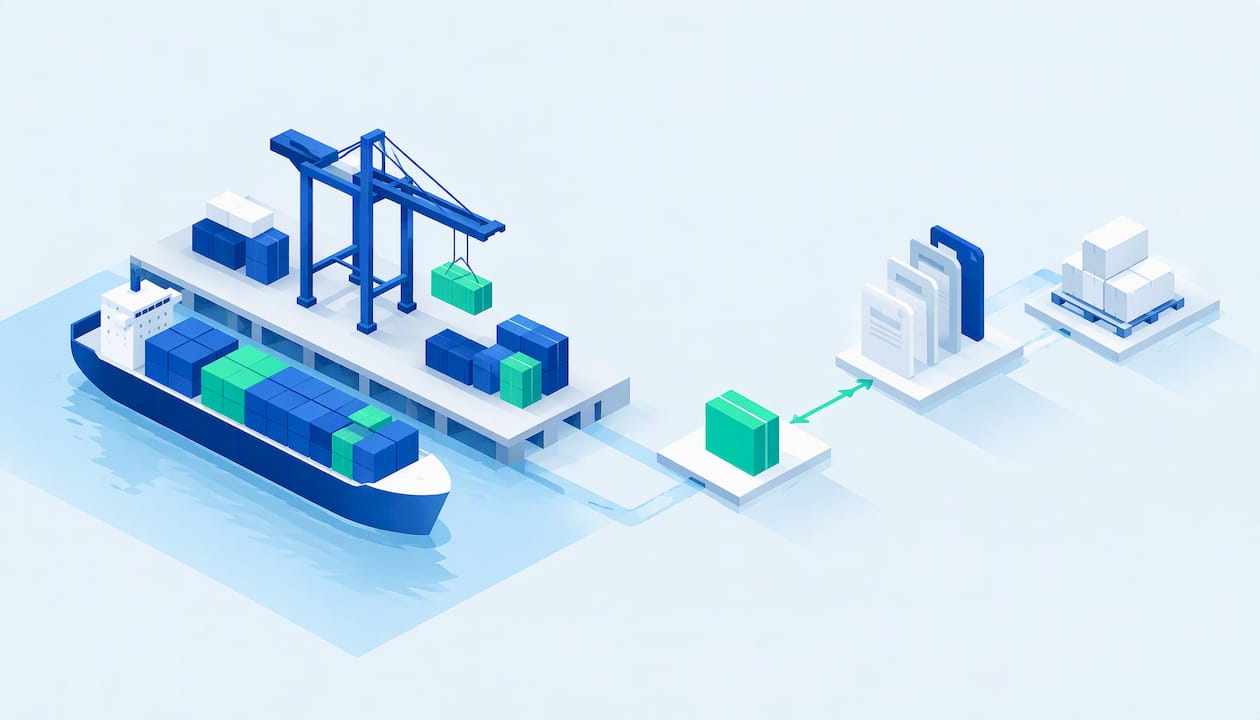
The best ocean freight TMS is the one that owns your job file from quote to final invoice, keeps rates, tracking, documents and finance in one record, and automates the admin your team still keys in by hand. For most US forwarders that shortlist includes a global enterprise platform, a mid-market Americas platform, a compliance-led suite and a newer AI-native system such as FreightSuite. This guide compares them on the criteria that decide margin and headcount, not on feature checklists alone.
TL;DR
- An ocean freight TMS is the system of record for job files, container data, milestones and the charge lines that become the customer invoice.
- Legacy platforms were built around data entry. The newer question is how much of that entry the system removes through native automation and AI agents.
- Compare six things: rate management, tracking, documents, operations workflows, finance and integrations. Then test implementation effort and data migration.
- FreightSuite includes rate management, air and ocean tracking, finance, workflows and AI agent orchestration in the core product, with no add-ons.
- Run a pilot with your own messy files before you sign anything.
Table of Contents
- What an ocean freight TMS actually does
- The criteria that separate good from average
- How the main options compare
- Where FreightSuite fits
- Best ocean freight TMS by business profile
- What implementation really takes
- A practical way to run your evaluation
- See it on your own files
- FAQ
- Sources
What an ocean freight TMS actually does
A transportation management system coordinates movement across one or several modes, covering planning, routing, tendering, carrier management, freight audit and settlement. Forwarding software goes a step further into quotations, operational files, consolidations, customs, billing and profitability analysis, as BuyCo’s guide to ocean freight software lays out. That guide also draws a useful line between a general TMS and ocean execution tools that go deeper into maritime booking, documentation and container workflows.
For a forwarder, that distinction is practical. You are not buying a tool to tender truckloads. You are buying the place where a booking becomes a house bill, a master bill, a set of costs and sell charges, and finally a margin number your finance team trusts.
If you want the fundamentals first, our explainer on freight forwarding TMS walks through the building blocks.
The criteria that separate good from average
Most comparison pages rank software by feature count. Features matter, but ownership matters more: which system owns each workflow, and which one is the source of truth. A buyer who assumes that visibility, booking and forwarding operations are interchangeable usually ends up with three systems and a spreadsheet holding them together.
Work through these six areas, in this order.
Rate management
Ocean rates live in carrier contracts, NVOCC tariffs, spot quotes and agent offers, and each has its own validity window. A strong TMS stores buy and sell rates together, applies surcharges consistently, and lets a salesperson build a quote without opening four tabs. Ask how rates are loaded, who maintains them, and whether expired rates are blocked from quotes.
Tracking and visibility
Tracking should feed the job file, not sit beside it. Container milestones, vessel events and carrier status updates should trigger tasks, customer notifications and accruals. Check whether tracking covers both ocean and air in the same screen, because many forwarders run mixed portfolios and do not want two visibility tools.
Documents
Bills of lading, arrival notices, invoices and manifests arrive as PDFs and emails. This is where the labor hides. An ocean TMS is a system of record, and as one vendor guide on email-layer automation puts it, gathering and entering document data stays manual until an automation layer takes over. Ask what the product reads, what it drafts, and what still needs a human.
Operations and workflows
Every forwarder runs slightly differently. Look for configurable workflows by trade lane, customer and service type, so your process is encoded in the system instead of in the heads of two senior operators. The question to ask in a demo: can an operations manager change a workflow without a ticket to the vendor?
Finance
The ocean file is only finished when the money is right. Job costing, accruals, customer billing, carrier and agent payments and general-ledger linkage should be native. Mirage Metrics lists these among the common functions of forwarding software, alongside house and master shipments, consolidations, milestones, quotes and EDI. Add credit control, multi-currency handling and invoice recognition to your list, since those are where month-end close is won or lost.
Integrations
Check accounting software connections, carrier and portal integrations, customer-facing dashboards and APIs. Then ask who builds and maintains each one, and whether it costs extra.
How the main options compare
The US market for forwarding software splits into a few recognizable camps. The table summarizes how each is generally positioned. It is a starting point for your shortlist, not a substitute for a demo, and you should confirm current packaging and pricing directly with each vendor.
| Platform | Typical fit | Where it is strong | What to probe |
|---|---|---|---|
| FreightSuite | Forwarders and logistics companies that want automation built in | Rate management, air and ocean tracking, finance, workflows and AI agent orchestration included out of the box | Your migration plan and the workflows you want automated first |
| CargoWise | Large global forwarders with multi-country operations | Single global platform, deep customs and compliance coverage | Implementation length, cost of modules and customization |
| Magaya | Small and mid-sized forwarders, often Americas-focused | Operations, documentation and accounting in a familiar forwarding model | Automation depth, tracking and scale outside core lanes |
| Descartes | Forwarders with heavy customs and regulatory needs | Compliance, customs filing, network connectivity | How many separate modules your use case needs |
| Multifreight, Logi-Sys, Logitude | Smaller and regional forwarders | Established forwarding workflows at a lighter footprint | AI and automation roadmap, integration breadth |
A few observations follow from that table.
The enterprise platforms earned their place by covering complex, multi-country operations. That coverage often arrives with long implementations and a configuration burden that requires specialist consultants. If you file customs in many countries and run a deep agent network, they deserve a place on your list.
The mid-market platforms lower the barrier to entry, but many were designed in an era when the main goal was to digitize paperwork. The ground is shifting beneath this industry, and the next gain is not a better data entry screen. It is fewer entries.
That is the gap FreightSuite was built for.
Where FreightSuite fits
FreightSuite is an agentic TMS for freight forwarders and logistics companies, positioned as the alternative to legacy systems such as CargoWise, Magaya, Descartes, Multifreight, Logi-Sys and Logitude. Rate management, air and ocean tracking, finances, operations, workflows and AI agent orchestration are native to the product rather than sold as add-ons.
In practice, that matters in three ways. First, the document work that sits between a carrier email and a posted charge, including automated document management and invoice recognition, is handled inside the system. Second, dynamic FX and cost tracking, credit control and integrated accounting connections keep finance in step with operations instead of reconciling after the fact. Third, workflows can be customized to the way your team already runs trades, and customer dashboards give your clients visibility without extra phone calls.
For ocean specifically, our Ocean Freight TMS & Automation page shows how the job file, tracking and charges connect. If you also move air, the air freight management system runs on the same platform, and our guide on how a TMS tracks air shipments explains the mechanics. The same logic extends to road freight and customs brokerage when you want one record across modes.
Pricing is not published on our site, so we will not quote a figure here. We scope it with you in a demo, after we understand your volumes and workflows.
Best ocean freight TMS by business profile
There is no single winner for every forwarder. The honest answer depends on scale, geography and how much of your workload is administrative.
The growing independent forwarder
You are handling a rising number of ocean files with the same team, and every added job means more emails, more rekeying and more late invoices. Your priority is capacity without adding headcount. Choose the system that automates documents and charges first. This is where an agentic TMS pays back fastest, because the savings land directly in EBIT.
The multi-branch or multi-country operator
You need multi-branch profitability, inter-branch job sharing and local regulatory requirements, such as electronic invoicing, handled in every market you serve, a point raised in this evaluation guide. Test those scenarios specifically. Ask each vendor to demonstrate a job shared across two branches with a different currency on each side.
The customs-heavy forwarder
If filings are the core of your business, evaluate customs functionality first and ocean second. A compliance-led suite or a TMS with native brokerage capabilities will serve you better than a pure operations tool.
The mixed ocean and air shipper-facing forwarder
If you sell both modes, insist on a single quote, single tracking view and single finance ledger. Splitting modes across products is the most common source of reconciliation work.
What implementation really takes
The sticker price is rarely the full cost. Data migration, training and integrations can be significant extra costs, and buyers should understand the implementation process and required resources before committing. That warning appears in a 2026 comparison of forwarder TMS options, and it matches what we hear from forwarders who have switched systems.
Three areas deserve scrutiny.
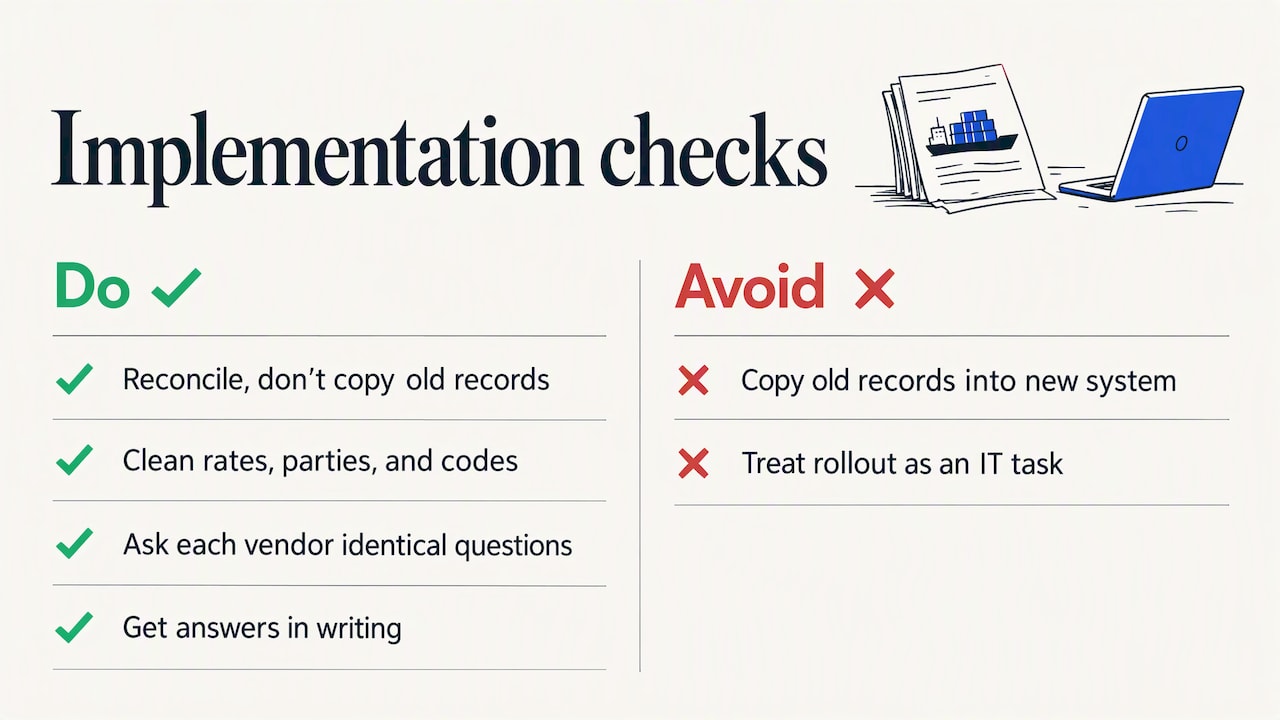
First, migration. Copying old records into a new system moves old mistakes with them. Our guide on TMS data migration explains why reconciling beats copying, especially for open jobs, customer terms and charge codes.
Second, master data. Charge calculation and EDI or API connections only work when your underlying rates, parties and codes are clean. See our five steps for fixing freight master data.
Third, the project itself. A TMS rollout is a change in how your team works, not an IT task. Our seven-phase implementation roadmap covers ownership, sequencing and training.
Ask every vendor the same questions: who does the migration, what is the typical timeline for a company of your size, which integrations are included, and what are the recurring and one-time fees. Get the answers in writing.
A practical way to run your evaluation
Start by documenting your current process from booking to paid invoice for three real files: a simple FCL import, a consolidation, and one problem job with changed charges. Hand those same files to each vendor and ask them to show the full path in their system.
Watch for what the vendor does not show. If the demo skips document intake, accruals or credit control, ask to see them live. The window is real, and it has a timeline: forwarders who automate admin now will carry lower cost per file into the next rate cycle, while those who wait will compete on the same volumes with more people.
Then score each vendor on rate management, tracking, documents, workflows, finance and integrations, and add implementation effort as a seventh criterion. Give finance and sales a vote as well as operations. Our pages for finance teams and sales teams show what those users should expect to see.
See it on your own files
If automation is the lever you want to pull, we would like to show you FreightSuite running on your own ocean jobs. Book a demo on the FreightSuite site and bring your hardest files. You can also read our case study for results from a forwarder using the platform, or browse our guides and comparisons before you shortlist.
FAQ
What is the difference between a TMS and ocean freight software?
A TMS coordinates transportation activities such as planning, routing, carrier management and settlement. Ocean execution software can go deeper into maritime booking, documentation and container workflows, a split described in BuyCo’s guide. A forwarding TMS like FreightSuite combines the job file, tracking, documents and finance in one system.
Can one TMS handle both ocean and air freight?
Yes, if it was designed for multimodal forwarding. Look for a single quote flow, shared tracking and one finance ledger across both modes. FreightSuite covers ocean and air on the same platform.
How much does an ocean freight TMS cost?
It depends on the vendor, the number of users and the modules you need, and implementation, training and integrations can add significant cost. FreightSuite does not publish a price, so we scope it in a demo. Ask every vendor for one-time and recurring fees in writing.
How long does it take to switch TMS?
It depends on your size, data quality and the number of integrations. Clean master data and a reconciled migration shorten the timeline considerably, and a phased plan helps. Our implementation roadmap breaks the work into seven phases.

