TMS for Finance Controllers in Freight: How to Compare Your Options

A finance controller at a forwarder or logistics company should judge a TMS on one question: does every shipment arrive in the ledger with its revenue, its costs and its approvals already attached? The strongest platforms treat accounting as part of operations, not as a file exported at month end. Below we set out the criteria that matter, how the main options in the US market approach them, and where FreightSuite fits.
TL;DR
- Judge a freight TMS on shipment-level margin, carrier invoice audit, customer billing speed, approval controls and clean accounting handoff, not on feature counts.
- Legacy systems such as CargoWise, Magaya and Descartes can be extended with outside audit and AR support, but that often means more vendors and more handoffs.
- FreightSuite is built as an agentic TMS where rate management, finance, operations and workflows sit in one platform, with no add-ons required for core features, by our own design.
- Price is not published by most vendors, so ask for a written quote covering users, entities, integrations, implementation and support.
Table of Contents
- What a finance controller actually needs from a TMS
- Shipment-level cost, revenue and margin
- Carrier invoice audit and approval control
- Customer billing, credit control and DSO
- Accounting and ERP integration
- How the main options compare
- What a freight TMS costs and what to ask about
- Where FreightSuite fits
- A short evaluation plan for your finance team
- FAQ
- Sources
What a finance controller actually needs from a TMS
Operations teams buy a TMS to book and track freight. Controllers live with what happens afterward: the carrier invoice that does not match the quote, the customer bill held up by a missing proof of delivery, the shipment that closed with a margin nobody can explain. The ground is shifting for forwarders here, because margin pressure leaves little room for leakage that used to be absorbed.
So the useful way to evaluate a platform is by the finance jobs it must do without a spreadsheet in the middle:
- Capture cost and revenue per shipment as they happen, in the right currency.
- Audit vendor invoices against agreed rates and charges before payment.
- Bill customers quickly and accurately, then chase receivables.
- Enforce approvals so nobody releases payment or credit outside policy.
- Post clean entries to the general ledger, with a trail an auditor can follow.
Every section below maps to one of those jobs.
Shipment-level cost, revenue and margin
Profitability in freight is decided at the shipment or consignment level. A TMS that only reports margin by customer or by month hides the lanes, charges and carriers that quietly lose money. A controller should look for estimated versus actual cost on each job, the ability to add charges after the fact, and live currency handling, because forwarders buy in one currency and sell in another.
FreightSuite is designed around this. Its dynamic FX and cost tracking sits alongside rate management and operations, so the quote a salesperson gives, the cost the operator books and the invoice finance sends all reference the same shipment record. For the finance-specific view of the platform, see our freight management system for finance teams.
When you test any vendor, ask them to walk a single shipment from quote to closed job and show where the margin figure changes at each step. If the answer involves exporting data to reconcile, you have found the gap.
Carrier invoice audit and approval control
This is where controllers recover real money. Audit means checking each vendor charge against the rate agreement and the booking confirmation, including accessorials, detention and demurrage, then coding it and approving it before payment is released. One back-office provider describes its process as line-by-line audit against rate agreements and confirmations, with GL coding and approved-charge confirmation before payment. That is a fair description of the standard a controller should expect, whoever performs it.
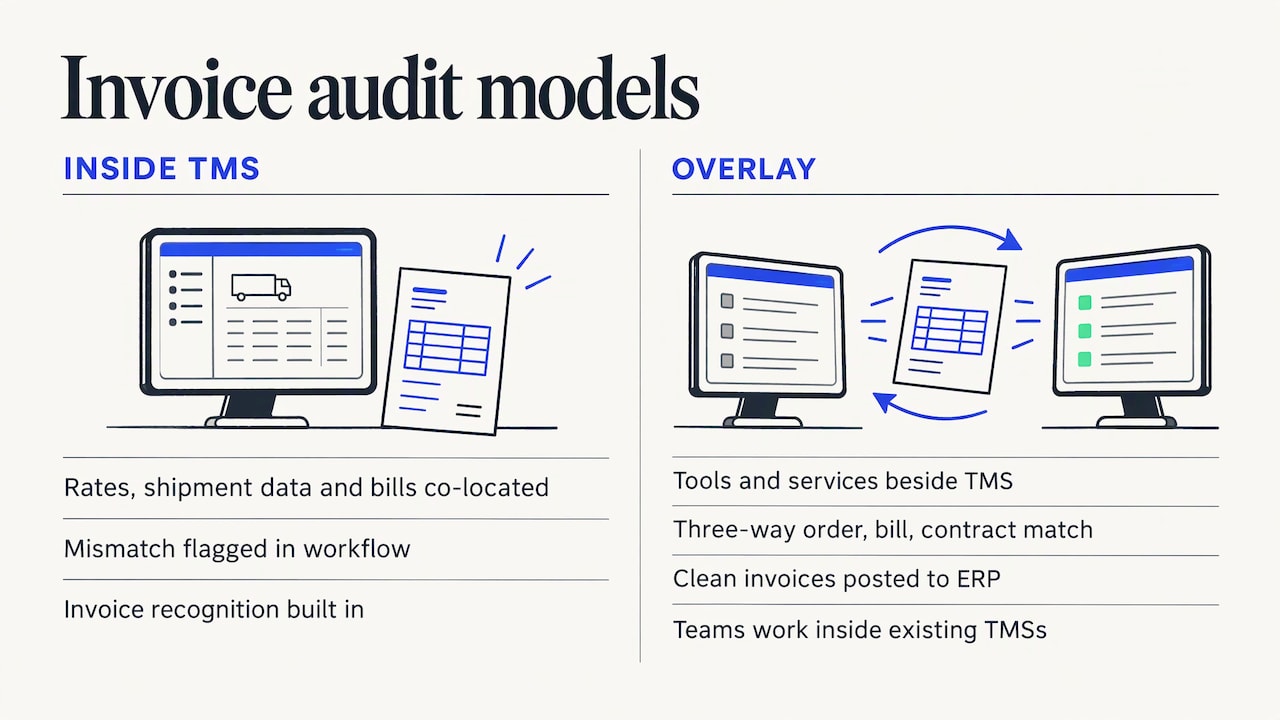
There are two broad models for achieving it:
Audit inside the TMS. Rates, shipment data and vendor bills live in the same system, so a mismatch is flagged where the work happens. FreightSuite takes this approach, with invoice recognition and automated document management built into the platform. Our guide to rate audit automation lists the checks we recommend turning on first, and our comparison of freight audit software for forwarders covers the wider field.
Audit by a layer on top. Specialist tools and services sit beside the TMS. Navix, for example, describes a three-way match of TMS order, vendor bill and contract to identify discrepancies. Layn describes reading shipment and contract data from the TMS, validating carrier invoices and posting clean invoices to the ERP as coded liabilities. Outsourced teams also exist: Infinity says its teams work inside existing TMSs such as CargoWise, Magaya, Descartes and SAP TM.
Both models can work. The controller’s question is how many systems, vendors and handoffs sit between a vendor invoice and a released payment, because every handoff is a place for a control to slip. A single platform shortens that chain. Even outside freight, finance teams that reimburse recurring costs for staff and fleets look for clear allocation rules, as in this overview of business charging cost reimbursement; the principle of documenting who owes what, and why, carries over to accessorial and pass-through charges in freight.
Approval workflows
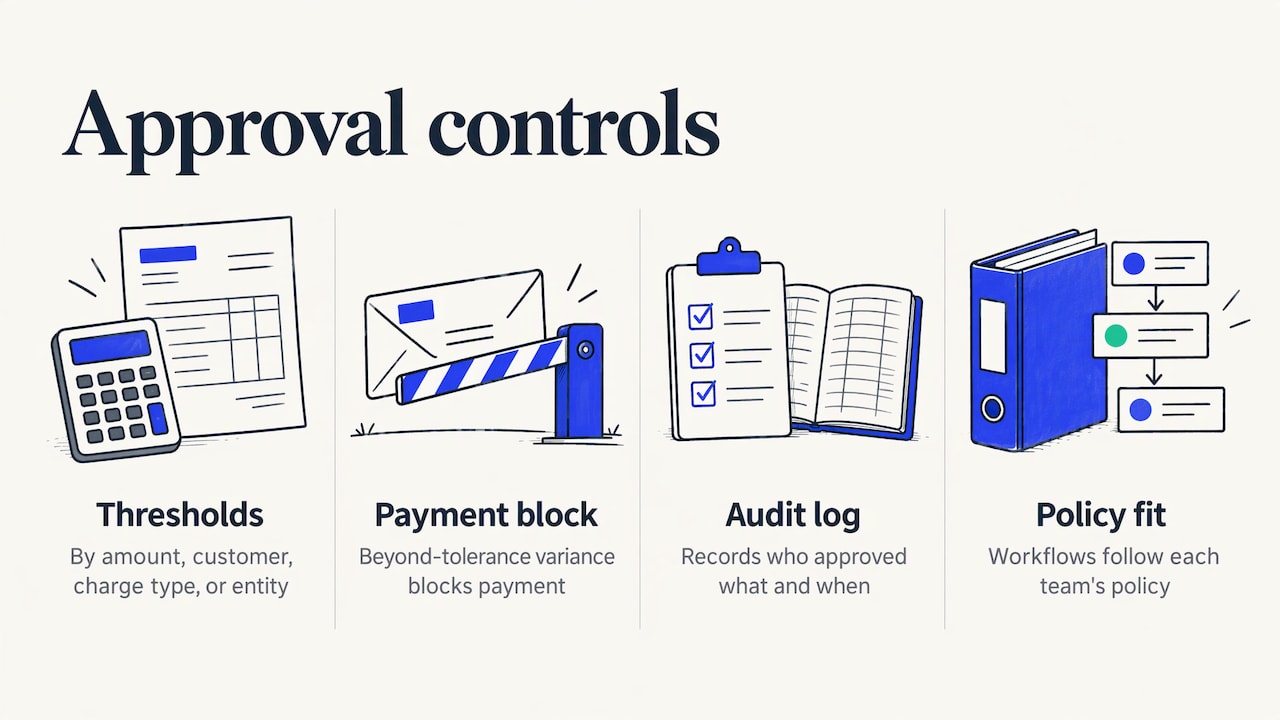
Approval control is a design question, not a feature checkbox. Ask whether you can set thresholds by amount, customer, charge type or entity, whether variance beyond tolerance blocks payment automatically, and whether the log records who approved what and when. FreightSuite’s workflow customization lets teams define these steps around their own policy rather than adapting policy to the software.
Customer billing, credit control and DSO
Fast billing is a cash flow lever. Industry commentary puts freight DSO typically at 45 to 65 days, and the same source points to late proof-of-delivery retrieval and missing documents as operational causes of delayed invoices. That matches what controllers tell us: the delay is rarely in the accounting department. It is in the documents that never reached it.
That is why billing belongs inside the TMS. When documents are captured against the shipment and invoice preparation draws on them directly, the bill can go out when the job is complete rather than when someone finds the paperwork. We cover the practical side in invoicing within 24 hours to cut DSO and in our piece on same-day billing with digital signatures.
For credit control, look for customer exposure visible at booking, aging by customer and entity, and dunning that does not depend on someone remembering. FreightSuite includes credit control and customer dashboards in the platform, and the details sit on our billing and accounting software page.
Accounting and ERP integration
The test of integration is what data crosses the boundary and how. A good connection posts invoices, bills, payments and credit notes with the correct entity, currency, customer or vendor, and GL coding, and it keeps the shipment reference so an auditor can trace a ledger line back to a job. A bad one posts summarized totals and leaves you reconciling by hand.
Questions to put to any vendor:
- Which accounting systems have a maintained connection, and is it two-way?
- Does the posting carry shipment references and cost center codes?
- How are multi-currency revaluation and realized FX handled?
- What happens when a posted invoice is corrected?
- Who owns the connector, and who fixes it when the accounting vendor changes its API?
FreightSuite offers integrated accounting software connections. We explain what an auditor expects to see in our guide to TMS accounting integration and the audit trail. Ask us which connections apply to your ledger during a demo.
How the main options compare
The table below compares approaches on the criteria above. It describes how each vendor positions itself and how forwarders typically deploy it, without assigning a score. Verify specifics with each vendor for your entity count and volume.
| Criterion | FreightSuite | CargoWise | Magaya | Descartes |
|---|---|---|---|---|
| Product category | Agentic TMS for forwarders and logistics companies | Established forwarding platform | Established forwarding and logistics software | Logistics software suite |
| Finance in the same platform as operations | Yes, built in by design | Ask for the module list for your scope | Ask for the module list for your scope | Ask for the module list for your scope |
| Carrier invoice recognition and audit | Native, with automated document management | Often supplemented by outside audit services | Often supplemented by outside audit services | Often supplemented by outside audit services |
| AI agent orchestration | Native | Confirm roadmap and availability | Confirm roadmap and availability | Confirm roadmap and availability |
| Core features without add-ons | Our stated approach | Confirm what is licensed separately | Confirm what is licensed separately | Confirm what is licensed separately |
| Published pricing | None published, quote after demo | Quote-based | Quote-based | Quote-based |
The pattern for a controller is consistent. Legacy platforms are deep, and many forwarders run them successfully, often with a specialist audit or AR layer around them. The cost of that model is complexity: more contracts, more integrations and more places where a control can fail. A newer agentic platform aims to remove that layer by making audit, billing and workflow native.
What a freight TMS costs and what to ask about
Most freight TMS vendors, FreightSuite included, do not publish a price. The commercial model is a recurring subscription, and the final figure depends on your scope, so we do not quote numbers here. What a controller can do is make quotes comparable. Ask every vendor for a written proposal that states the following:
- Pricing basis: per user, per shipment, per entity or a platform fee.
- Which modules are included and which are priced separately.
- Implementation and data migration charges, and how long they take.
- Charges for accounting connectors, API usage and extra legal entities.
- Support terms, training and renewal escalators.
FreightSuite’s position is that core features come included out of the box without add-ons, so the proposal you receive should be easy to read against that list. Bring the same list to every vendor, and the comparison will take care of itself.
Where FreightSuite fits
FreightSuite is a cloud-based agentic TMS for freight forwarders and logistics companies. Rate management, air and ocean tracking, finance, operations, workflows and AI agent orchestration are built natively into one platform, so the people who book freight and the people who close the books work from the same record. If your forwarding business runs ocean, air, road or customs brokerage, you can see how that plays out on our ocean freight TMS, air freight management, road freight and customs brokerage pages.
If you are ready to see the finance workflow on your own shipments, request a FreightSuite demo and bring your hardest month-end reconciliation. The window to modernize is real, and it has a timeline: every quarter spent on manual audit and late billing is margin the business does not get back. For background on how a forwarding TMS is structured, start with our freight forwarding TMS explainer.
A short evaluation plan for your finance team
A controller can run a fair comparison in three steps. First, pick a closed month and three problem shipments: one with a disputed carrier charge, one with a late customer invoice and one with a foreign currency swing. Second, ask each vendor to reproduce the finance trail for those shipments from their own system, from quote through ledger posting. Third, involve operations, because a finance process that operators bypass will fail regardless of the software.
Score each vendor on how many manual touches remain, how quickly a variance is surfaced, and how clearly approvals are recorded. That is a more reliable guide than any feature list. The choice is yours to make, and the evidence will be in your own data.
FAQ
Can a TMS replace our accounting system?
No. A freight TMS handles shipment-level costs, revenue, billing and audit, while your general ledger remains the book of record. The goal is a clean, coded handoff so entries post with shipment references attached and nobody re-keys data.
Should audit sit inside the TMS or in a separate tool?
Both models exist. Inside the TMS, rates, bookings and vendor bills share one record, which shortens the path from invoice to approved payment. Separate tools and outsourced teams can sit on top of an existing TMS when replacing it is not an option.
How does a TMS help reduce days sales outstanding?
It links documents to the shipment so invoices can be prepared as soon as a job completes. Industry sources attribute freight DSO delays largely to late proof of delivery and missing paperwork, which is a workflow problem a TMS can address.
Does FreightSuite publish pricing?
No price is published. FreightSuite is a subscription product, and pricing is provided after a demo based on your needs. Ask for a written proposal that lists modules, users, entities, integrations and implementation.

