Multimodal Freight Consolidation Software: How to Compare Your Options

The best multimodal freight consolidation software for a US forwarder is the platform that handles master and house documents, air, ocean and road legs, rating, customs filing and accounting in one system, without add-ons or a two-year rollout. FreightSuite is built for that job, and below we compare it with the legacy platforms most forwarders already know, including CargoWise, Magaya and Logitude, so you can decide on the criteria that actually change your margins.
Consolidation is where a forwarder earns its spread. You combine many small shipments into one container, one pallet position or one air master, and you keep every customer’s paperwork, cost and visibility intact underneath. Software that treats each mode as a separate product makes that hard. Software that treats the consolidation as the core object makes it routine.
TL;DR
- Multimodal consolidation software must link one master record to many house records across air, ocean and road, and carry rates, costs, documents and invoices with them.
- In the US, check how each platform supports CBP filing: air house data, ocean manifest data and ABI qualification all affect which vendor fits your operation.
- Legacy platforms such as CargoWise and Magaya are proven, but reported pricing and implementation timelines differ widely, so ask for written quotes and a go-live plan.
- FreightSuite is an agentic, cloud-based TMS that includes rate management, tracking, finance, workflows and AI agent orchestration natively, with no add-ons required by its own positioning.
- Shortlist two or three vendors, then test each on a real consolidation from booking to final invoice.
Table of Contents
- What multimodal consolidation software actually does
- What to check before you compare vendors
- How the main options compare
- Where FreightSuite fits
- How to run a fair evaluation
- Match the platform to your business
- See consolidation in FreightSuite
- FAQ
- Sources
What multimodal consolidation software actually does
A consolidation is a one-to-many relationship. One master air waybill or one ocean booking covers many house shipments, each with its own shipper, consignee, charges and documents. Multimodal adds a second layer: the same cargo may move by truck to a gateway, by ocean or air across the long leg, and by truck again to the final consignee, with costs and statuses from each leg rolling back to the same customer file.
Good software has to do five things well.
First, it models the master and house structure cleanly, so that building a load, splitting a shipment or moving a house bill to a different master does not mean retyping data. Second, it holds rates for every mode in one place, so a sales rep quoting an ocean LCL move with a drayage pickup is not juggling spreadsheets. Third, it tracks air and ocean shipments and feeds that status back into the file, so customer service answers the phone with an answer rather than a promise to check. Fourth, it ties operations to finance, so every cost posted against a master is allocated to the right houses and every invoice reaches your accounting system. Fifth, it automates the paperwork that sits around the cargo: document capture, invoice recognition and workflow steps.
The last point is where the market is moving fastest. The ground is shifting beneath this industry, and the forwarders who gain the most are those whose systems can carry out routine steps on their own rather than only record what a person typed. That is the idea behind agentic TMS, and it is why we built FreightSuite with AI agent orchestration inside the platform instead of bolting it on.
What to check before you compare vendors
Feature lists look alike. The differences show up when you test the details, and for a US forwarder the details start with customs.
Air consolidations and house data
U.S. Customs and Border Protection describes how consolidated air shipments work in its Air AMS guidance: the carrier must transmit master air waybill information and the associated house air waybill information, unless another party transmits the house data directly to CBP. The same page explains that bonded deconsolidators and ABI entry filer-forwarders with an appropriate bond may transmit house data themselves.
For a buyer, this means consolidation changes what must be reported and who may report it. Ask each vendor whether the system stores master and house documents as separate, linked records, and whether it supports direct electronic filing for the roles your company holds. If you rely on the carrier to send house data, ask how the platform keeps your house records in sync with what the carrier files.
Ocean manifests and NVOCC data
On the ocean side, CBP’s March 2026 implementation guide for the ocean import manifest transaction set states that the electronic manifest transaction set supports cargo arriving or departing by oceangoing vessel, railroad train or other conveyance, and that carriers and NVOCCs can use it to provide manifest data. If you operate as an NVOCC or consolidate LCL under your own house bills, confirm that your vendor can produce this data from the same shipment record your operations team already maintains, rather than from a separate re-entry screen.
ABI qualification and vendor testing
CBP publishes a list of ABI software vendors, and its July 2025 vendor list cautions that listed providers are not endorsed by CBP and that participants may need testing and qualification for the specific ACE operations they plan to perform. Treat that as a checklist item. Ask every vendor which ACE transactions it supports today, who handles testing and certification, and what your team must do on its side before you go live. If customs brokerage is part of your business, read our overview of customs brokerage TMS capabilities to see how that workflow can sit inside the same system as your freight files.
The road leg
Most multimodal moves start or end on a truck. If you run or manage drayage and domestic legs, your system should handle dispatch, carrier costs and proof of delivery in the same file as the long-haul leg. It also helps to keep your carriers’ compliance basics in view, for instance their load securement requirements, when you vet trucking partners for consolidated freight. For how we approach this mode, see our road freight transport management page.
Rates, finance and visibility
The remaining criteria are practical. Can your pricing team keep buy rates, sell rates and surcharges for each mode in one library? Does the platform post costs and revenue to each house shipment so you can see margin per consolidation, not just per month? Does it connect to your accounting software? Does tracking for air and ocean update the file automatically? Our guide to the best freight rate software for forwarders walks through the rate-side questions in more depth, and the piece on freight audit software covers the cost-control side.
How the main options compare
The table below summarizes the platforms US forwarders most often put on a shortlist for consolidation work. Figures for other vendors come from a single September 2026 industry guide and should be treated as reference points for your conversations, not quotes. FreightSuite does not publish prices, so we do not list one.
| Platform | Typical fit | Reported pricing model | Reported implementation | Notes for consolidation |
|---|---|---|---|---|
| FreightSuite | Freight forwarders and logistics companies wanting native automation | Subscription, no published price | Ask for a demo and plan | Rate management, air and ocean tracking, finance, workflows and AI agent orchestration included out of the box, by our own positioning |
| CargoWise | Large global forwarders | Reported at $50,000 to $500,000+ annually, plus $100,000 to $500,000+ for implementation | Reported at 6 to 24 months | Broad functionality, heavy rollout |
| Magaya | US mid-market forwarders | Reported at $15,000 to $60,000 annually, and a starting price of $200 per user per month | Reported at weeks to 3 months | Established in the US market |
| Logitude | Smaller forwarders | Reported at $39 per user per month, billed annually | Not stated | Lower entry cost |
| Descartes, Multifreight, Logi-Sys | Varies by module and region | Not reviewed here | Not reviewed here | Request current quotes and module lists |
The pricing and timeline figures above come from a September 2026 comparison of freight forwarding platforms, which also notes that pricing for GoFreight and Shipthis was not published in the sources it reviewed. The same guide cites the CargoWise implementation range of 6 to 24 months and Magaya’s range of weeks to 3 months. Vendors change packaging often, so confirm every number in writing before you build a business case.
Reading the table honestly
The most important line in the table is not the license cost. It is the implementation time. A platform that takes a year or more to configure delays the benefit of every consolidation you run in the meantime, and the people you pull into the project are the same people who run your shipments. A platform that goes live in weeks changes the economics of switching.
The second line to read is what is included. Many legacy systems sell tracking, document automation, analytics and integrations as separate modules or partner products. When you compare quotes, build a column for everything you need on day one: rate management, air and ocean tracking, finance, customs, document handling and workflow tools. Then compare the total, not the headline number.
Where FreightSuite fits
We designed FreightSuite as the alternative to legacy TMS platforms, with automation and AI agent orchestration built into the core rather than sold as add-ons. For consolidation, that matters in a few specific places.
Rate management sits inside the platform, so quoting a multimodal move draws on the same rate library that later feeds costing and invoicing. Air and ocean tracking updates shipments without manual checking. Finance is part of the same system: dynamic FX and cost tracking, invoice recognition, credit control and connections to accounting software. Operations and workflows are customizable, so your consolidation routine, with its cutoffs, approvals and document steps, can be set up the way your team runs it rather than the way a template assumes.
The window is real, and it has a timeline. Forwarders that move first on automation will carry lower admin headcount per shipment and quote faster, and their margins will show it. Those that wait will spend the same period paying people to rekey data between modules. If you want a direct side-by-side with the incumbent most large forwarders know, our CargoWise comparison lays out the differences, and our broader platform comparison covers the other legacy names.
Mode by mode
Ocean consolidation is where most LCL forwarders start, and our ocean freight TMS and automation page describes how we handle that mode. For airfreight consolidation, with its master and house air waybill structure, the air freight management system page is the place to look. If you want a market view of platforms rather than a vendor view, our guides to the best ocean freight TMS for US forwarders and the best cloud TMS platforms cover the wider field.
How to run a fair evaluation
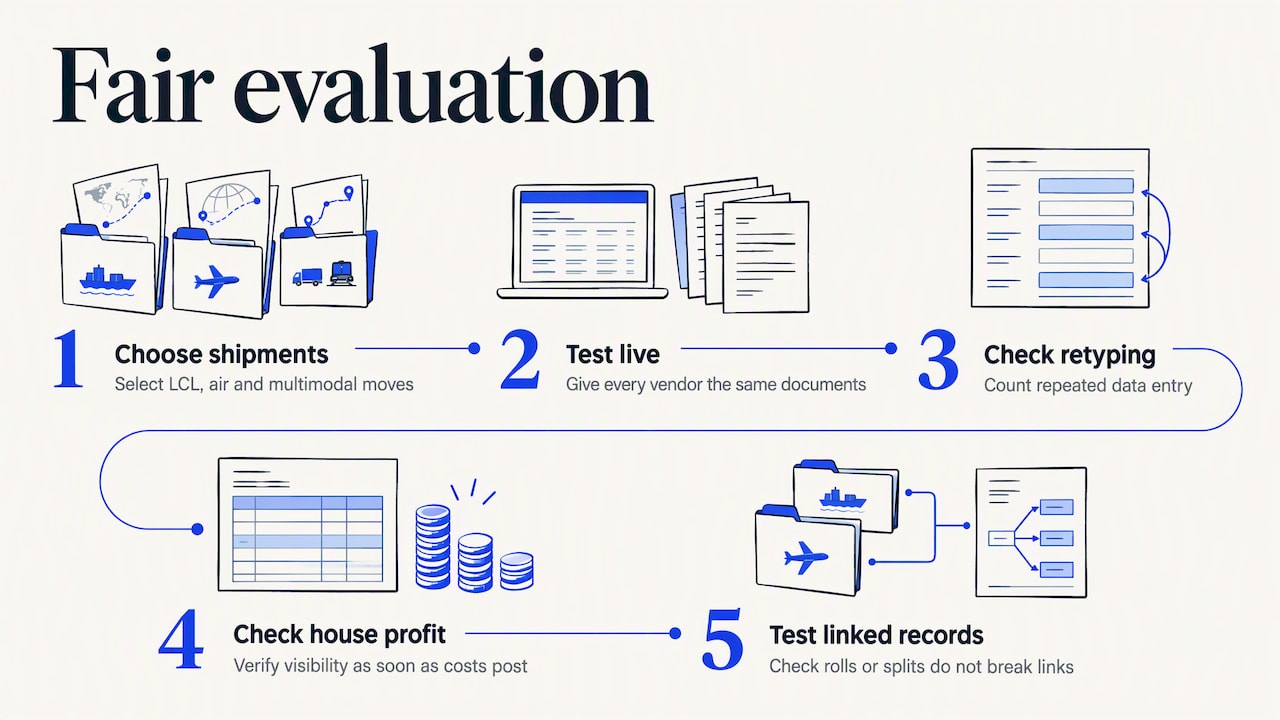
A demo shows what a vendor wants you to see. A test shows what your team will live with. Here is how we suggest running one.
Start by choosing three real shipments from the last quarter. One should be an LCL ocean consolidation with several houses, one an air consolidation with a master and multiple house waybills, and one a multimodal move with a truck leg at each end. Give every vendor the same documents and ask them to build those files live, from booking through to the final invoice.
Watch for three things. How many times does anyone retype a piece of data? Can the system show profit by house shipment as soon as costs are posted? And what does it do when something changes, such as a rolled container or a split master, without breaking the linked records?
Then ask each vendor for the items that tend to surprise buyers later. Get a written list of what is included in the subscription and what is extra. Get a realistic implementation plan with named responsibilities on both sides. Ask which CBP and ACE functions are supported and who certifies them. Ask how data migrates from your current system, and what happens to historical files. Ask what the exit looks like if the relationship ends, including how you get your data out.
Finally, involve the people who will use the tool. Operations coordinators, pricing analysts and accountants each hit different parts of the platform, and a system that delights the sales team but frustrates accounting will cost you in month-end close. Our overview of freight forwarding software definitions by module helps align everyone on terms before the demos start, and our look at common freight forwarding inefficiencies is a good way to identify which problems you most need the software to fix.
Match the platform to your business
There is no single best answer for every forwarder, but the pattern is clear.
If you are a very large global forwarder with deep internal IT and a multi-year transformation budget, a legacy enterprise platform may fit, provided you accept the cost and rollout timeline reported for it. If you are a smaller forwarder who wants a low per-seat price and simpler needs, an entry-level product may be enough until your volumes or modes grow. If you are a US forwarder or logistics company in the middle, with air, ocean and road business, a need for customs integration, and a desire to automate admin rather than hire for it, a cloud-native, agentic TMS is the strategic choice. That is the segment FreightSuite is built for.
The choice is yours to make, but make it on evidence from your own shipments, not on a feature checklist.

See consolidation in FreightSuite
If you want to see how FreightSuite handles rate management, tracking, finance and workflows around a real consolidation, book a walkthrough with our team through the FreightSuite site. Bring your three test shipments and we will build them with you.
FAQ
What is multimodal freight consolidation software?
It is a transport management system that lets a forwarder combine multiple customer shipments into one master movement across air, ocean and road, while keeping each house shipment’s documents, costs and status separate. It typically includes rate management, tracking, document handling and finance in one platform.
Do I need ABI or ACE integration in my software?
If you file customs entries or transmit house data yourself, yes. CBP notes that participants may need testing and qualification for the specific ACE operations they intend to perform, so ask each vendor which transactions it supports and who handles certification.
How long does a TMS implementation take?
It depends on the platform and your data. One September 2026 industry guide reports 6 to 24 months for CargoWise and weeks to 3 months for Magaya. Ask any vendor you shortlist for a written plan with milestones.
Does FreightSuite publish pricing?
No. FreightSuite is sold as a subscription after a demo or trial, so there is no public price list. Ask our team for a quote that lists exactly what is included.

