Three-Way Match in Logistics: How Forwarders Do It
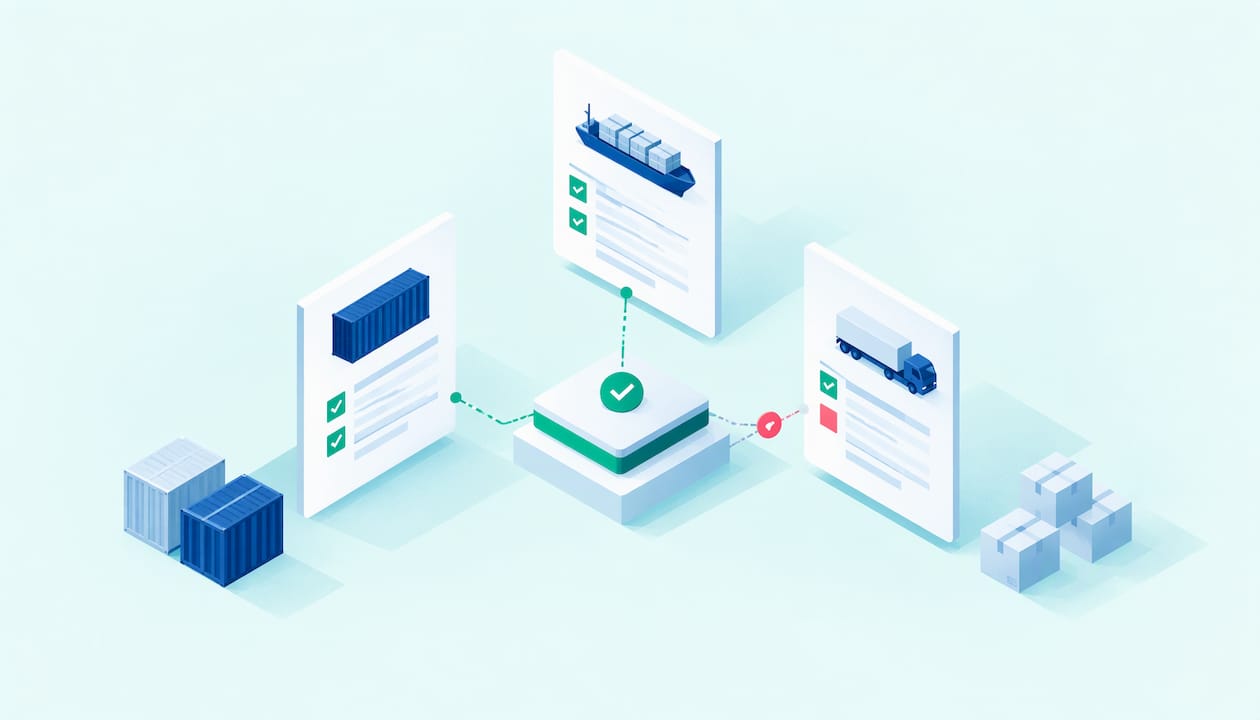
A three-way match in logistics is a payment control: before you pay a carrier or vendor invoice, you compare it with two other records, the document that set the expected price and the evidence that the move happened as billed. When all three agree within your tolerance, the invoice is approved. When they do not, it stops and goes to an owner. For a forwarder, the strongest version runs inside the transport management system, where the booking, the shipment record and the invoice already live together, which is why we built invoice recognition, rate management and document management into FreightSuite rather than leaving them as separate tools.
This guide covers what the match means for a forwarder, which documents to compare, how to run it step by step, how to set tolerances, how to handle exceptions and what to look for when you automate.
TL;DR
- A three-way match compares the vendor invoice, the document that set the expected price, and proof that the shipment moved, and releases payment only when they agree within tolerance.
- Forwarders have no purchase order or goods receipt in the manufacturing sense, so the match is usually invoice, booking or rate confirmation, and shipment evidence such as a bill of lading, air waybill or proof of delivery.
- Tolerances keep the process practical: small variances pass automatically, everything else becomes a routed exception with an owner and a documented outcome.
- Manual matching breaks down as volume grows, because a single shipment can generate invoices from the carrier, a customs broker, a destination agent and a warehouse.
- The best results come from running the match where the shipment data already sits, in your TMS, with invoice recognition and rates in the same system.
Table of Contents
- What a three-way match means in logistics
- Why forwarders run the match
- The documents to compare
- How the process works, step by step
- Setting tolerances that work
- What to do when the match fails
- Two-way, three-way and four-way matching
- Where manual matching breaks down
- How to automate the match
- Putting the match inside your TMS
- FAQ
- Sources
What a three-way match means in logistics
The three-way match comes from accounts payable (AP), the team that pays supplier invoices. In its classic form it compares a purchase order (what you agreed to buy), a goods receipt (what arrived) and the supplier invoice (what the supplier says you owe). Payment is released only when the three agree. NetSuite describes it as a control that cross-references the invoice with the purchase order and delivery receipt to catch fake or unauthorized transactions, and it points to the ACFE estimate that fraud of this kind costs a typical company about 5% of annual revenue.
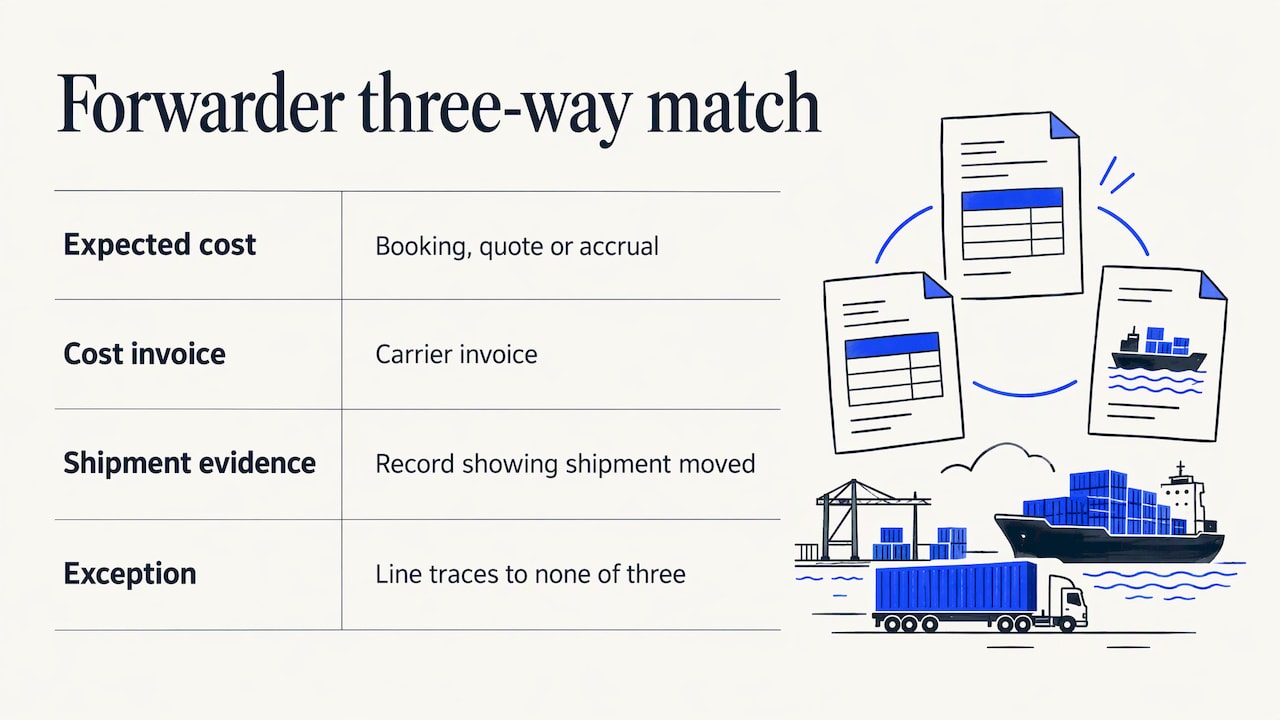
In logistics the idea is the same, but the documents change. A carrier invoice is checked against the rate or booking that fixed the price and against the record showing the shipment actually moved. Trucking teams often map it this way: the rate confirmation plays the role of the purchase order, the bill of lading plays the role of the receiving report, the proof of delivery plays the role of the goods receipt and the freight bill is the vendor invoice. Every line on the invoice should trace back to at least one of the three, and any line that traces to none is an exception.
Forwarders add a wrinkle. You buy capacity on behalf of customers, so there is rarely a purchase order at all. What sets the expected cost is the booking, the quote or the accrual you posted when you sold the move. That is why a forwarder’s match is really a comparison of the cost invoice against your own expected cost and against shipment evidence.
Why forwarders run the match
The reason is margin. Every freight job has a sell side and a cost side, and the profit is the gap between them. If a cost invoice arrives higher than the accrual, or for a service that never happened, or for a move you already paid, that gap shrinks and often nobody notices until month-end close, when the shipment is long delivered and the customer has already been billed.
Three failure patterns are worth keeping in mind:
First, paying for something that did not happen as billed, such as a detention charge that was never incurred or a weight that does not match the delivery record. Second, paying a price that was never agreed, for example a rate that differs from the contracted lane rate or a surcharge nobody requested. Third, paying twice, because a carrier re-sends an invoice and the original was already matched and closed.
There is also a governance benefit. When freight decisions are spread across offices, countries and carrier relationships, a consistent match makes any charge that falls outside the approved commercial framework visible. That is hard to achieve when each office checks invoices by its own habit.
The documents to compare
Which three documents you use depends on the mode and on your role in the chain. The table shows the usual mapping.
| Role in the match | Trucking and domestic freight | Forwarder, ocean and air |
|---|---|---|
| Expected price | Rate confirmation or contract tariff | Booking, quote or accrual line |
| Proof of the shipment | Bill of lading | Bill of lading, air waybill, tracking record |
| Proof of delivery | Signed proof of delivery | Proof of delivery or delivery confirmation |
| The bill | Carrier freight invoice | Carrier, broker, agent or warehouse invoice |
In the US, the bill of lading is more than paperwork. Under 49 CFR 373.101, a motor carrier’s bill of lading must identify the consignor and consignee, the origin and destination, the number of packages, a description of the freight and, where relevant to rating, the weight or volume. That is why so many billing disputes trace back to a thin or inaccurate bill of lading: if the document does not say what moved, nothing can confirm what should have been charged.
The fields that matter
A useful match does not just confirm that three documents exist. It compares specific fields across them. Group them into three checks.
The identity check confirms that the carrier name, shipment reference, bill of lading number, booking number and invoice number all point to the same move. The quantity check compares total weight, pallet count and piece count across the bill of lading, the proof of delivery and the invoice, after standardizing units, since kilograms against pounds is a classic false mismatch. The calculation check recomputes the invoice itself: base rate, fuel surcharge percentage, accessorial charges and the total.
Another way to say it is quantities, rates, services and identification. Quantities are units or pallets billed against what was received. Rates are the charge against the contracted rate for the lane, weight bracket and service level. Services ask whether each billed accessorial, such as liftgate or detention, was requested and performed. Identification confirms that reference numbers and dates line up.
Ocean invoices stretch this further. A typical ocean cost invoice carries a base rate, bunker and currency adjustment factors, terminal handling, documentation fees and a long list of surcharges that vary by lane, carrier and season. One shipment may also produce invoices from the carrier, an origin broker, a destination agent and a warehouse, each of which has to be matched against its own portion of the booking.
How the process works, step by step
Here is the sequence a forwarder’s team follows, with the point at which each step usually goes wrong.
Step 1: Set the expected cost before the move
The match needs a yardstick. In AP it is the purchase order, created before anything ships. For a forwarder it is the booking and its accrual, entered with the agreed rate and the expected charges. This is where many matches fail before they start: if the contracted rates live in spreadsheets, the yardstick is stale or missing. Rate management that sits in the same system as the booking keeps the expected cost current. Our guide on fixing freight master data shows why clean charge codes and rate structures decide how well everything downstream matches.
Step 2: Capture the shipment evidence
The bill of lading, air waybill and proof of delivery have to be attached to the shipment record, not sitting in an inbox. Proof of delivery is the document that most often lags, because the signed copy has to travel from a driver or agent into your system. Digital document handling, such as digital transport documents and POD captured at the point of delivery, shortens that lag and gives the match something to compare on day one.
Step 3: Capture the invoice and link it to the shipment
When the invoice arrives, its fields are read into the same structure as the other records and linked to the shipment through the booking number, bill of lading number, tracking number or other reference. The carrier decides which references to print on its invoices, so getting those reference fields agreed at carrier onboarding pays back on every invoice afterward.
Step 4: Compare and apply tolerances
The system or the AP clerk compares identity, quantity and calculation, then applies the tolerance you have set. Invoices within tolerance move on to approval and payment. Anything outside becomes an exception.
Step 5: Resolve exceptions
Every exception needs an owner and an outcome, covered in its own section below.
Step 6: Approve, pay and keep the record
Once approved, the invoice is posted and paid on the agreed terms, with all supporting documents retained against it. For US teams this audit trail matters beyond internal control, and our piece on TMS accounting integration and the IRS audit trail explains how the shipment record and the ledger should connect.
Setting tolerances that work
A match that demands to-the-cent equality creates a flood of exceptions that nobody can clear. Tolerances solve that. GEP’s AP guide gives a common example: many organizations automatically accept small variances, such as a price within 2% or $50, or a quantity within 1%, and block anything beyond that for review.
For freight, think in categories rather than one blanket number:
Base rate. Keep this tight. The rate is contracted, so a difference usually signals an error or a stale rate card.
Fuel surcharge. Allow for the index. The correct tier depends on the week of departure, so a static or manually updated fuel table creates false exceptions.
Accessorials. Charges not itemized in the original booking need their own category. A blanket exception lets unsupported charges through, while no allowance at all blocks legitimate ones.
Weight and piece count. Allow a small band for scale differences, and flag anything larger for the operations team.
A worked example makes it concrete. Suppose your booking accrued $4,500 for a truckload move, including a fuel surcharge of $450. The carrier invoices $4,820. The bill of lading and proof of delivery agree on weight and piece count. The extra $320 splits into $110 of additional fuel because the invoice used a different index week, and $210 for detention that no document supports. With a tolerance of 2% (here, $90), the fuel difference is over the line and still needs a quick correction, and the detention charge is a clear exception. The invoice goes on hold, the operations owner checks whether the truck actually waited, and you either pay the supported portion or dispute the rest.
Tolerances also protect against the opposite mistake. Basic three-way matching checks documents against each other but does not necessarily check the rate itself, so a team can match perfectly and still overpay if the contracted rate was never loaded. Build the rate and fuel index into the comparison, not just the three documents.
What to do when the match fails
An unresolved exception is not a closed exception. A sound workflow has four moves: identify and categorize the discrepancy, assign it to the team that owns the answer, gather documents and contact the carrier if needed, then decide and record the outcome as approved, adjusted or disputed.
Categorizing helps because each type has a different owner. A documentation gap goes to operations. A pricing error goes to the rate or procurement owner. An unsupported accessorial goes to whoever booked the move. A duplicate bill goes to AP. A service dispute, such as a late delivery, goes to the customer-facing team.
The resolution options are limited and should be written down. You can record a delivery that was received but never entered, correct an inaccurate receipt, update the booking after an approved commercial change, request a corrected invoice or credit note, wait for the remaining shipment, or document and approve a variance that is acceptable. Whatever you choose, each difference should be understood and authorized before payment goes out.
Put a clock on holds. A reasonable rule is to escalate an invoice that has sat on hold past a set number of business days, and to know each carrier’s dispute window, because a dispute filed after that window is usually unrecoverable. Our overview of freight exception management covers how to build that discipline across operations as well as finance.
Two-way, three-way and four-way matching
The numbers refer to how many documents you compare. Codebridge explains that two-way matching checks the invoice against the purchase order when there is no physical delivery to verify, three-way adds the receiving record, and four-way adds an inspection or quality report when delivery alone is not enough.
For a forwarder, services such as documentation, customs clearance and some fees have no physical receipt, so a two-way check against the booking is appropriate for them. Physical moves with a bill of lading and proof of delivery fit the three-way match. Four-way matching is rare in freight but can apply to damage-sensitive or regulated cargo where an inspection report must be accepted before payment.
One caution: do not choose two-way matching simply because your receiving records are routinely missing. If proof of delivery is part of how you buy transportation, a gap in that record is a process problem to fix, not a reason to lower the control.
Where manual matching breaks down
Manual matching works at low volume and fails predictably as you grow. Invoices arrive as PDFs in different layouts. Reference numbers are typed differently on each. Surcharges multiply on ocean and air. Multiple currencies enter the picture. Partial deliveries mean a single booking is received in pieces, so the match needs a running balance that shows cumulative received against what is outstanding, with each delivery kept in history rather than overwritten.
The result is that clerks spend their time on keying and chasing, while the invoices that truly need judgment get the same rushed attention as the routine ones. Teams then either pay too quickly and absorb the errors, or hold everything and miss early payment terms and strain carrier relationships.
How to automate the match
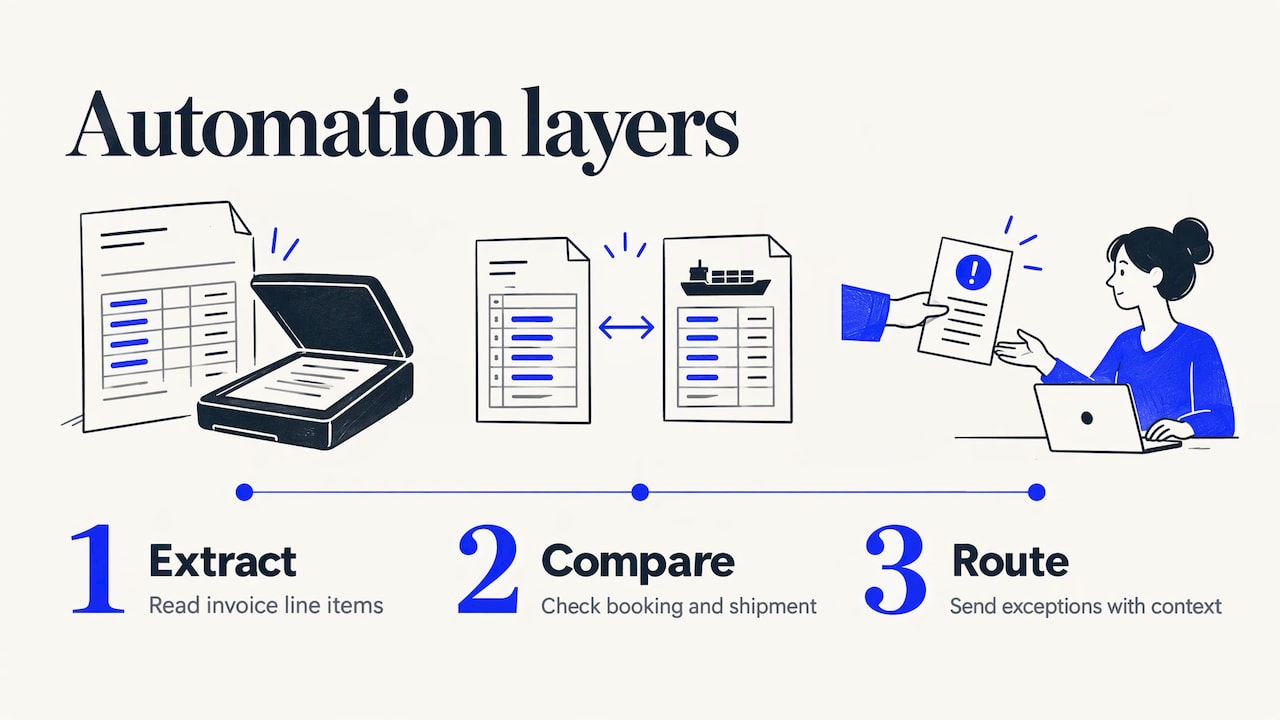
Automation has three layers, and it helps to keep them separate. The first reads: document extraction pulls line items, quantities, rates and references from the invoice. The second compares: a rules engine tests each line against the booking and shipment record inside your tolerances. The third routes: exceptions go to the right person, with both values, the variance and the source document shown, instead of landing in a general AP inbox.
A sensible split is to use AI where reading and linking are hard, such as recognizing that different abbreviations describe the same pack or proposing the likely booking when a reference is missing, and to keep the arithmetic and tolerance checks as plain, auditable rules. That way you can always explain why an invoice passed or stopped.
A few practical points decide whether automation pays off:
The quality of shipment data sets the quality of the match. If proof of delivery arrives late or rate cards are stale, the best rules engine produces noise. Pilot with one carrier group that has enough volume to measure before extending to everyone. Define a separate tolerance for accessorials and fuel. And make sure the system treats automation as a way to remove work that never needed judgment, then hands the rest to a person with context.
This is the case for running the match inside the TMS. The booking, the rate, the tracking events, the documents and the cost invoice are already tied to one shipment record, so the comparison does not depend on exports and re-keying. If you are weighing tools, our comparison of freight audit software for forwarders and our guide for finance controllers choosing a TMS set out the criteria that matter.
Putting the match inside your TMS
FreightSuite is an agentic TMS built for freight forwarders and logistics companies, and the pieces the match depends on are native to it: rate management, automated document management, invoice recognition, dynamic FX and cost tracking, credit control and connections to accounting software. All core features are included out of the box, without add-ons, and AI agent orchestration and workflow customization sit in the same platform, so the steps from booking to cost invoice to ledger do not need stitching together.
If you want to see how that fits your own invoice flow, you can book a FreightSuite demo, or look at how enterprise workflows for forwarders are configured. Teams moving freight by sea can start with our ocean freight TMS.
The ground is shifting for forwarders. Headcount that once went into keying invoices is better spent on pricing, customer service and carrier relationships, and the forwarders who build a disciplined match now are the ones whose margins hold when volume grows. The choice is yours to make, and the first step is simple: define your three documents, set your tolerances and decide who owns each exception.
FAQ
What is a three-way match in logistics?
It is a check that compares a freight invoice with the document that set the expected price and with proof that the shipment moved, then releases payment only if they agree within tolerance. In trucking those documents are often the rate confirmation, bill of lading and proof of delivery. For forwarders, the booking or accrual replaces the purchase order.
Which documents are used in a freight three-way match?
The core set is the carrier invoice, the booking, rate confirmation or contracted rate, and shipment evidence such as a bill of lading, air waybill or proof of delivery. The fields compared include reference numbers, weight, piece count, dates, rate, surcharges and accessorials.
What tolerance should we use?
There is no single right number. A common example is accepting a price variance within 2% or $50 and a quantity variance within 1%, as described in GEP’s guide. Set tighter limits for base rates and separate categories for fuel and accessorials, then review them as you see which exceptions recur.
What happens when the documents do not match?
The invoice goes on hold and is categorized, for instance as a documentation gap, pricing error, unsupported accessorial or duplicate. An owner gathers evidence and the outcome is recorded as approved, adjusted or disputed. Payment is released only after the exception is resolved or formally authorized.
Is two-way matching enough for freight forwarders?
For services with no physical receipt, such as documentation fees or customs clearance, a two-way check against the booking is appropriate. For physical moves, adding the shipment evidence gives you the stronger three-way control.
Sources
NetSuite: What Is Three-Way Matching & Why Is It Important?

