AI Exception Routing in Logistics: A Guide for Forwarders

AI exception routing means software spots the shipments that have broken from plan, ranks them by consequence and sends each one to the right person or automated action, so your team works the 5% that needs a decision instead of watching 100% of the freight. For a forwarder, the strongest version runs inside the transport management system (TMS), where rates, milestones, documents, invoices and customer commitments already live. That is the idea behind FreightSuite: an agentic TMS with workflows and AI agent orchestration built natively into the platform, not bolted on as a separate alerting layer.
The ground is shifting here quickly, and the window to build good habits is real. Below we cover what exception routing is, how detection and prioritization work, where humans must stay in the loop, what data you need, and how to measure the result.
TL;DR
- Exception routing is not route optimization: it detects what broke after the plan met reality, ranks it by consequence and routes it to a person or an agent.
- A workable system knows your customer commitments and costs, not just shipment status, otherwise it floods the team with alerts.
- Let agents act alone only on high-volume, low-risk, reversible cases. Anything that commits money, capacity or a customer promise gets human approval.
- Start with one or two exception types, set baselines first, then track time to action, touches per shipment and alert precision.
- Your TMS should remain the system of record, with an audit trail of what the agent saw, decided and why.
Table of Contents
- What AI exception routing actually is
- How detection and prioritization work
- Where humans stay in charge
- The data your forwarding operation needs first
- Roll it out in narrow slices
- Measuring whether it works
- Risks to design around
- Exception routing inside the TMS
- FAQ
- Sources
What AI exception routing actually is
A freight exception is any shipment event that departs from plan in a way that needs a decision: a missed pickup appointment, a container approaching the end of free time, a milestone that never arrived, a customs release still pending, a delivery refused or damaged. Exception routing is the discipline of finding those events fast, deciding how serious each one is and sending it to whoever, or whatever, should handle it.
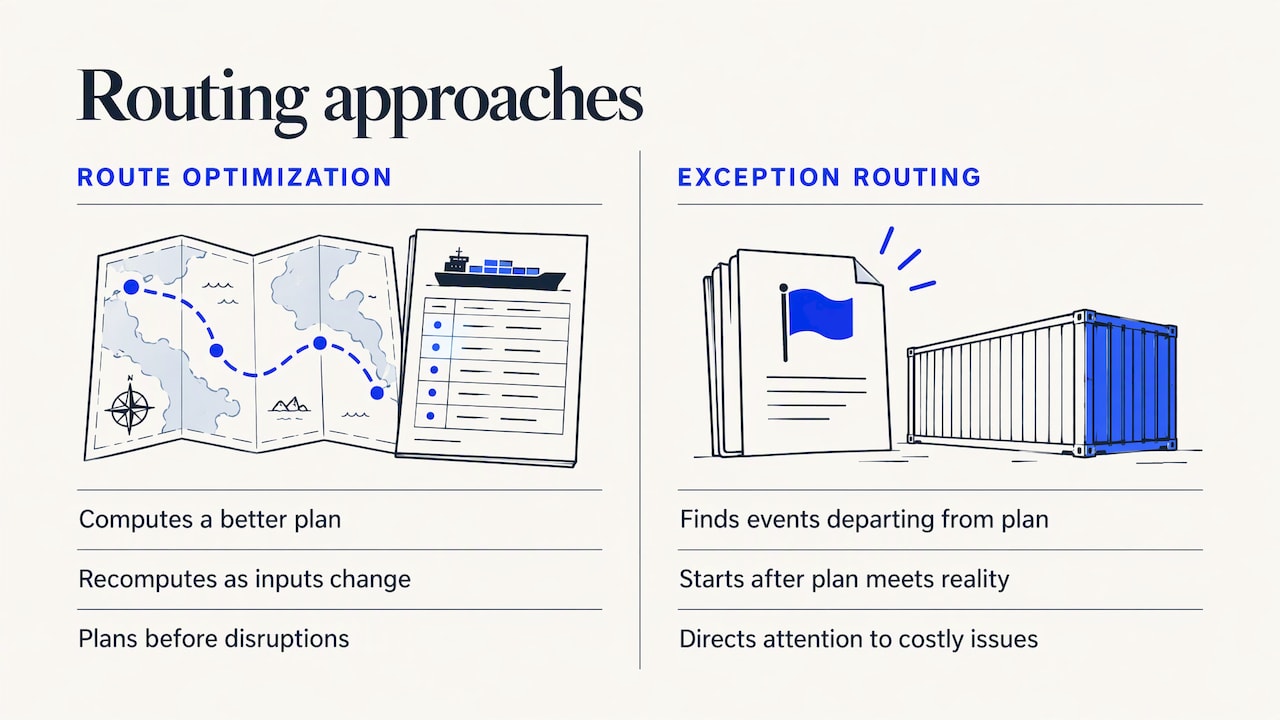
It differs from route optimization. Optimization computes a better plan, then recomputes it as inputs change. Exception management starts after the plan meets reality and concentrates attention where the cost is, as Nash describes in its July 2026 analysis. For a freight forwarder the distinction is practical. You rarely need an algorithm to re-solve a sailing that is on time. You need the system to tell you, early, which of 800 open files will miss a cutoff, a free-time deadline or a customer’s delivery window, and what the next move is.
The phrase also gets stretched. Not every scheduling rule is generative AI, and dispatch includes intake, assignment, approvals, communication and closeout around any routing decision. Good exception routing treats AI as one assist inside that wider process, with rules, thresholds and people around it.
How detection and prioritization work
The analyst firm ARC Advisory Group describes autonomous exception management as a progression through five stages: detection, prioritization, decision intelligence, workflow orchestration and bounded autonomous execution. The model moves from exception visibility toward exception resolution, and it escalates ambiguous or policy-sensitive situations to humans. That ladder is a useful way to judge any tool, including your own TMS: ask which rung it actually reaches.
Detection: comparing actuals against plan
Detection compares what is happening with what was planned. The inputs for a forwarder typically include carrier and vessel status messages, airline milestones, port and terminal events, GPS or telematics on the trucking leg, appointment times, documents and emails. A missed milestone, a stationary truck, a vessel ETA that slips past a cutoff, or silence from a carrier where an update should exist are all signals.
The quality of detection depends on the quality of the feeds. If you are weighing how tracking data reaches a TMS in the first place, our explainer on carrier tracking integrations walks through how those connections work, and the guide to how a TMS tracks air shipments covers the air side.
Prioritization: consequence, not volume
Detection alone creates noise. A control tower guide from AX3 Global warns that flagging every deviation as an exception overwhelms an operations team within days. The workable model ranks by consequence, which means the system has to know contract terms, service-level commitments and customer priority, not only physical status. The same two-hour delay is a crisis on a load feeding a production line and a non-event on a flexible delivery window.
For a forwarder, consequence usually combines a few things: how much time remains before a hard deadline, what the recovery options are, what the customer was promised, and what money is exposed through demurrage, detention, storage or missed cutoffs. A ranking built on those factors puts the shipment that can still be saved at the top of the queue, while there is still time to save it.
This is also where the principle of ranking alerts so planners focus on consequential disruptions meets customs and cross-border work, where a delay at the border carries cost and compliance risk at once. A customs and logistics shipping guide shows how much of that exposure sits in documentation and clearance timing, which is exactly the kind of exception that should rank high.
Decision intelligence and the recommended action
Once an exception is ranked, a good system assembles the context a planner would otherwise gather by hand: the shipment, the customer, the milestone history, the carrier’s record, the downstream orders affected. It then proposes an action: rebook onto another sailing or flight, notify the consignee, request a document, escalate to the carrier, or hold a release. The planner sees the cause, the recommendation and the reasoning, and approves or overrides. That sequence, not a flashing dashboard, is where the time is saved.
Where humans stay in charge
The central design question is not whether AI can act. It is where it may act alone. Supply Chain Management Review describes a tiered governance model that maps cleanly to forwarding work.
| Tier | Typical exception | Who decides |
|---|---|---|
| Autonomous execution | High-volume, low-risk, reversible: a routine notification after a known carrier delay, a minor data variance | The agent, with logging |
| Recommendation plus approval | Higher stakes: rebooking that changes cost or lead time, a revised delivery commitment | The agent proposes, a planner approves |
| Human-led with agent support | Novel, high-impact: a port closure, a facility outage, a geopolitical disruption | The team, with the agent gathering context |
The logic behind the tiers is accountability. As ASCM CEO Abe Eshkenazi put it in TechTarget’s reporting, “You can’t delegate accountability.” A decision can move to software. Responsibility for the outcome stays with your people.
In practice that means a person should stay in charge of anything that commits money or capacity, anything that changes what you promised a customer, and anything that carries legal responsibility, such as customs classification, where a licensed broker signs off. Boundaries should reflect the cost of a wrong decision and how easily it can be reversed, and they should be set on purpose rather than left to emerge from the technology.
Trust is the other half. PwC found that only about 37% of operations leaders are comfortable assigning AI agents to execute full end-to-end processes, and its guidance on AI in supply chain planning calls for testing agent behavior before release, monitoring decision boundaries and data access, defined escalation paths and clear ownership. The same PwC piece warns that where decision rights are undefined, planners override the outputs and the spreadsheets come back. An agent that acts without an explanation loses the room in one bad week. An audit trail of what it saw, decided and why keeps it.
The data your forwarding operation needs first
Intelligence is rarely the bottleneck. Data is. Before exception routing can work, a few foundations have to be in place.
Planned data comes first: appointment times, required delivery dates, cutoffs, last free days, stop sequences and the service levels attached to each customer. If the plan is wrong or missing, every deviation is either invisible or false.
Actual data comes second: the coverage and timeliness of carrier, airline, terminal and tracking feeds. Sources arrive in different shapes, such as EDI from established carriers, API feeds from digital ones and manual updates from everyone else, and they need to land on one shipment timeline. Prioritize ingestion by the volume of exceptions and the business impact, not by carrier size, and treat per-carrier data quality as an ongoing metric.
Reference data is third: consistent customer and location codes, charge codes, carrier identifiers and Incoterms. Much of what an exception looks like lives in emails, scanned documents and free-text notes rather than clean fields. That is why document handling and exception handling belong in the same system. A TMS that already captures documents, recognizes invoices and tracks cost against the quote gives an agent far more to reason with than a standalone alert tool reading a feed.
Finally, ownership: every exception type needs a named role, a first-response time and a playbook. An alert nobody owns is just a notification.
Roll it out in narrow slices
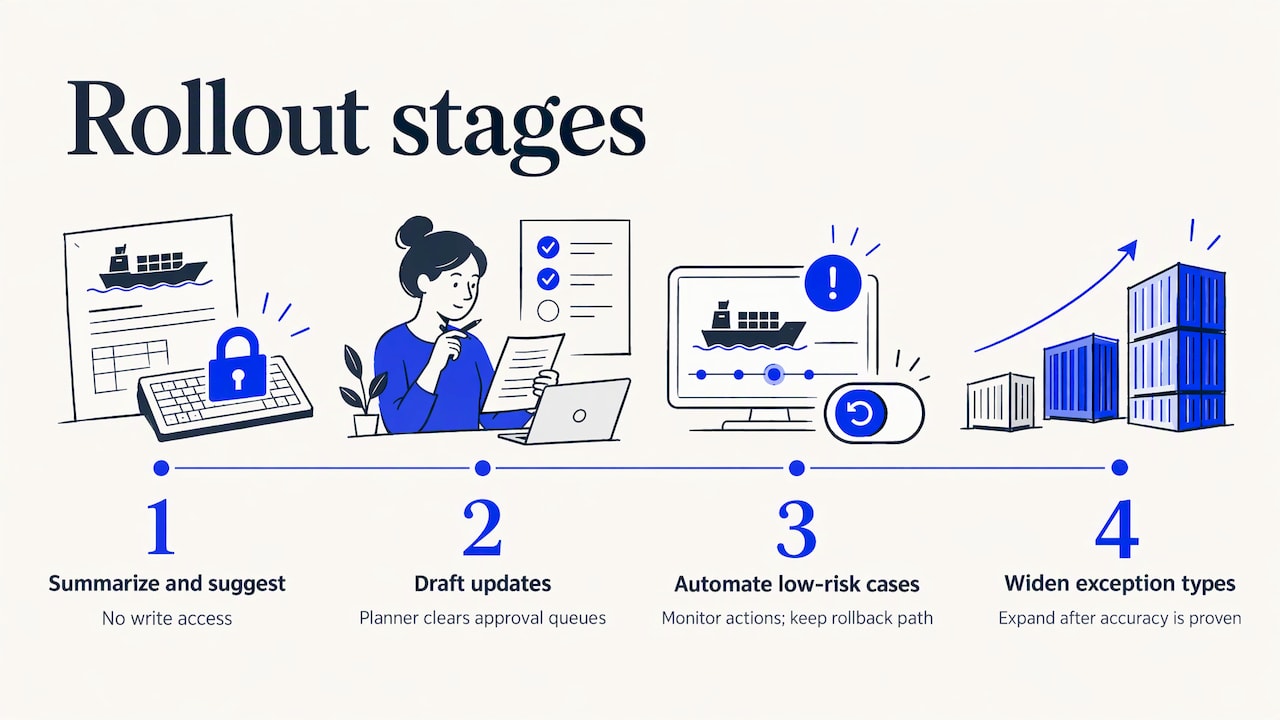
The pattern that holds up across the guidance is to start small and widen only as accuracy is proven. PwC advises starting with two or three exception-handling workflows that are technically feasible and commercially safe. For a forwarder, good first candidates are missed or slipped milestones, free-time and detention warnings, and missing-document chasers. They happen constantly, the data exists, and a wrong action is cheap to reverse.
Run them in stages. First, let the system summarize and suggest, with no write access. Second, let it draft customer updates and approval queues that a planner clears. Third, switch on automation for the lowest-risk cases, with monitoring and a rollback path. Fourth, widen to the next exception type. At each stage give the workflow one owner, one success metric and a way back. Log every suggested action and every override, because the overrides are your best training signal and your best audit evidence.
Our own write-ups on this cover the practical side: how AI agents handle freight tasks and what AI in freight forwarding can deliver inside a TMS in a single quarter.
Measuring whether it works
Set baselines before go-live, or you will never know what changed. A forwarder’s scorecard can be short.
Speed: time from detection to action, and time from action to resolution. Coverage: the share of exceptions found before the customer raised them. Precision: the share of alerts that required real action, alongside the missed-exception rate, since false alarms and misses both erode trust. Effort: human touches per shipment and the share of exceptions resolved without an operator investigating. Control: the rate at which planners accept versus override recommendations, escalation rates, and failed or reversed agent actions.
Add the financial line. Track avoided detention, demurrage and storage charges, and on-time performance on the lanes where exception routing is live. Treat any vendor’s headline percentage with care until you have your own baseline, and judge results on your own lanes and customers.
Market momentum explains why teams are moving. Gartner’s projection, cited by PwC, has supply chain software with agentic AI capabilities growing from under $2 billion in 2025 to $53 billion by 2030, with 60% of enterprises adopting agentic features by then, up from 5%. The forwarders that learn to govern agents now will not be learning under pressure later.
Risks to design around
The known failure modes are manageable when you plan for them. Stale tracking updates and inconsistent shipment identifiers produce bad recommendations, so data quality is a standing operations metric. Forecasts weaken when a disruption falls outside historical patterns, which is why novel events sit in the human-led tier. Agents need least-privilege permissions, transaction limits and logs. And, as TechTarget reports, researchers have observed inconsistent agent decisions across identical supply chain simulations, with errors compounding upstream. Bison Transport’s enterprise architecture lead told the publication that its agents scan documents, score confidence and enter orders, while exceptions still go to people.
The lesson is not to hold back. It is to keep authority bounded, keep the explanation visible and widen autonomy as the record earns it.
Exception routing inside the TMS
Exceptions are cheapest to fix when detection, context and action sit in one place. FreightSuite is a cloud-based TMS for freight forwarders and logistics companies with rate management, air and ocean tracking, financial management, operations automation, workflow customization and AI agent orchestration built natively into the platform, and all core features included out of the box without add-ons. Because tracking, documents, invoices, FX and cost tracking, and credit control share one system, our workflows and agents work from the same shipment file your team does.
If your exposure is concentrated in a mode, start there: ocean freight TMS and automation, the air freight management system, road freight transport management or customs brokerage software. To see how agentic platforms stack up against each other, read our comparison of AI TMS software, or see FreightSuite in a demo built around your own exception types.
FAQ
Is AI exception routing the same as AI route optimization?
No. Optimization builds and rebuilds a plan. Exception routing monitors the live operation against that plan, flags what breaks, ranks it by consequence and sends it to the right owner or action. Many forwarders need the second far more than the first.
Should AI be allowed to reroute shipments on its own?
Only for low-risk, reversible, high-volume cases with logging and a rollback path. Anything that commits money or capacity, or changes a delivery promise, should go to a planner for approval. Set those boundaries deliberately, based on the cost of a wrong decision.
What data do I need before starting?
Reliable planned data such as cutoffs, appointment times and free days, dependable tracking and carrier feeds, consistent reference codes, and a named owner and playbook for each exception type. Documents and emails matter too, since much exception context lives there.
Which exceptions should I automate first?
Pick one or two frequent, well-understood types, such as slipped milestones, free-time warnings or missing-document requests. Run them with human approval first, then automate the safest cases as your accept and override data shows the system is accurate.
How do I know it is working?
Compare against baselines you set before launch: detection-to-action time, share of exceptions caught before the customer noticed, alert precision, missed-exception rate, human touches per shipment and avoided detention or demurrage charges.
Sources
- Exception management: the highest-leverage work (Nash)
- Autonomous Exception Management in Logistics Execution (ARC Advisory Group)
- From forecast to action: How agentic AI is rewiring supply chain exception management (Supply Chain Management Review)
- Supply chain AI agents: Where should autonomy begin and end (TechTarget)
- How AI is redefining supply chain planning (PwC)

