Cost Variance Analysis in Logistics: A Guide for Forwarders

Cost variance analysis in logistics compares what a shipment, lane or period was expected to cost with what it actually cost, then explains the gap. For a freight forwarder, the most useful version runs at job level: every estimated charge is held against the vendor invoice that lands later, and every difference is traced to a specific cause. Done on spreadsheets, that review is slow and usually happens after the month has closed. Done inside a transport management system, it becomes a daily habit that protects margin while a job is still open.
This guide covers the formulas, a worked example, the causes that matter most in freight, and a routine your team can run every week.
TL;DR
- Cost variance equals actual cost minus expected cost. A positive result means you spent more than planned, which is normally unfavorable for a cost line.
- Split every variance into volume (you moved more or fewer shipments) and rate (each shipment cost more or less). They need different responses.
- The causes that recur in freight are spot-market premiums, fuel surcharges, accessorials, reclassification and currency movement.
- The review pays off only when the variance lands on the job file and is explained while the shipment is still fresh.
- A TMS with rate management, invoice recognition and finance built in lets your team do this without rebuilding data in spreadsheets.
Table of Contents
- What cost variance analysis means for a forwarder
- The formulas you need
- Split the variance: volume versus rate
- Where freight cost variances come from
- How to investigate a variance that matters
- Turn the variance into action
- A weekly routine for a forwarding team
- Why a TMS changes how fast you can see variance
- The strategic payoff
- FAQ
- Sources
What cost variance analysis means for a forwarder
The textbook definition comes from managerial accounting: actual costs are compared with standard costs, and the difference is a cost variance used to evaluate operating performance. A standard cost is simply the benchmark you agreed in advance.
In freight forwarding, the benchmark changes with the question you are asking. It can be the budget for the quarter, the contracted carrier rate, or the cost you estimated when you quoted the customer. Each baseline answers something different. Budget variance tells finance whether the department is on plan. Contract variance tells procurement whether carriers are billing what they agreed. Quote-to-actual variance tells sales and operations whether the price you gave the customer still holds a margin.
That last one matters most to a forwarder because your product is the spread between what you buy and what you sell. Net margins in this industry are thin, so a few hundred dollars of unexplained cost on a file is not a rounding error. It is the profit on the job.
The formulas you need
The arithmetic is simple. The discipline is in applying it consistently.
Dollar variance is actual cost minus budgeted or expected cost. Percentage variance is (actual cost minus budgeted cost) divided by budgeted cost, times 100. Use the dollar figure to prioritize and the percentage to compare lanes of different sizes.
A quick job-level example: you estimated $4,200 of total cost on an ocean import file, and the final vendor charges came to $4,610. The variance is +$410, or 9.8% over estimate. If you quoted the customer on the $4,200 basis, that $410 comes straight out of your margin.
Reading the sign: favorable and unfavorable
When variance is defined as actual minus budget, a positive result on a cost line means spending exceeded the plan. Academic managerial accounting texts state that positive cost variances are unfavorable and negative ones favorable, because the labels describe the effect on operating profit. The same arithmetic sign flips meaning on revenue, where higher than budget is favorable.
Favorable does not automatically mean good. A lesson from Varsity Tutors notes that a cheap input can create unfavorable efficiency variances further down the chain. In freight, the equivalent is a bargain carrier whose delays trigger detention, storage or a lost customer. Trace the chain before you celebrate a saving.
Split the variance: volume versus rate
A single total hides the story. The standard fix is to break total variance into a price (rate) effect and a quantity (volume) effect. Using the managerial accounting convention, the price variance is (actual price minus standard price) times actual quantity, and the quantity variance is (actual quantity minus standard quantity) times standard price. The two add up to the total.
Here is a worked example for one trade lane over a quarter. The figures are illustrative.
| Measure | Planned | Actual |
|---|---|---|
| Shipments | 40 | 46 |
| Cost per shipment | $2,000 | $2,150 |
| Total cost | $80,000 | $98,900 |
Total variance is $98,900 minus $80,000, or +$18,900, about 23.6% over plan.
Volume variance is (46 minus 40) times $2,000, which is $12,000. Rate variance is ($2,150 minus $2,000) times 46, which is $6,900. Together they equal $18,900.

The point is that two thirds of the overrun came from moving more freight, which is probably good news if the revenue came with it. Only $6,900 is a genuine unit-cost problem to chase with carriers. Without the split, a finance director would see a 23.6% overrun and ask the wrong questions.
A flexible budget does the same job from the other side: it restates variable costs at actual activity levels so that growth is not mistaken for waste. Most forwarders should report both views, because a cost line that rises with sales is not behaving the way a cost line that rises on flat sales is.
Where freight cost variances come from
Once you have isolated the rate portion, the causes in freight fall into a handful of repeating families.
Spot-market premiums
When a contracted carrier rejects a load and it moves on the spot market, the price moves with it. DAT’s guide to variable transportation budgets puts typical spot premiums at 25 to 35% per load, and notes they can run much higher in a tight market. It recommends reviewing lanes with frequent routing-guide failures and considering mini-bids where carrier commitments are not holding. If you need a way to think about estimating spot-market transport costs when contracted capacity is unavailable, build the premium into the estimate rather than discovering it on the invoice.
Reclassification and re-weighs
On US LTL freight, carriers re-rate shipments after inspecting weight, dimensions or class. Old Dominion’s white paper reports that some shippers see 25 to 30 percent of LTL freight re-rated, with the unexpected charges eroding margins and weakening cost projections. For a forwarder, that is a data-quality variance: the quote was built on declared dimensions that the carrier later changed.
Accessorials, fuel and mix
Detention, liftgate, storage, demurrage and destination charges that were never quoted are the classic leak. Fuel surcharges move on a schedule you do not control. Mode and service-level shifts, such as a customer who suddenly needs air instead of ocean, change cost per unit without any carrier misbehaving. Track base freight, fuel, accessorials and expedited spend as separate lines so each driver is visible.
Currency
If you buy in one currency and sell in another, part of the variance is pure exchange movement. Isolate it, so it is not blamed on carriers or operations. Our guide to multi-currency billing for freight forwarders goes deeper on how to keep those effects visible.
Timing and accruals
Some variances are not real. A charge accrued in October and invoiced in November will show as a favorable variance in one period and an unfavorable one in the next. Tag these so they are cleared, not investigated.
How to investigate a variance that matters
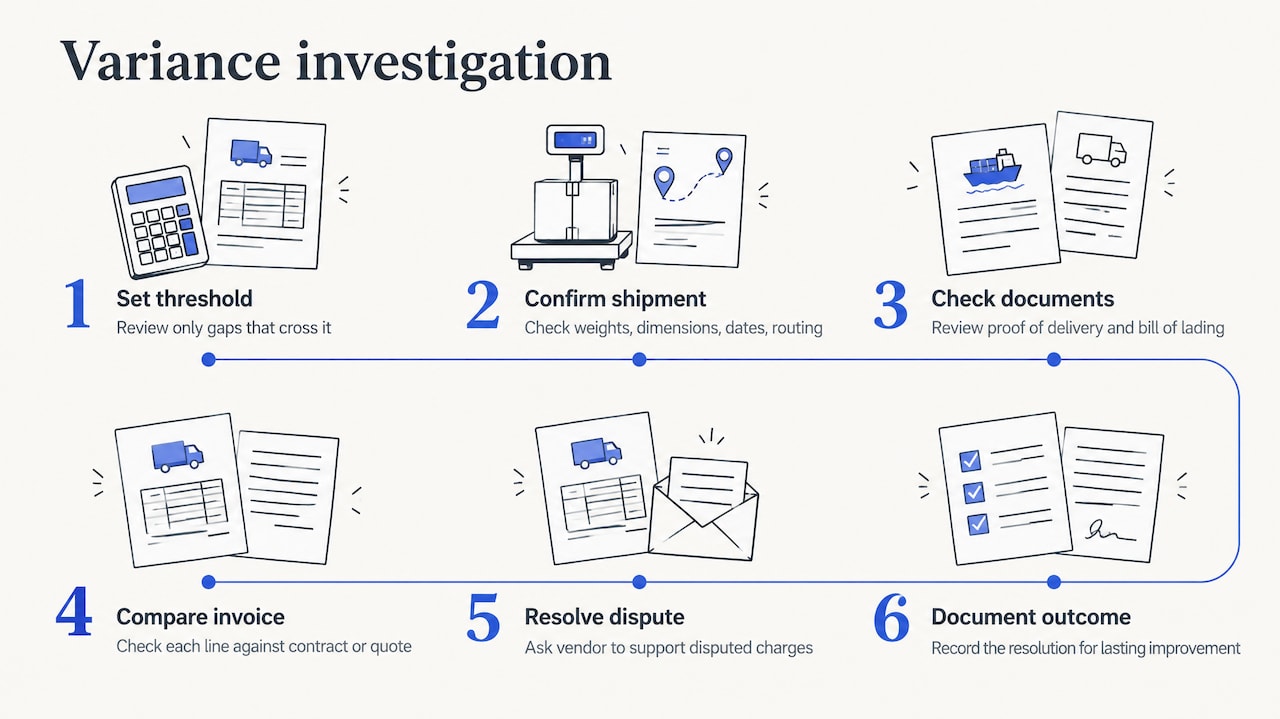
Not every gap deserves attention. Set a materiality threshold, for example a dollar amount or a percentage per job, and review only what crosses it. This is the management-by-exception principle: attention goes where the variance is large or recurring.
For a variance over the threshold, work through the same sequence each time. Confirm the shipment details first: weights, dimensions, dates and routing. Check the proof of delivery and the bill of lading. Compare the invoice line by line with the effective contract or rate quote. Ask the vendor to support any disputed charge, and write down the resolution. Guidance on invoice verification from a freight audit firm follows the same order: verify shipment details, compare against the contract, obtain carrier support for disputes and document the outcome.
The documentation step is the one teams skip, and it is the one that turns a one-off fix into a lasting improvement. If the same vendor over-bills the same charge on three files, that is a contract conversation, not three separate disputes.
Turn the variance into action
A variance report is worth nothing until it changes a decision. Match the cause to the response.
If the rate variance is concentrated in one lane, reprice or rebid it. Corrective actions in logistics commonly include renegotiating carrier rates or changing route plans. If rejected tenders are driving spot premiums, review the routing guide and the carriers behind it. If accessorials recur at one facility, fix the process that creates detention rather than paying it each time.
If the same adverse variance keeps appearing, ask whether the baseline is wrong. Budget guidance is clear that you should update forecasts or assumptions when the evidence shows the baseline is off, rather than treating every deviation as an operational failure. A quote template that omits a recurring destination charge is a quoting problem, and the fix belongs in the template.
Finally, feed the findings back into pricing. Our piece on job costing for freight forwarders shows how profit per shipment depends on closing this loop, and carrier contract management covers making negotiated rates stick once you have the evidence.
A weekly routine for a forwarding team
Cadence beats intensity. Large shippers often run a formal spend analysis once a year before a carrier bid, while the most disciplined teams review their top lanes every quarter. A forwarder can go faster, because the data is already attached to jobs.
Every week, review open jobs where the estimate and the accrued actual have diverged beyond your threshold. Every month, after close, review the volume and rate split by lane, vendor and charge type, and list the three largest recurring causes. Every quarter, take those causes to carrier and customer conversations: rebids, surcharge clauses, revised quote templates.
Keep the variance on the job file rather than letting it disappear into a general ledger account. A variance sitting on a specific file has a name, an owner and a fix. One sitting in a catch-all account is just a lower margin nobody can explain.
Why a TMS changes how fast you can see variance
The weakness of the spreadsheet approach is timing. Estimates live in one file, vendor invoices arrive in email, exchange rates sit somewhere else, and finance reconciles at month end. By then the shipment is delivered and the customer is invoiced.
When rates, costs, documents and accounting sit in one system, the comparison is continuous. In FreightSuite, rate management, invoice recognition, dynamic FX and cost tracking, automated document management and integrated accounting connections are built into the platform, and our positioning is that these core features come included without add-ons. For a finance controller, that means estimated and actual cost can be read on the same job, and the question shifts from “what happened last month” to “what is drifting on open files right now.” Our guide to logistics financial reporting lays out what those reports should contain, and the TMS comparison for finance controllers helps you set your criteria.
If you want to see how this works for your own cost structure, the FreightSuite solution for finance teams is the place to start. Teams running ocean, air, road or customs brokerage can find the relevant workflow on the ocean freight, air freight, road freight and customs brokerage pages.
The strategic payoff
The ground is shifting under forwarders who still close their books slowly. Customers expect fast quotes, carriers change surcharges often, and margins leave little room for leakage that is found in hindsight. The forwarders who pull ahead are the ones who treat variance as a daily operating signal, with owners, thresholds and a feedback loop into quoting and procurement.
Start small. Pick one lane, define the baseline, split volume from rate, and explain every variance above your threshold for a month. You will learn more about your real margin from that exercise than from a year of summary reports.
FAQ
What does a positive cost variance mean?
When variance is calculated as actual cost minus budget, a positive number means you spent more than planned. On a cost line that is unfavorable because it reduces profit. On a revenue line, a positive variance is favorable, so always check which line you are reading.
What is the difference between standard costing and variance analysis?
Standard costing sets the benchmark: the cost you expect for a unit, job or activity. Variance analysis compares actual results with that benchmark and explains the difference. In forwarding, the standard might be a contracted rate or the cost estimate behind a customer quote.
How often should a forwarder run cost variance analysis?
Review open jobs weekly for variances above your threshold, and run a lane, vendor and charge-type review monthly. Quarterly, use the recurring causes to rebid lanes, adjust quote templates or renegotiate surcharge terms.
How do I separate volume variance from rate variance?
Volume variance is (actual volume minus planned volume) times planned cost per unit. Rate variance is (actual cost per unit minus planned cost per unit) times actual volume. The two add up to total variance when units and scope match, as in the lane example above.
Sources
- Cost Variance Analysis Explained, Pearson
- Budget vs actual variance analysis: a worked example
- 10.4 Direct Materials Variance Analysis, LibreTexts
- Favorable vs. Unfavorable Variances, Varsity Tutors
- DAT guide to variable transportation budgets
- The Power of Data Accuracy, Old Dominion Freight Line
- How to Verify a Freight Invoice, MAS Partner
- Cost Variance Analysis, WiseBI glossary
- Budget Variance, Money Master HQ

