LLMs in Logistics: What They Do for Freight Forwarders

A large language model (LLM) is an AI model that reads and writes human language, and in logistics it earns its keep on the work forwarders drown in: rate request emails, booking confirmations, customs paperwork, invoices and status questions. The model alone is not the advantage, though. The advantage comes from where it sits. An LLM connected to your rates, shipments, documents and financials inside one transport management system (TMS) can act on your data. An LLM in a separate chat window can only talk about it. That is the reasoning behind how we built FreightSuite, with AI agent orchestration native to the TMS rather than added later.
TL;DR
- An LLM predicts language, so it excels at unstructured work: emails, PDFs, quotes and document classification.
- US freight players already report results at scale, including quotes in minutes and a 23% cut in customs document handling time at C.H. Robinson.
- Most forwarders are still early: Deloitte found logistics providers lagging other transportation segments in at-scale generative AI.
- Data quality, permissions and human approval decide whether an LLM helps or creates risk.
- The strongest setup runs the LLM inside the TMS that already owns your rates, shipments and accounting.
Table of Contents
- What an LLM actually is, in forwarder terms
- Where LLMs fit in a forwarding operation
- What the US numbers say about adoption
- Why the LLM belongs inside the TMS
- Guardrails: data, permissions and human control
- A practical rollout path
- Putting LLMs to work in FreightSuite
- Where this is heading
- FAQ
- Sources
What an LLM actually is, in forwarder terms
According to Harvard Business School’s explainer, LLMs are trained on enormous collections of text and learn statistical patterns that let them process, predict and generate language. At their core they predict the next token, a word or part of a word, in a sequence. At scale, that simple mechanism produces summaries, drafts, explanations and conversation.
Two technical points matter for a freight operator. First, LLMs rely on the transformer architecture introduced in 2017, whose self-attention mechanism lets the model weigh relationships between tokens, including distant ones, according to IBM. In practice, that is why a model can read a long email thread and still tie the last line to the container number in the first. Second, MIT Sloan Management Review explains that an LLM generates an answer token by token inside a loop run by external software, and that developers tune stopping rules that affect completeness, cost and formatting. The model is one component in a system, and the system around it decides how useful it is.
There is a third point you should hold onto: LLMs can hallucinate, meaning they produce confident text that is wrong. The HBS piece advises verifying output before high-stakes use. In a business where a wrong HS code or a misread consignee can stop a container, that is a design requirement, not a footnote. It is the reason approval steps and system-of-record data belong at the center of any LLM deployment.
Where LLMs fit in a forwarding operation
Forwarding runs on unstructured inputs that arrive in no particular format. A shipper emails for a rate. A carrier sends a PDF booking confirmation. A broker needs a commercial invoice matched to a packing list. Traditional software wants clean fields. LLMs handle the mess, which is why the early use cases cluster around communication and documents.
Deloitte’s March 2024 analysis of generative AI in transportation management lists real-time carrier and shipper communication, autonomous freight audit that verifies invoices and checks contract compliance, and natural-language report generation among the leading applications. Each one maps to a daily forwarder task.
Quoting and inbound requests
In a 2025 Deloitte podcast on transportation efficiency, a carrier executive described receiving 60,000 rate-quote emails and 40,000 shipment-tracking emails a day. The AI reads the email, calls an internal API for the answer, drafts the reply, and a rep approves and sends it. A three-to-four-minute transaction became two mouse clicks, with a person still in the loop.
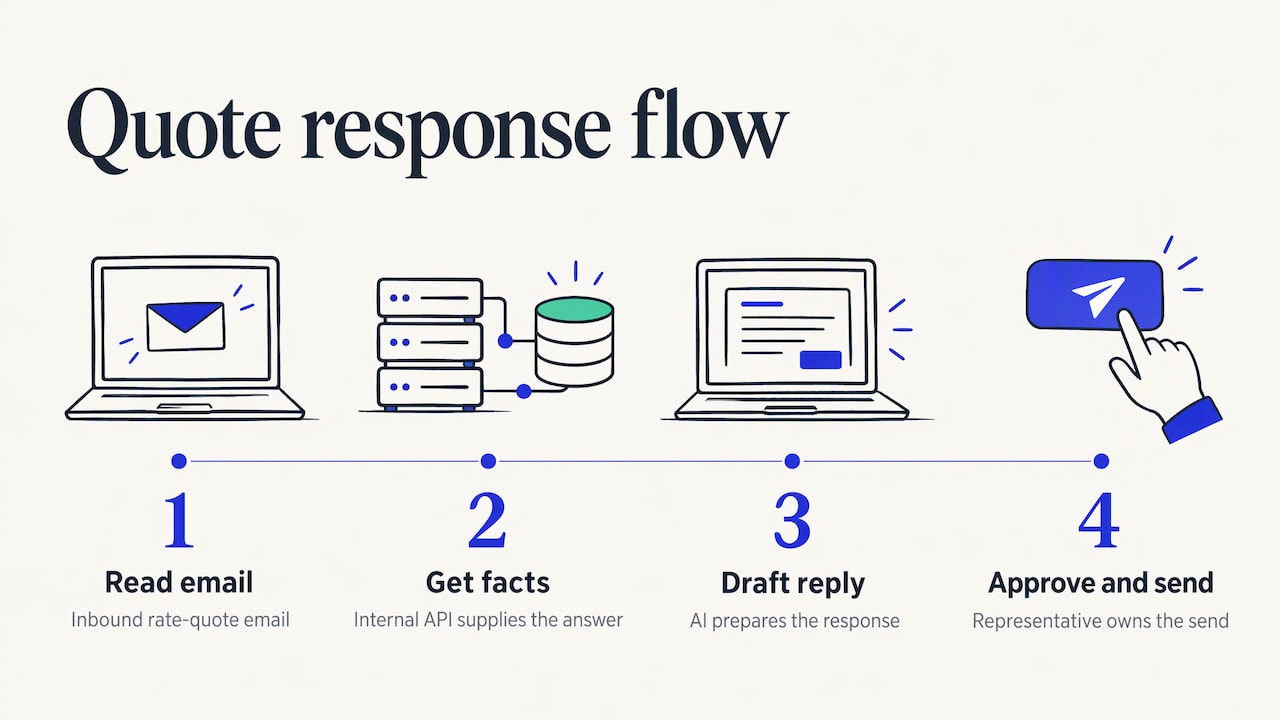
The pattern is worth copying: the model does the reading and drafting, your system supplies the facts, and a human owns the send button. The facts have to come from somewhere reliable, and for a forwarder that means a rate management module holding current contracts, surcharges and validity dates. Without it, the model has nothing trustworthy to draft from.
Customs and document handling
C.H. Robinson reports that its customs AI agents handle more than four dozen document types for US Customs clearance. They split, classify and attach documents to shipments, extract data, watch for missing documents and request them. The company says this reduced time spent by 23%, leaving brokers to focus on validation and compliance.
Note what the humans keep: validation and compliance. That division of labor is the template. The model clears the clerical load, and licensed judgment stays with licensed people. For brokerages, customs brokerage workflows built around automated document management follow the same logic.
Finance, audit and invoice recognition
Finance is where the numbers are most striking. In Deloitte’s July 2024 survey of 210 US transportation and supply chain executives, only 30% had a mature finance implementation of generative AI, yet 93% of those reported high economic impact, the highest of any use case in the study. Route optimization, asset management and warehouse operations led on adoption, but finance delivered the strongest return where it had been done properly.
For a forwarder, that translates into invoice recognition, cost matching against quotes, dynamic FX handling and credit control. These are margin tasks. Every unbilled accessorial or mismatched foreign exchange rate comes straight off your EBIT, and the staff time to chase them scales with headcount rather than with the business.
Asking questions of your own data
Supply Chain Dive describes a shift toward natural-language interfaces inside the TMS, where users ask a chatbot about market trends and performance metrics, such as spot versus contract utilization, instead of building a report. For a forwarder’s sales and operations leaders, that means questions like “which lanes lost margin last month?” get answered without waiting for a report build.
What the US numbers say about adoption
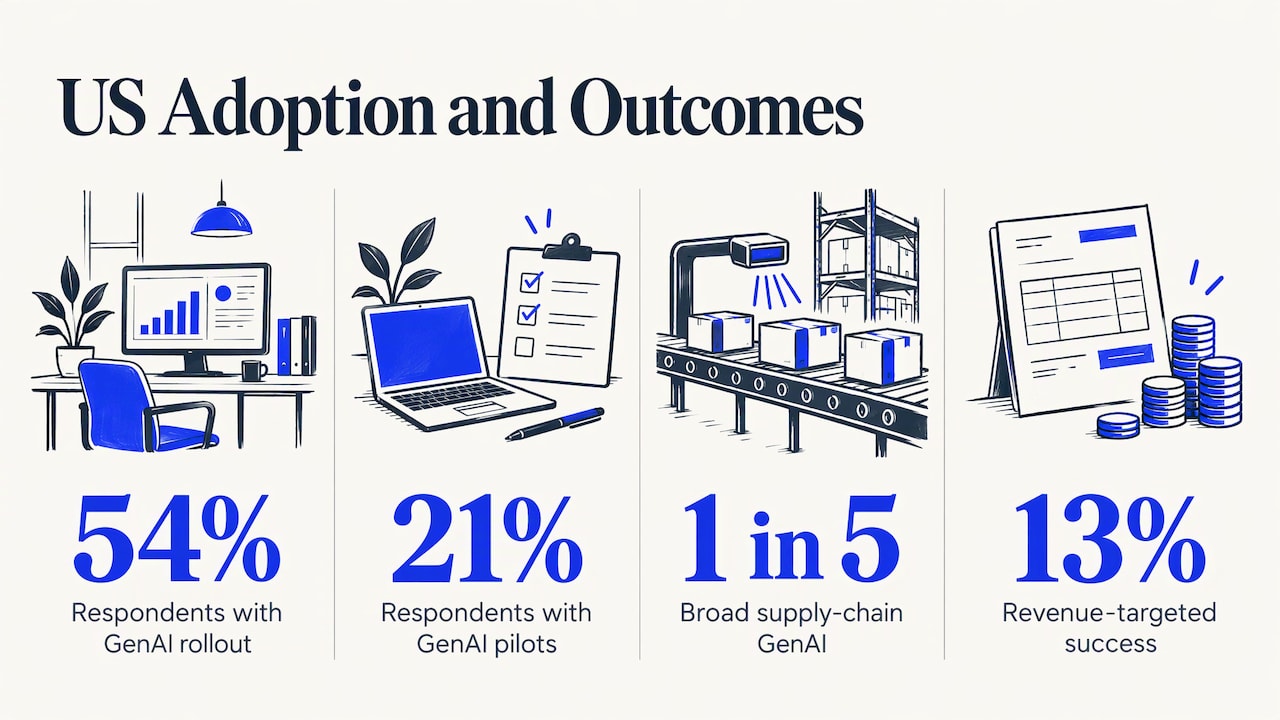
The honest picture is mixed, and it favors forwarders who move now. Deloitte’s 2024 survey found that 54% of respondents had at least one generative AI implementation and another 21% had pilots only. But only one in five companies had at least one broad generative AI implementation in supply chain or strategy and operations. Logistics providers, a group that includes 3PLs, freight forwarders and brokerages, were significantly less likely than trucking, first- and middle-mile, and retail players to run generative AI at scale in all functions except strategy and operations.
Read that as an opening, not a warning. The forwarding segment has the document-heavy, email-driven work that LLMs suit best, and it has adopted them least. Revenue results were also instructive: among the 56% of executives who hoped to increase revenue through generative AI, only 13% said they had succeeded, while more than half of those aiming it at innovation, client relationships or new insights said they had. The pattern points toward using LLMs to understand customers and shipments better and to answer faster, not just to cut a line item.
The ground is shifting beneath this industry, and the window is real. The deployments above are from large operators with deep engineering teams. A mid-size forwarder will not build its own agent infrastructure, which is why the choice of platform matters more than the choice of model.
Why the LLM belongs inside the TMS
Many teams start by pointing a general chatbot at a folder of PDFs. It feels productive for a week. Then the questions get operational: which rate is valid for this lane on this date, who owns this shipment, has this customer exceeded its credit limit. A chatbot with no connection to the system of record cannot answer, and one that guesses is worse than none.
The stronger architecture puts the model next to the data it needs and the actions it may take. Our positioning at FreightSuite is exactly this: an agentic TMS in which rate management, air and ocean tracking, finances, operations, workflows and AI agent orchestration are built natively, with core features included out of the box without add-ons. When the agent that reads an inbound email sits in the same platform that stores the contract rates, the shipment record and the invoice, there is no integration project between the language model and the facts.
If you want a fuller look at how agents divide freight tasks, our piece on how AI agents handle freight tasks walks through it, and AI in freight forwarding inside your TMS covers the case for keeping it in one system. For a broader view of agentic AI in freight forwarding, including quoting and customs clearance, the wider forwarding context is useful background on why these tasks are ripe for automation.
Guardrails: data, permissions and human control
Deloitte’s survey found that 41% of transportation executives named data-related concerns as their top generative AI risk: 21% unauthorized use of organizational data and 20% misuse of client data. One in five cited unintended outcomes, and risk, governance and talent were the biggest adoption barriers. Those concerns are reasonable and they are solvable with design.
Data quality first. A Lloyd’s Register report from 2024 quotes its VP of AI at OneOcean saying companies should spend as much as 80% of their effort on better-quality data to improve AI models, because models fed bad data give bad advice. It also notes that data shared with AI models needs safeguards so one company’s data does not benefit a competitor using the same model. For a forwarder, clean master data, consistent rate tables and a single customer record are the groundwork.
Document integrity. The same report warns that generative AI could be used to forge shipping documents such as cargo manifests and certificates of origin. Extraction tools should therefore check what they read against shipment records, rather than trusting a document because it looks right.
Verification. HBS faculty Karim Lakhani and Iavor Bojinov caution that fine-tuning and alignment reduce bias and hallucination risks but never eliminate them, calling alignment an ongoing effort, not a one-time fix. Build review into any workflow where an error costs money or compliance standing.
A practical rollout path
Start with work that is high volume and reversible. Inbound email triage, document classification and draft replies fit that description, because a person sees the output before it leaves the building. Give the agents read access to the data they need and nothing more, and keep decisions such as customs classification, dangerous goods handling and sanctions checks with your qualified staff.
Next, measure one workflow properly before expanding. Track quote turnaround time, documents handled per person and the share of items that needed correction. The C.H. Robinson and Deloitte examples share a trait: each names a specific task and a specific metric. Vague goals produce vague results.
Then widen to finance, where the Deloitte figures suggest the payoff is largest once the implementation is mature. Invoice recognition, cost tracking and credit control all draw on the same shipment data, so the earlier groundwork pays twice. Our guide to choosing AI agents for logistics lists the use cases we would start with, and the seven criteria that separate a useful agent from a demo are a solid yardstick for any evaluation.
Putting LLMs to work in FreightSuite
FreightSuite is a cloud-based TMS for freight forwarders and logistics companies. It brings rate management, air and ocean tracking, financial management, operations automation, workflow customization and AI agent orchestration into one platform, alongside automated document management, invoice recognition, dynamic FX and cost tracking, credit control, customer dashboards and connections to accounting software. We are positioned as the alternative to legacy systems such as CargoWise, Magaya, Descartes, Multifreight and Logi-Sys, built for forwarders who want to run faster, eliminate admin and improve profitability.
The modules map to the modes you run: ocean freight, air freight, road freight and customs brokerage. You can see how enterprise workflows are configured, or book a demo to see agents working on your own use cases.
Where this is heading
The C.H. Robinson announcement shows where large operators are going: agents spanning ocean, air and customs, producing quotes in minutes and handling documents that used to consume broker hours. The forwarders who benefit from the next wave will not be the ones with the most experiments. They will be the ones whose rates, shipments, documents and money already live in one governed system, so that every new agent has clean data to work from and clear limits on what it may do.
The window is real, and it has a timeline. Each quarter that quoting, document intake and invoice matching stay manual is a quarter of margin and headcount spent on work software can now do. The choice is yours to make, and the starting point is a TMS built for it.
FAQ
What does LLM mean in logistics?
LLM stands for large language model, an AI system trained on large amounts of text to understand and generate language. In logistics it reads and drafts emails, extracts data from shipping documents, answers questions about shipments and rates, and supports agents that complete routine tasks in a TMS.
Can an LLM replace my operations or customer service team?
The deployments reported in the US keep people in the loop. In Deloitte’s podcast example, a rep approves each AI-drafted reply, and C.H. Robinson says brokers stay focused on validation and compliance. The practical effect is that your team handles more shipments with less typing and chasing.
Where should a freight forwarder start with LLMs?
Begin with high-volume, reversible tasks: quote request emails, document classification and status updates. These have clear metrics, such as turnaround time and documents handled, and a person can review the output. Finance tasks like invoice matching are a strong second step.
Are LLMs safe to use with customer and shipment data?
They are when you control access. Deloitte’s survey shows data misuse is executives’ top concern, so limit what each agent can read and do, keep sensitive decisions with qualified staff, and run the model inside a platform that already governs your data. Your legal or compliance adviser should review how client data is handled.
Sources
- What Are Large Language Models (LLMs) & How Do They Work? (Harvard Business School Online)
- How LLMs Work: Top 10 Executive-Level Questions (MIT Sloan Management Review)
- What Are Large Language Models (LLMs)? (IBM)
- Generative AI and Transportation Management (Deloitte US)
- Gen AI in transportation (Deloitte, July 2024)
- Is GenAI the future of transportation efficiency? (Deloitte, That Makes Cents)
- C.H. Robinson debuts AI agents for ocean, air and customs
- Logistics management is leveling up with generative AI (Supply Chain Dive)
- Beyond the Horizon (Lloyd’s Register and Thetius, 2024)

