Surcharge Management in Logistics: A Forwarder's Playbook

Surcharge management is the discipline of knowing, before a shipment moves, which extra charges will apply, quoting them to the customer, and then matching what the carrier bills against what you bill. Forwarders that run it as one connected process, with surcharges held in the rate system and carried through bookings, shipments and finances, protect margin that spreadsheets and inbox searches quietly lose. We built FreightSuite around that idea: rate management, shipment tracking, finances and workflow automation live in one native platform, so a surcharge is entered once and follows the shipment to the invoice.
This guide is written for forwarders and logistics companies. It explains what surcharges are, which ones hit U.S. freight, how they are triggered, and how to build a process that stops the leakage.
TL;DR
- A surcharge is an extra charge on top of the base freight rate. Fuel, accessorials and ocean surcharges each follow different triggers and timing rules.
- Most margin loss happens in the gap between the carrier’s bill and your customer’s invoice: charges that were never quoted, never documented or never rebilled.
- Carrier tariffs differ, so trigger definitions and rates belong in structured rate data, not in memory or email threads.
- A TMS that holds surcharges in the rate record and carries them through booking, shipment and finance turns surcharge control into a routine instead of a month-end clean-up.
- FreightSuite includes rate management, finances, invoice recognition and AI agent orchestration natively, with no add-ons for core features.
Table of Contents
- What a surcharge is, and why forwarders feel it first
- The surcharge families you will meet in U.S. freight
- Where surcharge leakage actually happens
- A surcharge management process that holds up
- A worked example
- Why a TMS changes the economics of surcharge control
- See surcharge control in your own workflow
- FAQ
- Sources
What a surcharge is, and why forwarders feel it first
A freight surcharge is an extra charge added to the base rate to recover variable costs or cover particular shipment conditions. Finnlines describes fuel, emissions, cargo characteristics, port costs and operational disruption as common drivers. The base rate is the number everyone negotiates. The surcharges are the numbers that move after the deal is signed.
Forwarders sit in the middle of this. A carrier bills you on its tariff, your customer expects a price based on your quote, and the difference is yours to absorb or recover. When surcharges change weekly, vary by carrier and depend on facts only the driver or terminal knows, the middle position becomes a margin risk. That is why surcharge control is a profitability topic as much as an operations one. If you want to see where that margin goes shipment by shipment, our guide to job costing for logistics shows how forwarders find profit per shipment.
The surcharge families you will meet in U.S. freight
Surcharges fall into a few families. Each has its own trigger, and each needs a different control.
Fuel surcharges
Fuel surcharges are index-linked. AFS notes that they follow fuel prices and are normally calculated using the pickup date. That matters for quoting: the percentage that applies is the one in force on the day the freight is picked up, not the day you quoted.
Mechanics vary by carrier. One trucking carrier’s tariff, for example, applies its national fuel surcharge once the U.S. Department of Energy national average diesel price reaches $2.00 per gallon, and adjusts the percentage of the net line-haul charge weekly after the Monday index announcement. That is one carrier’s rule, not a universal one, which is exactly the point: every carrier you use has its own table, its own index and its own schedule.
Accessorial charges
Accessorials pay for services beyond standard pickup and delivery. In LTL, a freight bill is commonly built from linehaul, fuel surcharge and accessorials, and linehaul itself depends on origin and destination ZIP codes, weight and freight class under the NMFC classification system (the National Motor Freight Classification, which groups commodities by shipping characteristics).
Old Dominion’s 2026 brochure lists typical accessorials: hydraulic lift gate service, inside pickup or delivery, and limited-access locations such as residences, schools, construction sites and military facilities. It also covers appointment or prior-notification, after-hours service, hazardous materials, airport pickup or delivery, overlength freight, and weekend or holiday service. Its rates apply in the 48 contiguous states and may vary for Alaska, Hawaii and Puerto Rico, and the brochure points to the tariff for detail.
The triggers are usually simple. A liftgate charge arises when no dock or forklift is available and freight has to be lowered to the ground. Sort-and-segregate fees arise when palletized freight must be broken up and redistributed. Overlength fees apply once freight passes the carrier’s length threshold, and AFS reports that freight of 8 feet or longer was the single greatest driver of accessorial growth in its freight-spend data. Treat that as a signal about where to look, not as a threshold every carrier uses.
Ocean surcharges
Ocean freight adds its own vocabulary. IFT’s November 2026 explainer separates the main ocean items: the bunker adjustment factor (BAF) passes through bunker fuel cost, the peak season surcharge (PSS) reflects seasonal demand, the container imbalance charge (CIC) relates to repositioning empty containers, congestion surcharges are tied to events, and war-risk charges attach to elevated-risk routes. Terminal handling charges cover receipt, movement, loading or discharge at the terminal, documentation fees cover issuing and handling bills of lading, and VGM fees cover processing the verified gross mass declaration.
The practical lesson is that some ocean charges are recurring pass-throughs, while others are event- or lane-specific. The route and the applicable date decide which ones belong on a given shipment. Air freight has its own version of this problem, which we cover in taming air freight tariffs and hidden charges.
Where surcharge leakage actually happens
Most forwarders do not lose money because they misunderstand surcharges. They lose it in five predictable places.
The first is the quote. A quote that carries only the base rate leaves every later surcharge to be absorbed or argued over. Quotes need to state which surcharges are included, which are estimated and which are billed at actual cost. Our guide to freight quote management covers how to structure that.
The second is shipment data. Inaccurate dimensions can lead to an LTL reclassification or reweigh charge, errors on the bill of lading can trigger administrative charges, and an unspecified liftgate need can add equipment fees, correction time, redelivery and delays. These are surcharges created upstream by information that was wrong or missing at booking. The same pattern applies to long-haul moves with special handling needs, as this long-distance freight shipping guide shows for shipment characteristics that change what a move costs.
The third is timing. Fuel is set by the pickup date, ocean surcharges by route and effective date. If your system stores one flat rate with no effective dates, someone has to remember which version applied.
The fourth is documentation. A charge you cannot support with the shipment, the location, the date, the time stamps and the service performed is a charge your customer can dispute, and often will.
The fifth is reconciliation. Carrier invoices arrive in different formats and on different schedules. If matching them to shipments is manual, the charges that were never rebilled are the ones nobody notices.
A surcharge management process that holds up
The process below works whether you run it by hand or inside a TMS. The difference is how much of it depends on people remembering.
Step 1: Put every surcharge in structured rate data
Carrier-specific definitions are the foundation. Old Dominion’s brochure is a good illustration of why trigger definitions and rates should be checked against the actual carrier tariff rather than assumed to be universal. Each surcharge needs a carrier, a trigger, a rate or formula, an effective date range, and any minimums or caps. When those live in a spreadsheet, they go stale. When they live in the rate record, they can be applied automatically at quote and booking. Clean master data is what makes this possible, and our five steps for fixing freight master data walk through charge calculation and EDI or API connections.
FreightSuite’s rate management is built natively into the TMS, so surcharge logic sits with the rates themselves rather than in a separate tool.
Step 2: Quote with the surcharges visible
Decide the policy for each family. Fuel can be quoted as an index-linked percentage. Predictable accessorials such as a known residential delivery can be included. Event-driven charges such as congestion or war risk can be flagged as subject to change. The customer should know at quote stage which category each charge falls into. A well-built freight rate software setup lets the sales team do this without rebuilding the calculation each time.
Step 3: Capture the facts at booking
Most avoidable accessorials come from missing booking data: delivery location type, liftgate need, appointment requirements, true dimensions and weight, hazmat status. A required-field workflow at booking is cheaper than a reclassification fee later. FreightSuite lets teams customize workflows, so these checks can be part of how a booking is created rather than a reminder in a training document.
Step 4: Track what actually happened
When the driver waits, the terminal charges detention, or the delivery is refused, that event needs to be attached to the shipment as it happens. Record the shipment ID, location, date, arrival and departure times, the service performed and who requested or approved it. That record is both your internal proof and your answer to a customer dispute.
For air and ocean, live tracking supplies part of that evidence, because the dates and events that trigger demurrage, congestion or storage charges are already on the shipment record. FreightSuite includes air and ocean tracking natively.
Step 5: Reconcile carrier bills against the shipment
Match each carrier charge to the shipment, the contracted rate and the evidence. Anything outside tolerance goes to a named person. Then decide for every surcharge whether it is rebilled, absorbed by agreement, or disputed with the carrier. The worst outcome is a charge that was paid and never rebilled because nobody connected it to a customer.
FreightSuite’s invoice recognition, dynamic FX and cost tracking, and credit control sit in the same platform as the shipment, which keeps the cost side and the customer invoice side looking at the same record. Teams comparing finance tooling can start with our guide to TMS options for finance controllers in freight.
Step 6: Review the pattern monthly
Once a month, look at which surcharges were billed by carriers, which were rebilled and which were absorbed, grouped by customer, lane and carrier. A customer who generates repeated liftgate or redelivery fees needs a pricing conversation or a data fix. A carrier whose accessorials keep outrunning your quotes needs a rate review. This is the step that converts surcharge handling from reactive to strategic.

A worked example
Take an LTL shipment quoted at a linehaul price with fuel as a percentage. At booking, the delivery location is recorded as a business with a dock. On the day, the consignee turns out to be a construction site with no dock.
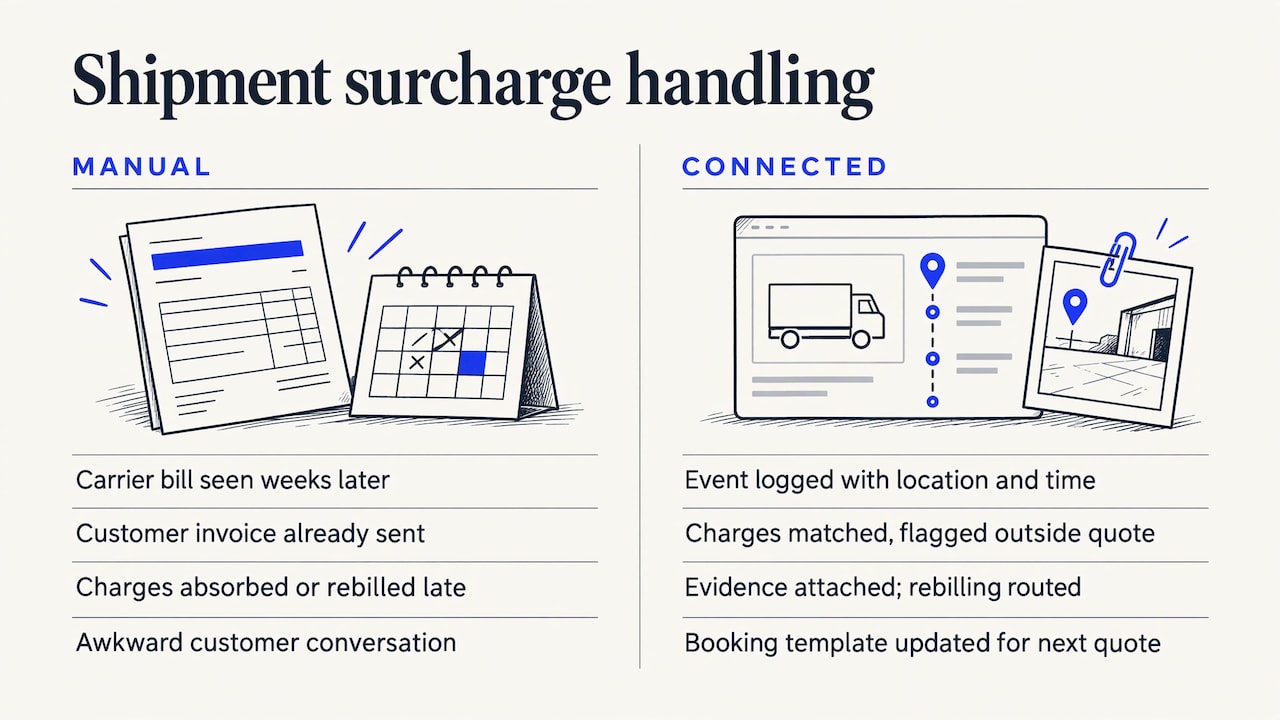
The carrier’s bill arrives with a limited-access charge and a liftgate charge. In a manual process, someone sees the carrier invoice weeks later, and by then the customer invoice has gone out. The charges are either absorbed or rebilled late, with an awkward conversation.
In a connected process, the delivery event is logged on the shipment with the location and time. When the carrier invoice is recognized, the two charges are matched to the shipment, flagged as outside the quote, and routed to whoever owns rebilling. The evidence is already attached. The customer receives a supported charge on the same invoice cycle, and the booking template for that consignee is updated so the next quote includes it.
The freight is the same. What changes is whether the margin is kept.
Why a TMS changes the economics of surcharge control
Surcharge management fails when it is split across tools: rates in one file, bookings in another system, tracking in a portal, invoices in the accounting package. Every handoff is a place where a charge drops out. The case for a TMS is that the surcharge is one data object that travels from rate to quote to booking to shipment to invoice.
An AI-native TMS goes a step further. FreightSuite supports AI agent orchestration natively, so routine work around documents, invoices and exceptions can be automated inside the same platform that holds your rates and shipments. For forwarders, the commercial result is the one that matters: less administrative effort per shipment, fewer missed rebills and cleaner margins. Pricing models matter too, since add-on modules can quietly raise cost. Our guide to TMS pricing models and total cost lists what to include in a fair comparison. FreightSuite includes its core features out of the box without add-ons.
The forwarders that will pull ahead are the ones that stop treating surcharges as an after-the-fact reconciliation and start treating them as part of pricing. The ground is shifting beneath this industry, and the teams that move first on structured surcharge data will have the margin and the speed to show for it.
See surcharge control in your own workflow
If your team still rebuilds surcharge calculations in spreadsheets or chases carrier invoices after the customer has been billed, it is worth seeing the process end to end. FreightSuite is a cloud-based TMS for freight forwarders and logistics companies, with rate management, ocean and air tracking, finances and workflow automation in one platform. Explore the FreightSuite platform, or go directly to the capabilities for ocean freight, air freight and road freight.
FAQ
What is a surcharge in freight logistics?
A surcharge is an extra charge added to the base freight rate to recover variable costs or cover specific shipment conditions. Common examples are fuel, congestion, peak season and accessorial charges such as liftgate service. Each carrier defines its own triggers and rates.
What is the difference between a fuel surcharge and an accessorial charge?
A fuel surcharge is index-linked and usually calculated as a percentage of the line-haul charge, based on the pickup date. An accessorial charge pays for a service beyond standard pickup and delivery, such as inside delivery, appointment scheduling or limited-access locations.
How do forwarders avoid surprise surcharges?
They capture accurate shipment data at booking, quote surcharges by category, log events as they happen and match every carrier invoice to the shipment before billing the customer. Structured rate data with effective dates is what makes this repeatable.
Can a TMS manage surcharges across rates, bookings and invoices?
Yes, when surcharges are stored with the rate and carried through the shipment to the invoice. FreightSuite’s rate management, tracking, finances and workflow tools are built into one platform for this purpose.
Sources
- Freight surcharges, Finnlines
- Managing LTL rules, tariffs and accessorials, AFS
- Accessorial brochure, Old Dominion Freight Line
- Fuel tariff, D.Y. L. Transport
- Ocean Freight Quotes: Base Rates, Surcharges and Hidden Costs, IFT
- What Is a Freight Accessorial?, Freightquote
- Accessorial Charges Explained, National Freight Hub
- What Is Long-Distance Freight? 2026 Shipping Guide

