SOC 2 for Logistics Software: What Forwarders Should Look For

SOC 2 is an independent examination of the controls a software provider uses to protect customer data, and for a freight forwarder it is the most useful single document for judging whether a cloud TMS can safely hold your rates, shipments, invoices and customer records. The report is only as good as its scope, its period and its exceptions, so the skill that matters is reading it well. A modern cloud platform built for forwarders, like FreightSuite, puts rate management, air and ocean tracking, finances and workflows in one system, which is exactly why the security of that one system deserves a careful look.
This guide explains what SOC 2 is, why it applies to logistics software, which criteria matter most for a TMS, and how to read a report line by line.
TL;DR
- SOC 2 is an attestation by an independent CPA firm on a provider’s controls, measured against the AICPA’s Trust Services Criteria. It is not a certificate.
- Security is mandatory in every report. For a TMS, Availability, Confidentiality and Processing Integrity are the optional criteria that usually matter most.
- A Type 2 report tests controls over a period of time, so it generally carries more weight than a Type 1 snapshot.
- Check three things first: that the TMS and its integrations sit inside the audit boundary, how many exceptions there are, and which complementary user entity controls land on you.
- SOC 2 does not replace customs, transport or other regulatory obligations.
Table of Contents
- What SOC 2 actually is
- Why SOC 2 applies to logistics software
- The five criteria and which ones a TMS needs
- Type 1 versus Type 2
- How to read a SOC 2 report in six passes
- What the report cannot tell you
- Where SOC 1 fits
- Has the standard changed recently?
- What SOC 2 costs, and why it shows up in your price
- Choosing a TMS with security and capability in view
- A buyer’s routine you can reuse
- FAQ
- Sources
What SOC 2 actually is
SOC stands for System and Organization Controls. A SOC 2 examination is performed by a licensed CPA firm, and it evaluates how a service organization protects the systems and data it runs for customers. The AICPA’s guide covers examinations of controls relevant to security, availability, processing integrity, confidentiality or privacy. Those five categories are the Trust Services Criteria, which the AICPA’s Assurance Services Executive Committee established for attestation and consulting engagements.
Two details help you read any report. First, the examiner uses one set of criteria to evaluate controls and a second set, the description criteria, to evaluate how the provider describes its system. Second, because a CPA firm attests rather than certifies, there is no pass or fail badge. You get an opinion and a body of test results, and your job is to interpret them.
Why SOC 2 applies to logistics software
A TMS is a system of record for the most commercially sensitive information a forwarder owns: buy and sell rates, customer lists, routes, shipment status, invoices and bank-linked financial data. It is also the system your customers see through portals and dashboards, and the one that exchanges data with carriers, accounting software and customs systems through APIs and EDI.
That profile fits SOC 2 closely. One US audit firm notes that SOC 2 suits transportation management software, warehouse platforms and freight technology, scoped to the systems and services customers depend on. Another source lists the triggers: customer portal access to orders and shipment status, API or EDI integrations, storage of sensitive operational data and reliance on cloud systems. A cloud TMS meets every one of them.
SOC 2 also has limits worth stating plainly. It does not stand in for transportation, workplace safety or customs obligations. Those regimes keep their own rules, and a clean SOC 2 report says nothing about whether a forwarder’s customs filings are correct.
The five criteria and which ones a TMS needs
The provider’s management chooses which categories go in scope, based on what its customers need, according to Baker Tilly’s US guidance. That choice tells you something about the provider before you read a single control.
Security is mandatory in every report. It covers protection against unauthorized access, and it is where you find access management, monitoring and incident response.
Availability matters because forwarding runs around the clock. When a vessel is delayed or a booking cutoff approaches, a TMS that is down is an operational problem, not an IT one.
Confidentiality covers how information designated as confidential, such as your rate sheets and customer pricing, is protected and disposed of.
Processing Integrity asks whether the system processes data completely, accurately and on time. For a TMS that touches invoicing, FX and cost allocation, this is the criterion closest to your margins. One US firm points out that it may be relevant where customers rely on complete, accurate and timely processing.
Privacy applies where the platform handles personal information about individuals, such as consignee contacts or driver details.
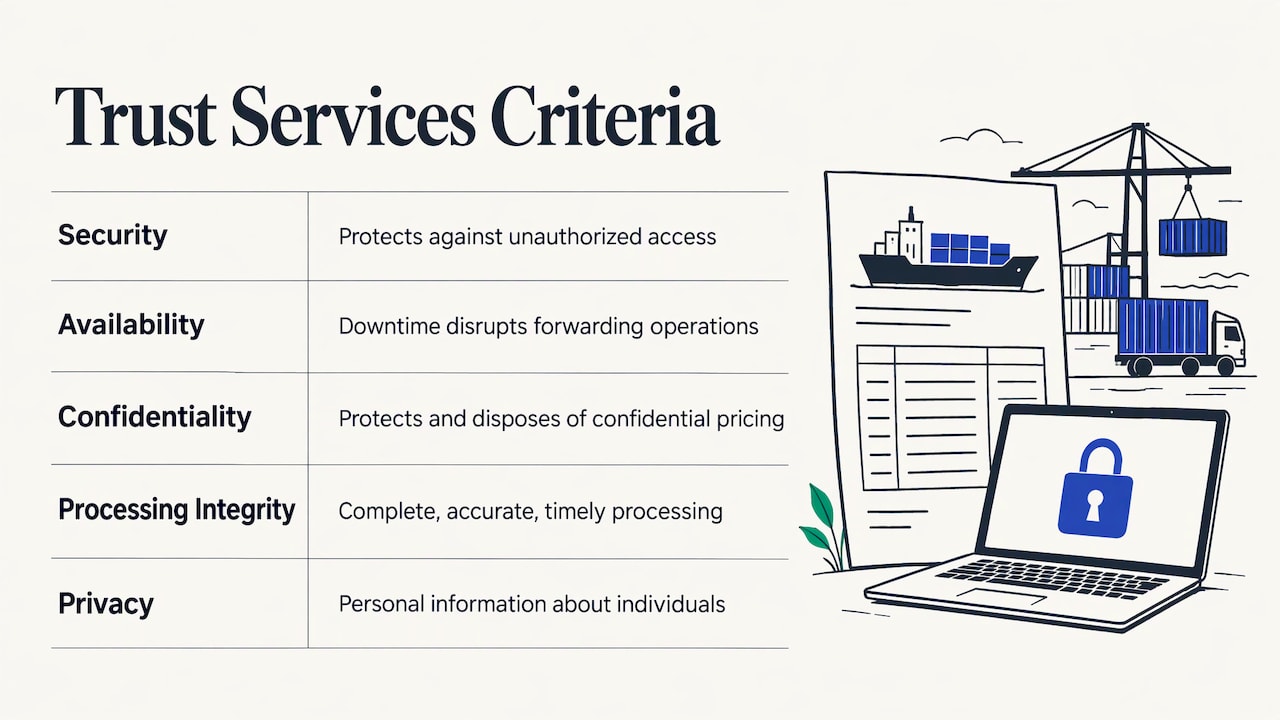
A logistics-focused source reports that for platforms it almost always recommends adding Availability, Confidentiality and Processing Integrity to Security, since the platform runs continuously, holds shipper rates and routes, and produces billing data that must be accurate. A separate buyer’s checklist makes the same point from the other side: a Security-only report means the vendor answered just the mandatory question.
Type 1 versus Type 2
A Type 1 report describes whether controls are suitably designed at a single point in time. A Type 2 report adds whether they operated effectively over a period, and it includes the auditor’s detailed test results. Baker Tilly notes that user organizations generally prefer Type 2 for that reason.
The practical difference for a forwarder is time. A snapshot tells you the locks were installed. A period report tells you the locks were used, on schedule, for months. The report you receive will state its observation window, and you should check that the window is recent enough to describe the system you will actually be running on. One logistics-focused provider describes a 12-week minimum observation window for a first Type 2, and many providers then renew annually, so a series of consecutive reports is a stronger sign than a single one.
How to read a SOC 2 report in six passes
Most reports run to many pages. You do not need to read every control. You need to read the right parts in the right order.
Pass one: the auditor’s opinion
Start with the opinion letter. An unqualified opinion means the auditor found the description fair and the controls suitably designed and, for Type 2, operating effectively. A qualified opinion means the auditor found a material problem, and it deserves a direct conversation with the provider.
Pass two: the system description and scope
This is the most important section. The buyer’s checklist cited above calls the system description the section to check first, because a report never mentions problems in systems it did not examine. For a TMS, confirm that the scope names the core platform, the integration layer for EDI and APIs, and the shipment and financial data stores, not just the customer-facing portal. A logistics-specialist source makes the same point: the description should cover the TMS and tracking platform, the integration layer and the shipment data stores.
Also confirm the product lines. A SOC 2 report may cover a specific platform or service rather than every product, so if you will use air, ocean, road and customs modules, check that the examined system is the one you will use.
Pass three: the criteria in scope
Check which of the five categories are included, using the logic above. For a TMS carrying live shipments and financial data, Security alone is thin. Availability, Confidentiality and Processing Integrity line up with how forwarders actually use the system.
Pass four: subservice organizations
Cloud TMS providers sit on top of hyperscale infrastructure. A real logistics example is a published Type 2 report from a delivery platform, which covers a logistics management system against the Security, Availability, Confidentiality and Privacy criteria and names AWS and Google Cloud as subservice organizations. The report will state whether those infrastructure controls are included or carved out. Carve-outs are normal, but you should know which controls belong to which party.
Pass five: exceptions
Exceptions are test results where a control did not work as described. They are not automatically disqualifying, but pattern matters. One checklist suggests counting them on three dimensions: how many, whether they cluster on one control, and whether the same control fails year after year. An isolated exception with a documented fix is a different story from a repeat failure on access reviews.
Pass six: complementary user entity controls
Complementary user entity controls, or CUECs, are the controls the provider expects you to run on your side. The same checklist gives examples: periodic access reviews, encrypting data in transit and removing terminated users. They become your responsibility the day you sign, so hand them to whoever owns IT and HR offboarding at your company. In practice, a forwarder with a clean offboarding routine for departed staff and agents covers the most common one.
What the report cannot tell you
A SOC 2 report is restricted-use. Baker Tilly notes that, like SOC 1, it is restricted to specific users, so expect to receive it under a confidentiality agreement rather than download it from a website. It also describes the past. A report covering a period that ended many months ago does not speak to the most recent weeks, and the guidance on reviewing reports lists bridge letters among the key considerations for covering that gap, per the AICPA-based review points.
It is also not a measure of product quality. SOC 2 does not tell you whether a TMS handles consolidations, FX or ocean tracking well. For those questions you need to compare functionality directly. Our guide to TMS selection criteria forwarders can test live covers that side, and the comparison of cloud TMS platforms for US forwarders places security next to functionality.
Finally, it covers the provider’s system, not your whole stack. Your own spreadsheets, shared mailboxes and ad hoc file transfers sit outside any vendor’s audit boundary.
Where SOC 1 fits
Forwarders sometimes ask whether they need SOC 1 instead. The distinction is the subject. SOC 1 concerns controls that affect customers’ financial reporting, such as inventory records or billing. SOC 2 is most relevant when customers want assurance over a technology or data service. For a software platform, SOC 2 is the report most buyers ask for first. A TMS that also drives invoicing and credit control may be relevant to both, and your finance team can tell you which your auditors expect.
Has the standard changed recently?
The framework behind current reports is stable. The criteria date from 2017, and the AICPA issued revised points of focus in October 2022. Schellman’s breakdown says the criteria were not materially changed, while the guidance added detail on areas such as change management, data management and periodic reassessment of vendors and third parties. EY’s note on the revision says service organizations may need to adjust controls and system descriptions. For you as a buyer, this means reports from different years are comparable on the same footing, and the vendor-management emphasis in the guidance matches what you are doing when you review a provider.
What SOC 2 costs, and why it shows up in your price
Providers carry the cost of the examination, and buyers feel it indirectly through subscription pricing and through how seriously a vendor treats security. The ranges are wide. A study of 192 audit firms found median planning estimates of $35,000 for Type 1 and $55,000 for Type 2, with Type 2 fees at specialist CPA firms listed at $15,500 to $50,000. Another source puts a first-year all-in total, including readiness, tooling and internal labor, at $30,000 to $150,000. Add the recurring work: one cost guide lists readiness assessments, documentation tools, penetration testing and 100-plus hours of internal staff time on top of the audit fee.
The lesson is that a Type 2 report is a sustained, expensive commitment. Providers who renew one every year are paying for ongoing discipline, not a one-time badge.
If you are a forwarder who runs a customer portal and your own customers start asking you for a report, the same cost logic applies to you. Choosing a platform whose security posture you can document makes that conversation easier.

Choosing a TMS with security and capability in view
Security evidence and capability belong in the same evaluation. A forwarder consolidating rate management, tracking, finances and workflows into one cloud system reduces the number of data stores, logins and integrations to govern, and that makes every one of the checks above shorter. FreightSuite is a cloud-based TMS for forwarders and logistics companies that includes rate management, air and ocean tracking, financial management, automated document management, invoice recognition, credit control, customer dashboards and accounting software connections, and its core features are included out of the box without add-ons. Its modules for ocean freight, air freight, road freight and customs brokerage run on one platform, and you can see how it differs from legacy systems on the CargoWise comparison page. When you are ready to see it against your own workflows, start at freightsuite.com.
A buyer’s routine you can reuse
The strongest vendor reviews are repeatable. Treat the report as one input among several and run the same sequence each year: confirm the opinion, confirm that the product you use is inside the scope, confirm that the criteria include Availability, Confidentiality and Processing Integrity, note every subservice organization, count and classify exceptions, and assign each CUEC to a named owner on your team. Baker Tilly’s Kim Koch frames the report as a tool for vendor management programs and internal governance, not a one-time sales document, and that is the right way to file it: with the contract, reviewed on a schedule.
FAQ
Does SOC 2 apply to a TMS or other logistics software?
Yes. SOC 2 is scoped to the systems and services customers rely on, and that includes transportation management software and freight technology. It is most relevant when the platform holds shipment data, offers portals or exchanges data through APIs and EDI.
Is a SOC 2 report a certification?
No. It is an attestation: an independent CPA firm gives an opinion on a provider’s controls against the Trust Services Criteria, with detailed test results for Type 2. There is no certificate, so the value lies in what the report covers and what it found.
What should I check first in a SOC 2 report?
Start with the system description. Confirm that the platform and integrations you use are inside the audit boundary, then check which criteria are in scope, how many exceptions there are, and which complementary user entity controls you must run.
How much does SOC 2 cost?
It varies with scope, size and starting security maturity. One 2026 study of audit firms found median planning estimates of $35,000 for Type 1 and $55,000 for Type 2, and all-in first-year costs run higher once readiness and internal time are included.
Sources
- SOC 2 Reporting on an Examination of Controls, AICPA & CIMA
- 2017 Trust Services Criteria with Revised Points of Focus 2022, AICPA & CIMA
- Criteria for a SOC 2 Examination, PwC Viewpoint
- What is a SOC report, Baker Tilly
- Logistics & Supply Chain, Zero Day CPA
- Why SOC 2 Matters in the Physical Supply Chain, Cofactr
- How to Review a 3PL’s SOC 2 Report, Logi Frontier
- SOC 2 for Logistics & Supply Chain Platforms, Tranquility Cybersecurity
- Why SOC 2 Type II Matters, ShipERP
- Roadie, Inc. SOC 2 Type 2 report
- A Breakdown of the Latest SOC 2 Guidance Revisions, Schellman
- To the Point: AICPA revises guidance, EY
- SOC 2 in 2026: Median Audit Estimate, SimpleAudit
- SOC 2 Cost Calculator, Konfirmity
- How Much Does a SOC 2 Audit Cost, Workstreet

