Quote Margin Control for Freight Forwarders

Quote margin control is the discipline of making sure the margin you promise in a quote is the margin you keep after the shipment is invoiced. In freight forwarding it comes down to three things: a complete cost stack at the moment of quoting, guardrails that apply the same margin rules to every rep, and a feedback loop that compares quoted margin to realized margin on every file. A TMS that holds rates, charges, FX and approvals in one system, which is how FreightSuite is built, turns those three things from a spreadsheet habit into a default.
A note on the search results: most pages for this phrase cover margin trading in brokerage accounts. This article is about something different: the gross margin on a freight quote.
TL;DR
- Quote margin control means the margin on the quote and the margin on the final invoice are the same number, or close to it, and you can prove why when they are not.
- Most leakage comes from incomplete cost stacks, stale surcharges, expired buy rates, FX movement and waived fees, not from reps deliberately underpricing.
- Set margin by lane, customer tier and service, quote with margin rather than markup, and require approval only below a floor.
- Track quoted versus realized margin on every shipment. The gap between the two is your leakage rate.
- FreightSuite includes rate management, dynamic FX and cost tracking, workflows and invoice recognition out of the box, so these controls sit in the system your team already quotes from.
Table of Contents
- Why quoted margin and realized margin drift apart
- Start with margin math the whole team shares
- Build the full cost stack before you set the price
- Set guardrails by lane, customer and service
- Treat surcharges and currency as live variables
- Measure quoted versus realized margin on every file
- Reduce the human steps that create errors
- Control the customer as well as the quote
- Where a TMS changes the picture
- A 30-day plan to put this in place
- FAQ
- Sources
Why quoted margin and realized margin drift apart
A forwarder sells a promise at one point in time and delivers it weeks later. Between those two moments the buy side moves: carriers add or change surcharges, a contract rate expires, a pickup turns into a detention event, a currency swings, a customs or documentation fee is waived to win the deal and never added back. The sales team sees a healthy margin on the quote. Finance sees something thinner when the vendor invoices land.
That is why the numbers matter more than the intent. One industry analysis describes gross margin, meaning the sell rate minus the buy rate before overhead, as typically running 12 to 20 percent per shipment, with net margins of only a few percent. When net margin is that thin, a two or three point slip between quote and invoice is not a rounding error. On many files it is the profit.
The drift almost never comes from one dramatic mistake. It comes from small, repeated gaps: a terminal charge copied from last quarter’s quote, an inland leg estimated by memory, a fuel surcharge left off because the carrier had not published it yet. Each gap is defensible on its own. Together they are your leakage rate.
Start with margin math the whole team shares
Before any control works, everyone has to calculate margin the same way. The most common confusion is margin versus markup.
Margin is profit as a share of the selling price. Markup is profit as a share of cost. A forwarder who buys a move for $1,800 and sells it for $2,000 earns $200. That is a 10% margin ($200 divided by $2,000) and an 11.1% markup ($200 divided by $1,800).
The mistake shows up when a rep is told to hit a 12% margin and adds 12% to cost instead. On that same $1,800 cost, adding 12% gives a $2,016 quote, which is an 10.7% margin. To actually earn 12%, the sell price is cost divided by 0.88, which is $2,045.45. On a book of several hundred files a month, that gap is real money, and it is invisible unless the quoting tool does the calculation for the rep.
The fix is simple: quote from a target margin, let the system derive the sell price, and show both numbers on the quote screen. Whichever way your team prefers to think, the system should never leave the arithmetic to memory.
Build the full cost stack before you set the price
Margin control fails first at the cost side. If the cost stack is incomplete, even a perfect percentage produces a bad quote. A complete stack for an ocean import, for example, includes the base freight, bunker and currency adjustment charges, peak or congestion surcharges, terminal handling at origin and destination, documentation and release fees, drayage, chassis and per diem exposure, customs entry, and any accessorial that the lane commonly triggers.
For each lane and service, the stack should be a template rather than a blank page. When a rep quotes a Shanghai to Chicago move, the system should already carry the components that file will need, flag any that have no current rate, and refuse to calculate a final margin until each has either a figure or an explicit, approved exclusion.
This matters most for the charges people forget. Air freight is the clearest case: tariffs layer fuel, security, handling and terminal fees on top of the base rate, and the hidden charges that accumulate in air freight tariffs are exactly where quoted and actual cost split. The same applies to the inland leg. If you run or buy trucking, the cost of the equipment and how well it is used shapes the rate you can quote profitably, which is why trailer fleet optimization methods belong in the same conversation as your road quote margin.
Keep buy rates tied to their validity
Every buy rate has a window. A contract rate, a spot rate from a carrier portal and an air rate from a general sales agent each expire on different clocks. If a quote outlives the buy rate behind it, you are no longer selling a margin, you are selling a guess.
The practical rule is that a quote’s validity should never exceed the validity of the shortest-lived cost line inside it. When a general rate increase or peak season surcharge is announced, the quote should expire before the change takes effect. Systems that store rates with their effective dates make this automatic. Spreadsheets make it a matter of whoever remembers to check. Our guide to carrier contract management covers how to make negotiated rates stick across a book of business.
Set guardrails by lane, customer and service
A single company-wide margin target is almost always wrong. A high-volume, competitive trans-Pacific lane cannot carry the margin that a small, urgent project move can. A customer who pays in 15 days and never disputes an invoice is cheaper to serve than one who pays in 75 days and disputes every accessorial.
Effective guardrails therefore have three layers.
The first is a target margin by lane and service, built from your own history rather than from a rule of thumb. The second is a floor, the lowest margin a rep can quote without asking anyone. The third is an approval path: below the floor, the quote routes to a manager with the cost stack, the customer’s history and the reason attached, so the decision takes a minute and leaves a record.
The design principle is that guardrails should flag incomplete cost stacks more than they flag low percentages. A 6% margin on a complete, current stack is a business decision. A 14% margin on a stack that is missing the destination terminal charge is a loss waiting to be invoiced. Approval rules that only look at the percentage miss the second case entirely.
Workflow tooling is what makes this livable. When approvals, thresholds and exceptions are built into the quoting flow rather than handled by email and chat, reps do not feel the guardrails as friction, and managers are not the bottleneck on every deal. For a deeper look at the process end to end, see freight quote management for logistics teams.

Treat surcharges and currency as live variables
Two cost lines move more than any others after the quote goes out: surcharges and exchange rates.
Surcharges first. A carrier can announce a new charge with very little notice, and a forwarder with hundreds of open quotes has to decide which ones are affected, whether the quote terms allow a pass-through, and which customers to tell. If the terms of the quote do not say that surcharges are subject to change, you are absorbing them. Strong quote templates state which charges are fixed, which are at cost, and which can be adjusted, so that a surcharge change becomes a notification rather than a negotiation.
Currency is the quieter leak. If you buy in one currency and bill in another, the exchange rate on the day you quote is rarely the rate on the day you pay the vendor or collect from the customer. On thin margins even a modest swing consumes a meaningful share of the profit on the file. The control is to quote using a documented rate, carry the exposure explicitly in the margin, and revalue the file as rates move so finance sees the true figure. FreightSuite’s dynamic FX and cost tracking is built for this, and the mechanics are explained in our exchange rate integration guide.
Measure quoted versus realized margin on every file
The single most revealing metric in this whole topic is the difference between the margin you quoted and the margin you realized after all vendor invoices and adjustments are posted. Most forwarders do not track it, because the quote lives in one place and the final costs live in another.
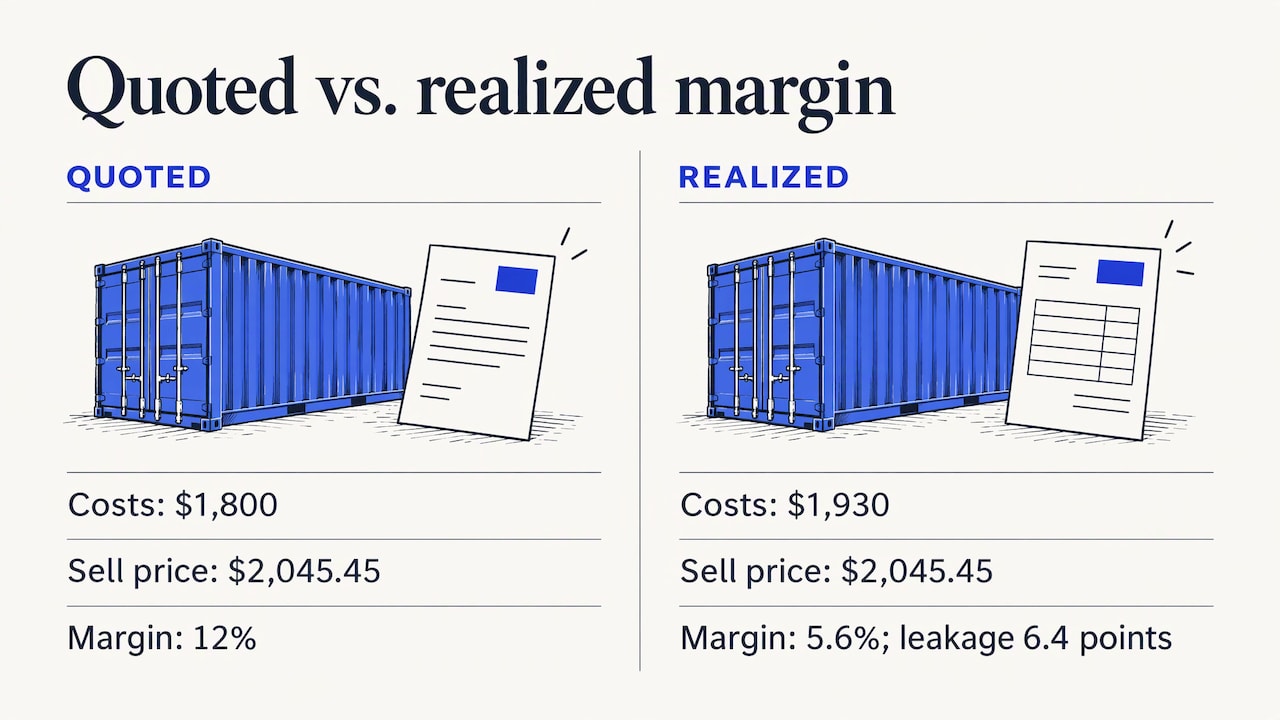
Here is a worked example. A rep quotes a 12% margin on a container move. The cost stack in the quote totals $1,800, so the sell price is $2,045.45. By the time the file closes, the actual costs are $1,930: a late bunker adjustment added $60, detention added $45, and an unrecorded documentation fee added $25. The sell price stays at $2,045.45, so profit is $115.45 and the realized margin is 5.6%. The quote said 12%. The leakage is 6.4 points on this one file.
Now multiply that across a month of files and sort them. You will usually find the leakage is concentrated: certain lanes, certain customers, certain reps or certain cost types account for most of it. That is the point. You do not fix a company-wide 3 point gap with a company-wide memo. You fix the three lanes and the two cost lines that cause it.
To make the measure routine, a few conditions have to hold:
Every quote must be linked to the shipment it becomes, so the comparison is automatic and not a reconciliation project at month end. Vendor invoices must be matched against the costs in the quote rather than keyed in as new data, which is where invoice recognition helps by reading the document and surfacing differences. And the variance must be reported by cause, so that “detention” and “stale surcharge” and “waived fee” each have their own line.
Reduce the human steps that create errors
Almost every quoting error is a copy-and-paste error in disguise. A rate is lifted from an email, a charge is typed in from memory, a previous quote is cloned and one line is forgotten. The more steps that rely on someone retyping data, the more margin leaks.
The controls here are structural. Keep rates in one managed source instead of in inboxes and personal sheets. Let the quote pull its cost lines from that source and refuse to proceed when a line is missing. Where you compare carriers, use an auditable process so you can show later why a given rate was chosen; our carrier rate shopping checklist lays out nine steps for doing that. And when the quote is accepted, carry the same figures straight into the shipment and the finance record, so no one rebuilds them.
There is a related benefit on the sales side. Customers who receive a clear, itemized quote with stated validity and stated pass-through terms dispute fewer charges later. Fewer disputes mean faster collection and less margin given away in credit notes.
Control the customer as well as the quote
A quote can hit its margin and the customer can still erode it. Slow payment ties up cash, and late payers often come with more adjustments and disputes. A forwarder that treats the margin on the quote as separate from the credit risk of the customer is only measuring half of the file.
The connection is practical. A customer on 60-day terms with a history of disputes should probably carry a higher target margin than one who pays on time. Credit limits and holds should be visible to the person quoting, not only to finance. And customer-facing dashboards that show shipment status and charges reduce the back and forth that often ends with a goodwill discount.
This is the link between quote margin control and profitability by customer. Once realized margin is tracked per file, you can roll it up by account, see which customers are actually profitable after leakage and credit cost, and reprice or release the ones that are not.
Where a TMS changes the picture
Everything above can be done in spreadsheets by a disciplined team with time to spare. The difficulty is that quote margin control is a high-frequency, detail-heavy job. It has to happen on every quote, every day, under time pressure from a customer waiting for a number.
FreightSuite is a cloud-based, agentic transport management system for freight forwarders and logistics companies, with rate management, air and ocean tracking, financial management, workflow customization and AI agent orchestration built in, and all core features included without add-ons. For quote margin control, the pieces that matter are the ones that keep the cost side honest: rates managed in one place, dynamic FX and cost tracking, automated document management and invoice recognition, credit control, and integrated accounting software connections, so the figure the sales team quotes and the figure finance books come from the same record.
The mode-specific pages show how this applies to your operation: ocean freight TMS and automation, the air freight management system, road freight transport management and customs brokerage software. If you would like to see your own quote-to-invoice flow in the system, you can book a demo.
If you are comparing tools, our review of freight quoting software for US forwarders and the guide to freight rate software set out the criteria that matter, and the piece on TMS pricing models explains which costs belong in a total cost of ownership comparison. For the accuracy side specifically, the rate quote accuracy playbook goes further into stopping margin leakage.
A 30-day plan to put this in place
You do not need a transformation program to start. In the first week, pull the last 100 closed files and compare quoted margin to realized margin for each. Sort by the size of the gap. In the second week, group the gaps by cause and find the top three. These are your first controls.
In the third week, write the cost-stack templates for your five busiest lanes, including the charges that caused the biggest gaps, and set a target margin and floor for each. In the fourth week, fix quote validity rules so no quote outlives its shortest-lived cost line, and define what gets approved and by whom. Then repeat the 100-file comparison a month later. If the leakage rate has fallen, you have a measurable result to show the team. If it has not, the report tells you which lane or cause to look at next.
The window to tighten this is not abstract. Margins are thin, customers compare quotes quickly, and every point you recover on quotes you already win goes straight to the bottom line without selling a single additional shipment. The choice of whether to leave that to chance is yours to make.
FAQ
What is the difference between margin and markup on a freight quote?
Margin is profit divided by the selling price, and markup is profit divided by cost. A $200 profit on a $2,000 sale is a 10% margin but an 11.1% markup on $1,800 of cost. Quote from target margin so the sell price is cost divided by one minus the margin, and your team stops under-earning by mixing the two.
How do I know how much margin I am losing between quote and invoice?
Compare the margin on each quote with the margin on the closed shipment after all vendor invoices are posted. The difference, averaged across a sample of files, is your leakage rate. Sort by lane, customer and cost type to see where it concentrates.
Should every rep use the same margin target?
No. Set targets by lane, service and customer tier, with a floor below which a quote needs approval. Reps then have room to win competitive deals, and managers see only the quotes that genuinely need a decision.
How long should a freight quote stay valid?
No longer than the shortest-lived cost line inside it. If a surcharge change or general rate increase is coming, the quote should expire before it takes effect. State clearly in the quote which charges are fixed and which can be adjusted.

