Freight Forwarding Software Compared: Options for 2026
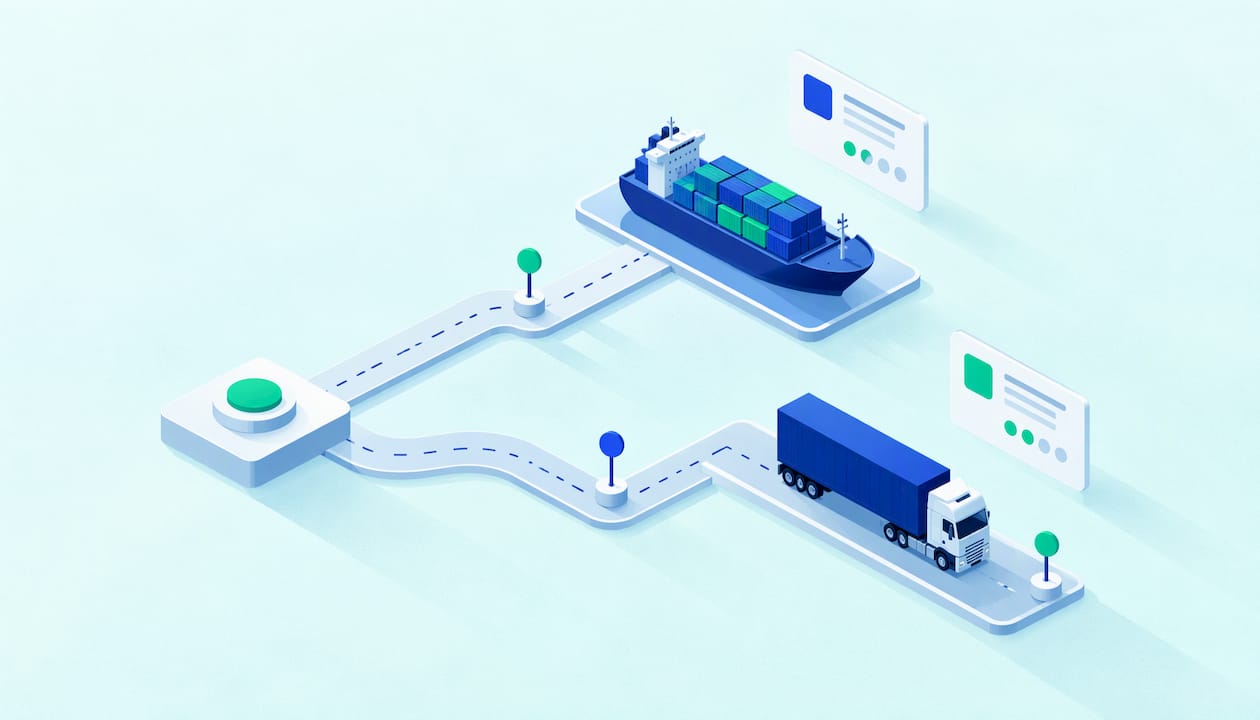
The best freight forwarding software is the platform that keeps one shipment record alive from quote to invoice, tracks air and ocean freight without rekeying, and puts finance in the same system as operations. Most forwarders shortlist the same names: CargoWise, Magaya, GoFreight, Logitude World, Descartes Aljex and a handful of newer cloud platforms. We build FreightSuite, an agentic TMS designed as the alternative to legacy systems, so we have a view. This guide still gives you the criteria to judge every option, ours included.
A note on the search itself. People type “freight forwarding software UK” and find lists of vendors that sell across borders. The comparison below is built from the roundups that cover forwarders in the United States, and the selection criteria apply to any trade lane. If you clear goods in the UK or the EU, the customs and filing questions in this guide matter more than any feature list.
TL;DR
- Freight forwarding software should cover jobs and shipments, documents, customs, rates and quotes, tracking, accounting and messaging in one system.
- The shortlist most roundups publish is CargoWise, Magaya, GoFreight, Logitude World, Descartes Aljex, Linbis, Freightify and a few others, and most do not publish prices.
- Where prices are public, they run per user per month, so total first-year cost, including implementation and migration, is the number to compare.
- FreightSuite is built around native automation and AI agent orchestration, with core features included out of the box instead of sold as add-ons.
- Judge any platform on integrations, implementation effort and support before you judge it on its feature grid.
Table of Contents
- What freight forwarding software actually does
- The options forwarders shortlist
- How the pricing works
- Core features to compare
- Freight forwarders and NVOCCs have different needs
- Integrations, implementation and support
- Where FreightSuite fits
- A simple way to run your evaluation
- FAQ
- Sources
What freight forwarding software actually does
A forwarder’s business runs on a chain of handoffs: an enquiry becomes a quote, the quote becomes a booking, the booking becomes a house and master shipment, and the shipment ends in an invoice and a payment. Software earns its place by removing the gaps in that chain. Mirage Metrics describes seven functional areas that a complete platform covers: jobs and shipments, documents, customs, rates and quotes, tracking, accounting, and messaging with EDI.
In practice that means house bills, manifests and arrival notices generated from the job data rather than retyped. It means buy and sell rates, contracts and tariffs stored where quoting happens. It means carrier status events feeding customer visibility, and job costing and accruals feeding the general ledger. When any of these live in a separate tool, someone on your team becomes the integration, copying data between screens and catching the errors afterward.
That is the strategic point behind the category. Margins in forwarding are shaped by how many shipments each person can handle and how few mistakes slip into invoices. Software that removes admin raises both numbers at once. The ground is shifting here, because the newest platforms treat automation and AI as part of the core product rather than a bolt-on, and the gap between forwarders who adopt them and those who do not will widen each quarter.
The options forwarders shortlist
There is no single official ranking, so the fairest approach is to look at what independent roundups include. SoftwareConnect’s 2026 roundup lists Magaya, GoFreight, CargoWise, GoComet, Scope, Logitude World, Linbis, Freightview and Descartes Aljex. CargoLinked’s August 2026 comparison covers CargoWise, Magaya, GoFreight, Logitude World, Logiware, Freightify, Freightos for Forwarders and FreightPOP, and notes that most of them do not publish prices.
Put those lists together with FreightSuite and the field sorts into three groups.
| Group | Examples named in the roundups | What buyers usually weigh |
|---|---|---|
| Established, broad platforms | CargoWise, Magaya, Descartes Aljex, Logiware | Breadth of modules, implementation effort, how many add-ons the full scope requires |
| Cloud platforms for forwarders and NVOCCs | GoFreight, Logitude World, Linbis, Freightify, Scope | Speed of rollout, per-user pricing, depth of finance and customs features |
| Rate and quoting tools | GoComet, Freightos for Forwarders, Freightview, FreightPOP | Rate access and quoting speed, and how well they connect to the operations system |
| Agentic TMS | FreightSuite | Native automation, AI agent orchestration, all core features included without add-ons |
The categories overlap, and your fit depends on your trade lanes and headcount. A forwarder running mostly ocean consolidations has different needs from one handling urgent air freight and customs brokerage together.
How the pricing works
Pricing is the hardest part of this comparison, because most vendors want a conversation first. CargoLinked reports that only Logitude World shows a dollar figure among the eight systems it compared, at $75 and $99 per user per month, with enterprise pricing custom. Another listing reports Logitude plans at $45 per month for Economy, $70 per user per month for Business and $90 per user per month for First Class, with a free trial. The two sources differ, which is itself useful: plan names, tiers and rates change, so treat any third-party number as a starting point and confirm it with the vendor.
FreightSuite follows the subscription model, and pricing is quoted after a demo. We do not publish a price on the site, so we will not put a number here.
Whatever the model, the figure that matters is total first-year cost. CargoLinked’s advice is to ask for it including implementation and migration. We would add three line items to the request: modules that are priced separately, per-user versus per-shipment charges as you grow, and the cost of connecting your accounting software. A low seat price with a long list of add-ons is often more expensive than a higher price that includes the core.
Core features to compare
A feature grid flatters every vendor, so compare on the jobs your team performs daily. Start with these.
Rate management
Your team quotes from carrier contracts, spot rates and agent tariffs, often in spreadsheets and inboxes. Good rate management keeps buy and sell rates in one place, ties them to the quote, and carries the quote into the job without retyping. Ask to see a quote built from a real contract, then converted into a booking. Our own guide to freight rate software for forwarders goes deeper on what to look for.
Air and ocean tracking
Tracking should do more than display a status. Carrier events should update the shipment record, flag exceptions to the person responsible, and feed customer visibility so your team stops answering where-is-my-cargo emails. Check which carriers and airlines are covered for your lanes, and whether events trigger workflow steps such as arrival notices.
Finance and accounting
This is where many forwarders lose margin. Job costing, accruals, customer billing, and carrier and agent payments should be generated from the job rather than rebuilt in a separate accounting package. Look at how the system treats foreign exchange and costs that arrive after the invoice. FreightSuite includes dynamic FX and cost tracking, invoice recognition and credit control, and connects to accounting software. Finance leaders can see the detail on our freight management system for finance teams page.
Documents and labels
House bills, manifests and arrival notices should come from job data. The physical side matters too, since clear labeling underpins handling and tracking, and this overview of the role of labels in logistics explains how label quality affects shipment flow. In the software, check that document templates can be customized per customer and per mode.
Workflow automation and AI
Software that stores data is a database. Software that acts on data is a workflow engine. The test is simple: pick a repetitive task, such as processing a carrier invoice or confirming a booking, and ask how much of it the system does without a person. Industry commentary suggests the upside is large. Sure Send reports that automation can reduce manual data entry by 80% according to industry benchmarks, and that users report a 90% reduction in weekly reconciliation time with a TMS. These are brokerage-oriented, vendor-published figures, so treat them as a direction of travel rather than a promise for your operation.
The difference between bolt-on AI and native AI is where the agents work. In FreightSuite, AI agent orchestration is built into the TMS, so agents operate on the same shipment, rate and finance records your team uses. We explain how in how AI agents handle freight tasks, and why this reduces mistakes in why automation reduces freight errors.
Freight forwarders and NVOCCs have different needs
If your company is an NVOCC as well as a forwarder, your software requirements widen. In the US, both are Ocean Transportation Intermediaries regulated by the Federal Maritime Commission. Integrated Global Logistics explains that an NVOCC issues its own house bill of lading and assumes direct liability for cargo, while a forwarder arranges transportation as the shipper’s agent. It also states the surety bond requirements as $75,000 for NVOCCs and $50,000 for forwarders. ReformHQ adds that NVOCCs face tariff publication requirements that forwarders do not, and that many companies hold both licenses.
For software buyers, the consequence is practical. If you operate as an NVOCC, you need rate and tariff handling that supports publication, house bill issuance in your own name and liability-aware documentation. If you hold both licenses, the platform should handle both service lines in one system, so you are not running two sets of books. Ask each vendor to demonstrate both workflows.
Integrations, implementation and support
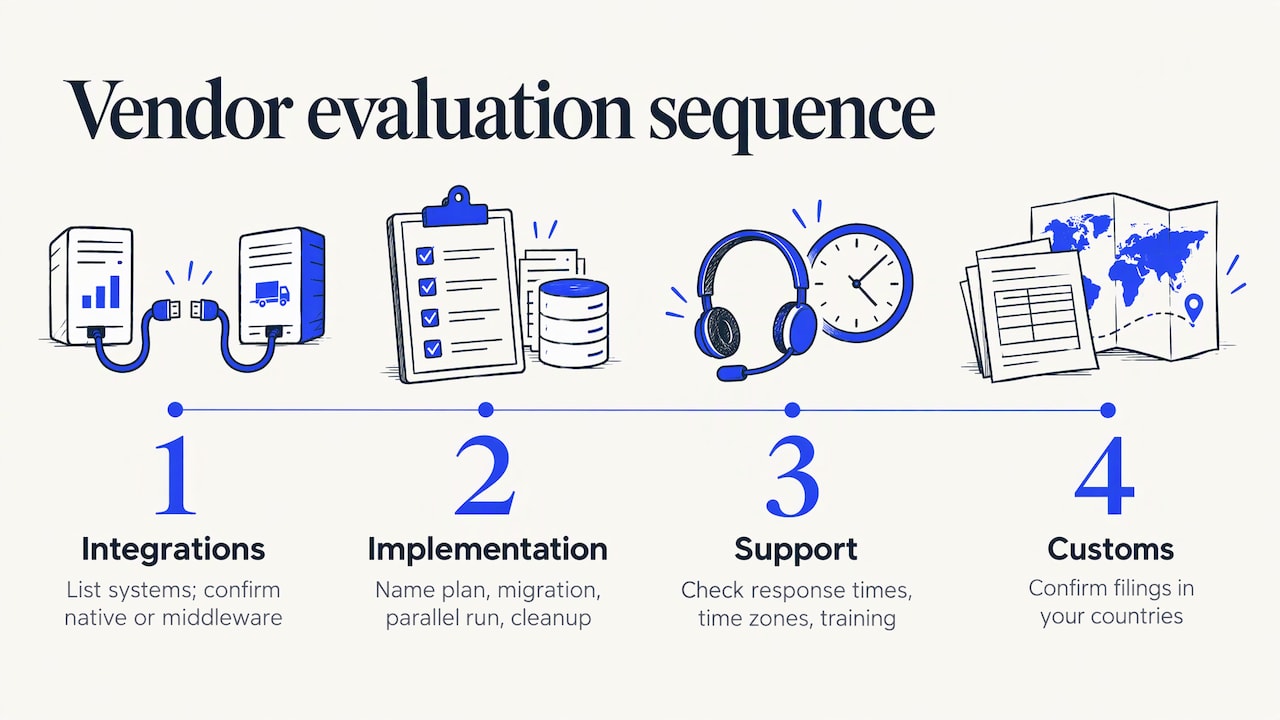
The research for this question is thin, which is common: vendors rarely publish implementation detail. That makes your own questions the main tool. Use this sequence in every vendor call.
Start with integrations. List the systems that must connect: your accounting package, carrier and airline feeds, customs filing, customer portals, and email. Ask which connections are native and which require middleware or paid services. Mirage Metrics lists messaging and EDI among the core areas, covering bookings to carriers, messages to agents and filings, so confirm the standards your trading partners already use.
Next, implementation. Ask for a named project plan: who migrates your customers, rates and open jobs, how long parallel running lasts, and what your team must supply. A cloud platform should shorten this, but data cleanup is always your responsibility, so budget time for it.
Finally, support. Ask about response times, whether support covers your time zones, and whether training is included or charged. A forwarder running air freight cannot wait a day for an answer when a shipment is stuck.
If you do business through customs, add the customs question. Mirage Metrics frames customs as declarations and filings for the countries where you clear, so the practical test is whether the system supports the filings in your specific countries, including the UK or EU if your lanes touch them. Our customs brokerage TMS software page shows how FreightSuite approaches this.
Where FreightSuite fits
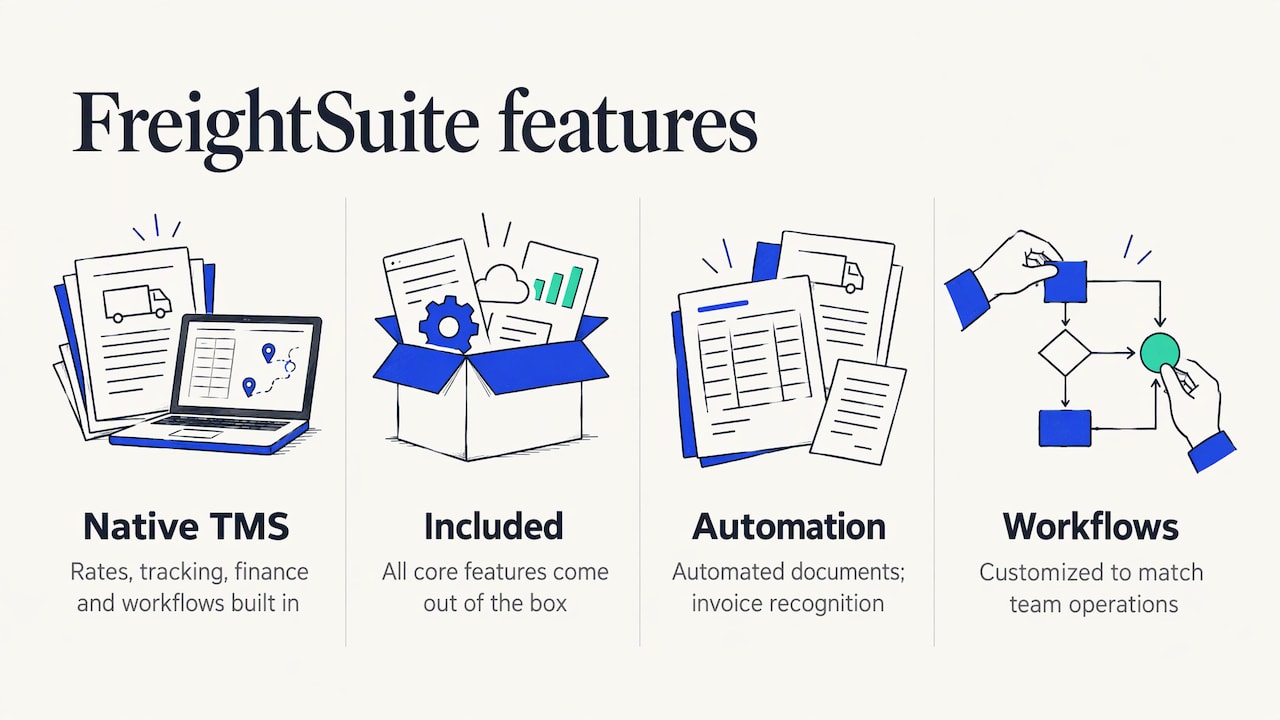
We built FreightSuite for freight forwarders and logistics companies who want a modern alternative to legacy platforms such as CargoWise, Magaya, Descartes, Multifreight, Logi-Sys and Logitude. Rate management, air and ocean tracking, finances, operations, workflows and AI agent orchestration are built natively into the TMS. Our design principle is that all core features come out of the box, with no add-ons to buy, so the system you demo is the system you run.
The product includes automated document management, invoice recognition, dynamic FX and cost tracking, credit control, customer dashboards and accounting software connections. Teams can customize workflows to match how they operate, and mode-specific capabilities are available for ocean freight TMS and automation, the air freight management system and road freight transport management.
If you are comparing FreightSuite directly with an incumbent, our CargoWise comparison and broader comparison page lay out the differences side by side. For a view of cloud platforms for US forwarders, read our guide to the best cloud TMS in 2026. When you are ready to see it on your own shipments, book a FreightSuite demo and bring a real quote, a real job and a real carrier invoice.
A simple way to run your evaluation
The window to modernize is real, and it has a timeline: every quarter on a manual process is a quarter of margin spent on admin. Here is how to run an evaluation that finishes in weeks, not months.
First, write down the five workflows that consume the most staff time, such as quoting, booking confirmation, tracking updates, invoice entry and customer reporting. Second, shortlist three platforms from the groups above, mixing at least one established system with one cloud-native option. Third, give every vendor the same real scenario and watch how many steps need a person. Fourth, request total first-year cost in writing, including implementation, migration and add-ons. Fifth, speak to a forwarder of your size and trade profile who has gone live in the last year.
Reporting deserves its own check. Management needs margin by shipment, customer and lane without a weekend of spreadsheet work, and our guide to freight operations reporting automation shows what good looks like. For a view on the strategic payoff of AI inside the system you already use, see AI in freight forwarding inside your TMS.
The choice is yours to make, and the forwarders who make it deliberately will set the pace for the rest of the industry.
FAQ
What is the best freight forwarding software?
There is no single best option, because it depends on your modes, volumes and whether you also operate as an NVOCC. Roundups commonly list CargoWise, Magaya, GoFreight, Logitude World and Descartes Aljex. FreightSuite is our pick for forwarders who want native automation and AI agent orchestration with core features included.
How much does freight forwarding software cost?
Most vendors do not publish prices. Where figures appear, they are per user per month, such as the Logitude rates reported by CargoLinked. Ask every vendor for total first-year cost including implementation and migration. FreightSuite pricing is provided after a demo.
What should freight forwarding software include?
At minimum it should cover jobs and shipments, documents, customs, rates and quotes, tracking, accounting, and messaging with EDI. Beyond that, look for workflow automation, invoice recognition and customer dashboards that work on the same data as operations.
Does freight forwarding software work for UK trade lanes?
Many platforms serve forwarders on international lanes, but the deciding factor is whether the system supports customs declarations and filings for the countries where you clear. Ask each vendor to show the specific filing flow for the UK or EU lanes you run.
Sources
- Freight forwarding software: what it does, how to choose (Mirage Metrics)
- Best Freight Forwarding Software on the Market (SoftwareConnect)
- Freight Forwarding Software Compared (CargoLinked)
- Logitude pricing, features and details (SoftwareSuggest)
- Freight Broker Software: How to Know if It is Right for You (Sure Send)
- NVOCC vs Freight Forwarder (Integrated Global Logistics)
- NVOCC vs Freight Forwarder: Key Differences (ReformHQ)

