Ocean ETA Prediction: How It Works and How Forwarders Use It
Ocean ETA prediction is the practice of estimating when a vessel, and the container on it, will actually reach a port, using live position, speed, history, weather and port conditions instead of the carrier’s planned schedule. For a forwarder, the prediction itself matters less than where it lives: an ETA that sits in a separate tracking portal informs one person, while an ETA that updates inside your TMS can reprice, reroute, notify customers and trigger workflows without anyone retyping a date. That is the argument of this article, and the sections below give you the mechanics first so you can judge it for yourself.
TL;DR
- An ocean ETA prediction estimates actual arrival by combining vessel position and speed, historical voyage patterns, weather and port congestion, rather than relying on the published schedule alone.
- Academic work groups the factors into six types: vessel static data, vessel dynamic data, route conditions, environmental conditions, human factors and unexpected external events.
- Published accuracy figures come from specific studies on specific vessels and ports, so treat any single number as a range for that context, not a promise for every lane.
- The ETA only creates value when it reaches the people and processes that act on it: customer updates, drayage, customs, invoicing and cash exposure.
- Keeping tracking, workflows and finance in one TMS shortens the distance between a changed ETA and a changed decision.
Table of Contents
- What ocean ETA prediction actually is
- The basic calculation behind every ETA
- How predictive systems go further
- Why ocean ETAs change
- How accurate are the predictions?
- From a predicted date to a decision
- Why the TMS is the right home for ETA data
- Building an ETA routine your team can run
- Common mistakes with ocean ETAs
- See it in your own operation
- FAQ
- Sources
What ocean ETA prediction actually is
A carrier publishes a scheduled arrival when it sells the space. A predicted ETA is a running estimate that is recalculated as the voyage unfolds. A 2025 review in Maritime Policy & Management by Jiang and colleagues defines vessel arrival-time prediction as estimating when a vessel will reach a port, and it surveys 29 academic studies published since 2011. The topic is not new, but the quality of the data feeding it has changed what is possible.
The distinction matters commercially. Hapag-Lloyd’s August 2025 guide notes that traditional ETAs have relied on planned schedules, historical data and assumptions about weather and port conditions. A planned date is a statement of intent. A predicted date is a statement of what the evidence says right now. Forwarders live in the gap between the two, because that gap is where missed cutoffs, detention charges and unhappy customers come from.
The basic calculation behind every ETA
Underneath every sophisticated model sits simple navigation arithmetic. Distance equals speed multiplied by time. Rearranged, the hours remaining on a passage are the nautical miles left divided by the vessel’s speed in knots. A ship with 1,200 nautical miles to go at 15 knots has 80 hours to run, which is just over three days and eight hours.
Two practical habits keep that arithmetic honest. First, work in UTC, then add the destination port’s offset to express the arrival in local time, because a vessel crossing time zones will otherwise produce dates that shift by a day for no real reason. Second, remember that speed over ground is rarely constant. Vessels slow down for weather, speed up to make a berthing window, and wait at anchor when the terminal is full. A straight division gives you a first estimate and nothing more.
This is why the simple method fails at scale. It ignores everything that happens between the current position and the berth, and the berth is the event your customer cares about.
How predictive systems go further
The 2025 review identifies two broad approaches: prediction that works without reconstructing the vessel’s trajectory, and prediction that uses path finding to model the route the vessel is likely to take. It also sorts the models themselves into statistical, machine-learning, deep-learning and reinforcement-learning families. For a forwarder, the family matters less than the inputs, because every approach is only as good as the data it sees.
Hapag-Lloyd’s guide lists the inputs that modern dynamic systems use: AIS position, speed and course, historical voyage patterns, weather forecasts, port congestion and machine learning layered on top. AIS, the Automatic Identification System, is the transponder signal that ships broadcast so that their position and movement can be followed. Each input answers a different question. Position and speed tell you where the vessel is and how fast it is closing. History tells you how this service, on this lane, usually behaves. Weather tells you what is about to slow it down. Congestion tells you whether there will be a berth when it arrives.
The six factor groups
The Jiang review groups relevant prediction factors into six types: vessel static information, vessel dynamic information, route conditions, environmental conditions, human factors and unexpected external factors. The same review explains that static features such as ship type, length and draft shape the vessel’s navigational constraints, while dynamic speed and course reflect the operational adjustments a master makes along the way.
Translated into forwarding terms, that gives you a useful mental checklist when an ETA moves. Is it the vessel, such as a slow-steaming decision or a mechanical issue? Is it the route, such as a canal queue or a diversion? Is it the weather? Is it the port? Or is it something nobody planned for? Knowing which group a delay belongs to tells you how long it is likely to last, and that determines what you say to the customer.
Why ocean ETAs change
Most forwarders do not need a model to tell them ETAs slip. They need to know which slips are likely to compound. Hapag-Lloyd’s guide gives three examples that can make a vessel arrive days later than a static ETA: congestion at a prior port, Atlantic storms and mechanical problems. Notice that the first of those happens before the vessel ever reaches your port. A delay at the previous call travels forward with the ship.
The U.S. side adds terminal dynamics. A November 2021 Maersk notice on U.S. export terminals says that vessel schedules, weather and terminal congestion can affect receiving dates and lead to last-minute changes. Although that notice concerns exports and dates from the 2021 congestion period, the mechanism applies in both directions: the ETA is only one of several dates that move together, and the others, such as the earliest receipt date or the last free day, move with it.
This is the point where a single ETA field stops being enough. A forwarder is really managing a chain of dependent dates: vessel arrival, discharge, availability, customs release, truck appointment, return of the empty container. When the first date changes, every later date needs to be re-examined.
How accurate are the predictions?
Accuracy is the question every operations manager asks, and it is the one that most deserves a careful answer. Published figures are real, but they describe specific studies.
A Port of Houston study of AIS-based ETA prediction for tankers and cargo vessels, using historical data from 2018 to 2020, reports a 5% mean absolute percentage error for its XGBoost approach. That result applies to the vessel types and port context it studied, not to all ocean freight. An AWS case study from January 2021 reports an R-squared score of 0.9473 for its vessel-arrival model, and again the number belongs to that dataset and that design.
What should a forwarder take from this? Not a benchmark to quote to customers, but a direction. Models built on live position, speed and history can narrow the error compared with a static schedule, and the error is smaller the closer the vessel gets to port. Your own history is the best test: compare predicted arrival with actual arrival on the lanes you run most, and note how many days out the estimate becomes dependable for each.
Treat the ETA as a range
The practical consequence is to stop treating an ETA as a single date. A vessel eleven days from Savannah has a wide window. The same vessel two days out has a narrow one. Teams that communicate this honestly, with a date and a confidence that tightens over time, keep customer trust when the date moves. Teams that quote a hard date at booking and defend it until the vessel is late lose it.
From a predicted date to a decision
An accurate prediction that nobody sees in time is worth nothing. The value comes from the chain of actions that a changed ETA should trigger. Here is how that chain tends to run in a well-organized forwarding operation.
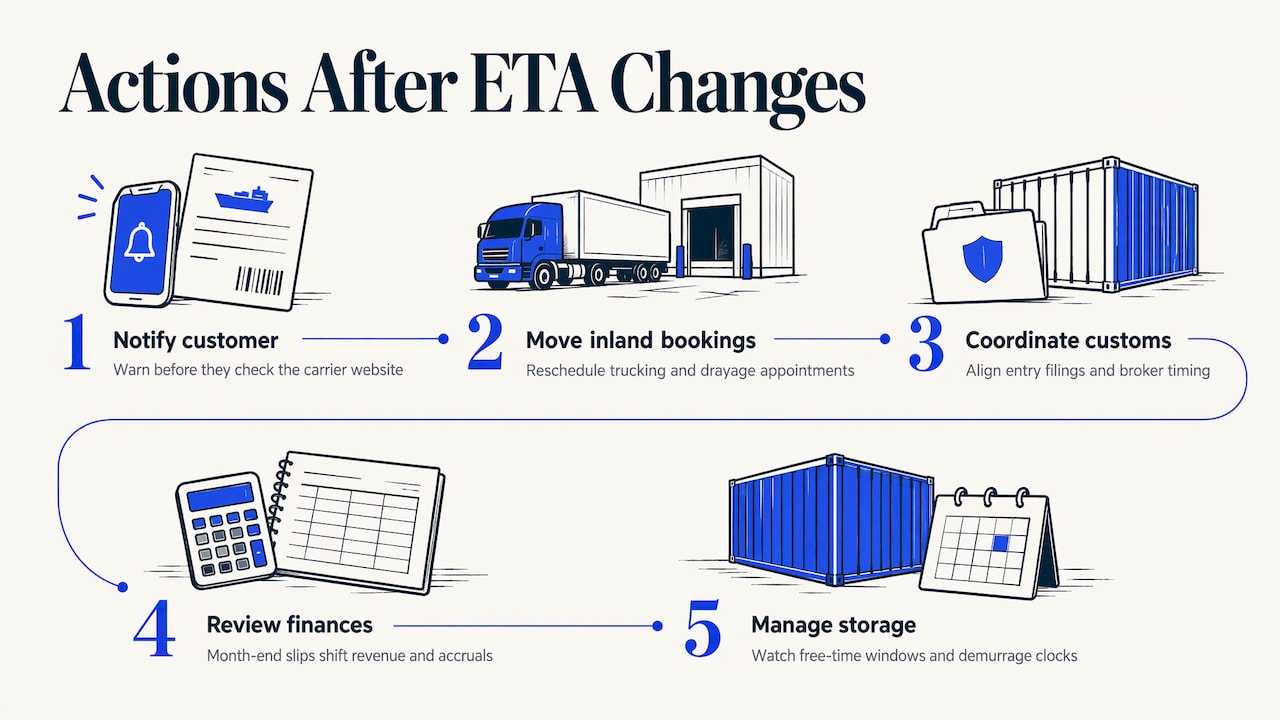
The first action is customer communication. When an ETA moves by more than a set threshold, the customer should hear it from you before they find it on a carrier website. The second is the inland leg: trucking and drayage appointments built on the old date have to move, or you pay for a truck that waits. The third is customs, where entry filings and broker timing depend on arrival. The fourth is financial: if a vessel slips across a month-end, revenue recognition, accruals and cash forecasts shift with it. The fifth is storage exposure, because a late arrival can collide with free-time windows and demurrage clocks.
Each of those is a handoff between people or systems. In many forwarding offices the handoffs run through email and spreadsheets, so the ETA changes in one place and takes hours to reach the others. That delay, not the prediction error, is often the larger loss.
Why the TMS is the right home for ETA data
Standalone visibility tools show you where a container is. They do not know your customer’s terms, your drayage bookings, your customs file or your open invoices. A transport management system does, because it holds the shipment record that all of those attach to. Putting predicted arrival into that record means one date drives many actions, and nobody has to carry it between screens.
FreightSuite is a cloud-based TMS for freight forwarders and logistics companies with air and ocean tracking, operations, workflows, finance and AI agent orchestration built natively into one platform. Because those capabilities are included out of the box without add-ons, a shipment’s tracking status, its workflow and its financial position sit in the same record. In practice that means a changed arrival date can be seen by operations, customer service and finance at the same moment, instead of reaching each of them separately.
For a deeper look at how tracking data gets into a TMS in the first place, our guides on sailing schedule integration and real-time logistics tracking for supply chain teams cover the data side, and the comparison of ocean tracking software for forwarders walks through what to look for when you evaluate it.
Building an ETA routine your team can run
Whether you are using a TMS or still stitching tools together, the routine below is the one that turns predictions into protected margin. It is written as a sequence because the order is the point.
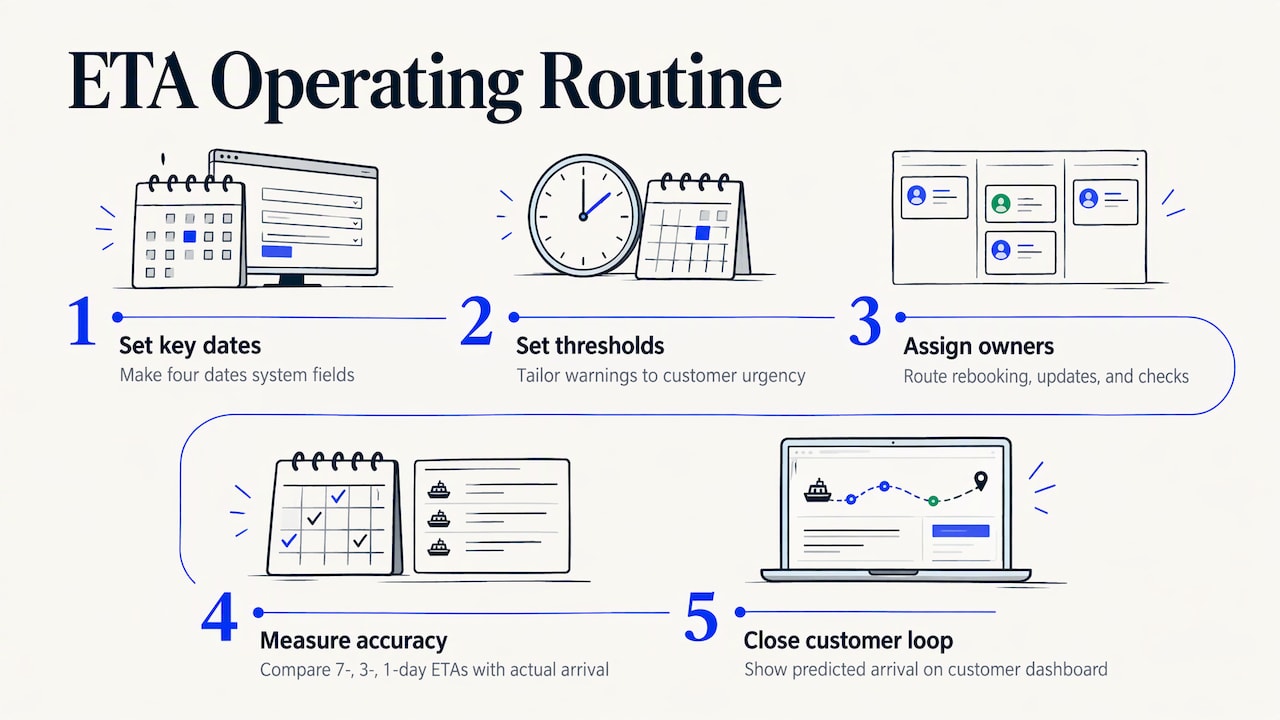
Start by deciding which dates matter for your business. For most ocean forwarders these are vessel arrival at the discharge port, container availability, last free day and the delivery appointment. Name them, and make sure each one is a field in your system, not a note in an email.
Next, set thresholds. A move of a few hours at sea rarely justifies a customer message. A move of a day or more usually does. Different customers deserve different thresholds: a retailer with a tight in-store date needs earlier warning than a bulk buyer with warehouse buffer.
Then decide who owns each reaction. When the ETA moves, who rebooks the truck, who updates the customer, who checks the free-time clock, who flags the finance team? If the answer is everyone, the answer in practice is no one. This is where workflow automation earns its place: the rule fires, the task lands with the right person, and the record shows it was done. FreightSuite supports workflow customization and AI agent orchestration inside the TMS, so routines like this can be built around how your team already works.
After that, measure. Each month, compare the ETA you held at seven days, three days and one day before arrival with the actual arrival date, by lane and carrier. You will quickly see which services are reliable and which need a buffer built into your quotes. That feedback is also the evidence you need when negotiating with carriers or setting transit-time expectations with customers.
Finally, close the loop with the customer. A dashboard that shows them the current predicted arrival means fewer “where is my container” emails, and it lets your staff spend their time on exceptions instead of status requests. Customer dashboards are part of the FreightSuite platform for exactly this reason.
Common mistakes with ocean ETAs
The first mistake is trusting the schedule date after the vessel has already told you otherwise. Position and speed data often show a slip days before the carrier updates its own estimate, so waiting for the official notice means reacting late.
The second is ignoring time zones. An arrival at 23:00 UTC is already the next day in many Asian ports and still the same day on the U.S. West Coast, and the confusion produces false alarms and missed ones in equal measure.
The third is reading a single study’s accuracy figure as a guarantee. A 5% error on one port’s tanker and cargo traffic says little about a transshipment-heavy lane with frequent blank sailings. Measure your own lanes.
The fourth, and the most expensive, is leaving the ETA in a system that does not connect to the rest of the file. The prediction is correct, and the decision still arrives late, because a person had to carry it.
See it in your own operation
If ocean volume is a core part of your book, the Ocean Freight TMS and Automation page shows how FreightSuite brings ocean tracking, rate management, documents, finance and workflows into one record, so a moving arrival date reaches every team that depends on it. For a wider view of how the options compare for U.S. forwarders, see the guide to the best ocean freight TMS in 2026.
The ground is shifting beneath this industry, and forwarders who treat arrival dates as live data, not as a line on a booking confirmation, are the ones who will keep margin when schedules wobble. The choice of how quickly to get there is yours to make.
FAQ
What is ETA prediction in ocean freight?
It is the estimate of when a vessel will actually reach a port, recalculated as the voyage progresses. Academic work such as a 2025 review of 29 studies treats it as predicting vessel arrival time to port. It differs from the carrier’s scheduled date because it responds to position, speed, weather and port conditions.
How do you calculate a ship’s ETA by hand?
Divide the nautical miles remaining by the vessel’s speed in knots to get the hours left on passage. Then add those hours to the current time in UTC and convert to the destination port’s local time. It is a useful first estimate, but it cannot account for slowdowns, weather or a congested berth.
What data do predictive ETA systems use?
Hapag-Lloyd lists AIS position, speed and course, historical voyage patterns, weather forecasts, port congestion and machine learning as the elements of modern dynamic ETA systems. Together they cover where the ship is, how it normally behaves, and what is likely to slow it.
Why does an ocean ETA keep changing?
Common causes are congestion at an earlier port, storms and mechanical problems, all named in the Hapag-Lloyd guide. Terminal congestion and weather can also shift receiving dates, as Maersk’s U.S. terminal notice describes.
How accurate are ocean ETA predictions?
It depends on the vessel type, the port and the data. A Port of Houston study reported a 5% mean absolute percentage error for its model, but that applies to its own context. The sensible approach is to compare predicted and actual arrivals on your own lanes.
Sources
- Prediction of vessel arrival time to port: a review (Maritime Policy & Management, 2025)
- ETA in Shipping: Why Getting It Right Matters More Than Ever (Hapag-Lloyd, 2025)
- Earliest Receipt Date (ERD) Communication (Maersk, 2021)
- Automatic Identification System-Based Prediction of Tanker and Cargo Vessel ETA (Port of Houston study)
- Using machine learning to predict vessel time of arrival with Amazon SageMaker (AWS, 2021)

