6 TMS Controls That Secure eBL Management for Forwarders
EBL management is the set of TMS processes that issue, endorse, track, and surrender an electronic bill of lading in place of a paper original. The legal groundwork for this has largely been settled across major trading jurisdictions. What still trips up forwarders is interoperability: whether your TMS can actually issue an eBL, maintain a clean audit trail, recover a lost identity credential, and pass that document to a carrier or bank rail that speaks a different standard.
TL;DR:
- EBL interoperability remains a challenge, requiring TMS compatibility with issuing, tracking, and passing control of digital titles across different standards.
- Legal recognition of electronic bills is advancing, but operational hurdles like carrier participation and platform approval still slow widespread adoption.
- Implementing eBL workflows demands careful planning, including carrier mapping, identity verification, reissue procedures, and stakeholder sign-offs before going live.
- Risks include lost credentials, amendment disputes, and vendor lock-in, so robust recovery processes and open data standards are essential.
- Industry adoption offers significant benefits, including reducing greenhouse gas emissions, cutting costs by billions annually, and speeding up cargo release times.
Table of Contents
- What eBL and eFBL Mean for Your TMS Workflows
- Standards and Legal Status You Need to Check Before You Adopt
- How Do You Integrate EBL Management Into a TMS?
- Why Do Forwarders Still Deal With Paper Bills of Lading?
- What Are the Main Risks in EBL Management?
- What’s the Business Case for Switching to EBLs?
- How FreightSuite Fits Your EBL Rollout
- Get Your TMS EBL-Ready
- Sources
- FAQ
What eBL and eFBL Mean for Your TMS Workflows
A bill of lading does three jobs at once, and any TMS handling one has to replicate all three or the document is worthless in a dispute. It is a receipt for cargo received, evidence of a contract of carriage, and a document of title, meaning whoever holds it legitimately can claim the goods. That third function is the hard one. Paper solves title through physical possession. An electronic version has to solve it through exclusive control, which means your system needs an unbroken, verifiable chain showing who held title at every point in the shipment’s life, not just a status field that says “transferred.”
This is exactly the gap FIATA’s electronic FIATA Multimodal Bill of Lading was built to close. The eFBL is designed for legal equivalence with paper bills while preserving the forwarder’s traditional role as issuer, and FIATA has partnered with TMS providers to distribute it directly into existing platforms. For a freight forwarder, that matters because you are not just tracking a document, you are the party legally issuing it.
A TMS built for this needs to handle:
- Immutable audit logs tied to each transfer event, not just a timestamp
- Digital identity verification for every party in the endorsement chain
- Multimodal document generation that maps to air, ocean, and road legs without manual reformatting
Standards and Legal Status You Need to Check Before You Adopt
The law caught up faster than most forwarders expected. Model legislation aligned with the Model Law on Electronic Transferable Records, along with UCP 600 and UNCITRAL references baked into instruments like the eFBL, gives electronic title transfers the same legal footing as an endorsed paper original in a growing list of jurisdictions. That is genuinely good news, and it is also not the part that will slow your rollout.
Industry analysis is fairly blunt on this point: the major legal obstacles have been addressed in many jurisdictions, and what remains is operational, meaning interoperability and change management inside individual companies. Before you commit budget to an eBL rollout, verify these three things:
- Whether your target trade lanes fall under MLETR-aligned legislation or still require paper fallback
- Whether the eBL rail you are evaluating participates in the interoperability work led by FIATA, DCSA, ICC, BIMCO, and SWIFT under the FIT Alliance
- Whether the platform carries IG Club or P&I insurer approval, since that acceptance materially reduces insurance friction for both carriers and forwarders on covered lanes
Skip that last check and you may find an insurer treating your “digital” shipment as an uninsured paper gap.
How Do You Integrate EBL Management Into a TMS?
Treat this as an infrastructure project with a change management layer, not a feature you switch on. Here is the sequence that keeps forwarders from getting burned on their first live shipment.
- Map carrier interfaces first. List every carrier and eBL rail your top lanes touch, then confirm which ones your TMS has an existing adapter for versus which need custom API work.
- Define issuance rules. Lock down who has authority to issue, amend, and endorse inside your organization, and write the amendment policy before your first live document, not after a dispute.
- Build identity and key controls. Multi-factor authentication, key management, and a full audit trail are non-negotiable for any party touching the title chain.
- Document a reissue-to-paper procedure. Some counterparties and customs regimes will still demand an original. You need a tested process that extinguishes the electronic record cleanly when that happens.
- Get commercial sign-off from all three gatekeepers. That means carrier agreements, a bank acceptance check on the financing side, and confirmation your insurer or P&I club recognizes the platform.
- Run an end-to-end paper-free trial. Pick one lane, one bank, one carrier, and reconcile the results against your existing paper process before scaling.
Pro Tip: Require documented recovery procedures for lost private keys before you go live, not after. A tested reissue-to-paper process that involves the carrier and has a clear legal basis should be part of your first-release acceptance criteria, the same way you would never ship a payment feature without a refund path.
Why Do Forwarders Still Deal With Paper Bills of Lading?
Even forwarders with a fully capable eBL-ready TMS run hybrid workflows, because one counterparty in the chain has not caught up. A bank that has not onboarded to your eBL rail may reject financing against it. A receiving customs office in a jurisdiction without MLETR alignment may demand a physical original. A buyer’s contract terms may simply specify paper, full stop.
This gap has a name in the industry: the coexistence tax. This term denotes the operational cost of running parallel paper and digital processes at the same time, and it shows up as duplicated document handling, courier costs you thought you had eliminated, and staff time spent reconciling two systems that should be one. DCSA’s cross-platform transfer work under PINT is closing this gap at the standards level, but that milestone changes long-term capability, not this quarter’s operational reality.
Three patterns reduce the friction:
- Run lane pilots instead of a company-wide switch, so you isolate which counterparties are the actual blockers
- Make eBL participation a mandatory onboarding condition for new carrier and bank partners
- Subscribe to more than one eBL rail rather than betting on a single platform, since your counterparties will not all standardize on the same one
Track your paper-free completion rate lane by lane.
What Are the Main Risks in EBL Management?
The risks are not exotic. They are the same categories you already manage for any financial document, applied to a newer format.
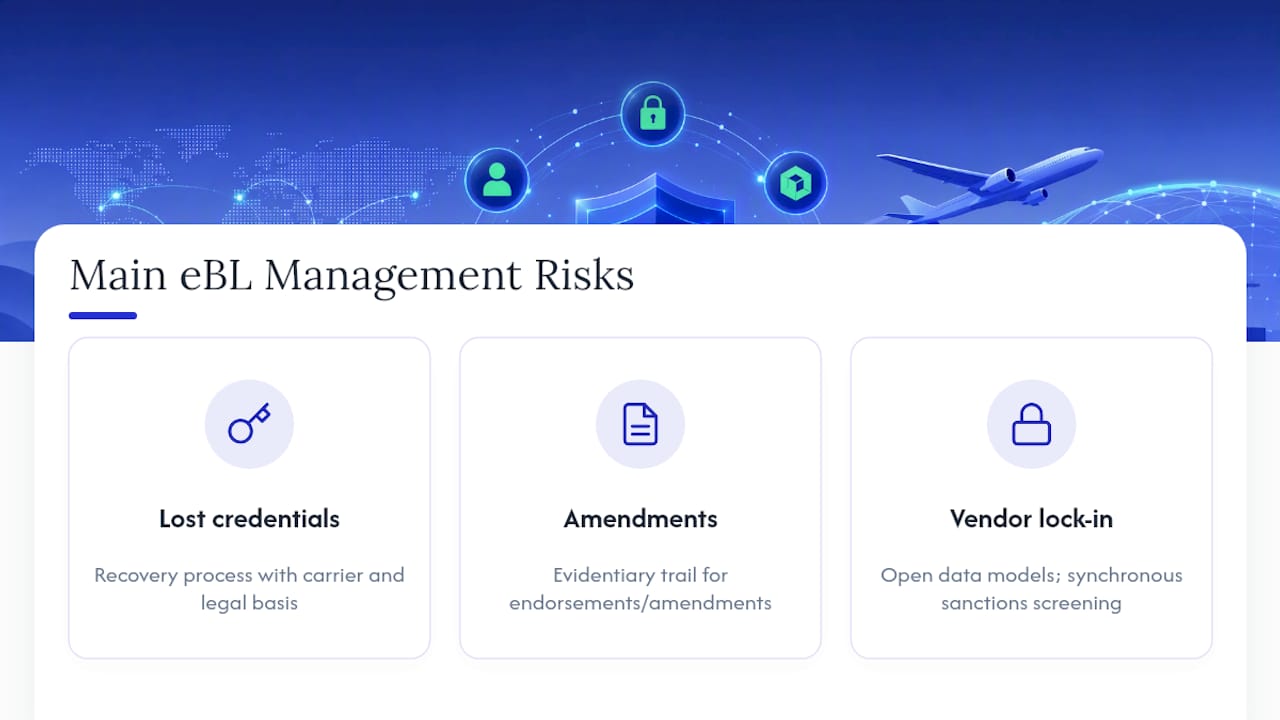
Lost credentials top the list. If a private key controlling title is lost or compromised, you need a recovery process that involves the carrier and rests on a clear legal basis, not a support ticket. Build this before your first shipment, because reconstructing it under pressure during an active dispute is how forwarders end up in arbitration.
Amendment disputes are the second risk. Every endorsement and amendment needs an evidentiary trail robust enough to hold up if a counterparty challenges it later.
Vendor lock-in is the third, and it is bigger than most teams initially treat it. Industry white papers warn that platform-exclusive eBLs fail long-term because banks, carriers, and customs authorities will never all converge on one proprietary system. Insist on open data models in any vendor contract, and confirm synchronous sanctions screening runs on every transfer, not as a batch job after the fact.
Pro Tip: Price eBL integrations per carrier or per rail in your vendor contracts rather than accepting a flat platform fee. It keeps the cost honest as your carrier list grows and protects you if one rail’s API changes require rework.
What’s the Business Case for Switching to EBLs?
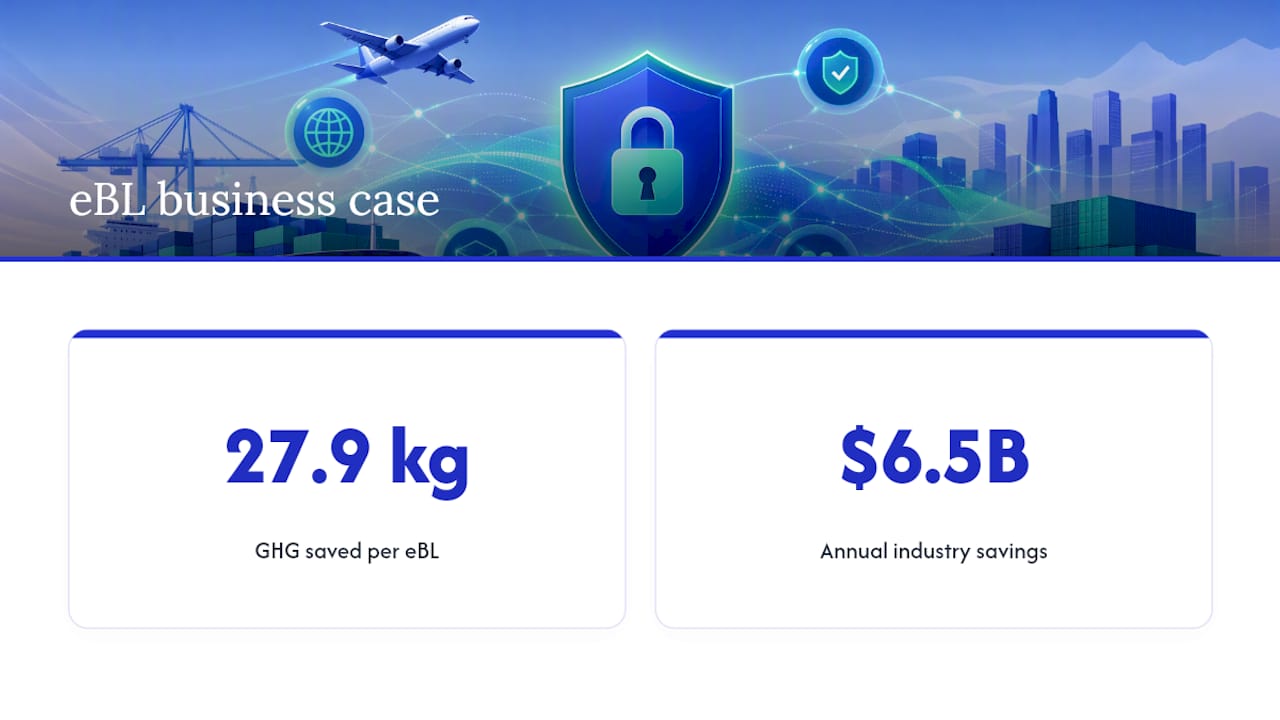
The numbers make a straightforward argument. Every electronic bill of lading issued in place of a paper original saves an estimated 27.9 kilograms of greenhouse gas emissions, and industry-wide adoption is projected to save stakeholders roughly $6.5 billion in direct costs annually across courier fees, processing delays, claims handling, and the working capital tied up while paper originals travel by mail.
Build your own payback model at the lane level. Track courier costs eliminated, days shaved off document release lead times, and claims avoided from lost or delayed originals. Most forwarders find the working capital release, cargo released days earlier because a bank accepted a digital document instead of waiting on a courier, is the line item that convinces finance. The GHG figure works well in customer-facing ESG reporting, since shippers increasingly ask for per-shipment emissions data you can now actually calculate.
How FreightSuite Fits Your EBL Rollout
Everything on the checklist above needs to live somewhere, and for most forwarders that “somewhere” is the TMS they already run daily. FreightSuite is built with the document management, audit logging, and identity controls this kind of workflow demands natively, rather than bolted on as a side integration.
Here is how the pieces map:
- Ocean freight capabilities handle the carrier interfaces and tracking data that eBL issuance depends on
- Air freight capabilities extend the same document logic across multimodal legs without manual reformatting
- Native workflow automation and audit trails give you the endorsement history a title dispute would require
If you are planning a pilot, the sequence is simple: pick one lane, onboard the carrier and bank on that lane, run digital and paper documents side by side for a full cycle, then reconcile. FreightSuite’s freight lifecycle guide is a useful reference for how the eBL step fits into the broader shipment lifecycle you are already automating.
Get Your TMS EBL-Ready
Most forwarders discover their eBL gap the hard way, mid-shipment, when a bank rejects a document their platform generated because it lacks the audit trail the bank’s compliance team needs. FreightSuite avoids that by building document management, audit logging, and identity verification into the same platform that already runs your rate management, tracking, and finances, so eBL issuance is not a bolt-on feature fighting the rest of your stack.

That matters most for forwarders juggling ocean and air lanes simultaneously, where a document standard that works for one mode but not the other just recreates the coexistence tax inside your own operation. FreightSuite’s ocean freight and air freight modules share the same underlying workflow engine, so an eBL issued on one mode carries the same audit standard on the other.
If you are ready to see how this fits your actual carrier list and lane mix, the fastest path is a direct look at the platform. Book a demo and bring your current eBL pain point, whether that is a bank rejection, a carrier onboarding backlog, or a reissue-to-paper process nobody has documented yet. You can also check current plans if you are further along and ready to scope a rollout.
Sources
- Electronic bills of lading can revolutionize international trade (ITC/Intracen)
- FIATA digital bill of lading / eFBL
- How the electronic bill of lading (eBL) is transforming digital trade (ICC Academy)
FAQ
What Is EBL Management in a TMS Context?
EBL management covers the TMS functions that issue, endorse, transfer, track, and surrender an electronic bill of lading, replicating the receipt, contract of carriage, and title functions a paper original performs.
Is an Electronic Bill of Lading Legally Recognized?
Yes, in a growing list of jurisdictions aligned with the Model Law on Electronic Transferable Records, and standards like FIATA’s eFBL are built for legal equivalence with paper originals under UCP 600 and UNCITRAL references.
What Is the Biggest Barrier to EBL Adoption Right Now?
Interoperability and operational integration, not law. Major legal obstacles have been addressed in many jurisdictions, but forwarders still face the coexistence tax of running paper and digital processes in parallel.
How Do I Recover a Lost EBL Credential?
You need a documented recovery procedure that involves the carrier directly and rests on a clear legal basis, established before your first live shipment rather than improvised during a dispute.
Does FreightSuite Support EBL Workflows?
The platform’s document management, audit logging, and identity controls are built natively into ocean and air freight modules, giving forwarders the audit trail and multimodal consistency an eBL rollout requires.
What’s the Cost Savings Case for EBLs?
Every electronic bill of lading saves an estimated 27.9 kilograms of greenhouse gas emissions versus paper, and industry-wide adoption could save stakeholders roughly $6.5 billion annually in direct costs.

