eAWB Management: A Forwarder's Guide to Getting It Right

Managing eAWBs well means treating the electronic air waybill as a data process, not a document. The paper is gone, so every error that a clerk used to catch at the counter now travels as a message to the airline. Forwarders who run eAWB cleanly sign the IATA agreement once, build accurate shipment data once, send it on time, watch every acknowledgement and correct rejections immediately. The strongest setup keeps that data in the same system that runs the rest of the shipment, which is the idea behind FreightSuite’s air freight management system.
TL;DR
- An eAWB replaces the paper air waybill with a data message (FWB or XFWB) sent to the carrier, under IATA Resolution 672, the Multilateral e-AWB Agreement.
- You sign the agreement once with IATA, then wait for each airline’s Activation Notice before you tender eAWB cargo to that carrier.
- The work is in the data: correct special handling codes, security information and house waybill details, sent before the goods arrive.
- After sending, watch for the carrier’s acknowledgement (FMA) or rejection (FNA) and resend corrected data immediately.
- Fewer manual re-entries means fewer rejections, so the shipment data should live in one system rather than being retyped into airline portals.
Table of Contents
- What an eAWB is and where it applies
- Step 1: Join the agreement and get activated
- Step 2: Build the shipment data correctly
- Step 3: Transmit, then wait for the acknowledgement
- Step 4: Monitor acceptance and correct fast
- Why the data should live in one place
- What eAWB brings, and what to plan for
- Running eAWB inside your TMS
- FAQ
- Sources
What an eAWB is and where it applies
The air waybill is the contract of carriage between shipper and carrier. IATA’s e-freight program explains that Resolution 672, the Multilateral e-AWB Agreement, removes the requirement for a paper air waybill, so nobody has to print, handle or archive one. In practice, the “document” becomes a structured message your system sends to the airline’s system.
The legal footing matters because not every lane is equal. IATA’s implementation playbook defines a feasible trade lane as one where origin and destination countries have ratified the same treaty, either Montreal Protocol No. 4 of 1975 or the 1999 Montreal Convention. A World Bank paper on air cargo digitalization notes that about 60 of 191 ICAO member states have not adopted the 1999 norm that enables electronic documentation.
For U.S. forwarders this shows up at the carrier level. United Cargo’s U.S. e-AWB page states that e-AWB is available worldwide except for certain flows, including those to or from the United States and Brazil or certain stations in China, where government and customs rules still require signed copies of the paper master air waybill. Always check the carrier’s own e-AWB page for the lanes it supports before you plan a shipment.
That is why IATA’s U.S. export procedure recommends what it calls the Single Process. According to IATA’s U.S. export SOP (version 1.0, September 2017), the agent always sends the FWB or XFWB and tenders without a paper master air waybill, while the carrier decides whether a paper AWB must be printed. The benefits are that e-AWB can be used even in most countries where paper is still legally required, and your team follows one standard process regardless of destination.
Step 1: Join the agreement and get activated
Every forwarder starts with the same two permissions: IATA’s, then each airline’s.
Sign the Multilateral Agreement once
Per IATA’s e-freight page, the Multilateral e-AWB Agreement is a single standard agreement that airlines and forwarders sign once with IATA to do e-AWB with every other party to it. IATA’s implementation playbook describes the forwarder’s path: complete the online joining form, receive the agreement by e-mail from IATA Cargo, e-sign it, receive the counter-signed copy and get listed as a party. The agreement does not amend the conditions of contract printed on the air waybill.
Older bilateral EDI agreements still exist, but IATA’s Basel SOP discourages tendering under them and asks forwarders to enter the multilateral agreement instead.
Get each airline to activate you
Signing is not the finish line. A forwarder may begin tendering e-AWB cargo to an airline only after receiving that airline’s Activation Notice under Article 3.1. IATA’s activation guidelines say both sides confirm operational readiness first: locations, start dates, messaging method (Cargo-IMP, Cargo-XML or a web portal), exception management, airport pairs and a validation of messaging capability through trial shipments.
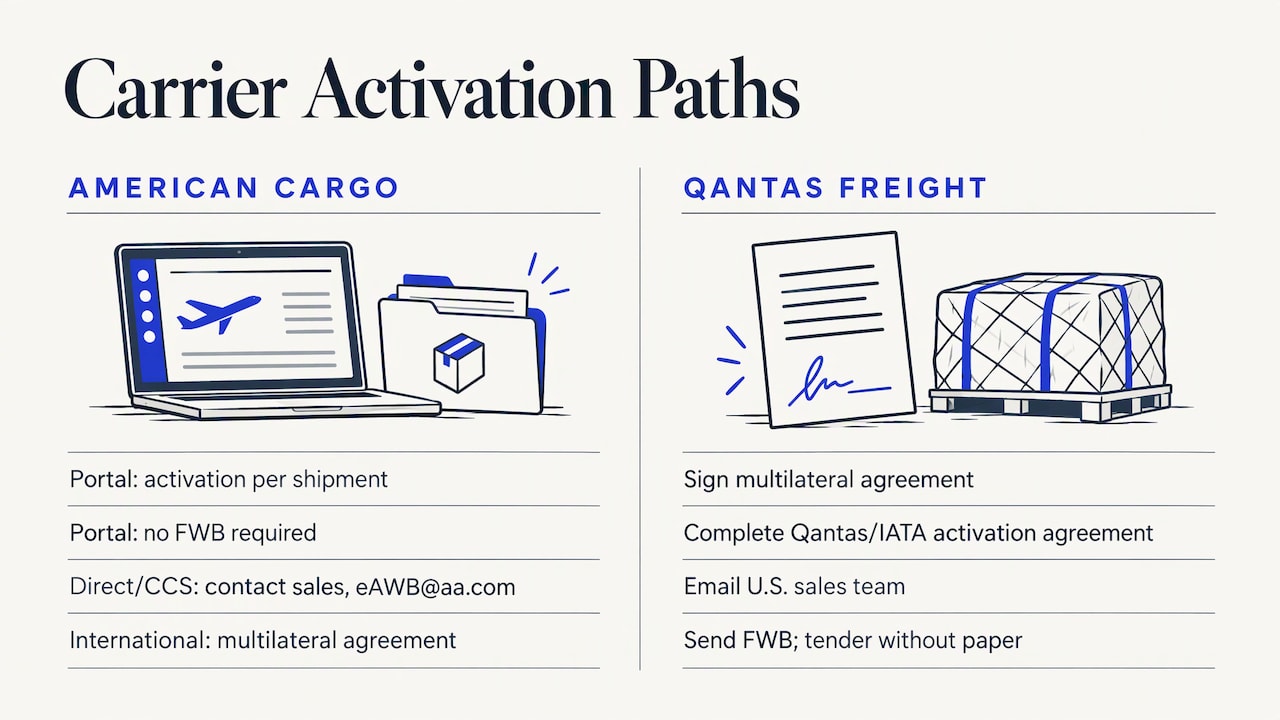
Carriers run this slightly differently. American Airlines Cargo states that sending an eAWB through its aacargo.com portal serves as activation per shipment with no FWB message required, while forwarders sending directly or through a cargo community system partner should contact their sales representative and eAWB@aa.com. It also distinguishes the multilateral agreement for international shipments from a separate bilateral agreement for domestic U.S. shipments. Qantas Freight’s U.S. page lists its own start steps: sign the multilateral agreement, complete the Qantas and IATA activation agreement and email the U.S. sales team, then send the FWB and deliver freight without paper. It also warns that customers must maintain two parallel shipping processes where paper is still required.
Keep a simple activation register: carrier, lanes activated, messaging method, date of Activation Notice, contact. A shipment booked on a carrier that has not activated you is the most avoidable eAWB failure there is.
Step 2: Build the shipment data correctly
Issuing an eAWB, as the U.S. export SOP puts it, is basically sending a FWB or XFWB message carrying everything usually printed on a paper master air waybill. The message is only as good as the data behind it.
The fields that decide how the shipment travels
IATA’s global e-AWB SOP sets out what the forwarder does when creating the record in its own system or a web portal:
- Insert the special handling code EAW when no paper documents accompany the shipment, or EAP when paper documents travel with it.
- For secured cargo, include the electronic consignment security declaration (e-CSD) in the OCI field, with the Regulated Agent number if a third party screened the cargo.
- For consolidations, create the house waybill data, with each HAWB’s security status and full shipper and consignee addresses when the destination requires them.
Security details deserve special care. The Basel SOP requires the complete Consignment Security Declaration in the OCI fields and the security code (SPX, SCO or SHR) in the SPH field for secure cargo.
Labels and supporting paperwork
Goods still need to be identifiable. IATA’s Doha procedure asks for labelling per IATA Resolution 833 and any applicable supporting documents, such as a Shipper’s Declaration for Dangerous Goods, tendered with the goods. Shipments marked EAP travel with a pouch labelled per IATA Recommended Practice 1600u. This is where many errors begin: the electronic record says “no paper” while a dangerous goods declaration rides with the freight. Decide the EAW or EAP code from the real paperwork on the pallet, not from a default.
If you issue invoices, packing lists and declarations alongside the air waybill, a single record of those files saves rework. FreightSuite’s platform includes automated document management and customizable workflows, and our guide to e-signature for logistics documents covers which of those documents can be signed electronically.
Step 3: Transmit, then wait for the acknowledgement
The global SOP says the forwarder creates the (X)FWB and preferably sends it by Cargo-XML (or Cargo-IMP FWB version 17 with FHL version 5), then waits for the carrier’s XFNM/FMA acknowledgement or web-portal notification before tendering without a paper AWB. Timing varies by station: IATA’s Doha procedure asks for the message at least 5 minutes before delivery of the goods, while the Basel SOP asks for a correctly formatted FWB at least 30 minutes before delivery. Plan to the strictest cut-off among your carriers and stations, and automate sending, because IATA’s playbook recommends automation to avoid late messages caused by human error.
What the carrier does with your message
According to the global SOP, the carrier checks data quality. With no errors it returns an acknowledgement (FMA, or XFNM under Cargo-XML). With errors it returns FNA (XFNM) asking for an updated message. The carrier also inserts the code ECC (electronic contract sufficient) or ECP (paper AWB needs printing). On receipt it matches the physical cargo against the electronic data, sends the FSU/FOH status and provides a Warehouse Receipt.
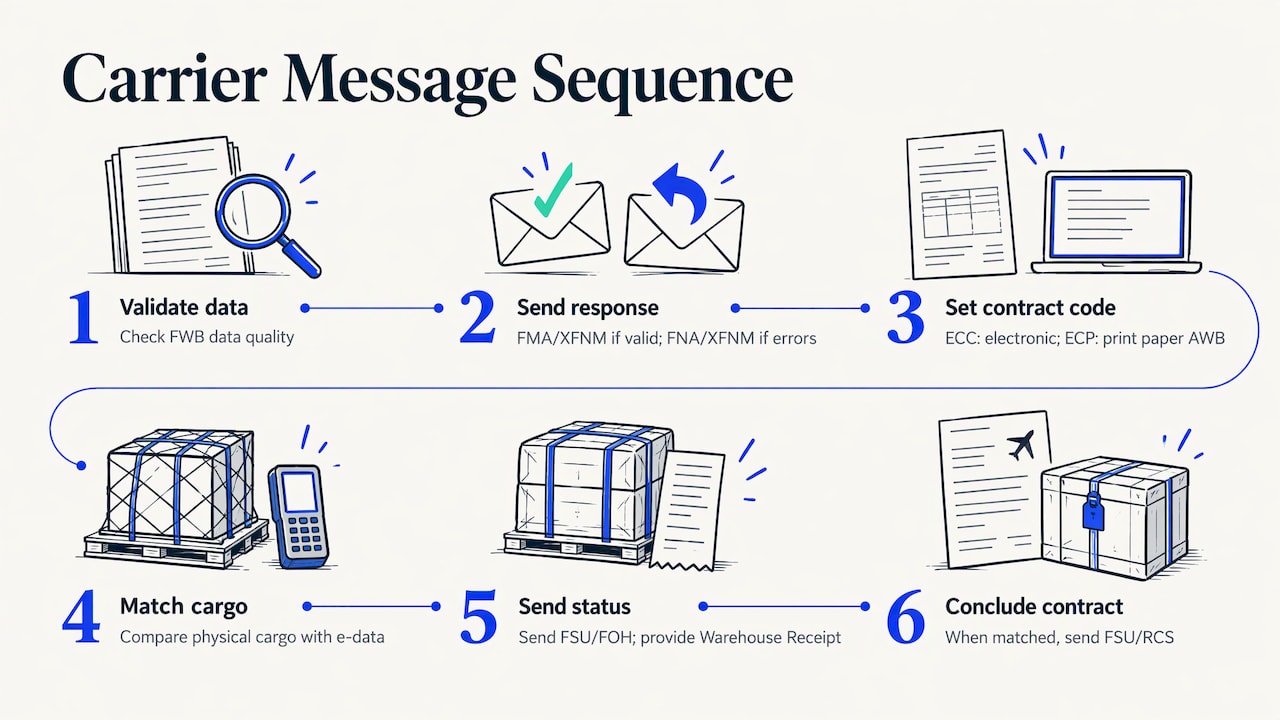
IATA’s Singapore handling guideline adds the end of the sequence: when the data matches, the airline sends FSU/RCS to conclude the contract. Knowing these status codes lets your team read a shipment’s eAWB position at a glance.
Cargo-IMP or Cargo-XML
IATA’s playbook notes that Cargo-IMP has not been maintained since 2014 and recommends Cargo-XML. Under XML the waybill message is XFWB and status updates are XFSU; under IMP they are FWB and FSU. The World Bank paper adds that many messages still move in the older standard and that full conversion can be costly or require translator services. If your system or your cargo community connection supports XML, use it.
Step 4: Monitor acceptance and correct fast
Sending is the easy half. The U.S. export SOP says the agent should check that acknowledgements, correction requests and status updates arrive on time and complete, and it treats a shipment as safe when message quality is 95% or more.
Rejections
The Australian handling guideline spells out the stakes: the forwarder must obtain the FMA to verify the FWB was processed, and after an FNA it must immediately resend the amended FWB. If the FWB is missing at delivery, it must be sent within 30 minutes of advice or before flight closure, whichever comes first, otherwise the shipment falls back to paper. If a replacement is not sent before cut-off, the shipment is offloaded. These timings are specific to that station’s guideline, so confirm each origin’s local procedure.
Amendments after acceptance
Per the Basel SOP, data changes after the first FWB can be sent as a subsequent FWB until the shipment reaches RCS status. IATA’s Singapore guideline cautions that if an airline sends FSU/RCS with incorrect data and a paper CCA, the wrong data remains in the original FWB, which authorities may access. It favors re-sending a corrected FWB so both records align.
Find the cause, not just the fix
The playbook lists the usual causes of quality problems: invalid or missing data, message syntax errors, cargo systems that are not configured properly and messages not sent in time. It recommends piloting with test cases drawn from real shipments, analyzing FNA/XFNM messages for root causes, printing and comparing results to find truncated information and monitoring message arrival time. A weekly review of every FNA by cause, by carrier and by user will point you to the one mapping table or the one habit responsible for most of them.
The U.S. SOP’s advice on go-live applies to any new carrier: test data exchange first, with fast and consistent transmission and accurate content, run pilot shipments, tell stakeholders that no master air waybill accompanies the freight, then make it a standard procedure with one airline before repeating it with others.
Why the data should live in one place
IATA’s U.S. SOP makes the point plainly: an e-AWB with incorrect or partly received data behaves like a paper AWB with wrong information and can cause delays, and the more standard your system is, the more accurate the information and the lower your costs and transit time. The World Bank paper describes the manual side of the same problem, where double entry of waybill data at destination can take at least one to two hours per flight and creates real error risk.
The lesson for a forwarder is to enter shipment facts once. When booking, rates, documents, tracking and billing sit in separate tools, the eAWB becomes yet another place to retype consignee addresses, weights and security status, and each retyping is a chance for an FNA. Our articles on how a TMS tracks air shipments, launching air waybill tracking and shipment status automation show how status events can flow back into the shipment record rather than into inboxes.
What eAWB brings, and what to plan for
IATA’s playbook cites e-Freight benefits of up to 24 hours less end-to-end processing time, more than 7,800 tons of paper eliminated annually (equivalent to 80 Boeing 747 freighters filled with paper), lower document processing and archiving costs, and better data quality through auto-checks and mandatory fields. It also reported that feasible trade lanes represented 64% of AWBs in the September it measured, so a large share of your volume may qualify while some will not.
Plan operations around that reality: keep a lane list showing which carrier and country combinations are eAWB-ready, and which still need paper. The same document describes complexity for forwarders working with many airlines, which is why a standard internal process and a single source of shipment data matter more as your carrier list grows.
Running eAWB inside your TMS
FreightSuite is a cloud-based, agentic transport management system for freight forwarders and logistics companies. Our air freight management system brings air shipment operations, tracking, financial management, automated document management and customizable workflows together, with AI agent orchestration built natively into the platform and all core features included out of the box without add-ons. For a forwarder, the point is that the shipment record your air waybill data comes from is the same record your operations, documents and finance teams already work in. If you handle ocean and road alongside air, the FreightSuite platform covers those modes too. More guidance is on our resources blog.
FAQ
Do I need a separate agreement with every airline to send eAWBs?
You sign the IATA Multilateral e-AWB Agreement once, and it lets you do e-AWB with every other party to it. You still need each airline’s Activation Notice before you tender eAWB cargo, and some carriers, such as American Airlines Cargo, ask you to contact their sales team or eAWB mailbox to be activated. Domestic U.S. shipments use a separate bilateral agreement with that carrier.
What do the EAW and EAP codes mean?
They are special handling codes in the FWB. EAW means the shipment has no accompanying paper documents, and EAP means paper documents travel with it, in a pouch labelled per IATA Recommended Practice 1600u. The carrier then inserts ECC when the electronic contract is sufficient or ECP when a paper AWB must be printed.
What should I do when an airline sends an FNA?
An FNA (XFNM under Cargo-XML) means the carrier found data errors and wants an updated FWB. Correct the data and resend immediately, because station procedures set short windows before flight closure. After the shipment reaches RCS status, further changes are no longer handled as simple FWB updates, so fix errors early.
Can I use eAWB for shipments to or from the United States?
It depends on the carrier and lane. United Cargo’s page says some flows to or from the United States, Brazil and certain China stations still require signed paper copies of the master air waybill. IATA’s Single Process lets you send the eAWB data anyway and leave the carrier to decide whether to print paper.
Which message standard should I use?
Cargo-XML. IATA’s playbook says Cargo-IMP has not been maintained since 2014 and recommends Cargo-XML, though many carriers and systems still exchange Cargo-IMP messages. Confirm which standard each carrier accepts during activation testing.
Sources
- IATA e-freight and eAWB program
- IATA global e-AWB SOP
- IATA e-AWB implementation playbook (2022)
- IATA e-AWB implementation playbook (2019)
- IATA e-AWB implementation playbook (2018)
- IATA SOP for USA export
- IATA Basel e-AWB SOP
- IATA Singapore e-AWB handling guideline
- IATA Multilateral e-AWB Agreement activation guidelines
- American Airlines Cargo eAWB
- United Cargo e-AWB
- Qantas Freight e-AWB
- World Bank document on air cargo digitalization

