Collections Automation for Logistics: A Forwarder's Guide

Collections automation for logistics means the receivables work that follows a shipment, from invoice creation and delivery to follow-up, dispute handling and cash application, runs as a workflow instead of a to-do list in someone’s inbox. It works best when it sits inside the transport management system, because that is where the rates, documents, costs and customer terms already live. That is how FreightSuite is built: finances, credit control, document management and workflows are native to the TMS, so collections starts from the shipment record rather than from a spreadsheet export.
The case is strategic, not only administrative. Forwarders carry freight costs to carriers and wait on customers, so every day an invoice sits unbilled or disputed is working capital the business finances itself. The window to fix that is real, and teams that move first run leaner with the same headcount.
TL;DR
- Collections automation in freight covers invoice accuracy, delivery, follow-up cadences, dispute routing and cash application, not just reminder emails.
- Most late payment starts upstream: wrong rates, missing proof of delivery and slow invoicing. Fix those first and collections gets easier.
- Commercial invoices between businesses are generally outside the federal FDCPA, but your own contracts, state rules and customer relationships still shape how you follow up.
- Measure it: baseline DSO, invoice error rate, dispute volume and aging before you switch anything on, then track the same figures monthly.
- Keep people on exceptions and relationships. Automate the execution of policies you already trust.
Table of Contents
- What collections automation covers in freight
- Why late payment usually starts before the invoice
- Designing follow-up that fits freight
- Disputes, short-pays and cash application
- What the law does and does not cover
- Connecting collections to the rest of the stack
- A rollout that keeps people in control
- Measuring whether it works
- Where FreightSuite fits
- FAQ
- Sources
What collections automation covers in freight
In a generic business, collections is a reminder schedule. In freight it is a chain. A shipment closes, the operations team confirms charges, finance builds an invoice from contracted rates and supplier costs, the customer’s accounts payable team receives it, someone disputes a surcharge, and eventually a payment arrives that has to be matched to one or several invoices. Each link can stall.
That is why a useful definition is wider than “automated dunning.” For a forwarder it spans:
Invoice creation and accuracy. Charges pulled from rate agreements and actual costs, with documents attached, so the invoice survives the customer’s first review.
Invoice delivery. The right document to the right accounts payable contact or portal, promptly after the shipment milestone that allows billing.
Follow-up. Reminders and escalations triggered by aging and customer behavior, not by whoever remembers to look.
Dispute handling. Short-pays and queries tied to evidence such as proof of delivery, routed to the person who can resolve them.
Cash application. Matching incoming payments and remittance details to open invoices, and flagging uncertain matches for a person.
Credit control. Using payment history and exposure to decide when a customer needs attention before the next shipment, not after.
Forwarders have extra complexity that generic receivables tools tend to treat as an edge case: multi-currency invoicing, rates that differ by customer and lane, agent settlements, and costs that arrive after the invoice is raised. The FreightSuite platform includes dynamic FX and cost tracking, rate management, invoice recognition and integrated accounting connections for exactly this reason, so the numbers a collector chases are the same numbers operations signed off.
Why late payment usually starts before the invoice
Collectors get blamed for slow cash, but a large share of late payment is manufactured upstream. Three causes recur in forwarding.
The first is slow billing. If the invoice leaves the building a week after delivery, the customer’s payment clock starts a week late. Our own guide on invoicing within 24 hours to cut DSO goes through how credit control and billing speed connect.
The second is invoice error. A wrong rate, a missing surcharge or a charge that does not match the quote hands the customer a legitimate reason to short-pay. Checking billed rates against agreed rates before the invoice goes out removes that reason. The same discipline applies on the cost side, which our piece on rate audit automation covers.
The third is missing paperwork. Customers often hold payment until they have proof of delivery or a supporting document. When documents are stored against the shipment and attach to the invoice, the question never has to be asked twice.
Put plainly, the best collections automation is the one that prevents the call. A TMS that builds invoices from contracted rates, keeps documents with the file and posts to your accounting system gives collectors a clean invoice to stand behind. See how that works in FreightSuite billing and accounting.
Designing follow-up that fits freight
A rigid 30-60-90 schedule treats every customer alike. Freight receivables do not behave that way. A large shipper with a long approval cycle, a small importer who pays by wire when reminded, and an overseas agent settling in another currency need different handling.
A practical design segments accounts by a few factors: payment history, the value of the relationship, how often the account disputes invoices, and the size of the balance. Then it assigns each segment a cadence.
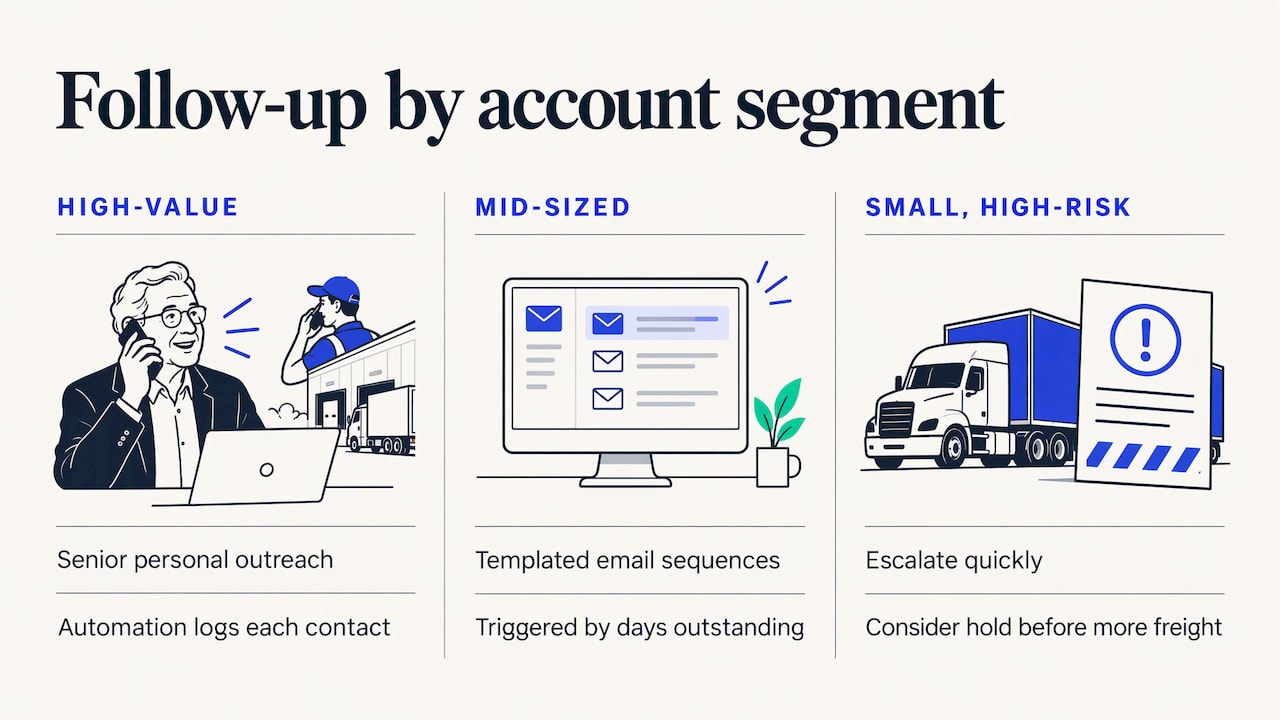
High-value accounts get personal outreach from a senior person, with automation making sure the contact happens on time and is logged. Mid-sized accounts get templated email sequences triggered by days outstanding. Small, high-risk balances escalate quickly, and a credit hold is considered before more freight moves. Our guide to the credit hold workflow for freight forwarders covers the triggers and the release process.
Two principles keep this sensible.
First, automate the execution of policy, not the policy itself. Most finance teams already know when a reminder should go out and when a customer should be escalated. What fails is consistency at volume: follow-ups lost in email, two people chasing the same invoice, a delinquent account nobody notices until the monthly aging report. A workflow engine fixes consistency. FreightSuite’s workflow customization and AI agent orchestration are built into the TMS so these routines can be configured around how your team operates.
Second, tie every message to the shipment. A reminder that cites the job reference, the delivery date and the attached documents gets paid faster than a generic statement, because the customer’s payables clerk can act on it immediately.
Disputes, short-pays and cash application
Disputes are where manual collections loses the most time. A customer pays most of an invoice and withholds a charge. Without structure, that short-pay sits in an inbox, the open balance ages, and nobody owns it.
A better routine has four parts. Record the dispute against the invoice with a reason. Attach the evidence: rate agreement, proof of delivery, supplier invoice. Route it to the owner who can decide, which may be operations for a detention charge or sales for a rate question. And keep it visible on an exception list with its own aging, so an unresolved dispute cannot disappear.
Cash application deserves the same care. Payments arrive with partial remittance details, bundled invoices and bank fees deducted. Automated matching handles the clear cases, and the sensible rule is to send uncertain matches to a person rather than posting them as if they were certain. That keeps the ledger accurate and your customer statements trustworthy. When the TMS connects to your accounting software, the posting happens once and the two systems agree. Our article on TMS accounting integration and the audit trail explains why that agreement matters at audit time.
What the law does and does not cover
Forwarders often ask whether automated collection messages put them under federal debt collection rules. The short answer for business-to-business freight invoices is that the main federal statute is aimed elsewhere.
The Consumer Financial Protection Bureau says the Fair Debt Collection Practices Act covers debts primarily for personal, family or household purposes and does not cover business debts. Its December 2022 examination procedures say the same: the FDCPA and Regulation F do not apply to corporate debt or debt owed for business or agricultural purposes.
That covers the typical shipper, importer or agent account. It does not mean anything goes. Your customer agreements, payment terms, any late-fee clauses, state law and basic professionalism still govern how you communicate. If you ever deal with an individual consumer, for example a household-goods shipment, or you hand accounts to a third-party collection agency, talk to your attorney before you automate those messages. Build contact limits and escalation rules into your workflow so tone and frequency stay consistent, and review the templates with counsel once.
Connecting collections to the rest of the stack
Collections automation fails quietly when it runs on a copy of your data. If the receivables tool does not see the same rates, charges and documents as operations, someone has to reconcile them by hand, and that someone becomes the bottleneck.
Three connections matter most.
TMS to billing. Invoices should come from the shipment file, using the rate management and cost tracking already in the system. This is where freight-specific logic lives: multi-currency, customer rate cards and charges that change between quote and delivery.
TMS to accounting. Invoice and payment postings should flow to your accounting software without re-keying. FreightSuite lists integrated accounting software connections among its features.
TMS to customer visibility. Customer dashboards let accounts payable teams see shipments and documents themselves, which cuts the “can you resend that” emails that stall payment.
For teams that want to see the full finance view, the solutions for finance teams page lays out how these pieces fit together. For a broader view of payment handling, read what finance teams must know about logistics payment automation.
A rollout that keeps people in control
The teams that get lasting results do not flip everything on at once. A sequence that works:
Map where time goes. Before choosing workflows, list where invoices wait, which exceptions recur, how many times each invoice is touched by hand and which customers generate the most disputes. Those are your first targets.
Baseline your numbers. Record days sales outstanding (DSO, the average days between invoicing and payment), invoice error rate, dispute volume, the share of receivables past 60 days, and the time from delivery to invoice. Without a before, you cannot show an after.
Start with the clean path. Automate invoice assembly, delivery and standard reminders for your most predictable accounts. Keep complex customers on manual review for the first cycles.
Run in parallel. Compare automated output against your existing process for a billing cycle or two before cutover, and fix mismatches while the stakes are low.
Define the human lane. Decide in advance what goes to a person: uncertain payment matches, disputes above a threshold, accounts approaching a credit hold, and any customer where the relationship outweighs the balance.
Review monthly. Look at the same metrics, adjust cadences, and move more accounts onto the automated path as confidence grows.
This is also a good moment to look at the wider operation. Collections improves when operations reporting, workflows and billing share data, which our guides on logistics workflow automation and freight operations reporting automation address.

Measuring whether it works
Pick a short list of measures and hold them steady.
| Measure | What it tells you | How to read it |
|---|---|---|
| DSO | Average days to collect | Track by customer segment, not just overall |
| Delivery-to-invoice time | Billing speed | Shorter means the payment clock starts sooner |
| Invoice error and dispute rate | Upstream quality | Falling disputes show cleaner invoicing |
| Aging over 60 days | Collection risk | Watch the share of total receivables |
| Touches per invoice | Staff workload | Fewer manual touches free the team for exceptions |
| Unapplied cash | Cash application health | Should shrink as matching improves |
Industry benchmarks vary widely by business model and by who publishes them, so treat them as context. Your own trend line, measured on the same definitions every month, is the figure that matters. Customer-level alerts are worth adding: a customer paying well beyond their own historical average, a balance above its credit limit, or an invoice sliding past 60 days are all signals that deserve a human look.
The point of the exercise is not only a lower DSO. It is a finance team that spends its week on judgment, negotiation and customer relationships instead of chasing and re-keying, which is where the margin and headcount benefits of automation come from.
Where FreightSuite fits
FreightSuite is an agentic TMS for freight forwarders and logistics companies, with rate management, air and ocean tracking, finances, operations, workflows and AI agent orchestration built natively, and its core features included without add-ons. For collections, that means the pieces this article describes sit in one system: invoice recognition, automated document management, dynamic FX and cost tracking, credit control, customer dashboards and accounting connections.
If you handle ocean, air, road or customs brokerage, the same finance foundation applies across ocean freight, air freight, road freight and customs brokerage capabilities. To see how it would run your receivables, start at freightsuite.com and book a demo. If you are comparing automation options more broadly, how to choose freight forwarding automation software is a good companion read.
FAQ
Does the FDCPA apply to collecting freight invoices from business customers?
Generally no. The CFPB states that the FDCPA covers consumer debts and not business debts. Your contracts, state law and any third-party collection arrangements still apply, so have counsel review templates and escalation rules.
Which collections tasks should stay manual?
Keep people on uncertain cash-application matches, high-value disputes, accounts near a credit hold and strategic customer relationships. Automation handles the routine execution so the team has time for these.
What should I fix before automating collections?
Start with billing speed, rate accuracy and document completeness. Late and inaccurate invoices create most disputes, and automating collections on top of them only chases the symptoms.
How do I know collections automation is paying off?
Baseline DSO, delivery-to-invoice time, dispute rate, aging past 60 days and manual touches per invoice before launch. Review the same measures monthly and compare them with your own starting point.

