Carrier Tracking Integrations: How They Work in a TMS
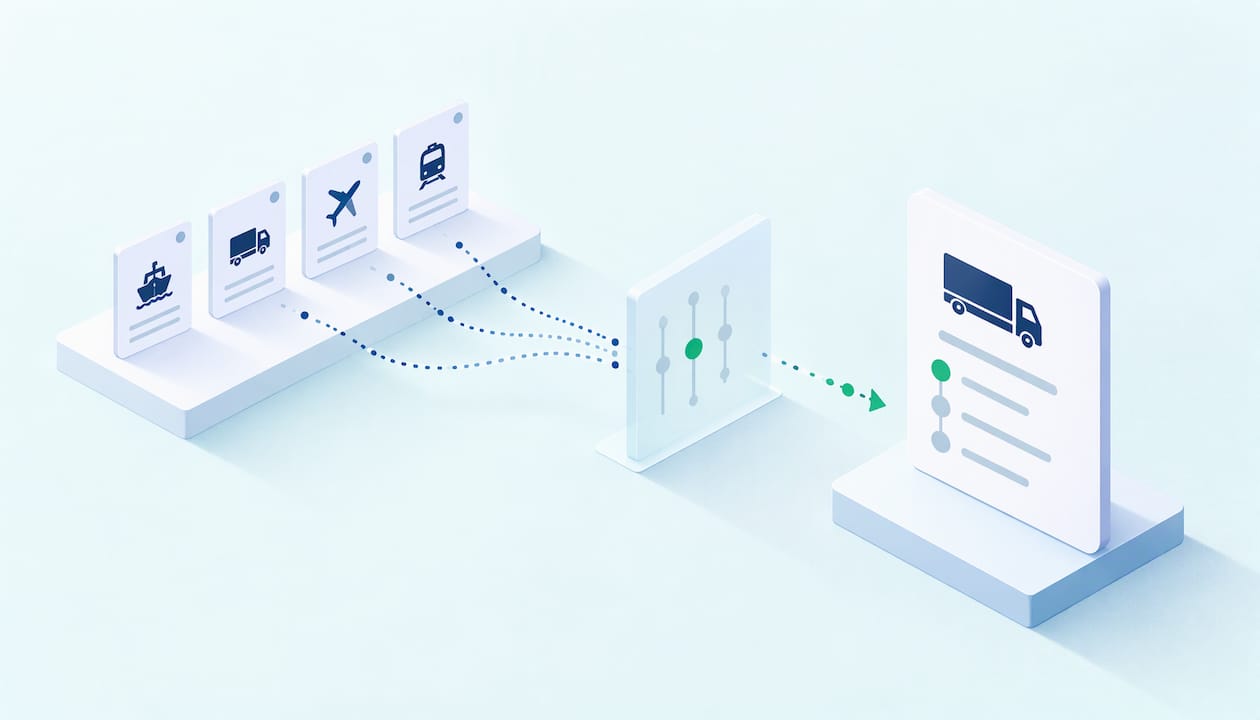
A carrier tracking integration is the connection that carries shipment events from airlines, ocean carriers, truckers and telematics providers into your transport management system, so the load record updates itself instead of waiting for someone to check a carrier website. For a forwarder, the real question is not whether to integrate but which channel to use for which carrier, and how to keep the data trustworthy once it lands. This guide covers both, with the air and ocean specifics forwarders ask about most.
The ground is shifting under manual tracking. Forwarders who still rely on portal checks and inbox updates are spending headcount on work that a well-built integration does in the background, and that gap shows up in margin. The teams that move first get faster answers for customers and a cleaner operation.
TL;DR
- A carrier tracking integration moves milestone events, positions and ETAs from carriers into the TMS load record through EDI, direct carrier APIs, or a tracking aggregator.
- Most forwarders end up with a hybrid: EDI where carriers require it, APIs where they offer them, and an aggregator to avoid building one connection per carrier.
- Air tracking runs on MAWB and HAWB numbers, ocean tracking on container number, bill of lading or booking reference, and each needs its own milestone logic.
- Integrations usually fail at the meaning of a status, not at the connection, so status mapping, ordering and deduplication matter more than raw coverage.
- In the US, plan for sandbox testing, documentation, and careful handling of driver location data.
Table of Contents
- What a carrier tracking integration does inside a TMS
- Three ways carrier events reach your system
- Air tracking integrations
- Ocean tracking integrations
- Where integrations actually break
- What to assess before you integrate
- Implementation considerations for US forwarders
- How FreightSuite handles tracking
- FAQ
- Sources
What a carrier tracking integration does inside a TMS
At its simplest, the integration answers one question automatically: where is this shipment, and what happened last? Behind that answer sit several data sources. For road freight these include GPS trackers, ELDs, engine data and driver mobile apps. FreightWaves describes REST APIs, webhooks and EDI transactions such as 204 and 214 as the mechanisms that move this data between systems, feeding TMS planning, execution, visibility, billing and customer communication.
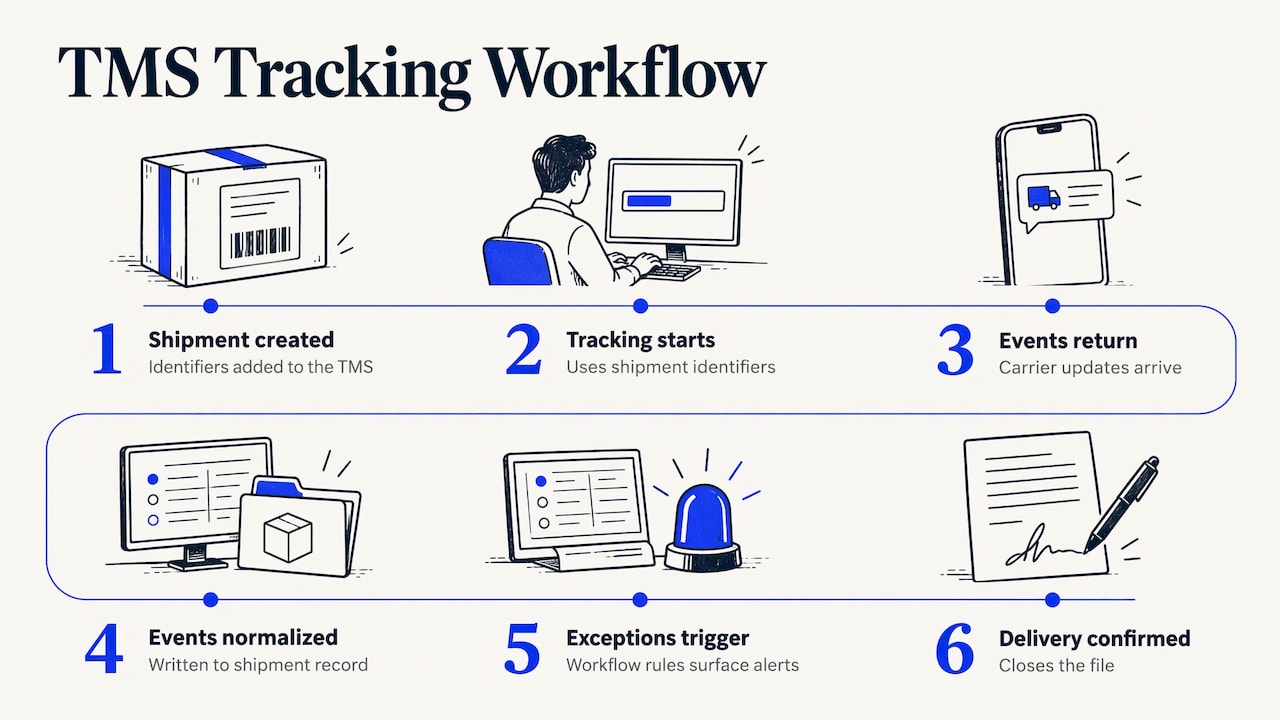
For air and ocean, the sources are airlines, ocean carriers, and in some cases vessel position data, but the pattern is the same. A shipment is created in the TMS with its identifiers. Tracking starts against those identifiers. Events come back, get normalized, and write to the shipment record. Exceptions trigger workflow rules, and delivery confirmation closes the file.
There is a distinction worth understanding before you shop. A TMS tracks shipments through its own carrier connections, while a dedicated visibility platform connects to many carrier networks and normalizes everything into one record. GlideApps Agency’s guide explains that the two work best together: the TMS passes shipment identifiers and carrier assignments out, predictive ETAs flow back to the shipment record, and alerts surface in the TMS exception queue. At FreightSuite, we build tracking natively into the TMS so forwarders are not stitching this loop together themselves.
Three ways carrier events reach your system
Every integration decision comes down to three channels: direct carrier APIs, EDI, and aggregators. Each trades speed, depth and effort differently.
| Channel | Connections | Timing | Strength | Cost to carry |
|---|---|---|---|---|
| Direct carrier API | One per carrier | Near real time | Full access to carrier-specific services | Engineering time, plus rebuilds when carriers change endpoints |
| EDI | One per trading partner | Batch-based | Standardized, reliable, strong for high-volume freight | Slow onboarding, 4 to 8 weeks per carrier |
| Aggregator | One for many carriers | Depends on the provider | Far less maintenance | Per-transaction or subscription fees, less per-carrier depth |
The figures in this table come from FreightWaves Checkpoint’s 2026 guide to freight shipping APIs, which also notes that direct APIs typically take weeks to launch per carrier and months for a full network.
EDI: the established standard
EDI remains the backbone of North American truckload and LTL tracking. The usual sequence runs from the 204 load tender, to the 990 accept or decline, through 214 status messages as the load moves, and ends with the 210 freight invoice. Because it is batch-based, EDI is dependable but not instant, and every new carrier is a project.
Maritime has its own set. CoaxSoft’s connectivity guide lists EDI 300 for ocean booking confirmation, 310 for freight receipt and invoicing, and 315 for shipment status and milestones, and observes that many businesses run EDI and APIs side by side.
Direct APIs: depth with upkeep
A direct API gives you the richest data and the most control, but each carrier brings its own authentication, data format, service codes and event vocabulary. The build is rarely the problem. The problem is year two, when the original developers have moved on and a carrier deprecates an endpoint. GlideApps Agency’s guide makes the same point about institutional knowledge leaving with the team that built the connection.
Aggregators: breadth without the build
When you work with many carriers on different systems, an aggregator that connects to multiple providers at once is the more practical route, and direct connectivity delivers the deepest data but does not scale well, according to a US brokerage TMS engineering write-up. The right answer depends on how many carriers you use, how much engineering capacity you have, and whether you need carrier-specific services an aggregator may not expose.
Push beats polling
Whichever channel you choose, prefer push delivery. Hovership notes that polling can leave customer-facing status up to fifteen minutes stale and gets expensive at volume. When evaluating a provider, ask whether webhook deliveries are retried and for how long, whether events are ordered and idempotent, and whether payloads are signed.
Air tracking integrations
Air tracking is built around the master and house air waybill. A forwarder needs both: the MAWB to follow the cargo on the airline’s side, and the HAWB to tie events back to the customer’s shipment. Tracking APIs connect directly to airlines and other sources to pull milestone updates into your own system, with much lower latency than legacy EDI, as CargoAi’s integration overview describes.
The milestone model matters as much as the connection. A flight arriving on time does not mean the cargo is usable. IN Supply reports that unloading, handling, customs or breakdown delays can hold cargo back even when the aircraft lands on schedule, so forwarders need each usable milestone, not only the arrival at the airport. A good air integration therefore maps airline events into your own milestone set: booked, received from shipper, departed, arrived, ready for pickup, delivered.
When those milestones feed the TMS, they can drive KPIs and customer notices without manual updates. We cover that in our guide to turning air cargo milestones into TMS KPIs and in the broader walkthrough on how a TMS tracks air shipments. If you are planning a rollout, our air waybill tracking timeline for forwarders lays out a 12 to 16 week path.
Ocean tracking integrations
Ocean tracking starts from a different set of identifiers. Depending on the provider, you supply an ISO container number, a bill of lading or a booking reference, often with the carrier’s SCAC code to remove ambiguity. Panvaya’s developer documentation shows this pattern, with responses covering container status, milestone timeline, port pairs and vessel details, and live AIS positions where available.
The practical challenge is vocabulary. Ocean carriers describe the same events in hundreds of different ways, so a useful integration translates raw carrier events into a short, standardized milestone list such as gate-in, loaded, departed, transshipment, arrived, discharged and gate-out. Keep the raw carrier description alongside the normalized one, because you will need it when a customer or carrier disputes a date.
Most forwarders also need a clear way to compare options. Our comparison of ocean tracking software for freight forwarders covers the criteria, and our ocean freight TMS capabilities page shows how tracking connects to bookings, documents and finance.
Where integrations actually break
Tracking integrations rarely break at the API. They break at the meaning of a status. Twincore’s logistics integration guide points out that carriers, EDI feeds and webhooks describe identical physical events in different words, so the receiving system needs a mapping table that converts source codes into normalized statuses while preserving the original status for audit and carrier disputes.
The same guide lists the reliability patterns that production systems rely on: idempotency keys, retries with exponential backoff, circuit breakers, dead-letter queues, webhook deduplication, event replay, correlation IDs, audit logs, alerts, and fallback workflows for when a carrier API is down. You do not need all of them on day one, but you should know which ones your platform already covers.
Out-of-order and missing events
Two problems cause most of the pain. The first is ordering: if a late status arrives after proof of delivery, it must not flip a delivered shipment back to in transit. Ordering updates on the carrier’s event timestamp, not on arrival time, prevents that. The second is gaps. Missing events have traditionally meant manual work: someone checks a carrier site, compares it with the TMS, updates the record and then answers the customer. Repeated across hundreds of shipments, that turns a visibility gap into a labor problem, as IN Supply’s reporting puts it.
The fix is to treat manual verification as a legitimate, timestamped input rather than an override. A telematics ping and a verification call are two sources with two timestamps, and the system should store both. For road freight in particular, driver status automation shows how reliable status events can flow cleanly into logistics systems and customer shipment records.
Expired credentials
A quieter failure is credentials. Keeyu’s carrier integration guide warns that an unnoticed expired OAuth 2.0 token can stop a feed as completely as an outage. Add expiry monitoring and alerting to your integration checklist, and confirm sandbox availability and rate limits before you commit to a carrier connection.
What to assess before you integrate
Before you sign off on any tracking connection, work through a short evaluation. Start with coverage: which carriers, airlines and ocean lines matter to your lanes, and does the connection reach them? Then look at completeness and normalization, meaning how many milestones arrive, how they are named, and whether ETAs are included. Next, check delivery mechanics: webhooks, retries, ordering and rate limits. Finally, review security, data handling and pricing.
Functional scope matters too. Keeyu notes that integrations often cover label generation, rate retrieval and manifesting, but stop short of tracking events, address validation and claims submission, so confirm exactly which of those your connection supports. If rate shopping is part of your workflow, our auditable API checklist for carrier rate shopping is a useful companion.
Availability deserves a written commitment. AfterShip’s RFP guide for shipment tracking suggests looking for monthly uptime of 99.9% or better, with an SLA that states what it covers, how it is measured and what credits apply when it is missed.
Implementation considerations for US forwarders
US forwarders face a few specifics. Enterprise visibility platforms such as project44, FourKites and Shippeo each cover the major truckload and LTL networks, differing mainly in ocean, air and international depth, and rollout for domestic coverage typically runs three to six months, with international and ocean extending that, per GlideApps Agency. FourKites states that forwarders can connect through API or file integration to see ocean, air, rail and ground legs in a single shipment.
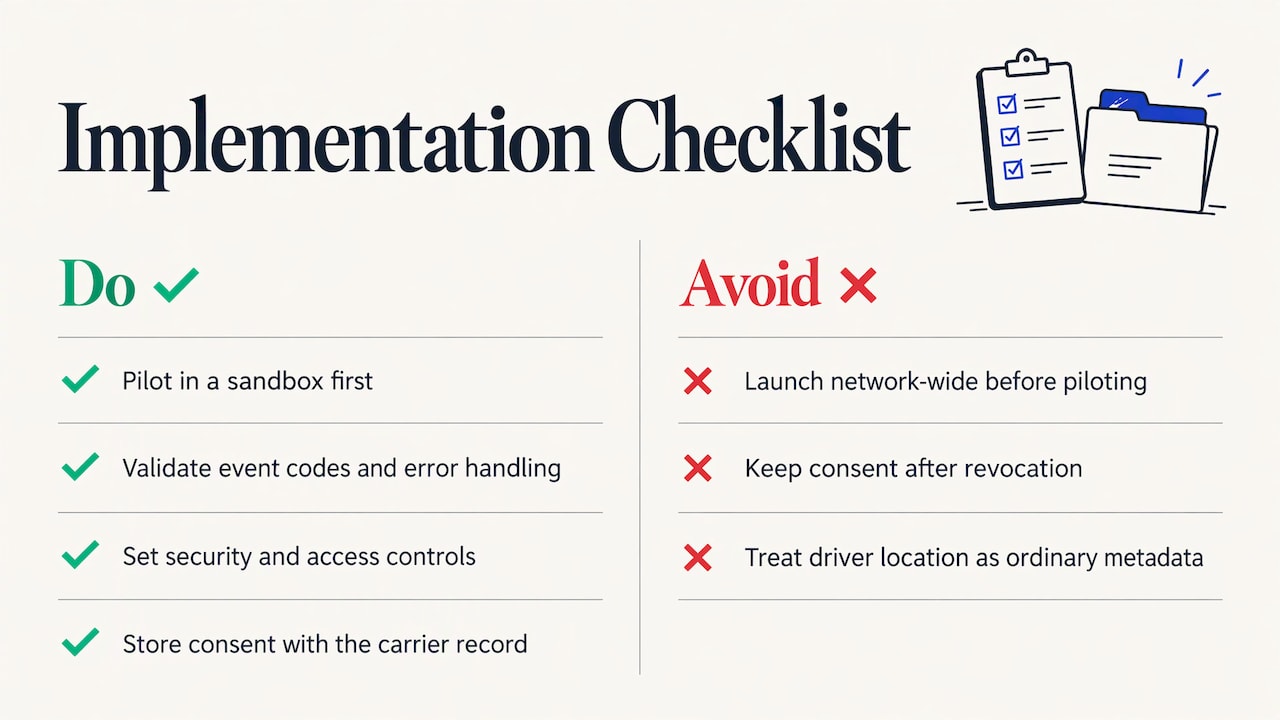
Whatever route you take, follow a disciplined rollout. The NMFTA’s API implementation checklist recommends piloting in a sandbox before network-wide launch, validating event codes and error handling, setting up security and access controls, and documenting each integration step as your source of truth for troubleshooting and onboarding.
Privacy needs attention as well. Consent to share visibility data is the carrier’s choice, should be stored with the rest of the carrier record, and must be removed immediately when revoked. Location data identifies the driver personally, so it should not be treated as ordinary shipment metadata, a point made in the brokerage engineering write-up cited above.
For teams with developers in house, our piece on logistics API integration for developers goes deeper on build effort, and our guide to real-time logistics tracking for supply chain teams covers the operational side.
How FreightSuite handles tracking
FreightSuite is an agentic TMS built for freight forwarders and logistics companies. Air and ocean tracking, rate management, finances, operations, workflows and AI agent orchestration are built natively into the platform, and our core features are included out of the box without add-ons. The aim is to let forwarders run faster, remove admin and improve profitability, rather than maintain a patchwork of connections.
If your team still checks carrier sites by hand, the window to change that is real, and it has a timeline. Explore the air freight management system or FreightSuite as a whole, and see how native tracking fits your lanes.
FAQ
What is the difference between a carrier tracking integration and a visibility platform?
A TMS tracks through its own carrier connections, while a visibility platform connects to many carrier networks and normalizes the data into one record. The two work best together, with the TMS sending shipment identifiers and receiving ETAs and exceptions back. A TMS with native tracking brings that loop into one system.
Which identifiers do I need for air and ocean tracking?
For air, you need the MAWB and, for customer-level visibility, the HAWB. For ocean, you typically supply a container number, bill of lading or booking reference, often with the carrier’s SCAC code. Having these on the shipment record at creation lets tracking start automatically.
Is EDI or API better for tracking?
Neither wins everywhere. EDI is standardized and reliable but batch-based and slower to onboard, while APIs offer near real-time events for carriers that support them. Most forwarders run both, and many add an aggregator for breadth.
How do I stop late events from corrupting a shipment record?
Order updates on the carrier’s event timestamp rather than arrival time, deduplicate repeated webhooks, and keep the original source status next to the normalized one. That way a stale message cannot revert a delivered shipment, and you keep an audit trail for disputes.
Sources
- Integrating GPS Tracking into Transportation Management, FreightWaves
- Supply Chain Visibility Platform Guide, GlideApps Agency
- What Is a Freight Shipping API? 2026 Guide, FreightWaves
- Connectivity in transportation, CoaxSoft
- EDI 204, 214 and 210 Transactions, NewAgeSysIT
- What to look for in a carrier API, Hovership
- Understanding API Integrations and Their Impact on the Air Cargo Industry, CargoAi
- CargoAi tracking expands scope across 260 airlines, IN Supply
- Logistics API for Developers, Panvaya
- Logistics API Integration Guide, Twincore
- Carrier Integration: Direct vs Aggregator, Keeyu
- RFP Guide for 3PL Ship Tracking, AfterShip
- For Carriers and Brokers, FourKites
- API Implementation Checklist for Shippers, 3PLs, and Brokers, NMFTA

