Carrier Rate Management: A Practical Guide for Freight Forwarders

Carrier rate management is the discipline of keeping every carrier rate, surcharge and term in one authoritative place, versioned by effective date, so that the rate you quote is the rate you can actually buy and the rate you pay is the rate you agreed. For a forwarder the work lives in the margin between those two numbers. When rates sit in inboxes and spreadsheets, that margin leaks. When they sit in a transport management system that applies them automatically, the margin becomes something you can plan around. FreightSuite builds rate management natively into its TMS, with the other core features included out of the box, because rates are not a side task in forwarding: they are the product.
TL;DR
- Carrier rate management means collecting rates, structuring them as complete records (base rate, surcharges, validity, terms), versioning every change and applying the right version to each quote and invoice.
- Forwarders carry more complexity than shippers: ocean, air and road rates from many carriers, each with its own surcharges, currencies and validity windows.
- The biggest losses come from stale rates, missed surcharge changes and invoices that never get checked against the agreed rate.
- Good rate software holds one rate source, versions by effective date, handles currency natively and feeds quoting, operations and finance from the same data.
- Start with a clean rate record and a change calendar before you automate anything.
Table of Contents
- What carrier rate management covers
- Why forwarders feel this more than shippers
- What a complete carrier rate record contains
- How rates enter your system
- Version every change instead of overwriting it
- Applying rates: from quote to invoice
- Measuring whether it works
- What to look for in carrier rate management software
- Where FreightSuite fits
- A sensible order of work
- FAQ
- Sources
What carrier rate management covers
The term gets used loosely, so it helps to draw the line. Carrier management is the wider job of selecting carriers, negotiating contracts, monitoring performance and maintaining relationships. Carrier rate management is the part of it that deals with the numbers: lane rates, surcharge schedules, accessorial charges, validity periods and the rules that decide which of them applies to a given shipment.
For a forwarder this has two sides that must stay in step. The buy side is what carriers charge you. The sell side is what you quote your customer on top of it. A rate management process that only tracks one side tells you nothing about margin. The goal is a single view in which a buy rate, its surcharges and your markup sit together, dated and traceable.
The discipline also has a back end that gets less attention. Every rate you load will eventually meet a carrier invoice. If the invoice is checked against the same current rate that drove the quote, overcharges surface in days. If it is checked against nothing, or against an outdated spreadsheet, they surface in a quarterly review or never. Our guide to rate audit automation walks through the checks that catch forwarder overpayments.
Why forwarders feel this more than shippers
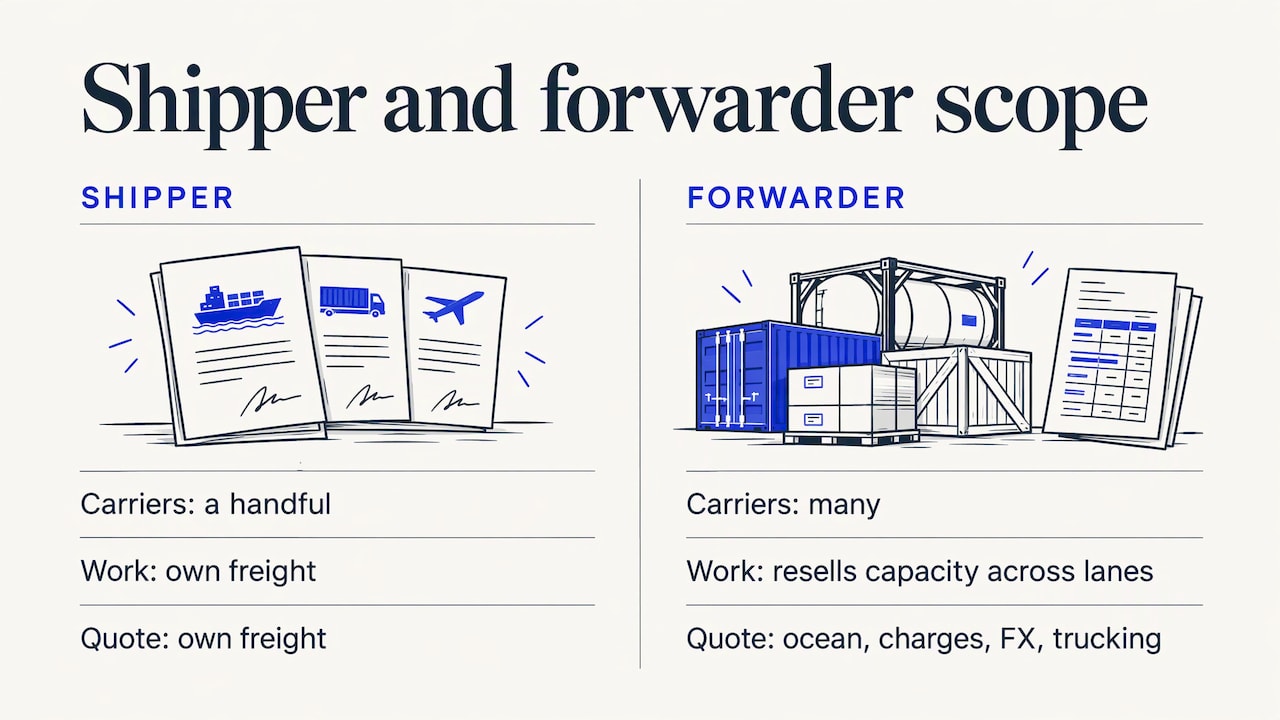
A shipper negotiates with a handful of carriers and applies the result to its own freight. A forwarder resells capacity across many carriers, modes and trade lanes, and does so under time pressure. A single customer inquiry can involve an ocean base rate, origin and destination charges, a fuel or bunker component, a currency conversion and a trucking leg.
Regulation adds structure on the ocean side. In the US, the Federal Maritime Commission requires every NVOCC operating in US trades to publish a tariff, and NVOCCs may use negotiated rate arrangements where an exception from certain tariff rate publication requirements applies. In practice some forwarders state that they use negotiated rate arrangements rather than publishing every rate, as IFF, Inc. does on its rules tariff page. Whatever your model, the consequence is the same: you need a record of what was agreed, with whom, for which lanes and for how long, and you need to be able to produce it.
The second pressure is speed. Customers expect a quote in hours. If your team has to open five files to assemble one, you either quote slowly and lose the job or quote from memory and lose the margin. Our piece on freight quote management covers how the quoting workflow should draw on the rate source.
What a complete carrier rate record contains
Most rate errors begin with an incomplete record. A rate that is just a number per container or per kilo is a rate waiting to be misapplied. A record that supports accurate quoting and invoice checking holds at least the following.
Start with the lane and the service: origin, destination, mode, equipment or weight break, and transit or service level where it matters. Then the base rate with its currency and its unit, whether per container, per kilo, per cubic meter or per shipment. Rating basis matters more than people expect: some tariffs charge on actual gross weight or overall measurement, and for weight or measurement rates the basis yielding greater revenue applies. If your system cannot apply that rule, someone will apply it by hand, and sometimes wrongly.
Next come the surcharges and accessorials, each as its own line with its own basis and its own validity. Fuel is the classic example. US trucking fuel surcharges have been known to swing widely: a Department of Justice complaint documented historical examples ranging between 6% and 39% of the line haul amount. A flat assumption about fuel is therefore a hidden bet. Separately itemizing it is not new either: a congressional report on a 2000 bill proposed requiring certain truckload fuel surcharges to be itemized separately on invoices, which tells you how long the industry has argued about transparency here.
Finally, the terms: validity start and end dates, minimum volume or allocation commitments, free time, payment terms and any conditions that trigger a surcharge. A rate without its effective dates is the single most common cause of stale quotes.
Three fields deserve a note because forwarders get them wrong most often:
The first is currency. A rate in euros quoted to a customer in dollars is a rate that changes between the day you load it and the day you invoice. The second is the validity window, which should be a hard field, never a comment. The third is charge naming. If one carrier calls a charge by one name and another carrier by a different one, your reporting will never compare them. This is a master data problem, and our five-step guide to fixing freight master data covers how to standardize charges so calculation and EDI or API feeds behave.
How rates enter your system
Rates arrive in every format imaginable: PDF rate sheets, Excel files, emails with a table pasted in, portal downloads, spot quotes over chat and, increasingly, API feeds. Whichever route they take, three principles keep the process honest.
First, one point of entry. Rates should be loaded into the system of record, never left in the mailbox where they were received. Anything that lives only in an email is a rate your colleague in another time zone cannot find.
Second, structure at the door. It is far cheaper to map a carrier’s sheet to your record format once, at load, than to interpret it on every quote. Standard templates per carrier, with the same field names every time, turn a messy intake into a repeatable one.
Third, an owner and a check. Someone is responsible for each carrier’s rates, and a second pair of eyes confirms a sample of lanes after each load. Errors found at load cost minutes. Errors found on an invoice cost margin and an uncomfortable call with a customer.
Onboarding a new carrier is where this discipline either starts well or does not start. If you want the identity and documentation side done quickly, see our article on carrier onboarding in one to two days.
Version every change instead of overwriting it
Contracts change. General rate increases land, surcharge schedules are amended, an allocation is renegotiated mid-term. The rule that separates a controlled process from a fragile one is simple: never edit a rate in place. Add a new version with an effective date and keep the old one.
The reason is that the correct rate depends on which date you ask about. A shipment booked in March, moved in April and invoiced in May may touch three different versions of a rate. With versioned records, the system selects the right one for the reference date your business rule specifies, whether that is the booking date, the departure date or the invoice date. With overwritten records, you have lost the evidence you need to dispute an invoice or defend a quote.
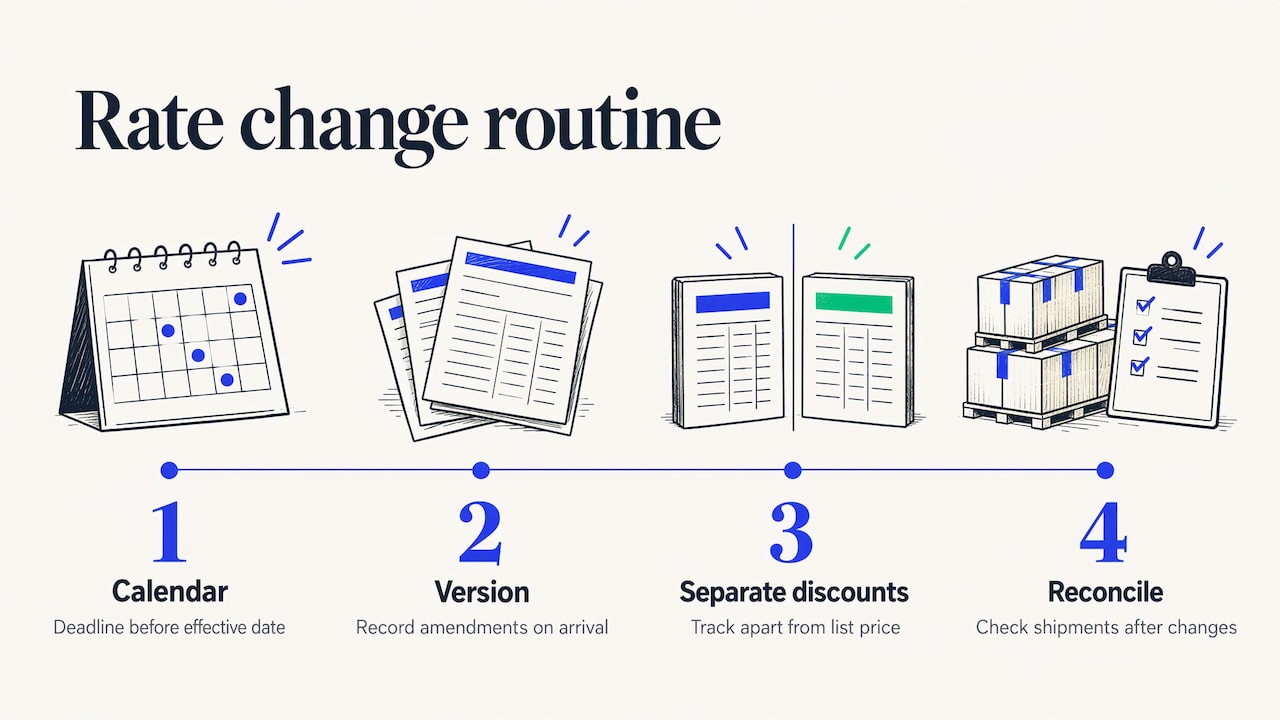
A workable routine has four parts. Put every announced increase and surcharge change on a shared calendar as a deadline, ahead of its effective date. Record each amendment as a new version the day it arrives. Track negotiated discounts separately from list price, because a discount off list does not protect you when the carrier changes the underlying charge categories. And after each change takes effect, reconcile a sample of live shipments against the new rates to confirm the update reached everything that depends on it.
Renewals deserve their own calendar entry. Negotiating late hands the leverage to the carrier, so many teams start renewal conversations well before expiry, six to nine months out for major contracts. Our article on carrier contract management for negotiators shows how to make negotiated terms stick once they are signed.
Applying rates: from quote to invoice
A rate record earns its keep only when it is applied automatically and consistently. That means four connections.
Quoting
The quote should draw base rate, surcharges and validity directly from the record, add your margin by rule, and show the customer a price that is valid for a stated period. If a sales rep has to retype a rate, you have created a transcription error and a version problem in one step. Rate shopping across carriers is a related task, and the auditable API checklist for carrier rate shopping sets out what a trustworthy connection looks like.
Operations
When a quote becomes a booking, the rate and its terms should travel with the shipment. Operations then sees the cost it is expected to incur, and exceptions, such as a detention or an extra accessorial, can be flagged against the agreed terms instead of discovered later.
Finance
This is where the least attention and the most damage tend to meet. When a carrier invoice arrives, the system should compare each line with the rate that was valid for that shipment and flag the difference. The same record then feeds accruals, margin by shipment and customer billing. Currency matters here too: if costs are recorded in one currency and billed in another, the exchange rate source and timing change your real margin. We cover that in our guides to exchange rate integration for logistics and to matching jobs to the right FX rate source.
Reporting
Once rates, quotes and invoices share a record, you can ask useful questions. Which carriers are consistently cheaper on which lanes? Where do actual costs run above quoted costs? Which surcharges are growing fastest? None of this is possible when rates live in individual spreadsheets.
Measuring whether it works
Carrier management is commonly judged on a short list of measures: on-time delivery, billing accuracy, damage rates and service response times. For rate management specifically, add measures that reflect the numbers themselves.
Track the share of quotes issued from a current, valid rate, and the time it takes to produce one. Track the share of carrier invoices that match the agreed rate without manual intervention, and the value of overcharges recovered. Track the gap between quoted margin and realized margin by lane. And track how long it takes between a carrier announcing a change and that change being live in your system.
A useful way to start is a baseline audit. Take a sample of last month’s shipments and compare the quoted rate, the agreed buy rate and the invoiced amount. The size of the differences tells you what the problem is worth and which of the steps above to fix first.
What to look for in carrier rate management software
By now the requirements should be clear. Spreadsheets can hold a rate, but they cannot version it by effective date, apply it to a quote, and compare it with an invoice, all without someone copying numbers. Software should do those things, and these are the criteria that matter for a forwarder.
| Criterion | What good looks like |
|---|---|
| Single rate source | Buy rates, surcharges and terms in one record that quoting, operations and finance all read |
| Versioning | Every amendment saved as a new version with an effective date, never overwritten |
| Surcharge handling | Each surcharge held as its own line with its own basis and validity |
| Multi-mode coverage | Ocean, air and road rates handled in the same system |
| Currency | Native multi-currency with a defined exchange rate source |
| Invoice matching | Carrier invoices compared with the rate valid for the shipment |
| Workflow | Rules for approvals, margins and exceptions that your team can adjust |
| Integration | Connection to accounting and to carrier data feeds |
Two questions cut through most vendor conversations. Does rate management come built into the core product, or is it an add-on module you pay for and integrate separately? And does the same rate data drive quoting, operations and finance, or does each team see a copy? Our comparison of the best freight rate software for forwarders and of freight audit software goes deeper on the feature checklist.
Where FreightSuite fits
FreightSuite is a cloud-based, agentic TMS built for freight forwarders and logistics companies, and rate management is native to it alongside air and ocean tracking, finances, operations, workflows and AI agent orchestration. Its core features are included out of the box without add-ons, which means the rate record, the quote, the shipment and the invoice are part of one system rather than a chain of integrations. The platform also covers automated document management, invoice recognition, dynamic FX and cost tracking, credit control and integrated accounting software connections, so the finance end of rate management sits in the same place as the rates.
The mode-specific pages show how this applies to your trade: ocean freight TMS and automation, the air freight management system, road freight transport management and customs brokerage software. If you are ready to see your own rate workflow in the system, start at FreightSuite.
A sensible order of work
The window to fix this is real, and it has a timeline, because every quarter of manual rate handling adds more records to clean up later. A sequence that works for most forwarding teams runs like this.
Begin with the baseline audit described above, so you know what the leak is worth. Then define the standard rate record and clean up charge names, because everything downstream depends on it. Load your highest-volume carriers and lanes first and set the change calendar. Switch quoting to draw from the record, then connect invoice matching so that every carrier bill meets the rate it should. Review the measures monthly, and expand to the long tail of carriers once the routine holds.
The choice is yours to make, but the direction is clear: forwarders who treat rates as governed data quote faster, defend their margin and spend less of their headcount on rekeying numbers.
FAQ
What is the difference between carrier management and carrier rate management?
Carrier management covers the whole relationship: selecting, contracting, monitoring and evaluating carriers. Carrier rate management is the subset focused on rates, surcharges, accessorials and validity, and on applying them correctly to quotes and invoices. For a forwarder it is the part that most directly protects margin.
What should a carrier rate record include?
At minimum the lane and service, the base rate with currency and unit, each surcharge as a separate line with its basis, the validity dates and the commercial terms. Dates and rating basis are the fields most often missing, and they cause most misapplied rates.
How often should carrier rates be updated?
Whenever a carrier amends a rate, surcharge or term, and always at its effective date. Put announced general rate increases and surcharge changes on a calendar, record each change as a new version, and reconcile a sample of shipments after it takes effect.
Do freight forwarders need rate management software?
Any forwarder handling rates from several carriers across modes benefits from it, because software can version rates, apply them to quotes and compare them with invoices without retyping. The need grows with the number of carriers, lanes and currencies you manage.

