TMS First: Launch Air Waybill Tracking in 12–16 Weeks for Forwarders
Air waybill tracking, done right, is not a lookup box. It’s a TMS feature that aggregates AWB and e-AWB status events across your entire book of business, automates the notifications your team currently sends by hand, and posts those events straight into billing and operations. It cuts manual rekeying, speeds up exception response, and closes the gap between what happened on a shipment and what your invoice reflects. If you’re ready to build it, the implementation checklist below is where to start.
TL;DR:
- E-AWB adoption above 75% enables automated tracking across carriers, supported by Cargo-XML messaging for modern, scalable operations.
- Implementing AWB tracking can take 12 to 16 weeks for a focused release or up to a year for a comprehensive, multi-carrier platform.
- A TMS must support native Cargo-XML ingestion, carrier API connections, and accurate data modeling for effective shipment status aggregation.
- Automating workflows around critical events improves efficiency by triggering documentation, customer updates, customs, and invoicing processes automatically.
- FreightSuite’s agentic platform integrates AWB tracking directly into operations and finance systems, enabling faster pilot launches and real-time margin updates.
Table of Contents
- What Is Air Waybill Tracking in a TMS?
- Key TMS Features You Should Require for AWB Tracking
- How Do You Implement AWB Tracking Step by Step?
- What Workflows Should You Automate Around AWB Events?
- How Do You Measure ROI on AWB Tracking?
- FreightSuite: How an Agentic TMS Handles AWB Tracking
- Sources
- FAQ
What Is Air Waybill Tracking in a TMS?
Air waybill tracking, in the context that matters to a freight forwarder, has nothing to do with a customer punching one AWB number into a carrier’s website. It’s an operational capability: your TMS pulls status events for every AWB and house AWB across every carrier you use, normalizes them into one timeline, and pushes updates into the systems your team already works in.
This only works at scale because of e-AWB. IATA made the electronic air waybill the default contract of carriage in 2019, and adoption exceeded 75% by May 2021. That shift matters because paper AWBs can’t feed a tracking system automatically. E-AWB can.
The messaging layer underneath it is Cargo-XML, which IATA now recommends over the older Cargo-IMP format. Cargo-XML handles unlimited data lines and meets modern customs and security requirements, which is why a TMS built for 2026 volumes should be built around it, not around a legacy format airlines are quietly retiring.
Key TMS Features You Should Require for AWB Tracking
Not every “AWB tracking” module does the same job. Before you sign a contract or greenlight a build, hold the platform to a specific feature list. Loose requirements here are how forwarders end up with a dashboard that looks good in a demo and falls apart at 200 shipments a week.
Message ingestion is the foundation. Your system needs to accept Cargo-XML natively, fall back to EDI where a carrier hasn’t modernized, and support API connections for carriers or ground handlers that offer them. Some forwarders also rely on web intermediary services as a stopgap for carriers with no direct feed, a strategy that complements RFID tool tracking for aviation maintenance teams to enhance operational visibility. A TMS that tracks air shipments well usually blends all three rather than betting on one channel.
The data model matters just as much as the plumbing. Look for:
- Native MAWB to HAWB linkage, so a consol’s status rolls up correctly instead of living in a spreadsheet on the side
- Chargeable weight fields tied to the actual AWB record, not a manually entered duplicate
- ULD-level event tracking where relevant, especially for consolidators running regular gateway routings
- A full event timeline per shipment with an archive that doesn’t purge after 90 days
- Configurable automation rules that trigger on specific status codes, not just a generic “shipment updated” flag
- Notification templates and integration points into your existing operations and accounting tools
Pro Tip: Don’t evaluate a vendor’s tracking module on how clean the live demo looks. Ask them to show you a shipment with a missed connection or a short shipment discrepancy. That’s where a real system either surfaces the exception clearly or buries it in a status field nobody checks.
Off-the-shelf modules exist and can support AWB and HAWB creation, status queries, and archives, often priced per document or per volume. That works for smaller operations. Larger forwarders tend to outgrow per-document pricing fast, which is where a platform TMS earns its keep instead of a bolt-on plugin.
How Do You Implement AWB Tracking Step by Step?
Rolling out AWB tracking is a sequencing problem more than a technology problem. Skip a step and you’ll spend months debugging data that was never mapped correctly in the first place.
- Audit carrier readiness. Pull your top carriers by volume and check which support Cargo-XML, which are EDI only, and which have no automated feed at all. This determines your connectivity mix before you write a line of integration code.
- Secure partner signoff. Confirm your IATA Multilateral e-AWB Agreement status or the bilateral equivalents you need. No live e-AWB exchange should start without this in place.
- Map data fields and status codes. Align your internal milestone names to each carrier’s FSU (Freight Status Update) codes so a “flight departed” event means the same thing regardless of source.
- Build and test in a sandbox. Run sample messages through your mapping logic before touching production data. This is where mismatched field lengths and truncated AWB numbers get caught.
- Pilot on a single lane. Start with one trade lane and your highest-transaction carrier on that lane. That’s usually where early ROI shows up fastest, since volume there justifies the engineering effort first.
- Tune exception rules and scale. Once the pilot lane is stable, widen the rollout carrier by carrier, lane by lane, rather than flipping every route on at once.
Pro Tip: Resist the urge to launch on your busiest lane first. A pilot lane with moderate volume and a cooperative carrier gives you cleaner signal on what’s actually broken in your mapping before you scale it onto a lane you can’t afford to disrupt.
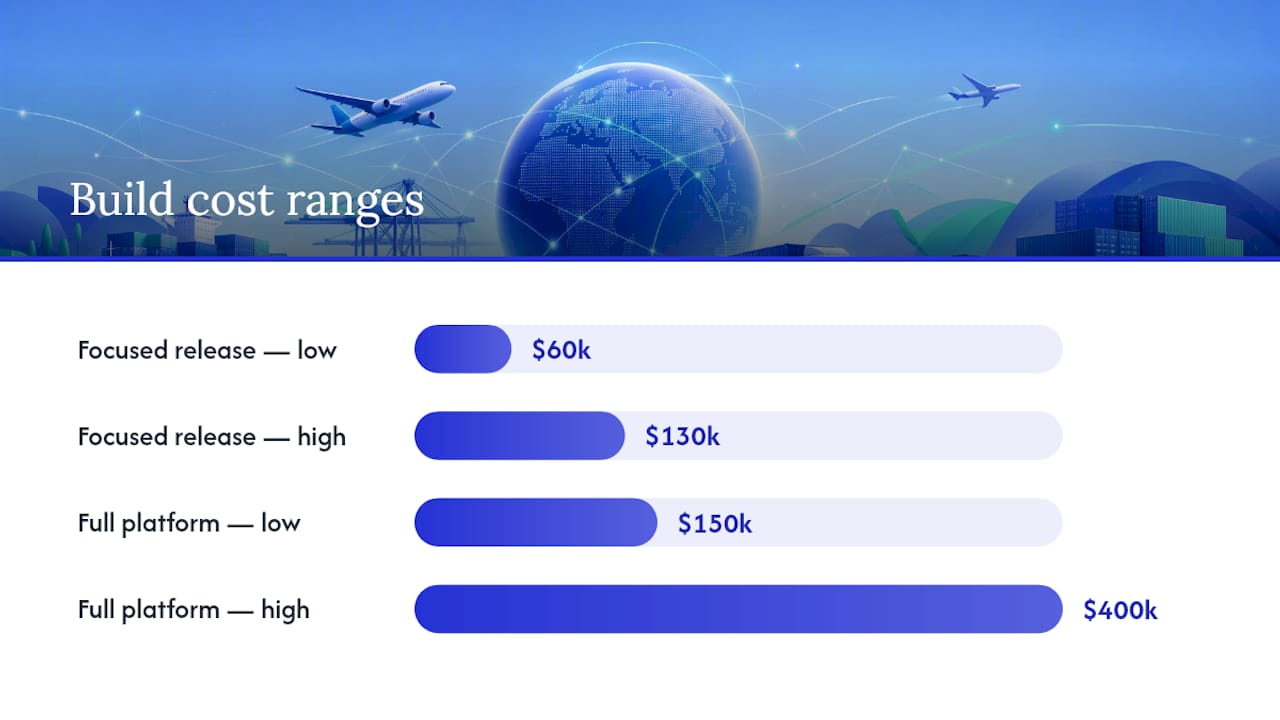
Timelines vary by build scope. A focused first release typically runs $60,000 to $130,000 and ships in 12 to 16 weeks; a full platform with broader carrier coverage runs $150,000 to $400,000 and takes six to twelve months. Know which one you’re actually buying before you sign.
What Workflows Should You Automate Around AWB Events?
Once status events flow reliably, the real payoff is what your team stops doing by hand. AWB tracking, integrated properly into freight management systems, connects shipment milestones directly to booking records, documentation, billing, customs clearance, and customer-facing updates.
Map your common events to specific actions rather than leaving them as passive status changes:
- Booked and manifested triggers document generation and pre-alerts to consignees
- Departed origin triggers an automated update to the customer dashboard rather than a manual email
- Missed connection or delay code triggers an internal escalation to the ops desk, not just a log entry
- Arrived destination triggers customs clearance workflows and warehouse notification
- Delivered triggers invoice release, closing the loop between operations and billing
The smarter approach is exception-first notification. Broadcasting every single milestone to every customer creates noise nobody reads. Better to trigger alerts only on the events customers actually care about, reserving routine updates for the dashboard and reserving direct alerts for delays, damage codes, or documentation holds.
This is also where billing integration pays for itself. A missed connection or short shipment shouldn’t just sit in a tracking feed. It should place a billing hold automatically, flag a potential rebook cost, and alert whoever owns that customer’s SLA. Forwarders who skip this step end up invoicing customers for service levels they didn’t actually hit, which is a slower and more expensive way to find the same problem. Our guide on freight exception management covers this mapping in more depth, and our shipment status automation guide breaks down notification design further.
How Do You Measure ROI on AWB Tracking?
Track a small set of KPIs from the pilot lane onward, not a dashboard full of vanity metrics. The ones that actually tell you whether the system is working: time to exception detection, percent of status updates handled without human touch, rekeying FTE hours saved per week, and billing discrepancy rate between what was tracked and what was invoiced.
Run data quality checks weekly during the pilot. Reconcile a sample of AWBs against the carrier’s own portal to catch mapping errors before they compound across hundreds of shipments.
On automation gains specifically, real builds have reached 80% to 92% auto-accept rates on extracted document fields after tuning, which is a reasonable benchmark for what “working well” looks like a few months in. The deeper win shows up when event data feeds your consol and P&L model directly, so margins update in near real time at the house and consol level instead of at month end when it’s too late to fix anything.
FreightSuite: How an Agentic TMS Handles AWB Tracking
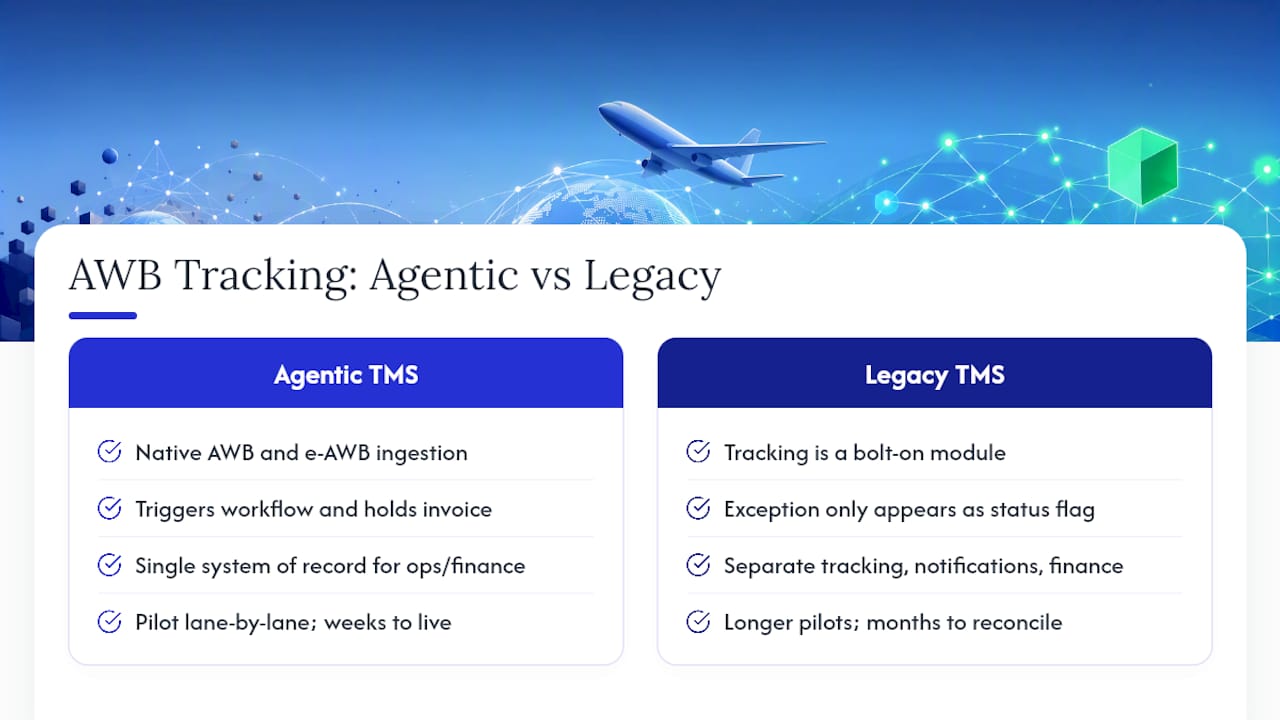
Some agentic TMS platforms are built to close the exact gap this guide walks through: AWB events that arrive automatically, get mapped correctly, and land in billing without a single rekeyed field. Where legacy platforms treat tracking as a bolt on module, these TMSs run AWB and e-AWB status ingestion natively alongside rate management, operations, and finance, so an exception on a shipment doesn’t just show up as a status flag. It triggers the workflow, holds the invoice if needed, and notifies the right person.

That native connection is the practical difference for a forwarder evaluating a switch. Instead of stitching together a tracking plugin, a separate notification tool, and a finance system that reconciles everything a week later, an agentic TMS architecture can handle message ingestion, exception routing, and billing updates inside one system of record. Pilots can start lane by lane, exactly as outlined above, with engineering support that maps your top carriers first.
If you’re evaluating a TMS for AWB tracking, take a look at FreightSuite’s air freight capabilities or, if your billing team is the one feeling the most pain right now, see how the platform handles finance and invoicing workflows tied to tracking events. Request a demo and bring your carrier list. That’s the fastest way to know whether a pilot lane could go live in weeks rather than months.
Sources
For deeper technical detail on e-AWB standards, the guide to integrating e-AWB for a freight forwarder covers IATA adoption figures and multilateral agreement requirements. AltexSoft’s breakdown of Cargo-XML versus Cargo-IMP is useful for technical teams mapping message formats. For build cost and timeline benchmarks, see Digital Heroes’ analysis of air cargo software economics. On the operational side, Gorilla Overview’s piece on AWB integration covers how tracking connects to customs and warehouse functions. For product specifics, visit FreightSuite’s air freight capabilities page.
- Guide of How to Integrate e-AWB for a Freight Forwarder
- Air cargo software that kills the AWB spreadsheet
FAQ
What Does AWB Tracking Mean Inside a TMS?
It means the system automatically ingests and aggregates status events for every air waybill and house air waybill across all your carriers, rather than requiring a manual lookup per shipment.
What Are AWB Status Codes?
They’re standardized event codes, typically delivered as FSU (Freight Status Update) messages, that mark milestones like booking, departure, arrival, and delivery, and a TMS should map these to internal workflow triggers automatically.
How Is E-AWB Different From a Paper AWB for Tracking Purposes?
E-AWB is the electronic contract of carriage that enables automated status messaging; paper AWBs can’t feed a tracking system directly, which is why e-AWB adoption above 75% has made TMS-level tracking practical at scale.
How Long Does It Take to Implement AWB Tracking?
A focused first release generally takes 12 to 16 weeks, while a fuller platform rollout across many carriers and lanes can take six to twelve months.
Can FreightSuite Handle AWB Tracking and Billing Together?
Yes. FreightSuite runs AWB and e-AWB tracking natively alongside operations and finance, so exception events can trigger billing holds or invoice releases automatically rather than through a separate reconciliation step.
Is Airline-Provided Tracking Enough for a Freight Forwarder?
Airline portals only cover that carrier’s own shipments and require manual lookups, while a TMS aggregates events across every carrier you use and automates the notifications and billing actions that follow.

