Tame Air Freight Tariffs: Cut 20–40% Hidden Charges for Logistics Teams Using TMS
Air freight tariffs are the airline base rates published under the TACT framework, plus mandatory surcharges and accessorial charges, all billed against chargeable weight rather than actual weight alone. Fuel and security surcharges swing with market conditions, and in 2026 those swings can move your per-kilo cost more than the base rate does. This article breaks down how billing actually works, what adds cost at every stage, and what you can do about it before the invoice lands.
TL;DR:
- Chargeable weight is calculated based on the higher of actual weight or volumetric weight, which can significantly impact costs on bulky shipments.
- Fuel surcharges fluctuate weekly with market fuel prices and can more than double the base rate cost in 2026 during peak price swings.
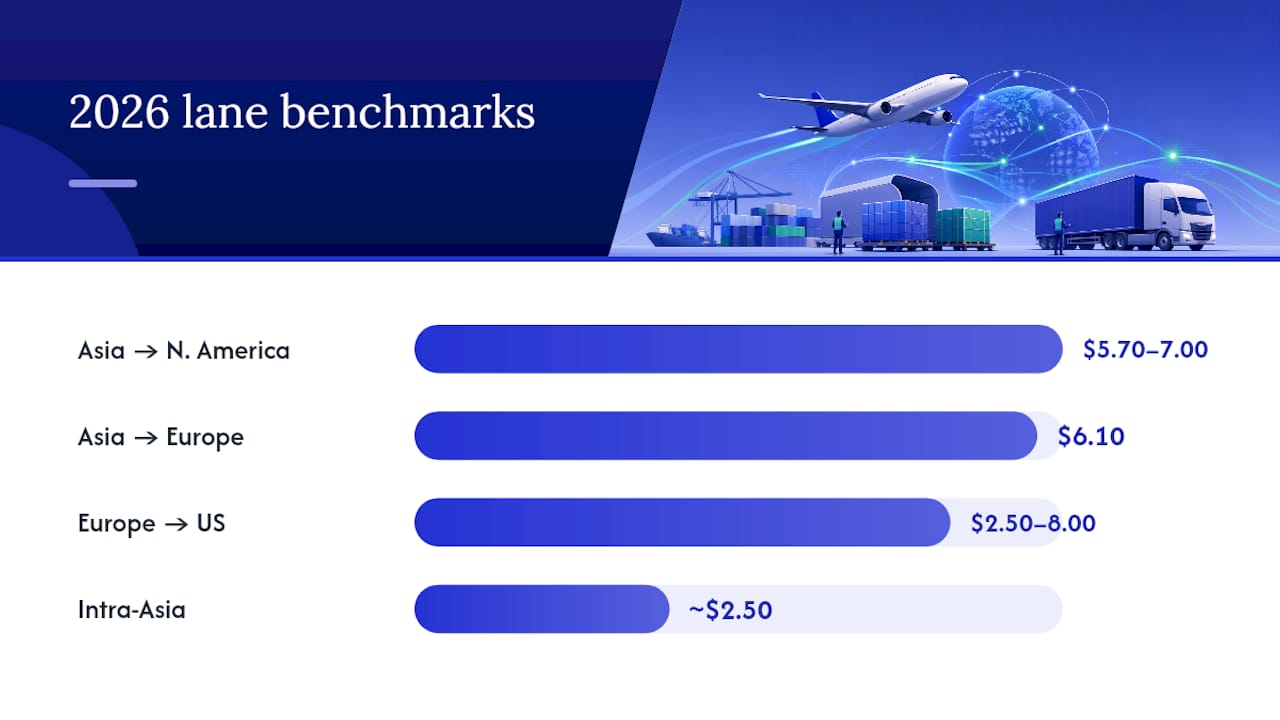
- Lane-specific rates vary widely, with Asia to North America reaching $5.70 to $7.00 per kilogram at peak times, much higher than the global average.
- Accessorial charges like terminal handling, documentation, and customs fees often make up 20 to 40 percent of total air freight costs, requiring careful negotiation and verification.
- Using a modern transportation management system helps prevent disputes by automating rate updates, volumetric calculations, and invoice reconciliation aligned with official tariffs.
Table of Contents
- What Air Freight Tariffs Actually Are (TACT and Airline Rules)
- How Air Freight Rates Get Calculated: Chargeable Weight and a Worked Example
- The Surcharges and Accessorial Charges That Inflate Your Quote
- What Air Cargo Actually Costs in 2026, Lane by Lane
- Cutting Your Air Freight Cost Without Cutting Corners
- Where a TMS Fits Into Tariff Management
- Quick Glossary: Terms You’ll See on Every Tariff and Invoice
- Where to Verify These Numbers Yourself
- Sources
- FAQ
What Air Freight Tariffs Actually Are (TACT and Airline Rules)
The base rate on any air shipment traces back to the Cargo Tariff, better known by its acronym TACT, the reference system airlines use to publish rate rules, commodity classifications, and special handling provisions. IATA describes TACT as the foundation of pricing transparency in the industry, the document that defines what an airline charges before a single surcharge gets added on top. When a rate looks wrong on an invoice, TACT and the carrier’s own published rules are usually where the dispute gets resolved, because they spell out exactly which commodity code and weight break applied at the time of booking.
A tariff document is not the same thing as the quote your forwarder emails you. It contains the underlying rules the quote was built from:
- Rate tables organized by weight break, so the per-kilo charge drops as shipment weight rises
- Commodity-specific charges for goods that carry handling risk, like dangerous goods or perishables
- Special rules covering minimums, rounding conventions, and exceptions by trade lane
- Currency and conversion provisions airlines apply when settling in different markets
Freight forwarders and airlines both refer back to these published rules when a rating dispute comes up, because a verbal quote carries no weight against a documented tariff. IATA’s own guidance recommends that shippers keep documentation precise enough to match against TACT rules at every step, since a mismatch between booked and actual cargo details is where most re-invoicing headaches start.
How Air Freight Rates Get Calculated: Chargeable Weight and a Worked Example
Airlines bill on chargeable weight, which is whichever is higher: the actual weight of your shipment or its volumetric weight. Volumetric weight uses a standard conversion of length times width times height in centimeters, divided by 6,000, the IATA volumetric factor that converts dimensions into an equivalent kilogram figure. A shipment that is light but bulky, think furniture, packaging inserts, or medical device casings, almost always gets billed on volume, not scale weight.
Here is how that math plays out for a real box:
- Measure the shipment: 100 cm x 80 cm x 60 cm, actual weight 150 kg
- Calculate volume: 100 x 80 x 60 = 480,000 cubic centimeters
- Divide by 6,000 to get volumetric weight: 80 kg
- Compare the two figures: actual weight (150 kg) exceeds volumetric weight (80 kg), so 150 kg is billed
Pro Tip: Run the volumetric calculation before you book, not after. A shipment that looks like a “weight” shipment on your warehouse scale can flip into a “volume” shipment the moment it’s repacked into a taller crate, and that flip changes your entire cost basis.
Rates also fall in bands, known as weight breakpoints, typically at 45 kg, 100 kg, 300 kg, and 500 kg. Crossing a breakpoint even by a few kilos can lower your per-kg rate enough to offset the extra weight entirely.
A worked example on a Shanghai to Los Angeles lane, 150 kg chargeable weight:
That works out to roughly $6.10 per kilo all-in, well above the $4.20 base rate. Industry breakdowns consistently show that indirect costs, accessorials and documentation, account for 20 to 40 percent of total air freight spend, and this example lands right in that range.
The Surcharges and Accessorial Charges That Inflate Your Quote
The base rate is rarely the number that determines whether your quote is competitive. Surcharges and accessorials do most of that work, and they shift for different reasons than the base rate does.
Fuel surcharge (FSC) moves with jet fuel indices and can change weekly on some carriers. It’s the single most volatile line item on an air waybill, and it’s the one most shippers fail to renegotiate even when fuel prices drop.
Security surcharge (SSC) covers mandated screening costs and tends to stay flatter than fuel, though it can spike on routes flagged for enhanced screening.
War risk and route risk surcharges apply on lanes crossing conflict zones or high-risk airspace, added on top of standard charges when carriers reroute around closed corridors.
Peak season and seasonal premiums appear around major shopping seasons and Lunar New Year, when capacity tightens and carriers price accordingly.
Beyond those, expect a cluster of accessorial charges on nearly every shipment:
- Terminal handling charge (THC) for moving cargo through the origin or destination warehouse
- Documentation fees for airway bill processing and paperwork
- Customs clearance and duty-related charges, separate from the transport tariff itself
- Storage and demurrage if cargo sits past free time at the terminal
- Special handling premiums for dangerous goods, cold chain, or oversized freight
Pro Tip: Ask your forwarder for a full accessorial schedule before booking, not just the headline rate. A quote that looks 15% cheaper on the base rate can lose that entire advantage once THC and documentation fees get added back in.
What Air Cargo Actually Costs in 2026, Lane by Lane
Global average spot rates in early 2026 have moved in a range of roughly $2.84 to $3.19 per kilogram, according to WorldACD’s weekly tracking, but that global figure hides enormous lane-specific variance. A quote near the global average on a congested Asia to North America lane during peak weeks would actually be a bargain.
| Lane | 2026 benchmark range (per kg) |
|---|---|
| Asia to North America | $5.70 to $7.00 |
| Asia to Europe | roughly $6.10 per kilo |
| Europe to United States | $2.50 to $8.00 (wide seasonal swing) |
| Intra-Asia | tends to be at the lower end of general benchmarks |
Lane benchmarks for Asia to Europe and Asia to North America reflect peak 2026 spot weeks, when capacity gets absorbed fastest. Broader benchmark data puts standard commercial air freight anywhere from $2.50 to $8.00 per kilogram depending on lane, service level, and season, a spread wide enough that a single “average” quote is close to meaningless without lane context attached.
Three forces drive most of that spread: available belly and freighter capacity, fuel price movement feeding the FSC, and geopolitical disruption forcing reroutes around closed airspace. Seasonality compounds all three, since capacity tightens fastest exactly when demand peaks. WorldACD’s own reporting stresses using lane-specific benchmarks rather than a single global number when you’re checking whether a quote is fair, because a rate that’s reasonable on one corridor can be well above market on another during the same week.
Spot rates and contract rates behave differently through all of this. Spot rates track the market in near real time and absorb volatility fastest, while a negotiated contract rate with volume commitments tends to lag the spot market, sometimes to your advantage when spot spikes, sometimes against you when spot rates fall and your contract floor doesn’t move.
Cutting Your Air Freight Cost Without Cutting Corners
Cost control here is less about squeezing one big number and more about closing a dozen small leaks, most of them on the accessorial side where 20 to 40 percent of total spend actually lives.
- Optimize packaging before you quote. Repack to reduce volumetric weight, since dimensional charges routinely exceed actual weight charges on lighter cargo.
- Consolidate shipments where lanes and timing allow. Combining smaller loads into one booking often crosses a weight breakpoint that lowers your effective per-kg rate. Reviewing your warehouse receiving process can reveal consolidation windows you’re currently missing.
- Lock rates through contract negotiation, but negotiate the fuel clause specifically. A flat base rate means little if the FSC formula attached to it resets every week.
- Push for minimum volume discounts once your shipment history gives you leverage, typically after three to six months of consistent lane volume.
- Capture dimensions before booking, every time. IATA’s own guidance ties accurate documentation and dimensional data directly to fewer re-invoicing disputes after the fact.
- Reconcile the airway bill against the final invoice line by line, and escalate any mismatched charge immediately rather than accepting it as a rounding difference.
Pro Tip: Clarify who pays which accessorial charge before the shipment moves, not after. Incoterm selection determines this more than most shippers realize, and a misread Incoterm is one of the most common causes of a surprise bill landing on the wrong side of the transaction.
Where a TMS Fits Into Tariff Management
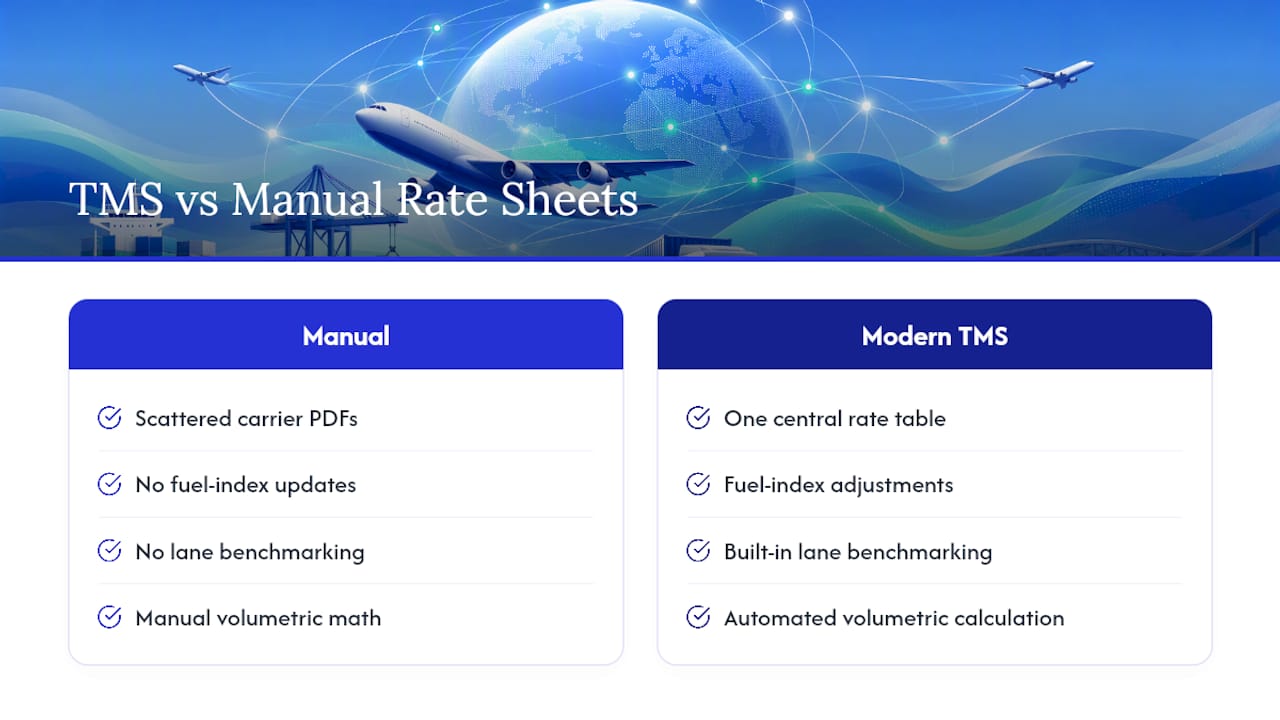
Manual rate management is where most tariff disputes are born, because a spreadsheet doesn’t update its fuel index automatically and it definitely doesn’t catch a volumetric miscalculation before booking. A modern TMS closes that gap directly.
A modern TMS centralizes rate management so your team works from one current rate table instead of scattered carrier PDFs, with fuel-index adjustments and lane benchmarking built into the same view. On the operational side, automated volumetric calculation removes the manual math error that turns a weight shipment into an unexpected volume charge, and automatic AWB-to-invoice reconciliation flags mismatches before they become disputed line items weeks later. Invoice recognition speeds up the audit step further, matching charges against the historical rate that was actually in effect at booking, which is exactly the evidence you need when a carrier’s invoice doesn’t match the quote.
Freight teams looking to move off manual rate sheets can start with FreightSuite’s air freight capabilities to see how rate tables, tracking, and invoice audit work together in one workflow.
Quick Glossary: Terms You’ll See on Every Tariff and Invoice
- TACT: The Cargo Tariff reference system airlines use to publish base rates and rules
- AWB (Air Waybill): The shipment’s contract of carriage, showing weight, rate, and charges applied
- FSC (Fuel Surcharge): An index-linked surcharge that moves with jet fuel prices
- THC (Terminal Handling Charge): A flat fee for moving cargo through origin or destination warehouses
- Chargeable weight: The higher of actual weight or volumetric weight, the figure airlines actually bill against
Check the AWB’s rate box and the attached invoice’s surcharge lines to see each of these in practice on your next shipment.
Where to Verify These Numbers Yourself
For ongoing benchmarking, consult IATA’s tariff guidance directly, track WorldACD’s weekly indices for lane trends, and cross-check quotes against operational cost breakdowns from established freight guides.
Sources
- Air Cargo Tariffs and Rules: What You Need to Know — IATA
- WorldACD weekly air cargo trends — WorldACD
- Air Freight Costs Explained (2026): Full Breakdown, Fees & Cost-Saving Tips — BSI Global Logistics
FAQ
What Are Air Freight Tariffs?
Air freight tariffs are the base airline rates published under the TACT framework, combined with mandatory surcharges like fuel and security, and accessorial charges such as terminal handling and documentation. They’re billed against chargeable weight, whichever is higher between actual and volumetric weight.
Will Freight Rates Increase in 2026?
Rates have already shown lane-specific volatility through 2026, with global averages around $2.84 to $3.19 per kilogram but sharp spikes on congested lanes like Asia to North America, where peak weeks have reached $5.70 to $7.00 per kilogram. Capacity, fuel prices, and geopolitical disruption remain the main swing factors.
Is Freight Subject to Tariffs?
Yes, but freight tariffs (transport charges from the airline) are separate from customs duties and import tariffs applied by commodity code and origin. Air imports generally follow the same duty rules as ocean imports, though certain fees like the Harbor Maintenance Fee don’t apply to air shipments, according to customs clearance guidance.
What Are the Current IATA Freight Rates?
IATA doesn’t publish a single universal rate. It maintains the TACT framework that airlines use to publish their own base rates, rate tables, and commodity rules, which is why checking a carrier’s published tariff or a current market index matters more than looking for one fixed IATA number.

