Accruals in Logistics: How Freight Forwarders Book Costs Before the Invoice

An accrual in logistics is an estimate of a cost or revenue that belongs to this month’s shipments but has not yet been invoiced or billed. You book it at period end so your profit reflects the freight that actually moved, not the paperwork that happened to arrive. Forwarders who tie each accrual to a job, price it from the rate they quoted or contracted, and reverse it on day one of the next period close faster and report margins they can trust.
The mechanics are simple. The discipline is hard, because a forwarder’s costs are scattered across carriers, airlines, truckers, terminals and customs partners, and each one invoices on its own schedule. This guide covers what to accrue, how to estimate it, which entries to post and how to clear them.
TL;DR
- A freight accrual records the estimated cost of a shipment that has moved but has not been invoiced, so the expense lands in the period of the service.
- Estimate from the shipment record: contracted or quoted rate, fuel surcharge, known accessorials, and a reserve based on your own history.
- Post one entry per job, tag it by job and cost center, and reverse it on day one of the next period.
- Inbound freight is generally an inventory cost and outbound freight a selling expense, so the offset account depends on the shipment.
- Review open accruals by age, and route differences to a variance account instead of burying them.
Table of Contents
- What an accrual means in a freight business
- Why skipping accruals produces a false month
- What to accrue, and when
- How to estimate cost when the invoice has not arrived
- The journal entries
- Recognizing revenue and cost for shipments still in transit
- Reversing, matching and clearing
- Measuring accuracy over time
- Where a TMS changes the accrual routine
- A month-end accrual checklist in prose
- FAQ
- Sources
What an accrual means in a freight business
Accrual accounting recognizes an expense when the service is delivered, not when cash leaves or when the bill shows up. For a freight forwarder, that means the ocean leg, the airline charge, the drayage move and the customs entry all belong to the month in which the work happened.
The entry has two sides. You debit an expense (or an inventory cost, for inbound freight) and credit a liability, usually called accrued freight payable. It sits apart from regular accounts payable because no invoice exists yet. When the real invoice arrives, you reverse the estimate and record the actual cost, so only the difference reaches the income statement.
Forwarders also accrue on the revenue side. If you have delivered a service but not yet billed the customer, that unbilled revenue is an accrual too. A job is only profitable once revenue and cost sit in the same period, which is why this topic belongs to the finance team and the operations team together.
Why skipping accruals produces a false month
Carrier and vendor invoices rarely arrive on the day the freight moves. Delays of several weeks are normal, and some charges, such as detention, demurrage and reweigh fees, surface long after delivery. If you book costs only when bills arrive, a quiet invoice week makes the month look better than it was, and a late batch of bills then lands in the next close and wrecks it.
The damage is concrete. Revenue is recognized in March while the cost sits in April, so March margin is overstated and April margin is understated. Management makes pricing, hiring and credit decisions from numbers that describe the wrong month. Lenders and auditors see the same distortion on the balance sheet, because unrecorded liabilities make the company look less leveraged than it is.
Auditors know where to look. Firms such as Pease Bell describe testing for unrecorded liabilities and cutoff testing of post-period freight invoices as standard steps when they examine cost of goods sold and inventory completeness. A forwarder with a reliable accrual process meets those tests without scrambling.
What to accrue, and when
A clean rule works best: accrue the cost of every job where the service has been performed by period end and no vendor invoice has been posted. For forwarders, that usually covers several cost types.
The first is the main carriage: ocean freight, airline charges or line-haul by truck. The second is the origin and destination charges around it, such as terminal handling, drayage, documentation and customs clearance. The third is the surcharges and accessorials that ride on top, such as fuel, currency adjustments, detention and demurrage. Each needs a different level of confidence, which matters when you estimate.
Set a cutoff time and freeze the accrual file at that point. A load or shipment that reaches its trigger event after the cutoff belongs to the next period. Operations should hand over a clean list of jobs, and finance should not reopen it. Agree who owns the process too. When both operations and finance accrue independently, costs get counted twice.
How to estimate cost when the invoice has not arrived
The best estimate is built in layers, because the parts of a freight bill differ in how predictable they are.
Start with the base rate. Pull the shipment record, with origin, destination, mode, carrier, weight or volume, and price it from the rate you contracted or the rate confirmation you accepted. This is the high-confidence layer. If you have no contracted rate for a lane, a trailing average of recent actual costs for that lane is the fallback.
Add the fuel surcharge. Many U.S. carrier contracts key the fuel surcharge to the weekly on-highway diesel price. The cost belongs in the month the shipment moved, so apply the contract schedule to the index week that applied to the move, not to the week the bill arrives.
Add known accessorials. If your team already knows about a liftgate, a reweigh, a detention hour or a storage day, accrue it. Operations data often holds these facts weeks before an invoice does.
Finish with a reserve based on your own history. Take twelve months of actual accessorials as a percentage of base rate, by lane or carrier, and apply it as an allowance for charges nobody has reported yet. This is the low-confidence layer, and it should be labeled as such in the entry so you can measure it later.
The tempting shortcuts are a trailing average of total freight spend or a percentage of sales. Both are quick, and both ignore which carriers, service levels and surcharges actually applied this month. They hide the very variance you need to see, so treat them as a last resort for lanes with no job-level data.
A worked example makes the layers concrete. Say a forwarder delivers a container in the last week of March with no carrier invoice yet. The contracted ocean rate is $3,000, the fuel and bunker adjustment from the rate schedule is $300, a known chassis charge is $150, and history suggests a 5% reserve on the base rate, or $150. The accrual is $3,600. Both the estimate and its composition are recorded against the job.

The journal entries
At period end, the entry for outbound freight is a debit to freight expense (a selling expense or, for forwarders, a cost of services line) and a credit to accrued freight payable. For inbound freight on goods you own, the debit goes to inventory instead.
That distinction is not cosmetic. PwC’s revenue guidance explains that when a seller ships after the customer takes control, it may elect to treat shipping and handling as a fulfillment cost and present it in cost of revenue. If control passes at the shipping point, shipping can be a separate performance obligation, which calls for a principal versus agent assessment unless the election is made. Forwarders acting as principals and agents on the same shipment should settle that question with their auditors, because it decides whether revenue is shown gross or net.
For inbound freight on inventory, Pease Bell notes that under FASB ASC 330 acquisition-related freight is capitalized into inventory and released to cost of goods sold when the product sells. Tax treatment is separate: Fyle’s summary of IRS guidance says freight-in is part of cost of goods sold, that businesses above the $30 million average annual gross receipts threshold generally capitalize it under the uniform capitalization rules, and that many smaller taxpayers can include it directly in cost of goods sold. Confirm your own position with your CPA.
Timing and category are two separate questions. The accrual answers when the cost is recognized. The classification answers which account carries it. Both must be right, and a correct accrual in the wrong account still distorts gross margin.
Recognizing revenue and cost for shipments still in transit
The hardest cases are shipments that start in one month and finish in the next. Public carriers show how it works. In a filing for the quarter ended March 31, 2026, one U.S. carrier reports recognizing revenue over time as freight moves toward its destination. For loads picked up in one period and delivered in the next, it allocates revenue to each period by the share of total transit time that falls in that period. The same filing records a contract asset for loads in process of $3.2 million at March 31, 2026, with the corresponding estimated expenses carried in accrued expenses and other liabilities.
The lesson for a forwarder is to treat revenue and cost symmetrically. If you recognize part of a transit-time job’s revenue in March, the matching share of the vendor cost belongs in March as well. A trade lane with a long ocean transit can straddle two period ends, so tracking data that shows which containers are still at sea on the last day is the best list of what to accrue. Your policy should say which method you use, and you should apply it the same way every month.
Reversing, matching and clearing
The cleanest routine uses reversing entries. On day one of the new period, the system debits accrued freight payable and credits the expense or inventory account, which zeroes the estimate. When the carrier invoice arrives, you book it normally to accounts payable and the expense account. Only the difference between estimate and actual remains in the new period.
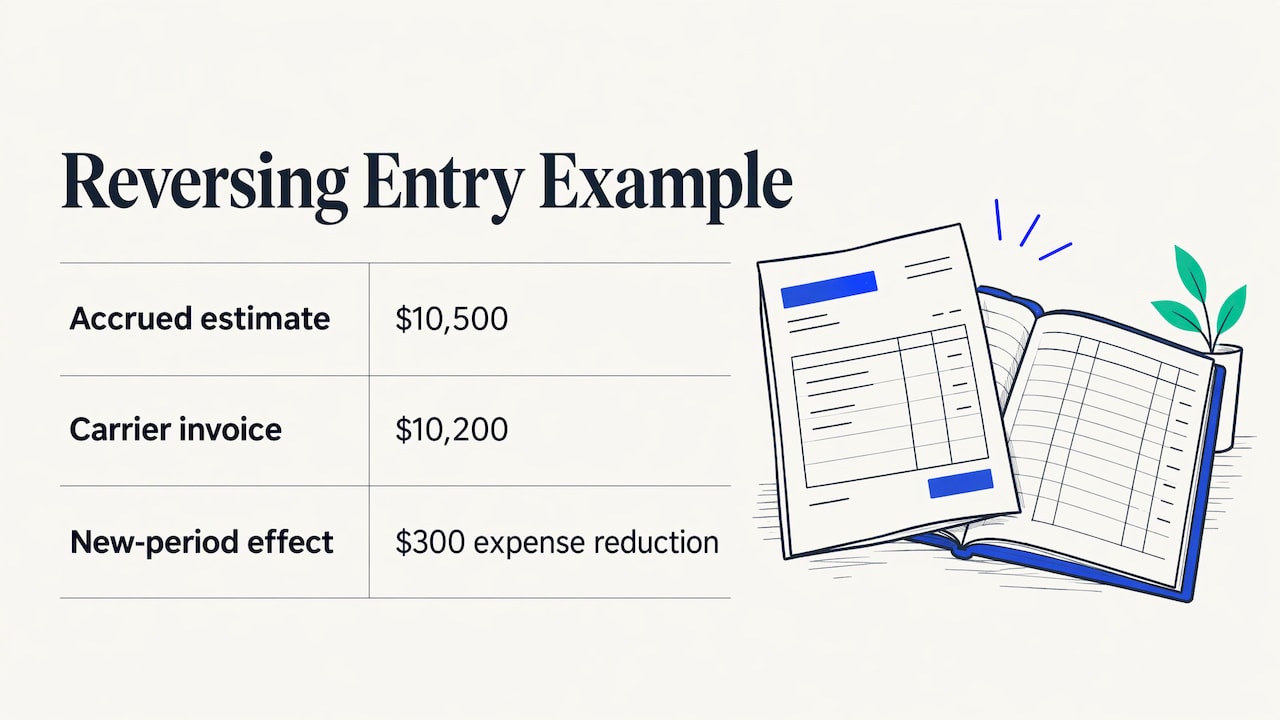
To see it with numbers, suppose you accrued $10,500 and the invoice arrives at $10,200. After the reversal, the actual invoice posts and the net effect is a $300 reduction in freight expense in the new period. That is a true-up, and it is small enough to be routine. A routine true-up is the sign of a good estimate.
Matching is where manual processes struggle. One carrier invoice often covers many shipments from different periods, so a team has to split it back to job references. Build the match around a shipment or job reference carried on both the accrual and the invoice. Without that key, finance ends up reversing everything and re-estimating from scratch, and the link between estimate and actual disappears.
A sound review has four parts.
First, run an accrual-to-invoice match report at month end that shows open items and variances. Second, set a tolerance, such as a few percent per job, within which the variance simply posts to expense, and send anything larger to exception review. Third, post the variance to the original lane or cost center, so your lane margins stay honest. Fourth, age open accruals. A balance that stays unmatched for 60 to 90 days usually signals a missing invoice, a cancelled move that was never reversed, a duplicate accrual or a dispute, and it should be investigated and released only with a documented reason. A disputed invoice is not a reason to release the accrual on its own, because the liability may still be real.
Keep one more thing in mind: carriers can bill late. Federal rules set time limits for carriers presenting freight bills and for billing additional charges after the original invoice, so a job you consider closed can still produce a charge months later. Your accessorial reserve is there for exactly that reason, and your reversal routine should expect it.
Measuring accuracy over time
An accrual process improves only if you measure it. Track the variance between accrued and invoiced cost each month, by carrier and by lane. Large, consistent errors in one direction point to a bad assumption, such as an out-of-date rate or a reserve percentage that no longer fits. Large, random errors point to missing data, such as jobs that operations never closed or rates that were never loaded.
Set a target you can defend to your controller. A miss in the single digits barely moves the close, while a miss of 30% forces a conversation about margin. The aim is to find the cause quickly, and a shipment-level accrual with its components visible makes that possible.
Where a TMS changes the accrual routine
Most accrual pain comes from data living in different places: quotes in email, rates in spreadsheets, shipment status in a tracking portal and costs in accounting software. Each handoff adds delay and error.
When rates, shipment events, documents and finance sit in one system, the job record itself becomes the source for the accrual. That is the logic behind job costing for logistics: profit per shipment is only trustworthy when every cost, estimated or actual, hangs on the same job. If your costs arrive in several currencies, the same principle applies to multi-currency billing, because an accrual booked at one exchange rate and settled at another produces a variance that has nothing to do with freight. Catching overcharges before they reach the ledger is the other half of the picture, which is what rate audit automation is for.
FreightSuite is a cloud TMS for freight forwarders and logistics companies, with rate management, air and ocean tracking, finances, operations, workflows and AI agent orchestration built into the platform. It also includes automated document management, invoice recognition, dynamic FX and cost tracking, credit control and integrated accounting software connections, all part of the core product without add-ons. For a finance team, that means shipment, rate and invoice data in one place when the close arrives. You can see how it supports ocean, air, road and customs work on the FreightSuite site, and finance controllers weighing their options can start with this guide to choosing a TMS as a finance controller.
A month-end accrual checklist in prose
On the last business day, freeze the list of jobs where services were performed. Price each job from its rate, add the fuel schedule for the right index week, add known accessorials and apply your historical reserve. Post one entry per job, tagged with the job reference, GL code and cost center. On day one of the next period, reverse every entry. As invoices arrive, match them to job references, post variances inside tolerance, and send the rest to review. At the end of the quarter, clear anything that has aged past 90 days. Then compare accrued against actual by lane and update your reserve percentages. Run that loop every month and the close stops depending on who remembers what.
FAQ
What are accruals in logistics?
Accruals in logistics are estimated entries that record freight and related costs, or unbilled revenue, in the period the service happened, before the invoice or bill exists. They keep each month’s expenses and revenue matched so margins are accurate. The estimate is reversed when the actual invoice arrives.
Is accrued freight a liability or an asset?
Accrued freight is a liability. It is recorded as a current liability, often called accrued freight payable, because the company owes the carrier for a service already received. The matching debit goes to an expense account or, for inbound freight on goods you own, to inventory.
How do you accrue freight when carrier invoices have not arrived?
Price each delivered shipment from its contracted or confirmed rate, add the fuel surcharge for the right index week and any known accessorials, then add a reserve from your own history. Post one entry per job and reverse it on day one of the next period. Measure the variance as invoices arrive.
How long should an accrual stay open?
Most should clear within a few weeks as invoices arrive. An accrual still unmatched after 60 to 90 days deserves review, since it often points to a missing invoice, a cancelled shipment or a duplicate entry. Release it only with a documented reason.

