Logistics Process Digitization: A Practical Guide for Supply Chain Teams

Logistics process digitization is the systematic replacement of manual, paper-based workflows with interconnected, automated, and data-driven operations spanning rate management, real-time tracking, document handling, and financial reconciliation. The immediate outcome is faster, cheaper, and more reliable freight operations, from quote-to-book through to finance close. Platforms like FreightSuite, built as agentic transportation management systems (TMS), represent the current frontier of this shift, where automation and AI agents handle decisions that once required manual intervention at every step. As NetSuite defines it, the scope runs end-to-end: quoting, shipment tracking, customs documentation, invoice matching, and financial settlement, all connected through a single digital thread.
Table of Contents
-
Why digitizing logistics processes matters to your bottom line
-
What are the core components of a digitized logistics stack?
-
How do the three levels of digitization differ from each other?
-
What are the real implementation challenges, and how do you mitigate them?
-
How do you measure success: KPIs, ROI, and realistic timelines?
-
What kinds of tools and vendor categories should you evaluate?
-
What do analysts and practitioners say about the state of logistics digitization?
Why digitizing logistics processes matters to your bottom line
The business case for logistics digitization is not abstract. It shows up in cost-to-serve, delivery performance, and cash flow, three metrics that operations, finance, and commercial teams all own simultaneously.
Primary benefits logistics leaders consistently report include:
-
Operational efficiency: Automated workflows eliminate manual data entry, reducing processing time for bookings, documentation, and invoices significantly.
-
Cost reduction: Fewer manual touchpoints mean lower headcount costs per shipment and fewer errors that generate costly rework or chargebacks.
-
End-to-end visibility: Real-time tracking of air and ocean shipments gives operations teams the data to act before exceptions become delays.
-
Customer experience: Proactive status updates and accurate ETAs reduce inbound customer queries and build the kind of trust that drives contract renewals.
-
Resilience: Digital data models allow faster replanning when disruptions hit, because the information needed to reroute or reprioritize is already structured and accessible.
Industry scale signal: Industry forecasts cited in market summaries project significant growth in the digital logistics market over the coming years, reflecting the scale of investment flowing into this space across U.S. and global operations.
The finance dimension deserves particular attention. Automated invoice reconciliation directly reduces Days Sales Outstanding (DSO), because matched invoices move to approval faster and disputes are flagged immediately rather than discovered weeks later. For a freight forwarder processing hundreds of shipments per week, shaving even two days off DSO has a measurable impact on working capital. Operations teams benefit from faster quote-to-book cycles. Sales teams close more business when they can respond to rate requests in minutes rather than hours. The gains are not siloed to one department.
What are the core components of a digitized logistics stack?
Logistics digitization is not a single technology. It is a layered stack of interconnected systems, and understanding what each layer does helps you make smarter investment decisions.

Transportation Management System (TMS) The TMS is the operational core. It manages rate procurement, booking, shipment execution, carrier communication, and financial settlement. Modern cloud TMS platforms like FreightSuite extend this further with native AI agent orchestration, meaning specific workflows (rate management, exception handling, invoice recognition) run autonomously rather than requiring human triggers. McKinsey’s analysis confirms that WMS and TMS are now foundational, and that companies skipping this layer before pursuing advanced analytics consistently see limited ROI.
Warehouse Management System (WMS) The WMS governs inbound and outbound inventory flows, pick-and-pack operations, and dock scheduling. It feeds the TMS with fulfillment status data, creating the shipment-ready trigger that initiates carrier booking.
Telematics and IoT sensorsIoT-enabled fleet compliance monitoring and telematics devices provide real-time location, temperature, and condition data for in-transit shipments. This data feeds visibility dashboards and triggers automated alerts when a shipment deviates from its planned route or schedule.
APIs and EDI Application Programming Interfaces (APIs) and Electronic Data Interchange (EDI) are the connective tissue. They allow the TMS, WMS, carrier systems, customs platforms, and accounting software to exchange data without manual re-keying. Without clean API or EDI integration, every system boundary becomes a manual handoff.
OCR and document automation Optical Character Recognition (OCR) extracts structured data from bills of lading, commercial invoices, packing lists, and customs declarations. Combined with document automation workflows, OCR eliminates the manual data entry that historically consumed hours of operations staff time per shipment.
RPA (Robotic Process Automation) RPA handles high-volume, rule-based tasks: status updates, carrier confirmations, data transfers between systems that lack native API connections. It is a practical bridge technology for organizations with legacy infrastructure that cannot be replaced immediately.
AI and machine learning analytics AI moves logistics from reactive to predictive. Rate optimization models, demand forecasting, anomaly detection in invoices, and dynamic routing all depend on ML models trained on historical operational data. The shift from dashboard reporting to embedded intelligence, where AI agents act within the TMS rather than sitting alongside it, is what separates modern agentic platforms from legacy systems.
Cloud infrastructure Cloud deployment enables multi-tenant access, real-time data synchronization across offices and time zones, and the elastic compute capacity that AI workloads require. It also eliminates the on-premise hardware maintenance burden that slows legacy TMS upgrades.
A practical example of how these components chain together: an inbound ocean shipment is booked via the TMS, tracked in real time via IoT vessel data, documents are captured and extracted via OCR on arrival, and the invoice is automatically matched and routed for approval, all without a single manual data entry step. That is what logistics payment automation looks like when the stack is properly integrated.
How do the three levels of digitization differ from each other?
Vendor messaging in this space is notoriously imprecise. Understanding three distinct maturity levels helps you cut through the noise and set realistic internal expectations.
Level 1: Digitization (paper to digital) This is the conversion of paper records into digital files. Scanning a bill of lading and storing it in a shared drive is digitization. The process itself has not changed; it is just no longer paper. Many logistics companies believe they have “gone digital” when they have only reached this level.
Level 2: Digitalization (process automation) Digitalization redesigns the process itself using digital tools. Automated invoice matching, electronic booking confirmations, and rule-based shipment status updates are all examples. The human is still in the loop for exceptions, but the routine steps run without manual intervention. This is where most mid-market freight forwarders are targeting their next investment.
Level 3: Digital transformation (embedded intelligence and operating model change) This is the deepest level, where AI-driven rate optimization, agentic decision-making, and predictive analytics change not just how tasks are done but who (or what) does them. The operating model itself shifts. Staff move from data entry to exception management and strategic oversight. This is the level that BCG’s research identifies as the frontier, where only about 13% of logistics service providers have embedded AI into core operations at scale.
Which level should you target first? For most U.S. freight forwarders and logistics companies, the right starting point is Level 2. Automating high-friction, high-value processes like freight quoting, invoice reconciliation, and shipment status updates delivers measurable ROI without requiring the organizational transformation that Level 3 demands. Smaller operations with limited IT resources should consolidate on a single cloud TMS before pursuing advanced AI features. Larger enterprises with existing TMS infrastructure can move faster toward Level 3 by layering agentic capabilities onto a clean data foundation.
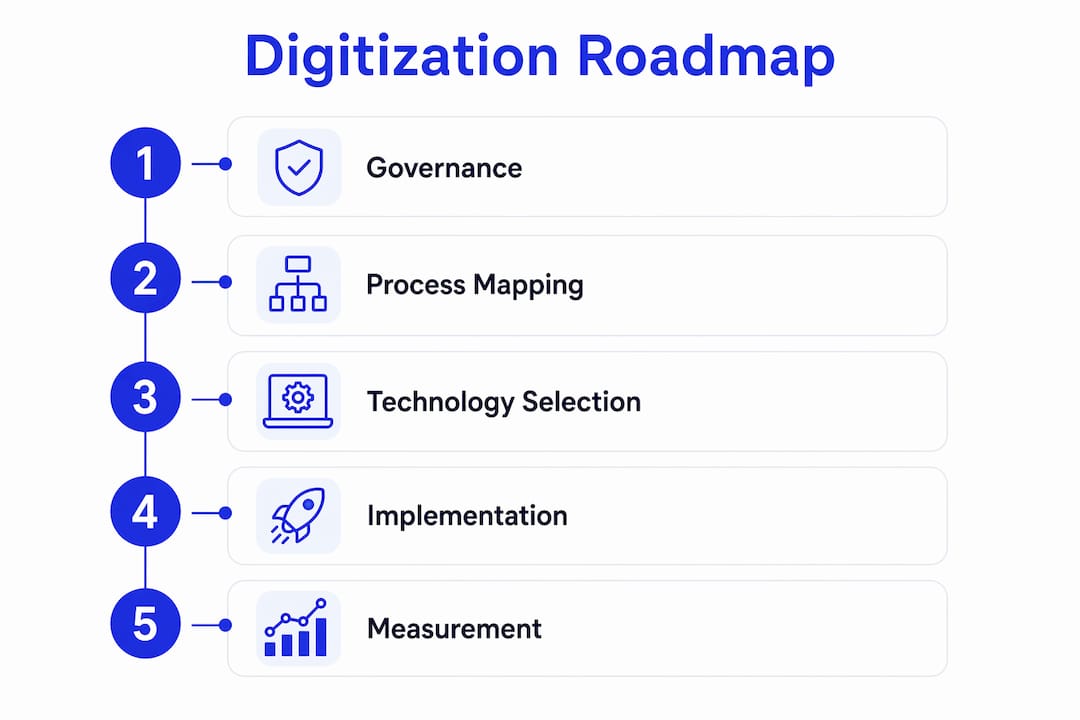
What does a step-by-step digitization roadmap look like?
The most common reason digitization projects stall is not technology. It is the absence of a structured rollout sequence. Here is a phased approach that works.
-
Assess your current state. Map every logistics process end-to-end: quoting, booking, tracking, documentation, invoicing, and financial reporting. Identify where manual steps, paper records, and data re-entry create the most friction and cost.
-
Define your use cases. Prioritize two or three high-friction, high-value processes for the pilot. Freight quoting automation, invoice reconciliation, and real-time shipment tracking are the most common first targets because they show measurable results quickly.
-
Evaluate data readiness. Before deploying any automation, audit your master data: carrier rates, customer records, cost codes, and financial references. Automating on dirty data accelerates existing errors rather than eliminating them.
-
Select your pilot platform. Choose a cloud TMS or automation tool that covers your pilot use cases natively, with open APIs for your accounting software and carrier connections. Avoid platforms that require bespoke middleware for basic integrations.
-
Run the pilot (3–6 months). Deploy in a controlled environment with a defined scope, a named internal sponsor, and baseline KPIs locked in before go-live. Measure weekly, not quarterly.
-
Iterate based on results. Use pilot data to refine workflows, address data quality gaps, and build the internal case for scaling. Document what changed in headcount time, error rates, and cycle times.
-
Scale across the organization (6–18 months). Expand the digitized workflows to additional lanes, offices, or business units. Integrate additional systems (WMS, customs platforms, accounting software) as the data foundation matures.
Timeline and cost considerations:
-
Pilot phase typically runs 3–6 months, with initial results visible within the first 60–90 days for process-level metrics.
-
Scale phase runs 6–18 months depending on integration complexity and organizational change readiness.
-
Cost structure splits between one-time implementation (data migration, integration setup, training) and recurring SaaS subscription fees. The integration tax, meaning the engineering effort to connect legacy systems, is consistently underestimated. Budget for it explicitly.
-
Data-cleaning effort is non-negotiable before advanced automation. Allocate dedicated sprint time before go-live, not after.
Governance matters from day one. Assign a named executive sponsor who owns the business outcome, not just the technology deployment. Establish a cross-functional steering group that includes operations, finance, IT, and commercial leadership. Lock in KPI baselines before the pilot starts so you can demonstrate ROI with data rather than anecdote.
What are the real implementation challenges, and how do you mitigate them?
Every digitization project encounters friction. The teams that succeed are the ones who anticipate it.
Common challenges:
-
Legacy system integration: Most U.S. freight forwarders run accounting software, carrier portals, and customs platforms that were not designed to connect. Each integration point carries an “integration tax,” meaning engineering time and ongoing maintenance cost.
-
Poor data quality: Rate tables with inconsistencies, customer records with duplicate entries, and cost codes that vary by office all create downstream automation failures. The data problem is usually larger than teams expect.
-
Cultural resistance: Staff who have built careers around manual processes often perceive automation as a threat rather than a tool. Without deliberate change management, adoption stalls even when the technology works.
-
Unclear ROI: Projects without pre-defined KPI baselines cannot demonstrate value, making it difficult to secure continued investment for the scale phase.
-
Vendor sprawl: Deploying multiple point solutions without an integration strategy creates new data silos that replicate the manual handoffs you were trying to eliminate.
Practical mitigation tactics:
-
Run phased pilots on contained, high-value processes before committing to enterprise-wide rollout.
-
Dedicate a data-cleaning sprint before go-live. Assign ownership of master data to a named individual, not a committee.
-
Redesign roles explicitly: shift staff from data entry to exception management and customer advisory. This reframing reduces resistance and creates genuine career development opportunities.
-
Build a training program that covers both the technology and the redesigned process. Tool training without process training produces low adoption.
-
Prefer platforms with native accounting connectors and built-in document automation over those requiring custom middleware. The reporting automation capabilities of a modern TMS should be evaluable during the demo, not promised in the roadmap.
Change-management checklist (modeled on adoption best practices):
-
Named executive sponsor with visible commitment
-
Clear communication of the “why” to all affected teams before go-live
-
Role-specific training delivered before, not after, deployment
-
A feedback channel for frontline staff to surface friction points
-
Weekly measurement against baseline KPIs in the first 90 days
-
Recognition of early adopters and quick wins to build momentum
Pro Tip: Before selecting any platform, map your current process in detail. If the process is broken, automating it will only make it break faster. Redesign the workflow first, then apply technology to the redesigned version.
How do you measure success: KPIs, ROI, and realistic timelines?
Measurement is where digitization projects either earn continued investment or lose it. The discipline is straightforward: define baselines before you start, track weekly in the pilot phase, and report against targets monthly during scale.
| KPI | Baseline guidance | Target range | Owner |
|---|---|---|---|
| Order-to-ship time | Measure current average in hours | Target significant reduction within 12 months | Operations |
| Invoice cycle time | Days from shipment close to invoice approval | Target meaningful reduction | Finance |
| Cost per shipment | Total ops cost divided by shipment volume | Target notable short-term cost reduction | Finance / Operations |
| On-time delivery rate | Current OTD percentage by lane | Aim for measurable improvement | Operations |
| Days Sales Outstanding (DSO) | Current average DSO in days | Target reduction in DSO | Finance |
McKinsey’s research on digital logistics investments reports short-term operational improvements of 10–20%, with larger gains of 20–40% achievable in some areas over two to four years when digital tools are integrated into operating models rather than deployed as standalone solutions.
A simple ROI calculation outline:
-
Cost savings from automation: Estimate hours saved per shipment multiplied by fully loaded labor cost, then multiply by annual shipment volume.
-
Reduced DSO value: Calculate the working capital benefit of reducing DSO by your target number of days, using your average accounts receivable balance.
-
Increased throughput: Estimate the revenue value of additional shipments your team can handle with the same headcount after automation.
-
Implementation cost: Sum one-time setup, data migration, integration engineering, and training costs plus first-year SaaS fees.
-
Time to payback: Divide total implementation cost by annualized savings. Most well-scoped pilots targeting invoice automation and tracking reach payback within 12–18 months.
Pro Tip: Use your finance team’s metrics as the primary ROI anchor. Finance-owned KPIs like DSO and invoice cycle time are harder to dispute than operational estimates and carry more weight in executive investment decisions.
Measurement cadence matters as much as the metrics themselves. Assign a single owner to each KPI, review operational metrics weekly during the pilot, and present a consolidated dashboard to the steering group monthly. Quarterly reviews without weekly data create blind spots that allow problems to compound before anyone notices.
What kinds of tools and vendor categories should you evaluate?
The vendor landscape for logistics digitization spans several distinct categories, each with a different scope, integration posture, and best-use case.
Entry-level field apps and point solutions These tools solve one specific problem: a standalone track-and-trace app, a document scanning tool, or a single-carrier booking portal. They are fast to deploy and low-cost, but they create data silos and require manual handoffs at every boundary. Appropriate for very small operations or as a temporary bridge, not as a foundation.
Modern cloud TMS platforms A cloud TMS covers the full freight forwarding workflow: rate management, booking, tracking, documentation, invoicing, and financial reporting in a single data model. The best platforms include native accounting connectors, automated document recognition, and agentic AI capabilities built into the core system rather than bolted on as add-ons. This is the foundational investment for most mid-market freight forwarders.
Specialist automation vendors RPA tools, OCR platforms, and standalone AI analytics products can augment an existing TMS but require integration work to connect to operational data. They are most valuable when a core TMS is already in place and specific high-volume processes need additional automation depth.
Freight marketplaces and carrier connectivity platforms These platforms focus on rate discovery and carrier booking rather than end-to-end operations management. They are useful for rate benchmarking and spot procurement but typically do not cover the financial and documentation workflows that drive operational efficiency.
Selection criteria checklist:
-
Native API connections to major accounting software (no custom middleware required)
-
Built-in OCR and automated invoice recognition
-
Agentic or workflow automation capabilities within the core platform
-
Open data model that allows export and integration without vendor lock-in
-
Demonstrated SLAs for uptime and support response times
-
Transparent pricing with no hidden integration fees
-
Vendor roadmap evidence of continued AI and automation investment
Integration posture is the most underweighted criterion in most RFPs. A platform that requires bespoke middleware to connect to your accounting software will cost more in year one and every year after than a platform with native connectors. During demos, ask vendors to show a live integration with your specific accounting software, not a slide deck about their API capabilities. The ocean freight and air freight workflows of a modern TMS should be demonstrable end-to-end in a single session.
What do analysts and practitioners say about the state of logistics digitization?
The ground is shifting beneath this industry, and the data is unambiguous about both the opportunity and the gap.
“Scaling AI across operational systems, especially transport management systems, warehouse management systems, and control towers, is more important than simply building standalone capabilities. Real value comes from embedding AI directly into systems where work happens. This requires redesigning workflows around AI, not bolting it onto unchanged processes.” — BCG, AI Is Already Moving the Logistics Industry Forward, 2026
BCG’s 2026 survey of logistics service providers found that only about 13% of providers have embedded AI into core operations at scale, while roughly 40% report deploying AI beyond pilots. The competitive gap between those two groups is already widening. Transport planning and execution leads AI adoption among logistics service providers, followed by tracking and visibility at notable levels.
The concept of an agentic TMS sits at the center of this shift. Rather than a dashboard that surfaces information for a human to act on, an agentic TMS assigns AI agents to specific operational workflows: rate management, exception handling, invoice reconciliation, shipment status updates. These agents make or recommend decisions autonomously within defined parameters, moving automation from the reporting layer into the operational core. FreightSuite is built on this architecture, with AI agent orchestration native to the platform rather than layered on top of a legacy data model.
MDPI research using multi-criteria analysis confirms that digital transformation impacts business performance through organizational capability and technological innovation together. Technology investment without organizational readiness consistently produces limited measured benefits. This is the practitioner warning that experienced implementation teams repeat most often: the technology is rarely the bottleneck.
The Wiley analysis of logistics digitization across infrastructure categories found that in road freight, 35–40% of companies have implemented TMS and related optimization technologies, while just half of customers are satisfied with their 3PL partners’ IT capabilities. That satisfaction gap is a commercial opportunity for logistics providers who move decisively.
The A1 Digital analysis of logistics digitalization reinforces a consistent practitioner finding: siloed point solutions without end-to-end networking create data exchange stalls and operational friction that can exceed the friction of the manual processes they replaced. The integration architecture decision made at the start of a digitization program determines whether the program delivers compounding returns or compounding maintenance costs.
Key Takeaways
Logistics process digitization delivers measurable gains in cost, speed, and cash flow only when digital tools are embedded into redesigned operational workflows, not layered onto broken manual processes.
| Point | Details |
|---|---|
| Start with high-friction processes | Target freight quoting, invoice reconciliation, and shipment tracking first for the fastest measurable ROI. |
| Foundation before advanced AI | Deploy a cloud TMS with native integrations before pursuing agentic or predictive analytics features. |
| Data quality is non-negotiable | Clean and standardize operational and financial data before go-live to avoid automating existing errors. |
| Change management drives adoption | Assign an executive sponsor, redesign roles explicitly, and measure KPI baselines before deployment starts. |
| Short-term gains are real | McKinsey reports 10–20% short-term operational improvements, with 20–40% achievable over two to four years. |
For implementation detail, the roadmap and KPI sections above give you the sequence and measurement framework to take this from planning to execution.
Useful sources and further reading
These are the primary sources that back the claims in this guide, along with a note on what each one supports.
-
McKinsey: Digital logistics Technology race gathers momentum — Supports the 10–20% short-term and 20–40% medium-term performance improvement ranges, and the case for foundational TMS/WMS investment before advanced analytics.
-
BCG: AI Is Already Moving the Logistics Industry Forward Source for the 13% embedded AI adoption figure, the 64% transport planning adoption rate, and the strategic case for embedding AI into operational systems rather than building standalone capabilities.
-
NetSuite: What Is Supply Chain Digitization? Supports the core definition of logistics process digitization and the role of OCR and RPA as high-value early automation targets.
-
MDPI: The Impact of Digital Transformation on the Business Performance of Logistics Enterprises Backs the organizational capability argument: technology investment without readiness consistently limits measured outcomes.
-
Wiley Online Library: The Digital Transformation of Logistics Source for the 35–40% TMS adoption rate in road freight and the 3PL customer satisfaction data.
-
A1 Digital: Digitalization of logistics Supports the integration architecture argument and the role of cloud, IoT, and digital platforms in a connected logistics stack.
-
Lengreo: Digital Transformation in Logistics Source for the digital logistics market growth forecast and the shift from proof-of-concept to embedded intelligence.
-
FreightSuite: AI-Native Freight Forwarding TMS For logistics teams ready to evaluate an agentic TMS with native rate management, air and ocean tracking, document automation, and AI agent orchestration, FreightSuite is built for exactly this transition.
-
Book a demo with FreightSuite If you are mapping your digitization roadmap and want to see how an agentic TMS fits your current stack, a product demo is the fastest way to pressure-test the architecture against your specific workflows.


