Don't Sign a TMS Without These 5 Security RFP Clauses
The minimum acceptable evidence from any TMS vendor is a current SOC 2 Type II report or CSA STAR Attestation, paired with an ISO 27001 certificate or a documented ISMS. Procurement should also request a recent independent penetration-test summary and proof of cyber insurance before a vendor advances past the shortlist. Confirm the identity of the auditor or certification body, then ask for direct access to the vendor’s Trust Center or a formal evidence bundle rather than a marketing deck.
TL;DR:
- Vendors should provide a current SOC 2 Type II report, ISO 27001 certificate, and if applicable, CSA STAR Level 2 validation, with documentation refreshed annually.
- Validation of certifications involves verifying accreditation, recertification dates, and scope of penetration tests, ensuring they cover the actual TMS environment.
- Certifications primarily address confidentiality, availability, and supply chain risks but do not guarantee system resilience during regional outages or operational readiness.
- A vendor’s evidence is only meaningful if it answers specific risk concerns, such as access controls, system uptime, disaster recovery, and subcontractor dependencies.
- Embedding explicit certification requirements into RFPs, including audit rights and incident notification timelines, improves the chances of obtaining genuinely secure vendor solutions.
Table of Contents
- Which TMS Security Certifications Actually Matter?
- What Evidence Should You Request, and How Do You Validate It?
- How Do Certifications Map to Your Actual Risk?
- How Often Should These Certifications Be Renewed?
- Building Certification Requirements Into Your RFP
- Where FreightSuite Stands on Security and Compliance
- Sources
- FAQ
Which TMS Security Certifications Actually Matter?
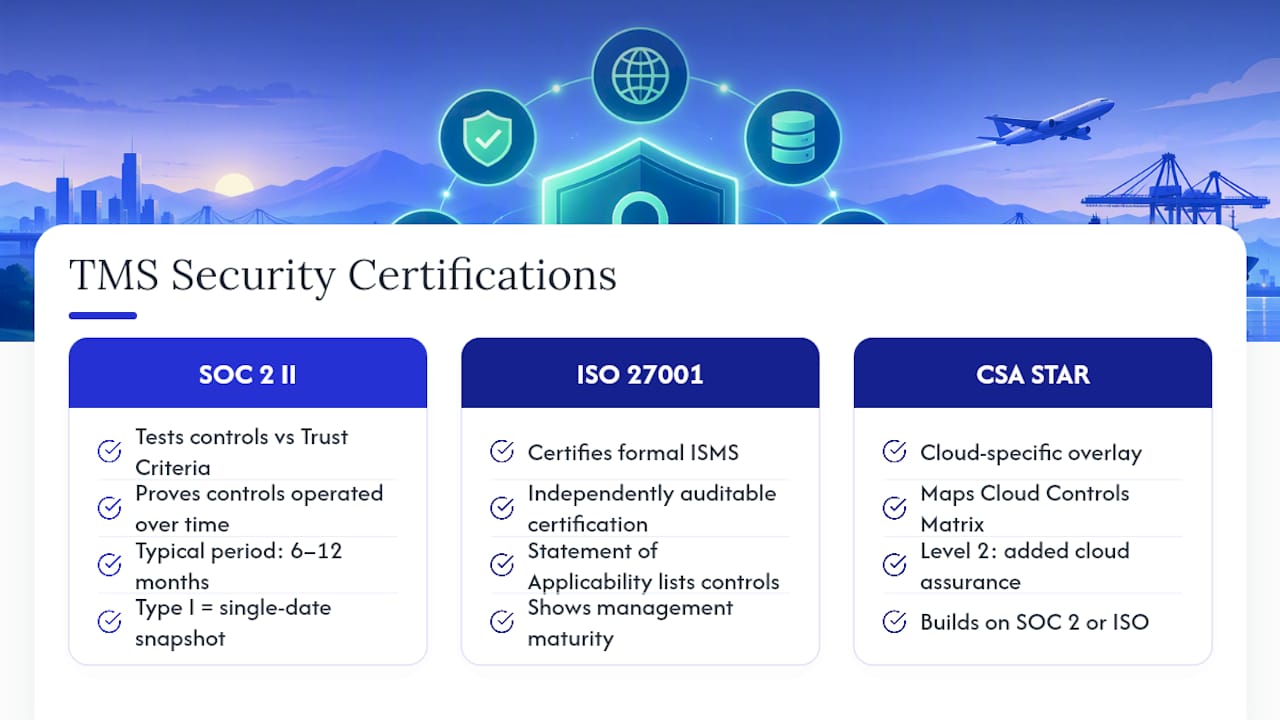
Three frameworks carry real weight when you evaluate a transport management system, and each proves something different. Confusing them, or accepting one as a substitute for another, is how procurement teams end up with paper compliance instead of actual protection.
SOC 2 Type II tests a vendor’s controls against the AICPA’s Trust Services Criteria, security, availability, processing integrity, confidentiality, and privacy, over a defined period, typically six to twelve months. That duration matters. A SOC 2 Type I report only confirms controls existed on a single date. Type II proves they operated consistently over time, which is why Outrider’s SOC 2 Type II audit for its autonomous yard platform required annual renewal, not a one-time badge.
ISO/IEC 27001 certifies that a vendor operates a formal Information Security Management System, and ISO’s own certification standard makes that certification independently verifiable rather than self-declared. The Statement of Applicability spells out exactly which of the standard’s controls the vendor applies and why others were excluded. Certification here shows management maturity, not a guarantee of specific technical defenses, so treat it as one input, not the whole answer.
CSA STAR overlays cloud-specific requirements from the Cloud Controls Matrix onto an existing SOC 2 or ISO 27001 program. CSA STAR Level 2 gives cloud-hosted platforms like a TMS an added layer of assurance without forcing a separate audit from scratch. For a supply-chain angle on the same principle, NIST’s SP 800-18r2 describes system security plans and cybersecurity supply chain risk management practices buyers can require to document how a vendor’s subcontractors and cloud dependencies are governed.
What Evidence Should You Request, and How Do You Validate It?
Move past the sales deck and ask for five specific documents before any contract discussion begins.
- The full SOC 2 Type II report, with the control period dates visible, not a summary letter.
- The ISO 27001 certificate along with its Statement of Applicability.
- A CSA STAR Level 2 Attestation or Certification, if the vendor claims cloud-specific assurance.
- The most recent penetration test report, or at minimum an executive summary with remediation status.
- A current certificate of cyber insurance naming coverage limits.
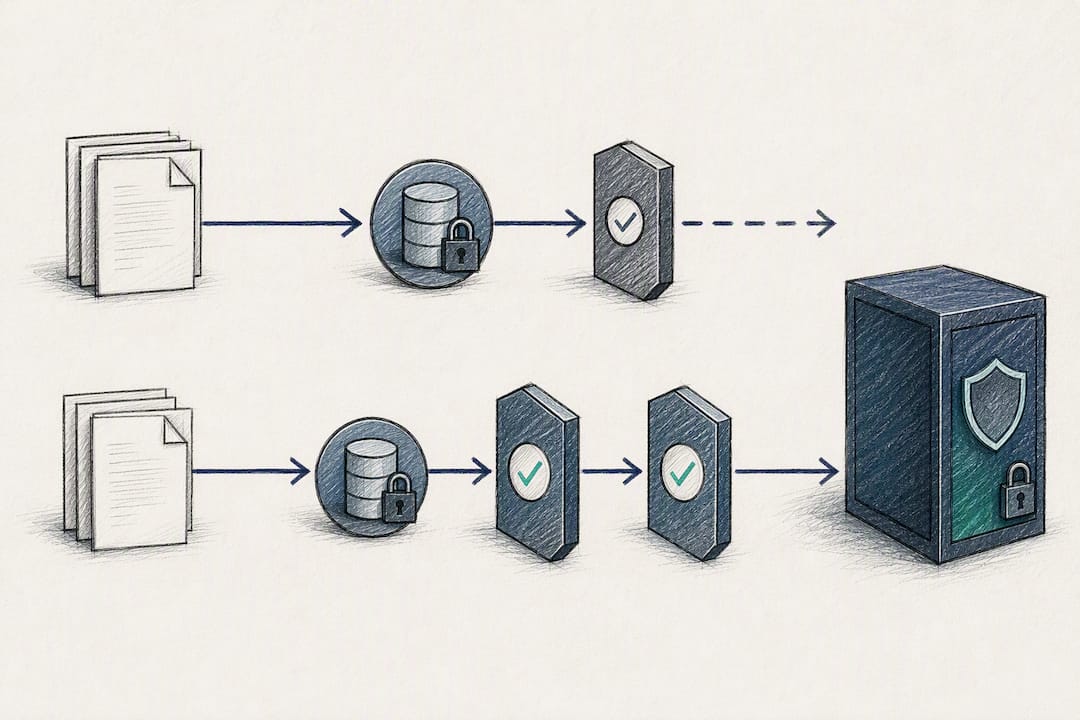
Validation is where most procurement teams stop too early. Confirm the auditing firm or certification body is actually accredited, not an obscure name that appears nowhere else. Check surveillance and recertification dates against the ISO cycle rather than assuming a certificate is still active. Verify the pen test’s scope, a test that only covered a marketing website tells you nothing about the TMS itself, and ask whether critical findings were remediated or just logged.
Industry guidance on vendor vetting warns that self-attested questionnaires without independent verification amount to security theater. Favor vendors that hand you restricted-use SOC 2 reports under NDA and commission third-party penetration tests, over vendors that answer every question themselves with no outside check.
Pro Tip: During the vendor demo call, ask them to pull up their Trust Center live and walk through the current report dates in real time. A vendor that hesitates or needs to “check with the compliance team” usually means the documentation isn’t as current as the sales page implies.
How Do Certifications Map to Your Actual Risk?
Certifications only matter if they answer the specific risk questions your business actually faces. Break the mapping into three areas before you score a vendor.
- Confidentiality and access control: SOC 2’s security criterion and ISO 27001’s Annex A controls should show logical access restrictions, role-based permissions, and monitoring logs, not just a policy statement.
- Availability and resilience: ask for uptime history, disaster recovery test results, and incident response timelines, since a certificate alone doesn’t confirm the system stays online during a regional outage.
- Supply-chain and subcontractor risk: NIST’s C-SCRM guidance in SP 800-18r2 gives you language to ask which cloud providers, freight-data integrations, and fourth parties the vendor depends on.
Third-party risk checklists built for freight and logistics buyers recommend weighing whether a vendor’s failure would disrupt your core shipment operations, not just whether they hold a certificate. That distinction separates process maturity from paper compliance: a vendor can be ISO certified and still lack the operational muscle to detect an incident quickly.
How Often Should These Certifications Be Renewed?
SOC 2 Type II reports typically cover a six to twelve month control period, and a report older than twelve months should raise questions about why a newer one hasn’t been issued. ISO 27001 runs on a three-year certification cycle, with surveillance audits required in years two and three to keep the certificate valid between full recertifications, according to ISO’s certification standard.
CSA STAR Level 2 slots neatly into either program rather than replacing it. Because STAR overlays the Cloud Controls Matrix onto existing SOC 2 or ISO evidence, a vendor running a combined program avoids duplicating audit work, and a mapped SOC 2 and ISO 27001 approach lets the same evidence satisfy multiple frameworks. Ask vendors whether they refresh evidence continuously through GRC automation or only scramble before each audit window, since the answer tells you how current their Trust Center actually stays between formal reports.
Building Certification Requirements Into Your RFP
Certification requirements only hold weight when they’re written into the contract, not just discussed on a call. Five clauses belong in every TMS RFP:
- Require a current SOC 2 Type II report or CSA STAR attestation, plus ISO 27001 certification, delivered before contract signature and refreshed on an annual cadence.
- Require disclosure of penetration test findings rated critical or high, along with remediation timelines.
- Include a contractual right to audit, with defined notice periods.
- Require subcontractor and cloud-dependency flow-down disclosure, consistent with NIST C-SCRM expectations.
- Set a maximum incident notification window, commonly 24 to 72 hours, and require proof of active cyber insurance at signing.
Where FreightSuite Stands on Security and Compliance
Most legacy TMS platforms bolt security on top of decades-old architecture. Some modern TMS platforms are built with automation, workflow controls, and AI agent orchestration native to the platform rather than layered in through third-party add-ons.

That matters for the exact evaluation process outlined above. Role-based access, operational workflows, and financial controls, the same areas SOC 2 and ISO 27001 are designed to test, run through the core FreightSuite platform instead of a patchwork of bolted-on modules. If you’re comparing certification evidence across vendors, ask FreightSuite for its current compliance artifact package alongside its ocean freight, air freight, and customs brokerage capabilities so your security review and your operational evaluation happen in the same conversation. Request a security-focused demo through FreightSuite and bring your RFP checklist. That’s the fastest way to see whether a vendor’s documentation matches what they actually run.
Sources
For deeper technical grounding, review NIST’s system security planning guidance, ISO’s official 27001 standard, and CSA’s STAR program overview. For operational context on how a TMS ties into broader risk decisions, see FreightSuite’s guide to risk management in logistics and TMS access controls. Supply-chain governance guidance from Herbi Labs adds useful buyer-side context.
- Do SOC 2 and ISO 27001 the right way with CSA STAR
- NIST SP 800-18r2
- Has vendor vetting become security theater?
- ISO/IEC 27001
- SOC 2 ISO 27001 joint certification: crosswalk guide
FAQ
What Is the Minimum Certification a TMS Vendor Should Have?
At minimum, request a current SOC 2 Type II report or CSA STAR Attestation, paired with ISO 27001 certification or a documented ISMS. Anything less leaves you relying on the vendor’s own word instead of independent verification.
Is ISO 27001 or SOC 2 More Important for a TMS?
Neither replaces the other because they measure different things. SOC 2 Type II verifies operational controls over time, while ISO 27001 certifies the management system governing those controls, and strong programs run both together.
How Often Should a SOC 2 Report Be Renewed?
SOC 2 Type II reports typically cover a six to twelve month control period and should be reissued annually. A report older than twelve months signals the vendor may not be maintaining continuous compliance.
What Does CSA STAR Add That SOC 2 Doesn’t?
CSA STAR layers cloud-specific control requirements from the Cloud Controls Matrix onto an existing SOC 2 or ISO 27001 program, giving cloud-hosted platforms added assurance for cloud infrastructure risks that general frameworks don’t specifically address.
Does FreightSuite Provide Security Documentation to Prospective Customers?
FreightSuite makes compliance artifacts available to procurement and security teams evaluating the platform. Reach out through FreightSuite to request the current documentation package or schedule a security-focused demo.

