Invoice Within 24 Hours to Cut DSO: Credit Control for Logistics Teams
Credit control in logistics is the discipline of setting terms, verifying creditworthiness, and collecting on freight invoices before service-contingent billing turns into cash-flow risk. Platforms such as transport management systems (TMS), credit bureaus, and trade credit insurers all play a role, but the single highest-impact move is pairing tiered credit terms with automated invoicing and dunning. Get that combination right and days sales outstanding falls fast.
TL;DR:
- Automated invoice generation within 24 hours of proof of delivery significantly reduces disputes and accelerates cash collection.
- Implementing tiered credit terms based on risk and routinely reviewing credit limits prevents overexposure to high-risk customers.
- Validating invoices against POD, weight, and rate documentation before sending minimizes long-term disputes and short-pays.
- Monitoring KPIs such as DSO, aging by band, recovery rates, and customer concentration helps identify systemic issues early.
- Integrating credit control into a unified TMS platform streamlines workflows and shortens the time between freight events and invoice payments.
Table of Contents
- What Credit Control Means Across Freight Forwarding and Warehousing
- Invoicing, Dunning, and the KPIs That Actually Predict Cash Flow
- Applying the Five Cs of Credit to Logistics Accounts
- Writing Credit Terms That Hold Up Under Pressure
- Where Automation Actually Moves the Needle
- What an Integrated Finance Platform Should Deliver
- FreightSuite: Credit Control Built Into the TMS, Not Bolted On
- Sources
- FAQ
What Credit Control Means Across Freight Forwarding and Warehousing
Logistics receivables behave differently than a typical B2B invoice; for more details, see our UK freight shipping guide. A retailer bills for goods already delivered. A freight forwarder often bills for a service that is still in motion, subject to weight discrepancies, customs delays, or a shipper disputing a fuel surcharge after the fact. That gap between “service performed” and “service confirmed” is where short-pays live, and it’s why logistics accounts receivable carries a structurally higher dispute rate than standard commercial AR.
Because of that, credit control in a forwarding or carrier business covers more ground than a finance team might expect walking in from another industry. The scope typically includes:
- Running credit checks and setting initial limits before onboarding a new shipper or consignee
- Assigning tiered terms based on risk, volume, and payment history
- Generating and validating invoices against proof of delivery, weight tickets, and rate confirmations
- Managing disputes and short-pays as a distinct workflow from standard collections
- Running a structured dunning cadence for overdue accounts
- Reporting DSO, aging, and recovery rate to operations and finance leadership
A credit controller in logistics needs fluency in Incoterms, HS codes, and carrier contracts, not just aging reports. A credit manager overseeing the function needs to sit close enough to operations to see disputes coming before they hit 60 days past due. Hiring managers building this team should look for candidates who have handled freight-specific documentation, not just generic collections experience.
Invoicing, Dunning, and the KPIs That Actually Predict Cash Flow
Pre-send invoice validation is the highest-leverage habit in the entire credit control process. Checking a freight invoice against the proof of delivery, the agreed rate, and the weight or volume documentation before it goes out catches the errors that would otherwise surface three weeks later as a dispute. Forwarders that build this check into their workflow see meaningfully fewer disputes and collect faster because there’s nothing to argue about after the fact.
Pro Tip: Invoice within 24 hours of proof of delivery. The correlation between invoice speed and payment speed is one of the most consistent patterns in logistics collections, and it costs nothing to fix beyond tightening your internal handoff.
A workable operational sequence looks like this:
- Validate the invoice against POD, weight, and contract terms before it’s sent.
- Send within 24 hours of delivery confirmation.
- Run an automated reminder at 7 days before due date, a second at the due date, and a firmer notice at 7 days past due.
- Escalate to a phone call or account manager involvement at 15 days past due.
- Route to a formal collections or legal process at 30 to 45 days past due, depending on account tier.
Short-pays need a separate lane entirely. The moment a customer pays less than invoiced, split the disputed line item from the undisputed balance and collect the undisputed portion immediately rather than letting the whole invoice sit in limbo. Resolving the disputed piece requires the same documentation set every time: proof of delivery, weight or volume verification, and the underlying rate agreement or contract clause being contested.
Four KPIs tell you whether the whole system is working: DSO, aging by band (current, 30, 60, 90+), recovery rate on disputed items, and customer concentration risk. Prioritize collections effort by cost-to-serve, not just balance size. An account with a small balance but frequent disputes can drain more staff time than a large, clean-paying account carrying ten times the exposure.
Applying the Five Cs of Credit to Logistics Accounts
The five Cs of credit, character, capacity, capital, collateral, and conditions, were built for lending, but they map onto freight customers with almost no translation needed. Character shows up in payment history and dispute frequency. Capacity shows up in shipping volume against the customer’s balance sheet. Capital is what reserves they carry to absorb a bad quarter. Collateral in logistics is often the freight itself or a personal guarantee on a new account. Conditions cover the contract terms, seasonality, and the broader freight market cycle the customer operates in.
Turning that framework into a working policy means building tiers, not a single blanket limit:
- Low risk: established accounts, clean payment history, Net 30 to Net 45, no prepayment required
- Medium risk: newer accounts or moderate volume, Net 15 to Net 30, partial deposit on large shipments
- High risk: new entities, thin credit files, or recent negative filings, prepayment or cash-on-delivery only
Review limits on a set cadence, quarterly for most accounts, but build in dynamic triggers too: a new UCC filing, a sudden spike in order volume that outpaces the account’s history, or a customer approaching your concentration cap should all force an off-cycle review regardless of where you are in the normal schedule.
None of this works without governance behind it. Basel Committee guidance on credit risk management and the OCC’s Comptroller’s Handbook were written for banks, but the underlying expectation, a documented risk-grading system, a management information system that tracks rating migration, and senior oversight of the whole process, scales down to a logistics credit desk just fine. If your exposure to any single customer or region is significant, a board or executive-level review of that concentration isn’t overkill. It’s what keeps a single bad account from becoming a liquidity event.
Writing Credit Terms That Hold Up Under Pressure
Vague terms are unenforceable terms. A policy that says “pay us reasonably promptly” gives a credit controller nothing to stand on when an account goes quiet. Specificity protects both sides.
Useful term structures to build into your contracts:
- Standard terms of Net 15, Net 30, or Net 45 depending on tier, with a clearly stated early-pay discount (commonly 1 to 2 percent for payment within 10 days) to pull cash forward
- A late fee, stated as a percentage per month, that applies automatically once an invoice crosses the due date
- Mandatory prepayment or deposit for new accounts and anyone flagged high risk under your tiering system
- Contract language requiring disputes to be filed in writing within a set window, commonly 5 to 10 business days, with the undisputed portion of the invoice due on the original schedule regardless of the dispute
Concentration policy deserves its own line in the contract review process. Capping any single customer at a defined share of total AR, 10 to 15 percent is a common threshold, forces the conversation about risk before that customer becomes too important to say no to. When a breach happens, the escalation should be automatic: a flag to the credit manager, a temporary limit freeze, and a review before any new business is extended.
Set a cadence for revisiting the whole policy, annually at minimum, with sign-off from finance leadership and operations. Terms that made sense two years ago rarely still fit a freight market that’s shifted since.
Where Automation Actually Moves the Needle
The gap between a spreadsheet-run credit desk and one built into an integrated TMS shows up fastest in how quickly an invoice goes out and how much evidence a controller can pull up during a dispute. Manual processes rely on someone remembering to check a proof of delivery folder. Integrated systems generate the invoice the moment POD lands, attach the supporting documents automatically, and log every touch for an audit trail.
The automations worth prioritizing, in rough order of impact:
- Immediate invoice generation triggered by proof of delivery, not a batch run at the end of the week
- Automated dunning sequences that fire on schedule without a person remembering to send them
- Risk scoring that updates as payment behavior changes, not just at annual review
- Exception routing that sends disputed line items to the right person automatically instead of sitting in a shared inbox
Trade credit insurance and external credit bureau feeds add another layer, shifting some risk off your own book and feeding outside data into your scoring model rather than relying solely on internal history. Neither replaces the internal discipline of pre-send validation and tiered limits. Both work better on top of it.
The role a TMS plays in this kind of risk management has grown as forwarders realize that finance and operations data need to live in the same system to be useful. A payment automation setup built separately from your operations platform tends to lag behind the freight events it’s supposed to track.
What an Integrated Finance Platform Should Deliver
An integrated TMS-finance platform earns its place in your stack by shortening the distance between a freight event and a resolved invoice. Look for billing automation that fires the moment proof of delivery is confirmed, a complete audit trail for every touch on a disputed invoice, and a dispute dossier that pulls POD, weight documentation, and contract terms into one place instead of scattering them across email threads.
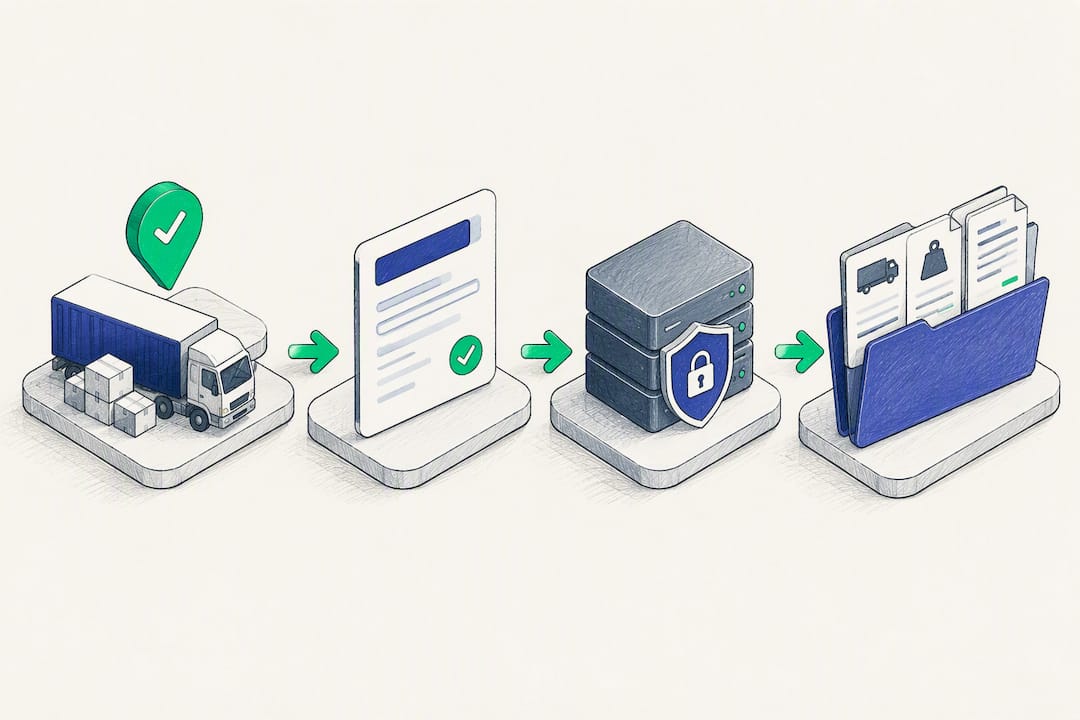
Real-time finance dashboards matter just as much as the automation itself. A credit manager who can see aging by band, concentration by customer, and dispute status without waiting on a weekly report can act on a problem while it’s still small. Dynamic FX and cost tracking round out the picture for forwarders running international lanes, where a currency swing can quietly erode margin on an account that looks perfectly healthy in local-currency terms.
FreightSuite: Credit Control Built Into the TMS, Not Bolted On
Most forwarders still run credit control on a patchwork of spreadsheets, email threads, and a finance system that talks to operations only when someone manually exports a file. FreightSuite is the alternative to that setup and to legacy TMS platforms alike: invoicing, dispute evidence, and finance dashboards live natively in the same system that tracks the shipment, so there’s no lag between a POD landing and an invoice going out the door.

Every core feature, rate management, air and ocean tracking, financial management, and credit control among them, comes included out of the box. There’s no add-on module to negotiate for later. That matters most for teams that have felt the drag of legacy systems where credit control was an afterthought bolted onto a shipment-tracking tool built for a different problem.
If your team is losing time chasing documentation for disputes or watching DSO creep because invoices sit in a queue, explore FreightSuite’s finance-team capabilities or see how it stacks up against the systems you’re already running on the CargoWise comparison page. A demo will show you exactly how fast a proof of delivery can turn into cash in hand.
Sources
- 5 Cs of credit: a complete guide | HighRadius
- Principles for the management of credit risk | Basel Committee / BIS
- Rating credit risk | Comptroller’s Handbook (OCC)
- Freehand
- How to manage credit risk: 7 business credit management tips | FreightAmigo
FAQ
Is Credit Control a legitimate debt collector?
Credit Control, LLC is a legitimate third-party collections agency, separate from the credit control function described in this article, which refers to the internal process logistics companies use to manage invoicing and collections on their own accounts. If you’re receiving calls from a company by that name, it’s worth verifying the debt directly with the original creditor.
Who does a collections agency like this collect for?
Third-party agencies typically collect on behalf of original creditors, ranging from telecom and utility companies to healthcare providers and retail lenders, once an account has gone unpaid long enough to be placed for outside collection. In logistics, most collections stay internal to the credit control team rather than being outsourced, at least until an account is severely delinquent.
How much do credit controllers get paid?
Pay varies by region, seniority, and company size, and no single figure applies across the industry. Logistics-specific credit controller roles tend to command a premium over generic AR roles because of the added complexity around disputes, documentation, and freight terminology.
Why would a collections company be calling me?
A collections call usually means an account tied to your name or business has an unpaid balance that was referred to a third-party agency after internal collection attempts failed. In a logistics context, this is exactly the outcome a strong credit control process, tiered terms, pre-send invoice validation, and automated dunning, is designed to prevent before it ever reaches that stage.
What’s the fastest way to lower DSO in a freight business?
Invoicing within 24 hours of proof of delivery and running an automated dunning cadence are the two changes that move DSO fastest, according to industry guidance on credit risk management. Some modern transport management systems build both directly into the invoicing workflow so neither depends on someone remembering to act.

