Logistics Managers: Identity-Driven Carrier Onboarding in 1–2 Days
Correct carrier onboarding logistics delivers one outcome above all others: a broker-ready carrier packet with verified authority, active insurance, and identity details that match across every document. The non-negotiable checks are FMCSA authority status, a certificate of insurance confirmed directly with the insurer, and a W-9 identity match. Expect verification to move quickly once paperwork is complete, but treat onboarding as the start of monitoring, not the end of it.
TL;DR:
- Speed of onboarding depends on completing verification tasks within one to two business days, but delays from insurers or missing details can extend this period.
- Verifying insurance coverage directly with the insurer is essential, as COIs are only valid on the issue date and may be expired or mismatched.
- Matching identity signals across FMCSA records, W-9 forms, and the carrier’s online presence is the most reliable fraud indicator, especially with recent FMCSA rule changes.
- Risk scoring should combine factors like authority age, safety data, and identity consistency and should automatically block activation if signals do not align.
- Automating record keeping and monitoring with a TMS platform improves onboarding efficiency, reduces manual work, and ensures ongoing oversight.
Table of Contents
- Step-by-step carrier onboarding workflow your team can run today
- What a complete carrier packet contains and how to validate each document
- Identity, fraud and risk controls to include in onboarding
- Timelines, SLAs and KPIs: what to measure and target for fast, safe onboarding
- How to store, audit and use onboarding records
- How FreightSuite helps automate onboarding: demo and next steps
- FAQ
- Sources
Step-by-step carrier onboarding workflow your team can run today
A workflow with clear owners and decision gates keeps onboarding fast without opening the door to fraud. Each stage should move a carrier from an open application to an activated, bookable profile with a traceable record of every check performed along the way.
- Collect the carrier application and immediately pull the FMCSA profile to confirm USDOT and MC numbers, legal name, and authority status.
- Create a pending carrier record in your TMS with structured fields for every packet item, rather than a loose folder of attachments.
- Assign document verification tasks for the W-9, certificate of insurance, broker-carrier agreement, and equipment details to a named reviewer.
- Run finance tasks in parallel: payment setup, factoring notice confirmation, and credit checks when the lane or volume warrants them.
- Score risk by combining identity consistency, authority age, safety data, and COI quality into a single pass or fail gate.
- Approve and activate the carrier under an SLA-driven notification, with controls on the first load tendered.
- Enroll the carrier in 90-day post-activation monitoring rather than treating approval as a final step.
The gate structure matters more than the sequence. A carrier can clear every document check and still fail the risk score if identity signals do not line up, and that single gate should block activation regardless of how clean the paperwork looks on its face.
- Pending carriers wait in a queue until all packet fields are populated and reviewed.
- Finance and compliance tasks run concurrently, not sequentially, to avoid stacking delays.
- A single owner signs off on activation so accountability is never split across teams.
Pro Tip: Build your risk score as a weighted checklist inside the TMS record itself, so the approval decision and the evidence behind it live in the same place an auditor would look.
What a complete carrier packet contains and how to validate each document
A complete carrier packet includes FMCSA registration, legal name and any DBA, a W-9, a certificate of insurance, a signed broker-carrier agreement, payment instructions, safety data, and equipment or commodity qualifications. Brokers use this file as the sole basis for the approval decision, so gaps or inconsistencies anywhere in it should pause the process.
- Confirm authority and safety history through FMCSA Licensing and Insurance records rather than relying on a screenshot the carrier supplies.
- Verify the certificate of insurance by contacting the insurer or producer directly, since a COI is only evidence of coverage as of its issue date.
- Match the W-9 name and taxpayer ID to the legal entity on file, flagging any variation for manual review.
- Confirm payment instructions against a voided check or ACH form before the first invoice is scheduled.
A certificate of insurance is evidence of coverage only on the date it was issued, and best practice calls for verifying it directly with the insurer or producer rather than accepting a forwarded PDF at face value. The most common packet problems are expired COIs, mismatched legal names or addresses, missing cargo endorsements, and last-minute payment changes tied to a factoring company, and each one is faster to catch with a direct insurer call than with a document review alone.
Identity, fraud and risk controls to include in onboarding
Identity consistency across FMCSA records, the W-9, the COI, and the carrier’s web presence is the strongest single indicator of a legitimate operation, and it is the control that catches fraud earlier than any document review. FMCSA’s identity and address rule changes have increased traceability for new applicants at the same time cargo theft tactics have grown more sophisticated, which makes identity-driven onboarding a frontline defense rather than a compliance formality.
- Watch for virtual office addresses, newly registered throwaway email domains, and banking details that do not match the named entity.
- Treat refusal to provide a direct insurer or producer contact as a disqualifying red flag, not a minor inconvenience.
- Confirm USDOT number placement on the physical fleet when a site or yard visit is possible, since mismatched or missing markings often accompany other identity problems.
Technical controls worth building into your stack include insurer-originated COIs, API-based insurance verification where available, and VIN or equipment checks against the application. Operational controls matter just as much: set minimum eligibility rules by authority age, layer your gates so no single check can clear a carrier alone, and maintain a broker eligibility tracker that records setup status per carrier so reviewers are not reconstructing history from memory.
FMCSA’s modernized checks have opened safer access to some new-authority carriers while still requiring brokers to maintain continuous monitoring rather than a single one-time check.
Pro Tip: Keep a standing list of insurer and producer phone numbers tied to your active carrier base, so a verification call takes minutes instead of becoming its own research project.
Timelines, SLAs and KPIs: what to measure and target for fast, safe onboarding
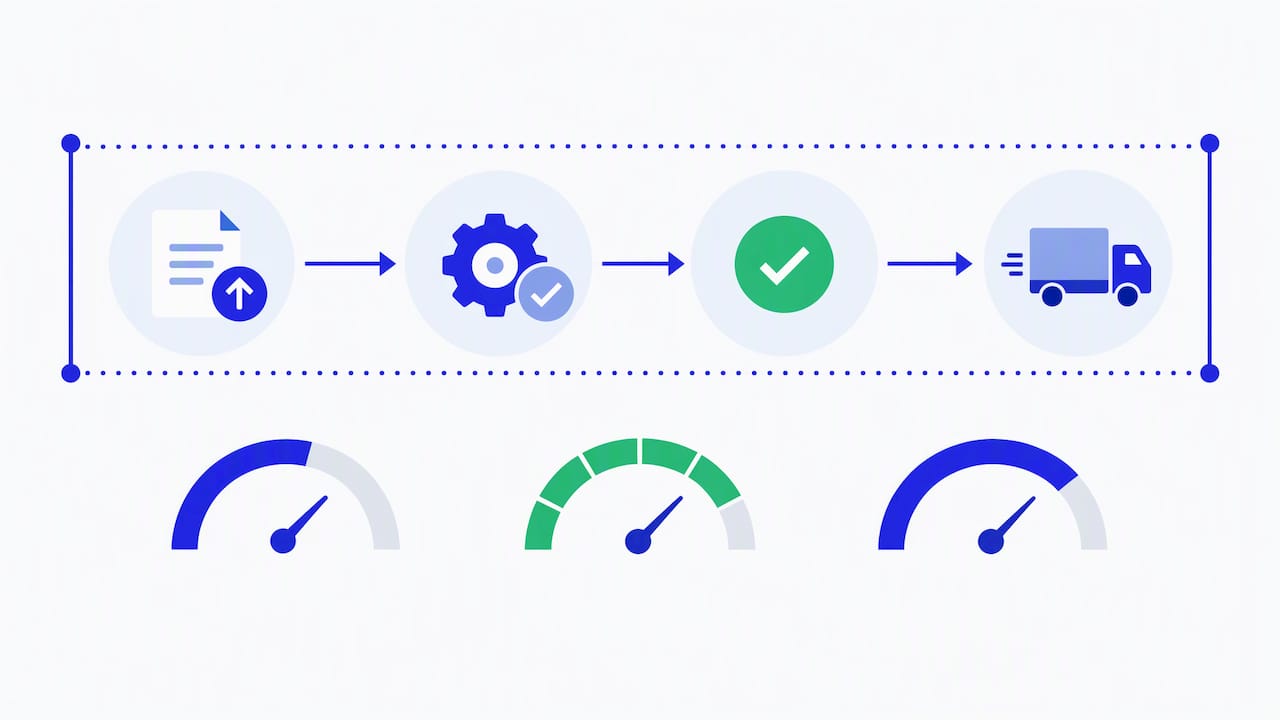
Document verification often completes within 1 to 2 business days once all paperwork is in hand and authority, insurance, and safety records are active and consistent. Dependencies such as a slow insurer response or missing banking details can extend that window considerably, so SLA targets need to account for the gap between “documents submitted” and “documents verifiable.”
Industry platforms have begun publishing formal carrier onboarding service level agreements to commit to predictable go-live timing, a sign that buyers increasingly expect onboarding speed to be measured, not assumed.
- Track time-to-approve and the share of carriers live within 30 days of first application.
- Track the share of packets completed within a few days once all documents are provided.
- Track rejection rate tied specifically to identity or fraud flags, separate from routine paperwork gaps.
| KPI | What it tells you |
|---|---|
| Time-to-approve | How fast your team clears a clean packet |
| Rejection rate (identity/fraud) | How often red flags stop an application |
| COI expiry coverage | Share of active carriers with current insurance on file |
| Onboarding backlog | Carriers waiting on a pending task or reviewer |
How to store, audit and use onboarding records
A dated, tamper-evident audit trail of every verification step matters most when a claim or legal dispute forces you to reconstruct exactly what was checked and when. A TMS that enforces structured carrier-packet fields and timestamps each review shortens that reconstruction from days to minutes, which is also where a well-built audit trail earns its keep in dispute resolution.
Your carrier record should expose searchable fields for authority status, insurance effective and expiry dates, the bank payee name, and verifier notes, rather than burying that information in attached PDFs.
- Set automated reminders ahead of every COI expiry date rather than discovering a lapse after a claim.
- Require insurer-sent COIs as a standing policy, not an exception for high-risk carriers.
- Auto-verify FMCSA status on a recurring schedule for every active carrier, not just at onboarding.
- Run lane-level carrier scorecards for the first 90 days to catch early deviations in tracking or claims.
- Compile a monthly onboarding summary covering approvals, rejections by reason, and open backlog for compliance and operations review.
- Keep that summary format consistent month to month so trend lines are visible without rebuilding the report.
How FreightSuite helps automate onboarding: demo and next steps

We built FreightSuite to take the manual weight out of carrier onboarding: centralized carrier records, automated COI expiry reminders, workflow-driven approval gates, and lane-level scorecards all run natively, without stacking on separate add-ons. That matters most for teams trying to cut onboarding time without loosening the identity and insurance checks that keep fraud out of the network.
- Centralize every packet field and audit note in one carrier record instead of scattered folders.
- Automate COI reminders and FMCSA status checks so monitoring continues past activation.
- Compare onboarding SLA performance before and after automation on a single pilot lane.
If your team is evaluating a TMS for carrier onboarding, start with our Road Freight Transport Management page or request a demo to pilot the workflow on one lane before rolling it out network-wide.
FAQ
What is carrier onboarding?
Carrier onboarding is the process of collecting, verifying, and approving a carrier’s documentation (FMCSA authority, insurance, W-9, and a signed broker-carrier agreement) before tendering freight. It ends with an activated carrier record and typically continues into ongoing monitoring rather than stopping at approval.
What is carrier logistics?
Carrier logistics refers to the operational and compliance work brokers and shippers perform to vet, manage, and move freight through qualified carriers. It spans onboarding, dispatch, tracking, payment, and compliance monitoring across a transportation network.
Who owns Carrier Logistics Inc.?
Ownership details for a company by that name are not publicly listed in the sources reviewed for this article. Readers researching a specific company should check that company’s own public filings or press materials directly.
How do I set up as a new carrier with a broker?
Setup generally starts by submitting an application along with your FMCSA authority details, a current certificate of insurance, a completed W-9, and signed broker-carrier agreement. Each broker applies its own eligibility rules, such as minimum authority age or insurance limits, so confirming those requirements upfront speeds approval.

