Standards First Sailing Schedule Integration for Logistics Engineers
Sailing schedule integration normalizes carrier timetable data into standardized ETA events that drive inventory planning, exception alerts, and rebooking workflows. Done well, it replaces manual date-checking with automated triggers that fire when a vessel’s estimated arrival shifts. The approach that works relies on the DCSA Commercial Schedules standard, and TMS platforms already build this normalization into their operational layer.
TL;DR:
- Integrating sailing schedules requires consuming specific schedule types—point-to-point, port, or vessel—based on operational needs to avoid conflating data.
- Normalized schedule feeds improve on-time delivery visibility and rebooking speed, especially considering persistent disruptions like rerouting and congestion.
- DCSA Commercial Schedules is the preferred standard, supported by conformance tools, with carrier APIs as richer but maintenance-heavy alternatives, and EDI 862 as a fallback.
- Building robust schema mapping around UN/LOCODE, vessel IMO, voyage numbers, and timestamps is essential to prevent integration failures.
- Implementing version control, exception handling, and downstream workflows ensures ETA changes, port skips, and reroutes trigger appropriate operational and customer actions.
Table of Contents
- What sailing schedules are and the three types you need to model
- Why integrate sailing schedules into logistics systems
- Standards and feeds: DCSA, EDI 862, and carrier APIs
- Data model and mapping essentials for useful schedule integration
- Implementation checklist and conformance testing before going live
- Handling updates, versions, exceptions, and downstream workflows
- Practical architecture patterns and how FreightSuite applies schedule integration
- How FreightSuite helps accelerate sailing schedule integration
- Sources
- FAQ
What sailing schedules are and the three types you need to model
A sailing schedule is not one data object. DCSA’s standard defines three distinct types, and conflating them is the first mistake most integration teams make.
- Point-to-point schedules show routing options between an origin and destination port, used by planners comparing transit times across carriers.
- Port schedules list every vessel call at a given port, used by terminal and operations teams managing berth windows.
- Vessel schedules track a single vessel’s full rotation across ports, used by tracking systems that follow one voyage end to end.
A single transpacific voyage might appear as one leg in a point-to-point search, one call in a port schedule at Busan, and one stop among a dozen in that vessel’s full rotation. Your integration needs to consume whichever type matches the job a downstream team is actually trying to do, not whichever feed was easiest to connect first.
Why integrate sailing schedules into logistics systems
Schedule data only earns its keep when it drives action rather than sitting on a dashboard. Normalized feeds let inventory planners hold or release stock based on real ETA shifts instead of static booking dates, and they let customer-facing teams push proactive delay notices instead of fielding “where is my shipment” calls.
The stakes are higher than most planning teams assume. Ocean carrier schedules face persistent disruption, according to UNCTAD’s 2025 Review of Maritime Transport, which points to rerouting, skipped port calls, and congestion as recurring causes of unreliability, and recommends digitalization and better data transparency as the fix. That is the case for building exception handling into the integration from day one, not bolting it on later.
Integration done this way moves several KPIs that matter to supply chain leadership:
- On-time delivery visibility improves because ETA changes reach planners before the cargo physically arrives late.
- Rebooking turnaround shortens because the system flags missed connections automatically instead of waiting for a customer complaint.
- Manual data entry drops because schedule lookups stop requiring a person to check a carrier portal by hand.
Standards and feeds: DCSA, EDI 862, and carrier APIs
Three mechanisms dominate schedule data today, and they are not interchangeable.
DCSA Commercial Schedules is the modern standard, built around REST endpoints for point-to-point, port, and vessel schedules. It gives commercial consumers, meaning forwarders, shippers, and software vendors, consistent field names and query parameters across participating carriers, which matters enormously when you are integrating more than one line.
EDI 862, the shipping schedule and delivery schedule transaction set, is still used in some legacy trading relationships, particularly where a trading partner has not modernized. Treat it as a fallback for specific partners rather than a primary design choice for new builds.
Carrier proprietary APIs sit in between. They can offer richer or faster data than a standards-based feed, but every carrier’s API behaves differently, which multiplies your maintenance burden as you add lines. A practical prioritization:
- Default to DCSA endpoints wherever the carrier supports them, since conformance tooling and consistent schemas reduce long-term maintenance.
- Fall back to carrier APIs only when a specific carrier lacks DCSA support or when you need a field DCSA does not expose.
- Keep EDI 862 alive only for partners who require it contractually.
DCSA also publishes conformance tooling and implementation guidance that is worth running against any new feed before it reaches production.
Data model and mapping essentials for useful schedule integration
Raw schedule data is close to useless until it is mapped into a consistent internal model. Build your schema around these fields:
- UN/LOCODE for every origin, destination, and transshipment port, never free-text port names.
- Vessel IMO number, which uniquely identifies the vessel regardless of name changes.
- Carrier voyage number and service code, which together identify the specific sailing.
- Leg sequence, so multi-leg routings reconstruct correctly in order.
- Planned and estimated timestamps, kept as separate fields rather than collapsed into one date.
- Cut-off types (documentation, cargo, VGM) mapped to your internal SLA triggers.
- Timezone, normalized to UTC at ingestion so downstream comparisons never drift.
- Routing reference, which DCSA’s 1.0.3 update added to link a booking back to the routing it was quoted against, without forcing a rekey.
Three mapping pitfalls account for most integration failures: port name variants that defeat simple string matching (always resolve to UN/LOCODE instead), silently missing fields when a carrier’s response omits an optional property, and unhandled pagination that causes voyages at the end of a result set to disappear. Build defensive parsing for all three before your first production feed goes live.
Pro Tip: Store the source timestamp and retrieval timestamp separately from the schedule’s own planned and estimated dates. When a customer disputes an ETA later, you will need to prove exactly what the carrier said and when.
Implementation checklist and conformance testing before going live
A sailing schedule integration should pass a defined set of checks before it touches production inventory decisions. Work through this sequence:
- Verify identifier mapping end to end, confirming UN/LOCODEs, IMO numbers, and voyage numbers resolve correctly against your internal reference data.
- Confirm timezone handling by testing a port in a different timezone than your home system and checking the converted ETA matches the carrier’s published local time.
- Test pagination behavior explicitly, including the edge case where a voyage spans multiple result pages.
- Check empty-result and malformed-response behavior so a feed outage fails loudly instead of silently returning stale data.
- Confirm update frequency and backfill windows so you know how far back a feed will return changes after an outage.
- Run DCSA’s conformance tool against any new carrier connection, and repeat it periodically, since carriers do update their implementations.
- Validate split voyages and transshipment cases specifically, since these are where most schedule parsers break.
- Add throttling, retry with backoff, source attribution on every record, and audit logging before granting the feed write access to inventory systems.
Skipping the conformance step is the most common shortcut teams regret, since a feed that worked in testing can drift out of spec after a carrier pushes an update.
Handling updates, versions, exceptions, and downstream workflows
Treat every schedule record as versioned operational data, not a one-time lookup. Retain the source timestamp, the retrieval time, and a schedule version identifier on every stored record, so a later ETA change can be reconciled against exactly what was known at booking time.
Specific event types need specific downstream behavior:
- An ETA change beyond a defined threshold should trigger an inventory hold review and a customer alert, not just a database update.
- A skipped port call should automatically move affected bookings into a rebooking queue for manual or automated reassignment.
- A reroute should refresh the full voyage leg sequence rather than patching a single field, since downstream systems may be relying on the old sequence.
Guard customer-facing ETAs by never pushing a carrier’s raw estimate straight to a customer portal. Apply your own buffer logic first, since UNCTAD’s reliability data makes clear that published estimates shift often enough to warrant caution.
Practical architecture patterns and how FreightSuite applies schedule integration
A workable architecture has four components with clearly separated responsibilities: a consumer client that pulls from DCSA endpoints or carrier APIs, a normalizer that maps every response into your canonical schema, a cache that holds the current known state per voyage, and an event bus that publishes ETA-change, reroute, and skipped-call events to downstream consumers.
- The consumer client handles authentication, pagination, and rate limits specific to each source.
- The normalizer applies the field mapping and timezone rules described earlier, regardless of which source the data came from.
- The event bus is what actually lets inventory, customer notification, and rebooking systems react without each one building its own polling logic.
Some logistics platforms apply exactly this pattern inside their ocean freight modules, pairing carrier feed consumption with AI agent orchestration so ETA changes route directly into operational workflows instead of sitting in a log file.
Pro Tip: Start a pilot with one DCSA endpoint or one carrier API, build the normalizer and event bus around it, then expand to additional carriers once the pattern is proven.
How FreightSuite helps accelerate sailing schedule integration

Building this architecture from scratch takes real developer time: a consumer client, a normalizer, a cache, and an event bus, each needing its own testing and maintenance as carriers update their feeds. Certain platforms remove that build cycle by shipping ocean and air tracking, rate management, and AI agent orchestration natively, so schedule data flows into inventory and exception workflows without a custom integration project. For background on how logistics API integration work typically unfolds for engineering teams, see this technical breakdown.
If your team already manages carrier relationships through a broker or network partner, resources like Worldwide Express’s ocean transportation overview are useful for understanding the carrier side of the equation.
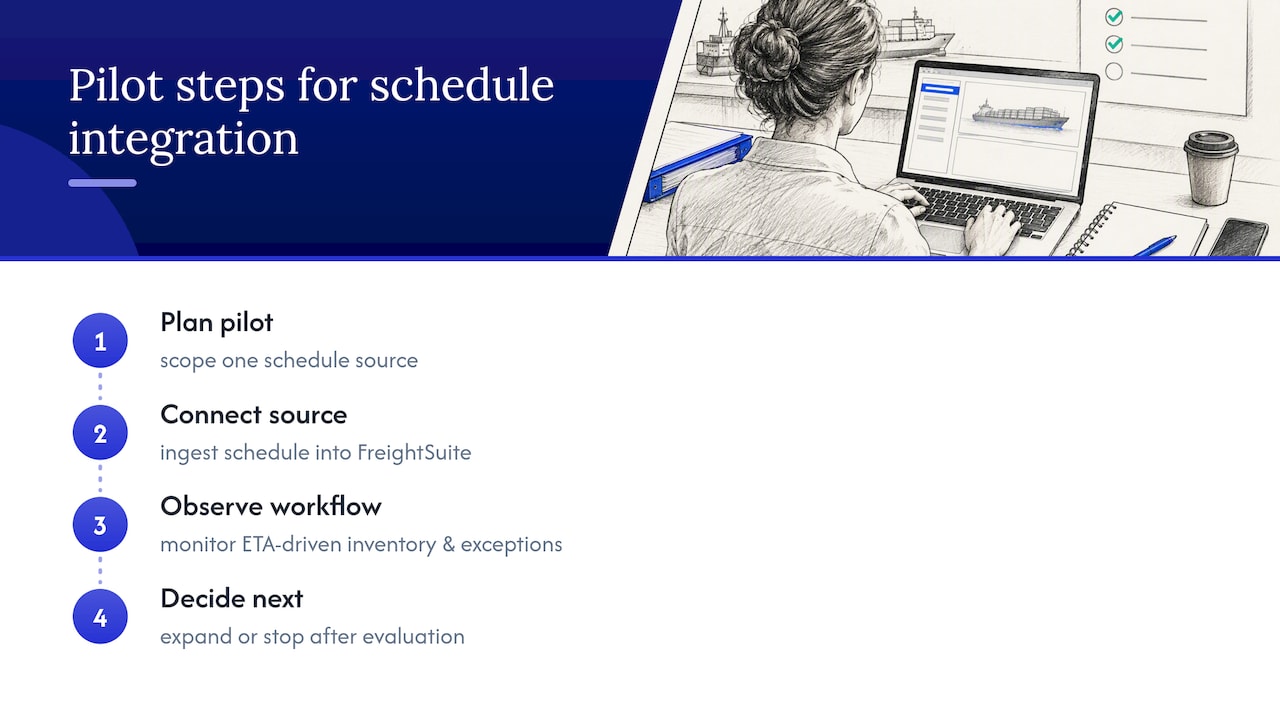
The practical next step is a focused pilot: connect one schedule source, watch how FreightSuite’s ocean freight capabilities handle the ETA-driven workflow, then decide whether to expand. Visit FreightSuite to book a demo and scope that first pilot.
Sources
- Commercial Schedule 1.0 - Introduction
- Implementing the DCSA Commercial Schedules Standard
- Stormy seas for global shipping: UNCTAD warns of uncertainty, volatility and rising costs
FAQ
What is a sailing schedule?
A sailing schedule is carrier-published data showing when a vessel calls at a port and when it departs, represented by DCSA as one of three types: point-to-point, port, or vessel schedules. Each type serves a different operational need, from route comparison to full voyage tracking.
What is vessel scheduling?
Vessel scheduling refers to planning and publishing a ship’s full rotation of port calls across a voyage, including estimated arrival and departure times at each stop. In DCSA’s framework, this is specifically the vessel schedule type, distinct from port-level or point-to-point views.
What is a shipment schedule?
A shipment schedule typically refers to the planned timeline for a specific booking or cargo movement, derived from the underlying vessel or point-to-point schedule plus cut-off dates. It is the operational layer that logistics teams build on top of raw carrier schedule data to manage a single shipment’s lifecycle.

