Why Automation Reduces Freight Errors: A 2026 Guide
.png)
Automation reduces freight errors because it removes the single most unpredictable variable in any logistics operation: human judgment applied to repetitive, rule-based tasks. When a system executes the same validation sequence on every bill of lading, every rate confirmation, and every customs document, the error rate drops not because people are trying harder but because the conditions that produce errors no longer exist. AI-driven automation removes human variability, creating systemic predictability and turning invisible failures into visible, actionable exceptions.
The mechanism is straightforward. Automated workflows enforce pre-flight validation checks before any data moves downstream, catching typos, mismatched container numbers, and missing HS codes at the point of entry rather than at the point of consequence. Every action is logged with a timestamp and full context, so when something does go wrong, the audit trail makes it traceable in seconds rather than hours. Exception routing means anomalies escalate immediately to the right person, with the right context, before they compound into customs delays or freight claims.
Pro Tip: Set validation and confidence thresholds deliberately. A threshold calibrated too conservatively generates more review tasks than it eliminates; set too loosely, financially significant exceptions reach customers without a human check. The right calibration is a judgment call with a direct financial consequence in both directions.
Table of Contents
- Why automation reduces freight errors across your operations
- What automation actually does inside a freight forwarding workflow
- How automation cuts costs by reducing errors and speeding up processing
- How to implement automation in your freight operations
- How FreightSuite’s AI-native TMS reduces freight errors
- Key Takeaways
- FreightSuite gives freight forwarders a faster path to error-free operations
Why automation reduces freight errors across your operations
The core value of automation in freight forwarding goes well beyond catching the occasional typo. When you replace manual workflows with rule-governed systems, the benefits compound across every function your team touches.
- Accuracy and consistency. Automated systems apply the same rules to every transaction, every time. There is no variation by shift, fatigue level, or workload pressure.
- Time savings. AI document automation scans, validates, and routes freight data at speeds no manual team can match, cutting document throughput times dramatically.
- Reduced operational costs. Fewer errors mean less rework, fewer penalties, and fewer freight claims eating into margins.
- Compliance confidence. Automated validation against contracted rates, HS codes, and regulatory requirements catches compliance gaps before shipments depart, not after customs flags them.
- Staff productivity. AI automation reduces cognitive load by 80–90% on routine tasks, freeing your team to focus on exceptions and strategic decisions rather than data entry.
- Customer satisfaction. Fewer shipment errors and faster processing translate directly into fewer customer escalations and stronger retention.
The ground is shifting beneath this industry. Shippers expect response times measured in minutes, and forwarders who can deliver that speed without sacrificing accuracy are the ones capturing market share.
What automation actually does inside a freight forwarding workflow
Understanding the specific technologies at work clarifies why the error reduction is so consistent and why legacy manual processes cannot replicate it.
- AI-driven document scanning. OCR, NLP, and machine learning work together to extract and classify data from bills of lading, commercial invoices, proofs of delivery, and cargo manifests. The system reads both typed and handwritten text, adapts to different carrier document formats, and improves its own accuracy over time through continuous learning.
- Automated validation against master data. Once data is extracted, the system cross-checks it against your TMS and ERP master records. A mismatch in container weight, a vessel name typo, or an unauthorized accessorial charge gets flagged immediately, before it propagates downstream.
- Rule-based workflows. Booking confirmations, rate calculations, invoice auditing, and compliance checks all run against encoded business rules. AI agents enforce these procedures every single time, with no informal variation and no undocumented edge-case handling.
- Real-time exception routing. When an anomaly is detected, it routes to the right team member in seconds, with full context already assembled. The right person receives the right information at the right moment, not the next time someone opens a queue.
- System integration. Connecting your TMS, ERP, and carrier portals eliminates the manual rekeying that happens between fragmented systems. Data moves directly from source documents into downstream systems without a human transcription layer.
- Adaptive algorithms. Machine learning models train on your specific document formats and business rules, so exception rates drop over time as the system recognizes patterns your team has seen for years.
Pro Tip: Prioritize automating the highest-volume, most repetitive document types first. Bills of lading and carrier invoices typically represent the largest share of processing volume and the highest error rates, so they deliver the fastest measurable return.
How automation cuts costs by reducing errors and speeding up processing

The financial case for automation in freight forwarding is built on two parallel tracks: direct error cost elimination and processing speed gains. Both matter, and both show up quickly.

Manual freight invoice audits generate discrepancy rates of 5–10% on average across shipper populations, yet most operations teams catch fewer than half before payment. Automated three-way matching, aligning the purchase order, rate confirmation, and carrier invoice, closes that gap by applying every contracted rule to every invoice consistently. Teams that automate this workflow typically recover 3–8% of audited freight spend by catching overbilling that would otherwise slip through.
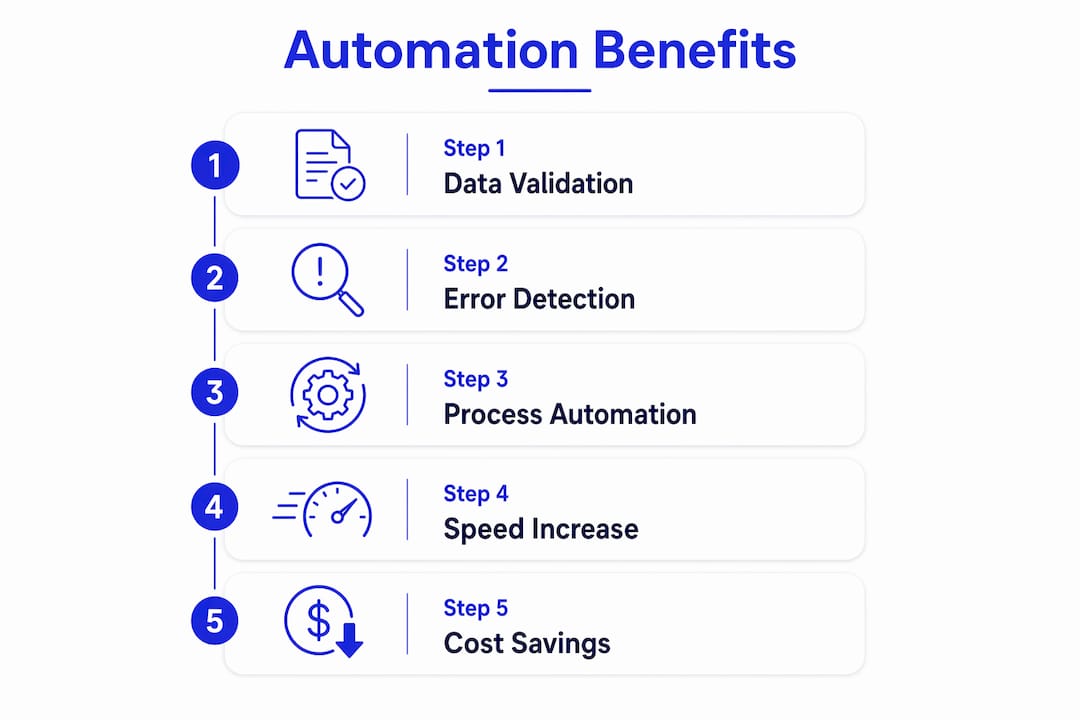
The speed gains are equally concrete. Load matching time drops from 15–20 minutes per load to 3–5 minutes with AI, and for an operation processing 500 loads monthly, that represents 125–140 hours of recovered staff time. Billing discrepancies drop by 90–95% with automated invoice processing, and carrier service failures decrease by 60–70% when vetting is automated.
| Process | Manual baseline | Post-automation range |
|---|---|---|
| Invoice processing time | 15–20 minutes per invoice | 3–5 minutes per invoice |
| Discrepancy detection rate | — | 90–95% of errors caught |
| Load matching time | 15–20 min per load | 3–5 min per load |
| — | 125–140 hours | 3–5 hours |
| Freight spend recovered | 3–8% of audited freight spend | — |
Beyond the direct numbers, there is the cascade effect. A single data error in freight forwarding rarely stays contained. A wrong container weight triggers a customs query. That query delays clearance. The delay generates demurrage. The demurrage generates a dispute. Automation breaks that chain at the first link, and the downstream costs simply do not materialize.
Stat callout: AI-powered automation in freight brokerage reduces operational errors by 78% and boosts profit margins by 23% within six months, through improvements in load matching, carrier vetting, and billing accuracy.
How to implement automation in your freight operations
Successful automation does not happen by layering new tools on top of broken manual processes. The operations that see the fastest error reduction are the ones that attack the manual workflow layer directly, mapping where fragmentation creates risk before they deploy any technology.
- Conduct an error audit first. Pull a sample of recent transactions and quantify your current error rate by category: data entry mistakes, billing discrepancies, compliance gaps, and communication failures. This baseline is what you measure against.
- Map your workflow gaps. Identify where data moves between fragmented systems manually, where rekeying happens, and where handoffs between teams create version errors. These are your highest-priority automation targets.
- Adopt AI-native solutions. Legacy TMS platforms record what happened. AI-native systems act across the fragmented environments where freight data actually lives, navigating carrier portals, normalizing rate formats, and flagging anomalies before they reach a customer.
- Set validation rules and confidence thresholds. Every automated workflow needs defined rules for what constitutes a clean record and what triggers human review. Pre-flight validations that detect invalid data early prevent inaccurate processing and compounded errors downstream.
- Retrain your team’s focus. The cognitive shift enabled by automation transitions freight teams away from repetitive data entry toward handling complex exceptions and operational decisions. Staff who previously spent hours on manual invoice verification can redirect that capacity to carrier relationships and dispute resolution.
- Monitor and refine continuously. Automation is not a set-and-forget deployment. Track first-pass yield, exception rates, and processing cycle times as primary KPIs, and refine your rules as your document mix and carrier base evolve.
The operations that close the efficiency gap fastest are the ones treating automation as a structural redesign of how work flows, not a feature added to an existing process.
How FreightSuite’s AI-native TMS reduces freight errors
FreightSuite is built as a fully agentic TMS, designed from the ground up to unify fragmented freight workflows under consistent, auditable automation. Where legacy platforms require manual intervention at every system boundary, FreightSuite’s AI agent orchestration executes across booking, rate management, operations, and invoicing as a single connected workflow.
- AI-driven rate management. FreightSuite automates rate requests across carrier portals, normalizes formats, and flags anomalies before quotes reach customers, eliminating the manual rekeying that introduces pricing errors on high-volume lanes.
- Real-time air and ocean tracking. Automated shipment status updates eliminate the manual status-checking that creates visibility gaps and delayed exception responses.
- Integrated validation from booking to invoicing. Every data point moves through automated validation rules, with full audit trails logged at each step. When a discrepancy appears, the system routes it with context, not just a flag.
- Human-in-the-loop design. FreightSuite’s confidence threshold architecture routes edge cases to human reviewers before they reach carriers or customers. This is what separates reliable production automation from demo environments that look clean until an unusual case appears.
- Multi-modal freight coverage. Whether your operation runs ocean freight, air, or road, FreightSuite’s automation features are built natively into the TMS, not bolted on through third-party connectors that break silently.
- Customs brokerage automation. Automated customs compliance workflows validate HS codes, duty calculations, and regulatory requirements in real time, catching compliance gaps before shipments depart.
Pro Tip: The human-in-the-loop design is not a limitation. It is the feature that makes the system trustworthy at scale. Configure your confidence thresholds to route genuinely ambiguous cases to reviewers, and you get the throughput of automation with the judgment of your best operators applied where it actually matters.
Key Takeaways
Automation reduces freight errors by enforcing consistent, rule-based workflows that eliminate human variability at every stage of the freight forwarding process, from document capture through invoice reconciliation.
| Point | Details |
|---|---|
| Error reduction at the source | Automated pre-flight validation catches invalid data before it propagates, preventing costly downstream cascade effects. |
| Speed and cost gains | Invoice processing drops from 15–20 minutes to 3–5 minutes per invoice; freight spend recovery improves from 3–8% of audited freight spend caught by automated three-way matching. |
| Staff productivity shift | AI automation reduces cognitive load by 80–90% on routine tasks, redirecting teams toward exception handling and strategic decisions. |
| Implementation sequence | Audit errors first, map workflow gaps, then deploy AI-native automation targeting the highest-volume document types. |
| FreightSuite advantage | FreightSuite’s agentic TMS unifies booking, rate management, and invoicing under native automation with human-in-the-loop controls for reliable, auditable operations. |
FreightSuite gives freight forwarders a faster path to error-free operations
Freight teams that have already mapped their error rates and workflow gaps know the problem is structural. The manual layers connecting your TMS, ERP, and carrier portals are where errors are born, and patching them with more headcount is not a solution that scales.

FreightSuite is the AI-native TMS built for freight forwarders who are ready to move past that structural problem. Rate management, air freight automation, ocean tracking, operations, finances, and AI agent orchestration are built natively into a single platform, not assembled from connectors that break without warning. The result is a freight operation where validation runs on every transaction, audit trails are automatic, and your team’s attention goes to the decisions that actually require human judgment. For road freight operations specifically, FreightSuite’s road freight TMS applies the same agentic automation to ground transport workflows, closing the visibility gaps that manual dispatch coordination leaves open. The window for competitive advantage through automation is real, and it has a timeline. Book a demo to see how FreightSuite performs against your current error rates.

