Freight Lifecycle Management: A Complete Guide for Logistics Pros
.png)
What is freight lifecycle management?
Freight lifecycle management is the end-to-end process of planning, executing, and monitoring the movement of goods from origin to final destination, with the goal of delivering on time, at the lowest viable cost, and in full regulatory compliance. The Council of Supply Chain Management Professionals (CSCMP) frames supply chain oversight as a discipline requiring continuous coordination across every node, and freight lifecycle management sits at the operational core of that discipline.
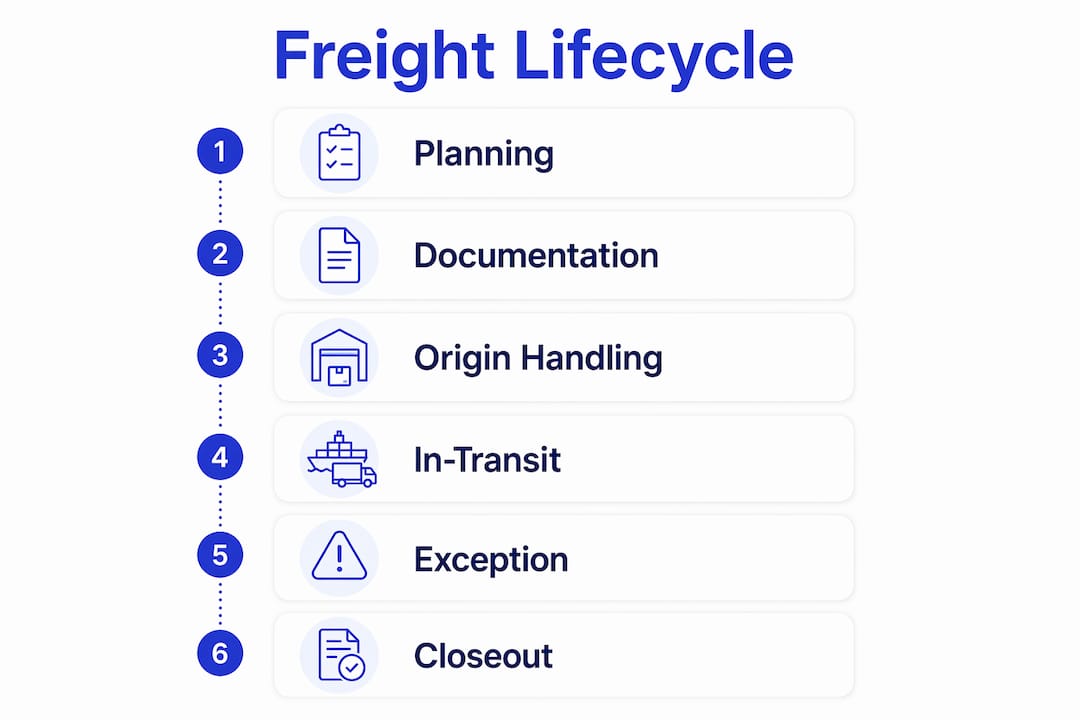
The process spans six key stages:
- Planning and booking: order processing, carrier selection, rate negotiation
- Documentation and compliance: bills of lading, customs declarations, insurance
- Carrier and origin handling: inspection, loading, pre-shipment verification
- In-transit monitoring: GPS tracking, status updates, performance metrics
- Exception management: disruption identification, impact assessment, corrective workflows
- Post-delivery and financial closeout: delivery verification, invoicing, reconciliation
Four stakeholder groups drive every stage: shippers, carriers, warehouses, and customs brokers. Continuous monitoring across all six stages is what separates organizations that protect margins from those that absorb avoidable losses.
The six stages of the freight management process
Understanding the freight shipping lifecycle means knowing exactly what happens, and who owns it, at each phase.

1. Shipment planning and booking
Every shipment starts with a decision: what moves, when, and how. Teams analyze freight classification, select carriers based on lane performance and cost, and negotiate rates shaped by market demand, fuel costs, and shipment type. Disciplined booking practices set pricing expectations and execution responsibilities before a single pallet moves. Cutting corners here introduces risk that compounds at every downstream stage.
2. Documentation and compliance
Paperwork is not administrative overhead. It is the legal foundation of every cross-border or domestic shipment. Bills of lading, packing lists, customs declarations, and insurance certificates must be accurate before goods leave the origin facility. Account Master Management (AMM), a pre-shipment compliance screening practice, maintains a single validated record for all trade partners, preventing the data fragmentation that causes costly delays at customs.
3. Carrier and origin handling
Once booked, the physical process begins. Goods are inspected for damage or discrepancies, shipping labels are generated, and loading is executed to prevent transit damage. A structured pre-pickup checklist determines whether a shipment starts cleanly or immediately enters exception status.
4. In-transit monitoring and visibility
Real-time freight tracking is the backbone of modern lifecycle of freight operations. GPS and IoT sensors monitor location, temperature, and potential delays across linehaul and cross-docking events. Status updates flow to shippers and consignees, and performance metrics accumulate for post-delivery analysis.
5. Exception management
No freight operation runs without disruptions. Vessel roll-offs, flight cancellations, and missed appointments are predictable occurrences, not surprises. Exception management is a proactive, structured workflow: identify the disruption, assess its impact on delivery commitments, and execute corrective actions rapidly. Speed of response here directly determines whether a disruption becomes a customer service failure or a resolved incident.
6. Post-delivery and financial closeout
Delivery confirmation is not the finish line. Proof of delivery (POD) must be signed, invoices processed, and accessorial fees reconciled immediately. Failure to close out ancillary charges promptly erodes margins and triggers disputes. Finance teams that own this stage with disciplined workflows protect profitability in ways that operational teams often underestimate.
Why effective freight lifecycle management pays off
The benefits of freight lifecycle management compound across every function that touches a shipment.
- On-time delivery rates improve when planning and exception management are disciplined, building carrier and customer trust simultaneously.
- Cost control tightens through optimized routing, smarter carrier selection, and accurate rate reconciliation after delivery.
- Regulatory risk drops when documentation and compliance processes are standardized rather than ad hoc.
- Supply chain visibility increases, giving leadership real data to act on rather than status updates assembled from emails and spreadsheets.
- Customer satisfaction rises with proactive shipment communication, particularly when exceptions are resolved before the consignee notices a problem.
- Carrier relationships strengthen when shippers demonstrate operational consistency and pay accurately and on time.
- Scalability becomes achievable once technology handles the transactional volume that manual processes cannot absorb.
Effective freight management enhances supply chain visibility, mitigates risks, and improves overall efficiency through integrated tracking and data analytics. The organizations that treat lifecycle management as a continuous discipline rather than a reactive function are the ones that turn logistics into a competitive advantage.
Common challenges in managing the freight lifecycle
The freight management process is complex by design, and the friction points are predictable.
- Multi-party coordination failures: shippers, carriers, brokers, and customs agents each operate on different systems and communication rhythms, creating gaps that delay decisions.
- Data silos: unstructured information flows between parties mean that critical shipment data lives in emails, spreadsheets, and disconnected portals rather than a single source of truth.
- Disruptions: weather events, port congestion, and capacity shortages are unavoidable. The difference is whether your team has a structured response or improvises each time.
- Regulatory complexity: cross-border shipments involve tariff classifications, export controls, and customs requirements that vary by country, commodity, and trade relationship.
- Documentation errors: a single incorrect field on a bill of lading can hold a shipment at customs for days.
- Manual processes: teams relying on manual data entry spend time on tasks that generate errors rather than insights.
- Cost versus service tension: pressure to cut freight spend often conflicts with the carrier quality and lane coverage needed to meet delivery commitments.
How technology and TMS platforms transform freight lifecycle management
A modern Transport Management System is not a tracking tool. It is a decision-making hub for complex logistics, integrating planning, execution, visibility, and compliance into a single operational environment.
AI-powered TMS platforms automate carrier selection based on lane performance data, forecast demand to prevent capacity gaps, and trigger exception alerts before disruptions escalate. Integration with ERP, inventory management, and customs systems eliminates the manual handoffs where errors accumulate. Generative AI now scans unstructured freight communications like emails to automate routine data entry tasks, freeing your team to focus on decisions that require human judgment rather than transcription.
Pro Tip: When evaluating a TMS, test its exception alerting logic before anything else. A platform that surfaces disruptions before your customer calls is worth more than one with a polished dashboard.
FreightSuite is built on this principle. Its air freight and road freight capabilities are natively integrated with AI agent orchestration, rate management, and financial workflows, so every lifecycle stage runs within one system rather than across a patchwork of tools. For teams managing container haulage, AI-assisted haulage platforms apply similar automation logic to carrier selection and compliance at the container level.
KPIs that tell you how well your freight lifecycle is performing
Measuring the lifecycle of freight operations requires metrics tied to each stage, not just final delivery.
| KPI | What it measures |
|---|---|
| On-time delivery rate | Percentage of shipments delivered within the committed window |
| Transit time variance | Deviation from planned transit time by lane or carrier |
| Exception rate | Frequency of disruptions per shipment volume |
| Documentation accuracy | Error rate on bills of lading, customs filings, and invoices |
| Cost per shipment | Total freight spend divided by shipment count, by mode and lane |
| Carrier performance score | Composite rating of on-time, damage, and communication metrics |
| Financial closeout cycle time | Days from delivery to fully reconciled invoice |
Real-time visibility and compliance management directly improve KPIs like on-time delivery and cost efficiency. Teams that review these metrics weekly, rather than monthly, catch performance drift before it becomes a pattern.
Best practices for optimizing freight lifecycle management
The organizations that consistently outperform their peers share a few operational habits.
Standardize documentation workflows before automating them. Automation applied to a broken process produces errors faster. Map your current documentation steps, identify where errors originate, and fix the process before deploying technology to scale it.
Build carrier scorecards and review them on a fixed cadence. Carrier performance data is only useful if it informs sourcing decisions. A quarterly scorecard review that feeds directly into carrier selection criteria closes the loop between measurement and action.
Treat exception management as a discipline, not a fire drill. Define response protocols for the most common disruption types (vessel roll-offs, missed pickups, customs holds) so your team executes from a playbook rather than improvising under pressure.
Invest in Account Master Management. Validated, centralized partner data prevents the documentation errors and compliance failures that stall shipments at origin or customs. This is one of the most overlooked levers in freight lifecycle optimization.
Pro Tip: Segment your shipment volume by lane, carrier, and commodity before setting KPI targets. A single on-time delivery target across all lanes masks the performance variation that actually drives cost and service outcomes.
Real-world impact: what good lifecycle management looks like
Consider a mid-size freight forwarder managing ocean and air shipments across North America and Asia. Before implementing a structured lifecycle management approach, their exception rate was high, documentation errors caused recurring customs delays, and post-delivery reconciliation took weeks. The financial closeout lag alone created cash flow pressure that affected carrier payment terms.
After deploying an integrated TMS with automated exception alerting, centralized AMM, and AI-assisted data capture, the team reduced manual data entry significantly, resolved exceptions faster, and closed invoices within days of delivery rather than weeks. The operational gains translated directly into stronger carrier relationships and measurable margin improvement.
This pattern repeats across the industry. The freight shipment lifecycle rewards organizations that treat each stage with equal discipline, because a breakdown at any point, whether at booking, in transit, or at closeout, affects every metric downstream.
Regulatory compliance and customs within the freight lifecycle
Customs and regulatory compliance are not a single event at the border. They run through the entire lifecycle, starting at the planning stage when commodity classifications and trade agreement eligibility are determined, through documentation preparation, and into post-delivery audit trails.
In the United States, freight brokers and forwarders operating across borders must be licensed with the FMCSA. Customs compliance requires accurate Harmonized Tariff Schedule (HTS) classifications, correct valuation, and adherence to export control regulations administered by agencies including the Bureau of Industry and Security (BIS). A single misclassification can trigger penalties, shipment holds, or loss of import privileges.
The practical implication: compliance cannot be delegated to a single specialist at the end of the process. It must be embedded in booking, documentation, and carrier selection workflows from the start.
Risk management and contingency planning in freight lifecycle management
Risk in freight is not a question of whether disruptions will occur. It is a question of how prepared your operation is when they do.
Effective risk management starts with mapping exposure by lane, mode, and carrier concentration. Over-reliance on a single carrier for a critical lane creates fragility that becomes visible only when that carrier has a capacity crisis. Diversifying carrier relationships and maintaining pre-qualified backup options for high-volume lanes is a foundational contingency measure.
Scenario planning for common disruption types, including port congestion, weather events, and regulatory changes, allows teams to execute response protocols rather than make decisions under pressure. Continuous improvement in freight lifecycle management builds resilience by enabling quick adaptation to disruptions, demand shifts, and regulatory updates. The organizations that treat risk planning as an ongoing operational practice, rather than an annual exercise, absorb disruptions with far less damage to margins and customer relationships.
Key Takeaways
Freight lifecycle management covers six distinct stages from booking to financial closeout, and performance at each stage directly affects cost, compliance, and customer outcomes.
| Point | Details |
|---|---|
| Six-stage structure | The lifecycle runs from planning and booking through post-delivery financial closeout. |
| Technology as command center | AI-powered TMS platforms automate carrier selection, exception alerts, and data capture across all stages. |
| Compliance starts at booking | Regulatory and customs requirements must be embedded from planning, not addressed only at the border. |
| KPIs require stage-level tracking | Metrics like exception rate and closeout cycle time reveal performance gaps that delivery rate alone cannot show. |
| Risk management is ongoing | Carrier diversification and scenario planning protect margins when disruptions occur, and they will occur. |
FreightSuite brings every stage of the freight lifecycle into a single AI-native TMS, from rate management and air and ocean tracking to financial workflows and agentic automation. If your team is managing lifecycle complexity across disconnected tools, the window to consolidate is open now.

Explore FreightSuite’s capabilities or book a demo to see how an agentic TMS handles the full freight lifecycle in one place.

