
A Transport Management System is the operational control center that detects, quantifies, and reduces transportation risk. It does this by combining real-time visibility, dynamic cost inputs, and predictive analytics into the routing and finance decisions your team makes every hour of the day.
That is the whole answer. The rest of this article is about what separates a TMS that actually does this from one that just displays data on a dashboard.
Three signals tell you whether a TMS is built for risk or just built for reporting:
FreightSuite was built around this exact premise: an agentic TMS that treats volatility as the baseline condition rather than an exception to patch around later. Rate management, live tracking, and finance data all sit inside one architecture so a risk signal can trigger a financial or routing action without a human relaying it between four disconnected tools.
Pro Tip: Before you evaluate any TMS on features, ask how often its cost data refreshes. Daily or real-time refresh is the line between a system that manages risk and one that just archives it.
A TMS reduces risk only when it connects live cost and compliance signals directly to routing and finance actions, not when it simply displays data faster than a spreadsheet.
| Point | Details |
|---|---|
| Treat volatility as baseline | Choose architecture that refreshes rates and surcharges in real time, not on a fixed cycle. |
| Test with a real scenario | Run a proof of concept using a tariff or surcharge change and review the invoice reconciliation output. |
| Map features to risk categories | Use a capability checklist covering operational, commercial, shipment, compliance, and financial risk. |
| Measure ROI with real KPIs | Track invoice reconciliation rate, exception resolution time, and customs hold frequency for 6 to 12 months. |
| FreightSuite as the agentic option | FreightSuite combines rate management, tracking, finance, and AI agent orchestration in one platform built for real-time cost inputs. |
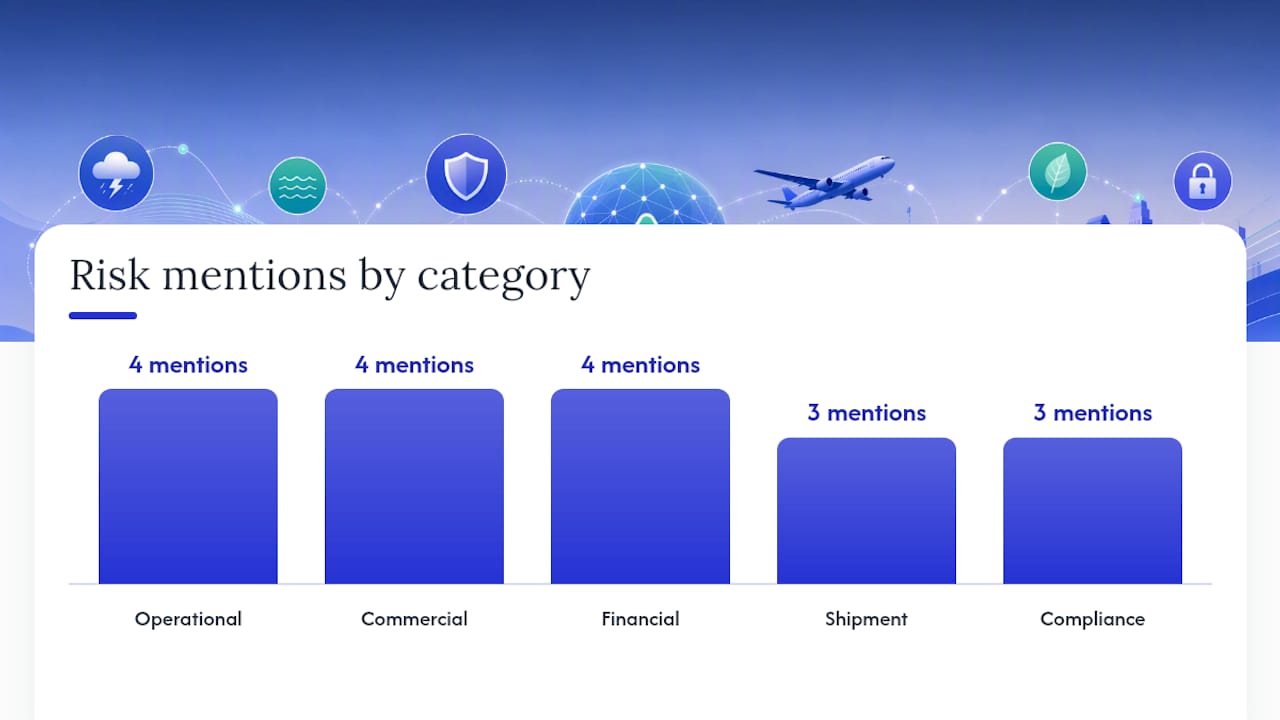
A TMS worth paying for handles five distinct risk categories, and most buyers only think about two of them before they sign a contract.
Each category compounds the others. A fuel surcharge spike (commercial) that isn’t reflected in your quote turns into an invoice discrepancy (financial) that your finance team discovers a month later, long after the customer relationship has already absorbed the friction. A customs document error (compliance) becomes a capacity problem (operational) when a container sits at the port instead of moving.
Transportation management systems address a meaningful share of this exposure through improved visibility and compliance support, and industry data shows a significant majority of supply chain executives now list end-to-end visibility as a strategic priority. That statistic matters because visibility is the precondition for everything else on this list. You cannot manage a risk category you cannot see moving in real time.
FreightSuite’s customs brokerage capabilities exist specifically to close the compliance gap, centralizing forms and validations so a documentation error doesn’t become a five-day port delay.
The capabilities that matter are the ones that connect a live signal to an automated or semi-automated action, not the ones that just generate a report after the fact.
Nine capabilities do the real work: real-time visibility, a dynamic rate and surcharge engine, live optimization and routing, scenario planning, exception management with automated alerts, customs and brokerage automation, invoice reconciliation tied to finance, audit trails with access controls, and AI-driven predictive analytics. Ask a vendor to demonstrate each one live, not describe it in a slide.
Run this checklist during any vendor demo:
| Capability | Risk category it mitigates |
|---|---|
| Real-time visibility and tracking | Operational, shipment |
| Dynamic rate and surcharge engine | Commercial, financial |
| Live routing and carrier optimization | Operational, shipment |
| Scenario planning and what-if modeling | Commercial, compliance |
| Exception management and automated alerts | Operational, shipment |
| Customs and brokerage automation | Compliance |
| Invoice reconciliation and finance integration | Financial, commercial |
| Audit trails and access controls | Compliance, financial |
| AI-driven predictive analytics | Operational, commercial, financial |
Pro Tip: Predictive analytics is only as reliable as the transaction history feeding it. If your current system has gaps in shipment or invoice data from the last two years, budget time to clean that history before expecting accurate risk scoring.
Watch for one architectural trap: some legacy platforms bolt AI features onto a database that still refreshes cost data on a fixed schedule. That combination gives you a smart-looking dashboard sitting on top of stale numbers, which is worse than no prediction at all because it creates false confidence.
A demo or proof of concept needs to prove one thing above all else: that the system treats a live cost or compliance change as a trigger for action, not a line item to review next quarter.
Structure your evaluation around four buckets:
Red flags worth walking away from:
Request a proof of concept that specifically tests: live data connectivity to at least one carrier or rate source, a simulated tariff or surcharge change scenario run end to end, and a sample batch of invoice reconciliation against historical quotes. A vendor that can run all three within a 30 to 90 day window is treating volatility as a baseline. A vendor that needs longer just to configure the test usually built the platform around a static world.
Most mid-size freight forwarders should plan for 8 to 16 weeks from contract signing to full operational use, with the largest cost driver being data integration, not software licensing.
| Phase | Typical duration | Key roles involved |
|---|---|---|
| Data mapping and integration | 2 to 4 weeks | IT lead, operations manager |
| Configuration and workflow setup | 3 to 6 weeks | Operations, finance |
| User training and change management | 2 to 4 weeks | All frontline staff, team leads |
| Parallel run and go-live | 1 to 2 weeks | Full team, vendor support |
Budget for these cost factors beyond the subscription fee itself:
To measure ROI on risk reduction, track a simple formula: (avoided surcharge leakage + avoided invoice variance + reduced demurrage from faster customs clearance) divided by total implementation and subscription cost over 12 months. Predictive analytics deployments in transportation typically show positive ROI once indirect benefits like faster recovery from disruption are counted alongside direct savings.
Track these KPIs in the first 6 to 12 months: percentage of invoices reconciled without manual review, average time from exception detection to resolution, number of customs holds per 100 shipments, and margin variance between quoted and final cost.
The scenarios that produce the clearest before-and-after value are the ones where cost or regulatory conditions change faster than a manual process can react.
| Scenario | Before (manual process) | After (real-time TMS) |
|---|---|---|
| Tariff change on a trade lane | Rates updated weeks later, margin erodes silently | Rate engine reflects change same day, quotes adjust automatically |
| Fuel surcharge spike | Surcharge applied inconsistently across shipments | Surcharge engine applies updated rate uniformly and reconciles at invoicing |
| Port congestion or carrier failure | Team discovers delay from a customer complaint | Exception alert fires, alternate routing suggested immediately |
| Customs documentation error | Shipment held for days, no visibility into cause | Automated validation catches the error before submission |
In the tariff scenario, a forwarder running static rate sheets typically absorbs the margin hit for the length of a full billing cycle before anyone notices. A system with live rate inputs closes that gap to the same day the tariff takes effect.
Pro Tip: When designing a scenario for a proof of concept, force it to touch both operations and finance at once, like a surcharge spike that also triggers an invoice mismatch. A vendor that only solves half the scenario is showing you half a system.
If your platform cannot answer a live cost change or compliance exception without a manual workaround, it is a spreadsheet with a user interface, not a risk management system.
Run this three-question test on what you have today:
If you answered no to any of these, your options are limited to two paths. Either invest in configuring the manual workarounds your team already uses into something closer to automated, or start a structured vendor evaluation using the checklist above. There is little value in a partial fix when the underlying architecture was never built to treat volatility as normal.
FreightSuite is an agentic TMS built specifically for the volatility this article has described, combining rate management, live tracking, finance, and AI agent orchestration into one architecture rather than a patchwork of connected tools.

The feature set maps directly to the capability checklist covered earlier: a live rate and surcharge engine, real-time air and ocean tracking, customs brokerage built into the shipment lifecycle, automated invoice reconciliation for finance teams, and AI agents that can act on a risk signal instead of just flagging it. Teams handling road freight lanes get the same live-input logic through the road freight capabilities built into the platform.
For proof of what this looks like in practice, the FreightSuite case study walks through real operational results. If you want to see how the platform handles finance-side risk specifically, the solutions for finance teams page covers invoice reconciliation and credit control in more depth, and the pricing page lays out plan structure for teams ready to move past evaluation.
The best next step is the same one described in the proof of concept template above: request a demo that tests live data connectivity, runs a simulated tariff or surcharge scenario, and reviews a sample of invoice reconciliation against real quotes.
A TMS reduces risk by combining real-time visibility, dynamic cost data, and predictive analytics so that a disruption signal triggers an immediate routing or financial action instead of a delayed manual review.
A capable TMS addresses five categories: operational delays, commercial rate volatility, shipment damage or misrouting, compliance and customs issues, and financial exposure from invoice variance or FX shifts.
Most freight forwarders should plan for 8 to 16 weeks from signing to full operational use, with data integration and change management as the largest time drivers.
ROI is typically calculated by dividing avoided surcharge leakage, avoided invoice variance, and reduced demurrage costs by the total implementation and subscription cost over 12 months.
FreightSuite combines rate management, live air and ocean tracking, customs brokerage, and finance integration inside one agentic architecture, so risk signals can trigger automated actions instead of routing back to a human at every step.

