Inbound Freight Management Workflow: 2026 Guide

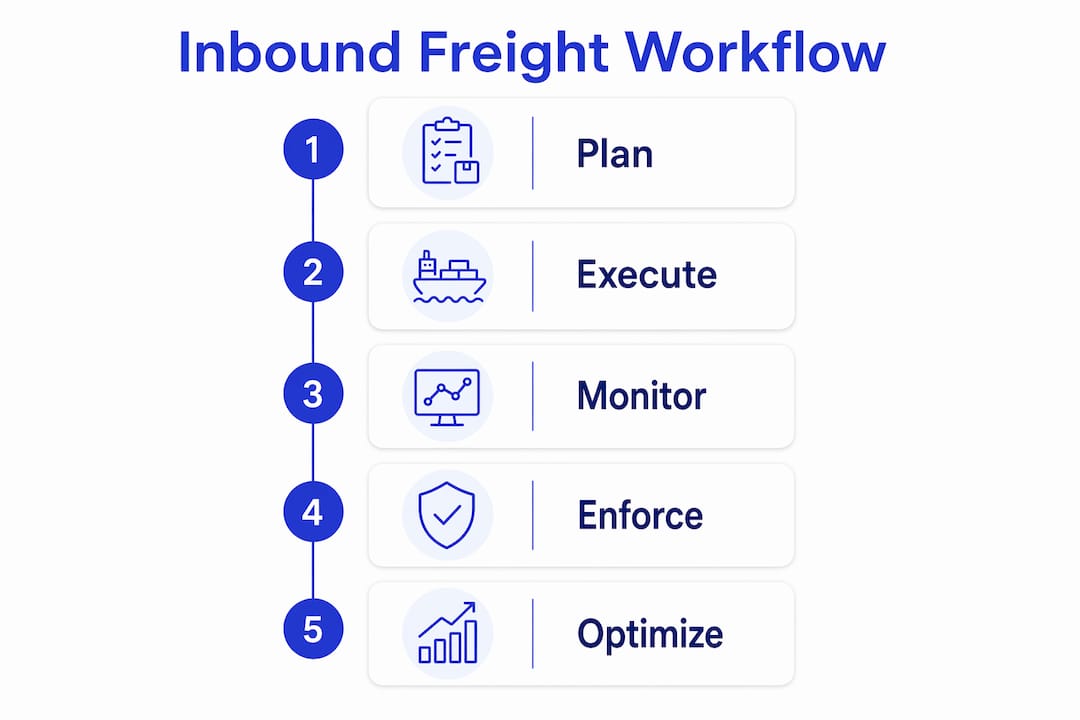
An inbound freight management workflow is the coordinated process of planning, executing, and monitoring incoming shipments from suppliers to receiving facilities. Transportation costs represent nearly 50% of total logistics spend, which means every uncontrolled inbound shipment is a direct hit to your margin. The freight management process covers routing guide development, vendor compliance enforcement, yard and dock orchestration, and technology integration across carriers and warehouses. Supply chain managers who treat inbound logistics as a passive function, rather than an actively managed workflow, consistently leave cost and service performance on the table.
What are the core components of an inbound freight management workflow?
A well-built inbound freight management workflow starts with a vendor routing guide. This document defines which carriers move which freight, under what conditions, and at what cost. Without it, suppliers default to their preferred carriers, and you absorb the premium.
Routing guide development covers four core decisions:
- Carrier selection criteria — mode, weight thresholds, commodity type, and service level requirements
- Geographic lanes — origin and destination pairings with primary and backup carrier assignments
- Compliance standards — packaging requirements, advance shipment notifications (ASNs), and documentation rules
- Penalty structures — financial deductions indexed to the actual cost of non-compliance
Routing guide development takes 5–8 weeks to complete properly. That timeline reflects the real complexity of aligning carrier contracts, vendor capabilities, and internal operational requirements before a single shipment moves under the new program.
Compliance enforcement is where most programs fail. Penalties must reflect real business costs, not token fines. Automated deductions from vendor invoices, triggered by validated routing and documentation failures, are the most effective enforcement mechanism available. They remove the manual dispute process and make non-compliance financially unattractive.
Technology integration ties the workflow together. A Transportation Management System (TMS) connects vendor portals, load tendering, carrier tracking, and compliance monitoring in one place. Freight management integrates port agents, customs brokers, and carriers who operate across different software environments, which is why a shared platform matters more than any single point solution.

Pro Tip: Build your routing guide in phases. Start with your top 20 vendors by freight spend, validate the compliance logic, then expand. Trying to onboard all vendors simultaneously is the fastest way to create exceptions you cannot manage.
How to orchestrate yard and dock operations for inbound freight
Yard and dock operations are where well-designed workflows either hold or collapse. The scheduling constraint is not dock door count. It is the alignment of three parallel variables: appointment windows, dock door capacity by hour, and labor availability. Scheduling based on these three constraints prevents congestion before it starts.
Dedicated spotter teams are the operational core of a high-performing yard. Their job is not simply to move trailers. Their job is to maintain flow. Effective spotter operations follow a clear priority sequence:
- Clear empty trailers from active dock doors before staging new arrivals
- Maintain move times under 15 minutes per trailer to prevent door lockup
- Track every trailer status in real time: live, staged, loaded, or empty
- Share trailer status visibility between transportation and receiving teams simultaneously
“Orchestrated yard operations build resilience and predictability, reducing costly congestion and dependency on external trailer pools.” — Inbound Logistics
Spotter teams prioritize door clearance and sequencing over raw yard space. A yard with 50 available trailer slots but 10 blocked dock doors is operationally worse than a tighter yard with clean door rotation. The difference is discipline in sequencing, not square footage.
Pro Tip: Standardize your trailer status codes across transportation and warehouse teams. When both groups use the same four status labels, live visibility replaces the radio calls and spreadsheet updates that slow every shift.
What role does technology play in freight workflow orchestration?
Modern freight workflow orchestration connects planning, execution, and visibility in a single event-driven system. The biggest margin improvements come from eliminating the gaps between these three functions, not from improving any one of them in isolation.
A capable TMS platform delivers four specific capabilities that manual processes cannot replicate at scale:
- Vendor self-service portals — suppliers book appointments, submit ASNs, and retrieve compliance status without contacting your team
- Multi-carrier connectivity — load tendering, tracking, and rate management across all modes from one interface
- Document storage — POD documents stored for up to 5 years reduce manual follow-up and protect you in disputes
- Compliance monitoring — automated flags trigger penalty workflows when routing or documentation rules are violated
AI-powered orchestration takes this further. AI systems unify order capture through freight payment under continuous monitoring, self-healing disruptions without waiting for human intervention. This is what freight workflow orchestration looks like at its most advanced: a closed-loop system that surfaces problems and resolves them before they become exceptions on your desk.
Integrating AI into your freight data management requires one dedicated role. An AI Engineer monitors network patterns and intervenes only when systemic anomalies occur. This is not a full-time firefighting role. It is a pattern-recognition function that keeps the automated system calibrated.
| Capability | Manual process | TMS with AI orchestration |
|---|---|---|
| Compliance monitoring | Weekly manual review | Real-time automated flags |
| Carrier tendering | Email and phone | Automated multi-carrier broadcast |
| Document retrieval | File request, 1–3 days | Instant, up to 5-year archive |
| Exception resolution | Reactive, after impact | Proactive, before shipment delay |
Freightsuite builds AI agent orchestration natively into its TMS, covering air and ocean tracking, rate management, operations, and finance in one platform. That native integration removes the middleware layer that creates data gaps in bolt-on solutions.
How to implement and maintain an inbound freight workflow over time
Implementation follows a predictable sequence. The routing guide and compliance framework take 5–8 weeks to develop. Technology deployment spans 8–12 weeks, covering TMS configuration, pilot testing with primary vendors, and ERP integration for invoice automation. Plan for both phases to overlap, not run sequentially, or your go-live date will drift by months.
The phased rollout structure that works in practice looks like this:
- Weeks 1–4: Finalize routing guide, carrier contracts, and compliance penalty schedule
- Weeks 3–8: Configure TMS, build vendor portal access, and set up compliance monitoring rules
- Weeks 6–10: Pilot with top 10–20 vendors by freight spend; document exceptions and adjust rules
- Weeks 9–12: Full vendor onboarding with training sessions and written compliance acknowledgments
- Week 13 onward: Daily exception reviews, monthly scorecards, and quarterly penalty audits
Vendor training is not optional. Change management determines whether your routing guide becomes the operating standard or a document vendors ignore. Written acknowledgment of compliance requirements, combined with a clear penalty schedule, creates accountability before the first shipment moves.
Ongoing maintenance requires daily exception reviews. A compliance rate that starts at 85% will erode to 60% within two quarters without active follow-up. Penalties indexed to actual business costs maintain vendor behavior over time. Token fines do not.
Common mistakes to avoid:
- Launching without a tested exception-handling process for routing guide conflicts
- Skipping ERP integration and managing compliance deductions manually
- Treating the routing guide as a static document rather than a quarterly-reviewed standard
- Failing to align warehouse receiving teams with transportation scheduling before go-live
Pro Tip: Run a compliance scorecard for every vendor at the 30-day and 90-day marks after go-live. Share the scores directly with vendor account managers. Visibility into their own performance changes behavior faster than any penalty alone.
Key takeaways
An effective inbound freight management workflow requires routing guide discipline, enforced compliance, coordinated yard operations, and technology that connects planning to execution in real time.
| Point | Details |
|---|---|
| Routing guide is the foundation | Develop carrier selection, lane assignments, and penalty structures before onboarding any vendor. |
| Compliance enforcement drives results | Index penalties to actual costs and automate deductions to make non-compliance financially unattractive. |
| Yard orchestration prevents bottlenecks | Align appointment windows, dock capacity, and labor availability; keep spotter move times under 15 minutes. |
| Technology unifies the workflow | A TMS with AI orchestration connects vendor portals, compliance monitoring, and freight payment in one system. |
| Phased implementation reduces risk | Overlap routing guide development and TMS deployment across a 12-week window to hit go-live on schedule. |
What I’ve learned from building inbound freight workflows that actually hold
The programs that fail share one common trait: they treat compliance as a relationship problem instead of a systems problem. I have seen teams spend months negotiating with vendors over routing violations that a properly configured automated deduction would have resolved in the first week. The moment you make non-compliance financially automatic, the conversation changes.
Yard orchestration is consistently undervalued. Most supply chain managers focus on carrier selection and rate negotiation, then wonder why their receiving throughput is unpredictable. The answer is almost always in the yard. Sequencing discipline and spotter accountability deliver more consistent throughput than any rate improvement you will negotiate this year.
The AI conversation in freight is real, but the implementation reality is more measured than the marketing suggests. Closed-loop AI orchestration works when your data is clean, your compliance rules are enforced, and your team has someone watching the system for anomalies. It does not fix a broken routing guide. It amplifies whatever foundation you have already built.
The choice that matters most is whether you treat inbound freight as a cost center to minimize or a workflow to actively manage. The operations that win on margin do the latter, consistently, quarter after quarter.
— Annabel
Freightsuite and the future of inbound freight management
Supply chain managers who have outgrown spreadsheets and disconnected TMS platforms need a system built for the way freight actually moves today.

Freightsuite is an AI-native TMS that covers road, air, ocean, and customs brokerage in one platform, with AI agent orchestration, rate management, compliance monitoring, and finance built natively. There is no middleware to configure and no data gap between your planning and execution layers. Operations teams get end-to-end workflow control from order capture through freight payment, with automated compliance flags and document storage that removes manual follow-up. If your inbound freight program is ready for a platform that matches its complexity, Freightsuite is built for that conversation. Book a demo to see it in action.
FAQ
What is an inbound freight management workflow?
An inbound freight management workflow is the coordinated process of routing, scheduling, and monitoring incoming shipments from suppliers to receiving facilities. It covers routing guide development, vendor compliance enforcement, yard orchestration, and TMS integration.
How long does it take to implement an inbound freight program?
Routing guide and compliance framework development takes 5–8 weeks. Full technology deployment, including TMS configuration and ERP integration, spans 8–12 weeks. Overlapping these phases keeps total implementation within a 12-week window.
What is freight workflow orchestration?
Freight workflow orchestration is the practice of connecting planning, execution, and visibility in a continuous, event-driven system. AI-powered orchestration manages order capture through invoice payment while automatically resolving disruptions without manual intervention.
Why do inbound freight programs fail?
Most inbound freight programs fail because compliance penalties are not enforced or are not indexed to actual business costs. Without automated deductions and daily exception reviews, vendor compliance rates erode within the first two quarters.
How does a TMS improve inbound freight management?
A TMS centralizes carrier tendering, compliance monitoring, document storage, and vendor communication in one platform. Modern TMS platforms store POD documents for up to 5 years and automate compliance flags, reducing manual follow-up and protecting against disputes.

