How AI Transforms Logistics Operations in 2026
%20(2).png)
Artificial intelligence is defined as the primary driver of autonomous logistics management, replacing manual coordination with systems that plan, execute, and correct shipments without human intervention. The global AI solutions market in logistics exceeded $13 billion by the end of 2025. That number reflects a fundamental shift, not a trend. Understanding how AI transforms logistics operations means understanding three core technologies: agentic AI, deterministic AI, and multi-agent validation frameworks. Together, they move supply chain management from reactive firefighting to predictive, enterprise-wide control. Freightsuite is built on exactly this architecture, with AI agent orchestration native to its transport management system.
What are the major AI technologies transforming logistics operations?
Agentic AI is the technology that makes autonomous logistics possible. Unlike rule-based automation, agentic AI makes decisions, adapts to new information, and coordinates multi-step workflows without waiting for human approval. Agentic AI enables logistics to scale through intelligence rather than labor, shifting the model from sequential optimization to dynamic system control. That distinction matters because traditional automation hits a ceiling when conditions change. Agentic AI does not.
Deterministic AI plays a different but equally critical role. Where agentic AI orchestrates decisions, deterministic AI validates the data those decisions depend on. Deterministic AI acts as a cognitive layer on verified data, protecting contractual truth and liability boundaries in logistics. A shipment manifest with a wrong weight or incorrect commodity code will corrupt every downstream process, from customs clearance to final delivery billing. Deterministic AI catches those errors at the point of entry, before they propagate.

Multi-agent validation frameworks are the third pillar. These architectures assign separate AI agents to cross-check each other’s outputs, functioning like a legal cross-examination rather than a single opinion. Multi-agent AI architectures validate decisions similarly to legal cross-examination, preventing propagation of errors from generative AI hallucinations in logistics. Prompt engineering alone cannot achieve this level of accuracy. Only structured agent-to-agent validation can.
Pro Tip: Treat your data receiving process as the first AI checkpoint. No downstream AI system can correct a false premise introduced at the dock floor. Enforce deterministic validation at every data entry point before any agentic process touches the record.
How does AI improve efficiency and accuracy in real-world logistics applications?
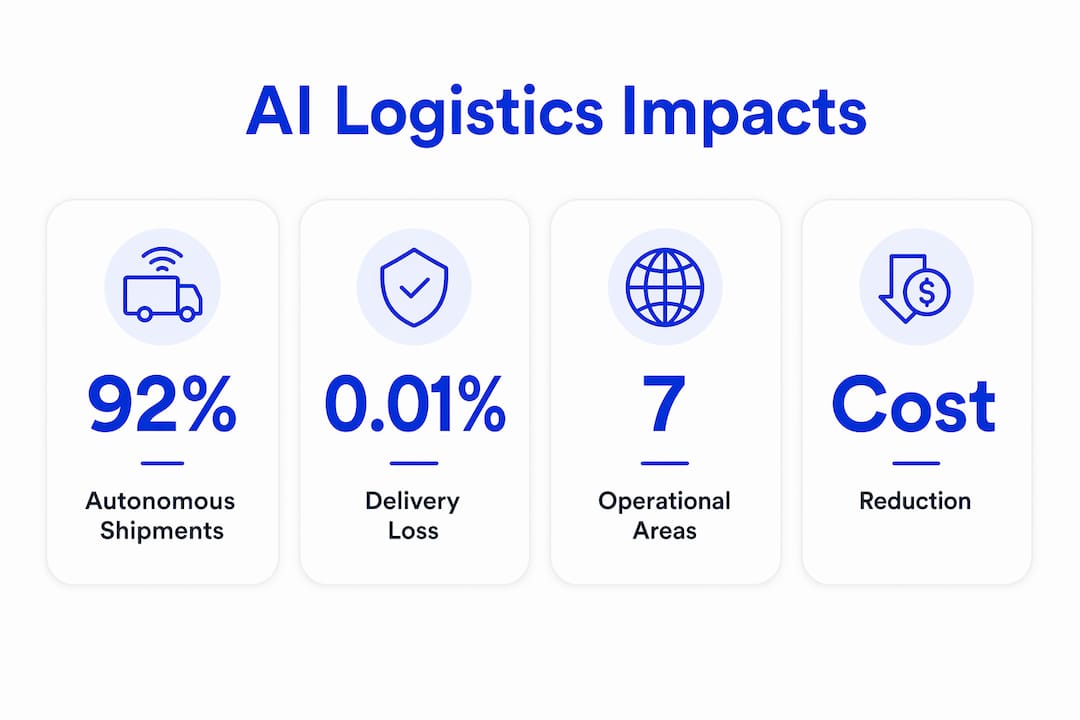
The numbers from 2026 are not projections. They are operational results. Over 92% of 4PL shipments are autonomously orchestrated by agentic AI, reducing manual task durations from hours or days to seconds. That compression of process time is not a marginal improvement. It is a structural change in how logistics networks operate.
The accuracy gains are equally significant. A medical logistics provider achieved a delivery loss rate of 0.01% using multi-agent AI frameworks that validate every decision before execution. Medical freight has zero tolerance for error, which makes it the most demanding test case for AI accuracy. Passing that test at scale proves the technology works beyond controlled environments.
The impact of AI on logistics spans seven distinct operational areas, not just speed and accuracy. AI-driven predictive analytics and route optimization affect cost reduction, automation, route optimization, warehouse management, customer service, sustainability, and risk management. Each area compounds the others. Better route optimization reduces fuel costs, which improves sustainability metrics, which reduces risk exposure from carbon regulations.
AI agents in supply chains expand the feasible solution space beyond human capabilities by coordinating complex multi-step decisions optimized for enterprise-wide objectives. A human coordinator optimizes for the shipment in front of them. An AI agent optimizes across the entire network simultaneously. That difference in scope is what breaks the traditional cost-speed tradeoff in logistics.
What challenges and nuances affect AI adoption in logistics operations?
The most common failure point in AI adoption is not the technology. It is the data. Data quality failures at receiving points propagate errors downstream, making deterministic AI validation at data entry essential for accurate logistics operations. Organizations that deploy AI on top of dirty data do not get better outcomes. They get faster errors.
The organizational challenge is equally underestimated. Successful AI adoption requires CEO-backed, end-to-end workflow redesign to integrate AI-led enterprise optimization beyond traditional functional silos. AI cannot be bolted onto existing processes. It requires those processes to be rebuilt around the logic of autonomous orchestration. That level of change demands executive sponsorship, not just an IT project.
Several specific misconceptions slow adoption across the industry:
The gap between organizations that treat AI as a point tool and those that build it into end-to-end orchestration is widening. The window to close that gap has a timeline. Logistics networks that delay integrated AI adoption will face a compounding disadvantage as competitors’ systems grow more capable through continuous learning.
How can logistics professionals apply AI to enhance their operations?
The starting point is not selecting a platform. The starting point is auditing your data entry processes. Entropy control at data intake points is paramount. No downstream AI process can correct false premises in shipping manifests or inventory data introduced at receiving. Before any agentic system touches your workflows, your data must be clean and validated at the source.
Once data integrity is established, the path to agentic AI adoption follows a clear sequence:
Pro Tip: Do not start with your most complex freight. Start with your most predictable. High-volume, low-variability lanes give AI the clean data and consistent patterns it needs to build accuracy before you expose it to edge cases.
AI implementations that move from tooling to autonomous agentic orchestration create self-healing feedback loops that improve over time through root cause analysis and continuous intelligence feeding. This is the compounding advantage that separates mature AI operations from early adopters. Each exception the system resolves becomes training data for the next one. Over time, the system anticipates disruptions rather than reacting to them.
AI agents transform supply chain decision-making from reactive and manual to predictive, proactive, and unified at the enterprise level. For logistics professionals, that means exception management shifts from a daily firefight to a monitored, automated process. Network resilience improves because the system identifies risk before it becomes a delay. And scalability no longer depends on headcount growth.
Key Takeaways
AI transforms logistics operations by replacing manual coordination with autonomous, self-improving systems that validate data, orchestrate shipments, and predict disruptions at enterprise scale.
The ground is shifting, and most operators are still standing still
I have watched this industry debate AI adoption for three years. The debate is over. The organizations that treated AI as a future consideration are now competing against networks where 92% of shipments run without a human touching the workflow. That is not a technology gap. That is an operational gap that grows every quarter.
What concerns me most is not the organizations that have not started. It is the organizations that have started wrong. Deploying a generative AI chatbot on top of a legacy TMS and calling it an AI strategy is the logistics equivalent of putting a GPS on a broken truck. The vehicle still does not move efficiently. The real shift requires rebuilding the workflow around autonomous orchestration, with deterministic validation at every data entry point and multi-agent cross-checking at every decision point.
The cultural shift is harder than the technical one. I have seen capable operations teams resist agentic AI not because they distrust the technology, but because autonomous orchestration changes their role. That resistance is understandable. It is also a strategic liability. The teams that will thrive are the ones that move from executing shipments to governing AI systems that execute shipments. That is a meaningful upgrade in both value and resilience.
The opportunity is real. The timeline is not indefinite.
Freightsuite: AI-native freight management built for this moment
Freightsuite is an AI-native freight forwarding TMS built for logistics professionals who need autonomous orchestration, not another layer of manual tooling. Rate management, air and ocean tracking, operations, workflows, and AI agent orchestration are all native to the platform, not bolted on after the fact.

Whether you manage road freight operations, complex ocean shipments, or time-sensitive air freight, Freightsuite’s multi-agent architecture handles end-to-end orchestration with deterministic validation built in. Finance teams get automated freight payment processing. Operations teams get self-healing exception management. The entire organization gets a system that improves with every shipment cycle. If you are ready to see what agentic TMS looks like in practice, book a demo and we will show you the architecture behind the results.
FAQ
What is agentic AI in logistics?
Agentic AI is an autonomous system that makes multi-step logistics decisions, such as shipment routing and exception resolution, without waiting for human input. It differs from basic automation by adapting to new conditions in real time.
How does AI improve logistics accuracy?
Multi-agent validation frameworks cross-check AI decisions before execution, reducing delivery loss rates to as low as 0.01% in demanding sectors like medical logistics. Deterministic AI validation at data entry points prevents errors from propagating downstream.
What is the biggest risk in AI logistics adoption?
Poor data quality at receiving and entry points is the primary risk. No AI system can correct false data introduced at the source, making deterministic validation the prerequisite for any agentic deployment.
How does AI in logistics reduce costs?
AI eliminates redundant manual handoffs, optimizes route selection using real-time conditions, and reduces exception handling labor across the shipment lifecycle. These gains compound as the system learns from each completed cycle.
Do small freight forwarders benefit from AI logistics solutions?
AI adoption scales with shipment volume, but the data governance and workflow redesign principles apply regardless of company size. Starting with high-volume, predictable lanes gives smaller operators a clear path to measurable results without overextending resources.

